A wise man once said: “We are like a bottle of medicine where God puts a label on it: SHAKE WELL BEFORE USING”.
Like a good wine drink or a sumptuous dish, some good things in life are at their very best if and when they are well-shaken, cooked, stirred and well-processed. Same thing could be said to us, Christians. Human as we are, we prefer not to be disturbed, on distress and discomfort. However, we are at our best selves not when we are pure, perfect or unblemished. Usually our greatness lies in these moments of struggles and sufferings – when we are shaken and disturbed by life’s misfortunes and trials. Saints become saints and great not because they are perfect but because, despite their imperfections and life-struggles, they remain steadfast witness to faith and medicine to others. Like a bottle of medicine, for us to be effective medicine to others, sometimes we need to be disturbed by God from our comforts and shaken vigorously by the trials and sufferings of life. We are meant to be shaken well before using.
So when things are rough and tough; and when life seems so hard and confusing perhaps we are being shaken by God in order to BE BETTER FOR others – a better person, witness and Christian for others. Just like what Jesus said: “When these things happen, stand up and raise your head for your salvation is near.”
It’s gloomy and depressing, filled with death and destruction. Chaos is overwhelming and seems to be there is nowhere to go but a horrifying end. These are the images that we could imagine as the Book of Revelations and the Gospel of Luke describe today the end of time, the time of punishment and wrathful judgment, a time of horror and deadly calamities.
John, in his visions, foretold the end of a great ancient nations of Babylon, who indeed, was once the superpower of the world. Babylon conquered many nations and peoples, plundered and exhausted their wealth. However, Babylon will end. It will be destroyed. Luke spoke as well of the end and destruction of Jerusalem, a great city, whose temple was adorned with gold and precious stones. The city will also be destroyed and its people will be scattered. Indeed, these happened and what history tells us. Babylon is nowhere to be found again. Jerusalem and its temple was destroyed. And those Christians during the time of Luke, witnessed this. With these images of death and punishments, horror and chaos, where shall we draw courage to hold on to faith? What shall give us hope, then?
Though John and Luke began with those terrifying events and scenarios yet, both also gave a glimpse of hope and salvation. John, in his vision again said, “Blessed are those who have been called to the wedding feast of the Lamb.” This is the prayer that the priest pronounces as we are about the receive the Body of Christ in the Sacrament of the Holy Eucharist. The Lord destroys evil and all those that corrupts life, yet, God through Christ, welcomes us into his presence. This is salvation!
Luke, further, reminds us in the Gospel, “stand erect and raise your heads because your redemption is at hand.” Again, the Lord shall judge and bring to an end what is evil and all those who rejected God and claimed to be god. The Lord shall come to rescue His people and bring them to safety and peace. This is hope!
Indeed, as the readings today seemed to be dark and terrifying, yet, the Lord gives us hope that the end is something not to be afraid of. The Lord in his faithfulness remains for us and with us.
This is the spirit that St. Andrew Dung-Lac and his companions showed us, whose memorial we also celebrate today. This Vietnamese priest and all those who together with him never gave up that hope to be taken away from them. Even in the midst of evil, persecution and death, they remained steadfast in their faith because they truly believed in God’s faithfulness.
Let this give us courage. Let this inspire in us, hope. Even when we are facing so much difficulties in our life, in our relationships and in reaching out our dreams in life, may we find comfort in the presence of God who abides in us. When we are persecuted, hated and misunderstood, may we find courage and hope in the Lord who promised not leave us alone. Kabay pa.
Who do we follow? What do we follow? What matters to us most? These are three questions that brings us into the message of the readings today. These will allow us also to see what is in our heart as we are about to close the Liturgical Calendar of the Church and begin a new one.
Thus, on today, John in his Book of the Revelations tells us of the end of time. It will be a time of gathering and harvesting what God has planted. Yet, it will also be a time of throwing away what were not of God’s harvest. Moreover, the Gospel of Luke today speaks as well of the end of time. However, Jesus warns us to beware with whom we listen and follow. Though the Gospel speaks of destructions and other horrifying events, yet, as Jesus assures us, this is not the end.
This is why, Jesus comforts us, “Do not be terrified! Do not be afraid!” The end of time and God’s time will be a moment of truth, a moment of joy, a moment of everlasting peace to all who listened and followed Jesus. This is a moment of contentment and fulfillment of what we desire most and long for because the presence of God will rest upon us.
As we await Jesus’ second coming, we are invited to evaluate our life and change our way of life according to the way of life of Jesus when we called. Hence, we ask ourselves, who do we follow? Is it the Spirit of God or the Evil spirit? What do we follow? Is it our personal desires, whims and wants? Or God’s plan and desire for us? What matters to us most? Is it success and wealth? Comfort and self alone? Our contentment and happiness? Our relationships and faith?
May these questions brings us closer in the mind and heart of God who longs for us and desires that we will be in communion with the divine. Kabay pa.
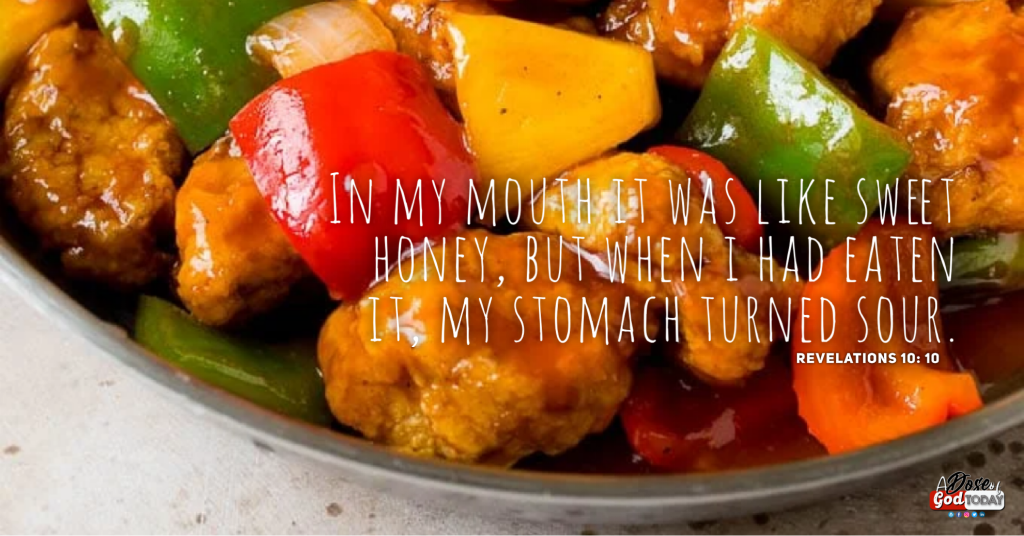
One of the popular Filipino dishes is “Sweet and Sour” which could be of fish, pork or chicken mostly. Even in any celebration, one could have this dish. Its sweetness and the sourness and the balance of the two would usually what gives us satisfaction in our appetite. However, there is another “Sweet and Sour” that is neither of fish, pork or chicken, but the Word of God. This is the sweet and sour that John in his Book of Revelation talked about.
John had this visions where he took and swallowed the small scroll which contains the Word of God. Its taste was sweet as honey on the mount but sour on the stomach. This tells us about God’s word and God’s desire for us as revealed in the Holy Scriptures.
God’s word may sound nice and wonderful to our hearing yet when we are called to absorb and practice it into our life and daily affairs, God’s word many become sour or even bitter. Why? Because God’s word would challenge us, disturb us and reprove us of our wrongdoings, of our wrong beliefs, of our selfish tendencies or our evil intentions.
This was what John was told to do – to prophesy again about many peoples, nations, tongues and kings. The call to prophesy is not to tolerate any evil deeds or pamper powerful people with flattery words but to disturb them, their indifferent hearts and from their comforts.
This is what we witnessed in today’s Gospel. Jesus entered the temple area and saw the disgrace and desecration done to the holy temple. Jesus could not tolerate it anymore or turn a blind eye once more to the corruption and abuse going on perpetrated by the merchants and temple authorities.
The temple became “a den of thieves” where merchants imposed high prices of temple commodities such as the animal-sacrifices. Because of their monopoly and connivance with the temple authorities they had the control of the supply and demand and thus can easily manipulate the prices and exchange rates of foreign coins to temple coins.
This was corruption and abuse against the ordinary people whose main intention was to pray to God. Thus, these money-motivated merchants and temple authorities desecrated the holy temple through their corrupt and unjust practices. Jesus stood up against this and drove them out of the temple area. Because of this also, the chief priests, scribes and leaders of the people became more hostile against Jesus. They wanted to kill him because he was bad for their business.
Today, the Lord calls us now – to take the Word of God be integrated into our life. This tells us that our Christian faith is not just a segment or a mere part of our life. Rather, our faith in the Lord encompasses our whole life and whole person.
Thus, we are called to integrate it into our daily life, thoughts, actions, dreams and hopes. With this, we too are called to let the Word of God challenge us and to disturb us when we have become cold, indifferent and unjust. We too are called to uphold honesty, justice, fairness and compassion in our work, business, studies and relationships that we may become true Christians today. Kabay pa.
How conscious am I of God’s many visits? Certainly, the Lord visits us because God desires that we shall be blessed by His divine presence. Yet, we could be more preoccupied with many things in life that we would take for granted God’s visits or not fully aware of His presence in us. The demands in our work, responsibilities at home or our studies or some other issues and concerns could sometimes be overwhelming that we lose the time to be more sensitive of God’s presence and even of the presence of people around us. The Lord, surely, comes to us and appears in ways that can be so ordinary and in ways we do not expect.
This is what we have received in today’s Gospel. Luke described to us how Jesus wept over Jerusalem because its people did not recognize that the Lord has already come and visited them. Jesus was constantly rejected because his appearance was not the way they expected it to be. The Messiah was believed to come majestically, with countless armies who shall defeat all enemies of Israel.
Let us remember, that this Gospel of Luke was also already written after the destruction of the Temple in Jerusalem. The Jews were shocked and in turmoil because of such abomination. Luke reminds us that our rejection of God leads us to misery and separation from the grace of God.
Hence, the Lord wept because he felt sad on how the people responded with cruelty and rejection against him. God only desires our freedom and salvation through our friendship with Him. However, we could be more focused on many things other than what God is offering us. Yet, the Lord is never tired of visiting us and letting us know that he has come to visit us, to offer his friendship with us and bring us into freedom, into peace and fullness of life.
This is where we also find God’s invitation for us today. The Lord continues to reach out to us, to visit us and to let us know that he is with us. God’s presence in our life will surely enrich our Christian faith as well as our relationships and daily affairs. It is our hope that as we carry things, we too shall grow in our awareness of God’s presence and let that divine presence give a significant impact into our daily life. There are at least three simple things I would like you to remember to grow in our awareness of God’s visits.
First, begin your day in prayer. There is no need for a long and wordy prayer but at least spend a moment of silence to recognize the Lord and his invitations for us day by day.
Second, bring the Lord with you. Whether you are going for work, for school or staying at home be aware that the Lord is with you. The Lord is not just in our moments of prayers or on Sundays in the Church. Allow the presence of the Lord to be there intertwined in your work, studies and house chores.
Third, recognize the Lord with people around you. This might be quite challenging especially when we encounter an annoying workmate, a bully at school, a problematic family member or an unjust person during the day. However, in any and in every situation, the Lord calls us to recognize him and respond to his invitations. In such a way, such awareness of God’s presence will help us to respond in compassion, in love, in showing concern or perhaps standing up for what is right and just, in defending the weak and in denouncing what is evil and unjust present in our community. Kabay pa.





 A DOSE OF GOD TODAY