Tag: Seeds

  • GROWTH AND FRUITFULNESS

    GROWTH AND FRUITFULNESS

    June 13, 2021 – 11th Sunday in Ordinary Time

    Click here for the readings (https://bible.usccb.org/bible/readings/061321.cfm)

    Have you ever witnessed the actual growing of a seed, or any plant or of a person? We could have claimed that we have witnessed it just as parents looked closely as their child grows, or just as a farmer tends everyday his plants and animals. Yet, because growing is a process, it takes time and it’s very slow. That is why, we don’t usually see with our own eyes how a seed begins to sprout and becomes a tree, or how a flower begins to grow and bloom or how a person develops physically and grows old. We only notice the gradual changes as time also goes by.

    Thanks to our latest technology because a camera can capture this process of growing particularly of a plant or changes that happen in our nature. Through a photographic technique called “time-lapse” we can witness how a seed begins to sprout, take its roots and come out from the soil and become a full bloom plant. This always amazes me to see that.

    (I want you to watch this short time-lapse of a growing seed in silence to bring yourself also into reflection and into calmness in the midst of noise, stress and anxiety that are around us today.)

    https://www.youtube.com/watch?v=jyRw597JBVg

    With this amazement and wonder of the process of growing, this brings me into reflection for this Sunday’s Gospel. Jesus tells the people about the two parables of the Kingdom of God. These are the parable of the seed scattered on the land and the mustard seed.

    In these two parables, what is common among them is the theme of growth and fruitfulness. From here, I would like you to see and recognize how God is growing in us and inviting us to be fruitful.
    I would like to begin with the parable of the mustard seed which brings us into the invitation of God to let us grow, to be mature and to develop. In fact, the first reading from the Book of Ezekiel has revealed to us how God would plant us so that we may become majestic and fruitful. Indeed, God allows growth and makes it possible for us to become what God wants us to be.

    In this process of growing, we now understand GROWTH to be dynamic. It involves changes, adaptations, shedding off of what was old and transforming into something new. Meaning, growing is a transformation.

    Thus, the parable tells us of the process of growth in a non-aggressive way because growth is gradual, silent and calm. Moreover, it is empowering and life-giving.

    This reminds us of the wonder of creation. Creation is silent and relaxed, yet, destruction is noisy, distressful, aggressive and violent. In destruction, there is no growing because it suppresses and destroys. Surely, this is how we would find life distressful, filled with anxiety and worries, because when we do not grow or when we stop growing then, it leads us to destruction and to death.

    God’s desire is that we develop into our full potential as what God desired us to be. We are called to continue growing no matter how our hair have turned into white or our wrinkles have become more visible.

    Likewise, growing leads us towards maturity which also leads us to fruitfulness. The first parable of the seed scattered on the land which grew in silence and bore fruit, leads us into this invitation, MATURITY and FRUITFULNESS.

    Remember, the man who scattered the seed did not know the entire process of the growth of the seed. The seed silently grew and became mature and bore fruit. This tells us how the Spirit of God works in our life silently. When we allow the Lord to work in us, then, God also make wonders in our life. God will surely transform us into persons that God desires us to be.

    This tells us that the Kingdom of God is already in us because God is with us. The seed has been planted on earth as Jesus was born for us. The Lord is already in our hearts as we are being baptized. Moreover, the Kingdom of God manifests in us when we also become mature in our faith and relationships with God and with others.

    How do we recognize that we have become mature? It is when we are able to give life to others, when we become persons for others. The seed produced grain for people to eat and the mustard seed became the largest of plants and puts forth branches where birds dwell in its shade.

    Now, these are the signs as well as the invitations for us to recognize the Kingdom of God and to let God to grow in us.

    First, as the mustard seed grows the Kingdom of God also begins in HUMILITY not in any form of aggression or arrogance. It is humble and simple. Thus, the kingdom of God can be very present in a family who makes the effort to pray together, in a couple who expresses their faithfulness despite their differences, in a person who shows true kindness and generosity to another who is in need of help, and of a neighbor who refuses to join in a gossip as his or her act of concern.

    Second, the kingdom of God is empowering and life-giving.  The kingdom of God is present when our community empowers the weak. A community that discriminates, judges, condemns and indifferent never empowers but it oppresses the weak. However, when our community empowers, then it also gives life. Let us remember, to be able to give life, we need to give more chances and opportunities for growth. To give life is to give hope. Therefore, our community is truly a kingdom of God when we uphold and protect every life to survive and to mature.

    As we recognize the Kingdom of God in us today, let us also allow the Lord to grow in us, to bring changes and transformation in ourselves, in our attitudes and relationships. As we continually grow and become mature, we may also become individually, a person for others and also a community for others that gives life, gives hope and allows opportunities for growth and maturity. Hinaut pa.

  • Mustard Seed

    Mustard Seed

    June 13, 2021 – 11th Sunday in Ordinary Time

    + Manny Cabajar, C.Ss.R. D.D.

    Click here for the readings (https://bible.usccb.org/bible/readings/061321.cfm)

    A grieving mother, unable to bear the burden of sadness due to her son’s death, goes to a wise hermit who tells her, “What you need is a special kind of mustard seed. Find a home where there is no grief like yours, get a mustard seed from the garden, bring it to me, then I will show you how to deal with your grief.” Strange advice! But she sets off on this unusual quest.

          The first house she approaches is that of a rich family. Is this by any chance where there’s no experience of grief as I have in losing my son? The woman who answers the door bursts into tears. “You just came to a worse place. Let me tell you about grief!” She describes the tragedy her family suffers. The woman who lost her son listens, amazed that one so rich can meet such a disaster. “My experience makes me the kind of person who may understand.” So, she stays a while, counsels the rich woman who appears able to cope a little better. She goes off to continue her journey.

          You guess what follows. The next house is exactly the same: nice on the outside, a sad story inside. Again she leaves but only after helping as best she can. Then, on to the next house of grief; and the next. The curious result is that she gradually forgets her own grief and becomes more focused on helping others. The quest for a mustard seed leads her to where her grief is but a memory while something else grows in its place. Truth emerges in imperceptible ways as in the mustard seed parable.

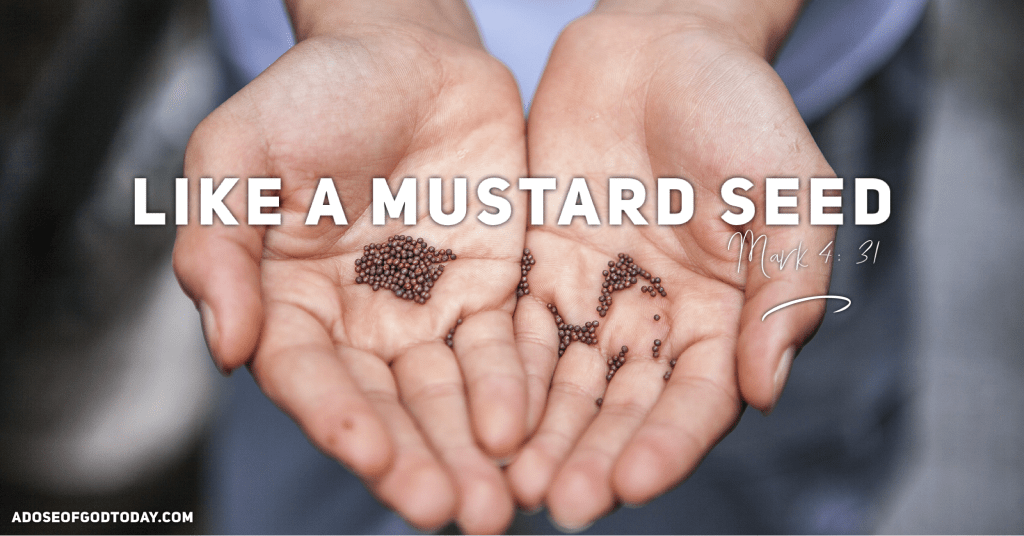
          The Kingdom of God grows in us like a tiny mustard seed. To find wonder in what is small is as good a place as any to start. Our own start in the Kingdom may be as small as the baptism of a child. But we see the potential in a tiny child introduced with the parents into the life of the Christian community through baptism just as Jesus saw the potential in His disciples entrusted with the next stage of growth. Might it be that, despite our humble beginnings, limitations and failures we too are needed, like the grieving woman who lost her son, as God’s Kingdom continues its mysterious growth? 

          We may not have the chance to do the big, heroic things. But we daily have the chance to do the small ones that show Christian values – the smallest act of kindness, the little gesture we offer a sick friend, the forgiveness we give in our family and to one who injured us. Small seeds, perhaps, but will bear fruit ten, twenty, forty years from now!

          Brothers and sisters, we ask the Lord to transform us into Christ-like holiness, increase our zeal for His Kingdom and instill in us a desire to live for His greater glory. Amen.


  • Me & We: Seed for the Kingdom

    Me & We: Seed for the Kingdom

    June 13, 2021 – 11th Sunday in Ordinary Time

    Click here for the readings (https://bible.usccb.org/bible/readings/061321.cfm)

    A newly-graduated but non-working young millennial, while hanging-out at home and playing with his X-Box video games, was once asked by his mom to buy some fruits for meals. Though he prefers to go to a mall for convenient–sake, hesitantly he went to a nearby market. He tried to find his way looking for the fruit-stand since he was never been to this market before. Eventually he found the fruits he needed to buy at a particular fruit-stand. While paying, he jokingly said to the vendor: “Sir, I cannot help but notice you do look like Jesus Christ.” The fruit-vendor reply: “Others would say the same. But assuming I am who you seem I look alike. Do you have any questions for me?” Up for the challenge, he asked: “If you are said-to be the Christ, the savior of the world, how come the world is still a mess? Have you and God done and is doing something about these mess?” After giving much thought, the vendor answered, “For sure God has and is doing something about these mess – He created YOU.”

    Defensively, he countered: “Me, who am I to fix these mess? I am not rich, not  successful, still no-job. I am nobody, no hero. I am limited”. So the vendor further challenged him, “So what do YOU need then now to fix these mess?” He dreamingly replied, “Well if only I have more power, resources and opportunities, perhaps like in a computer game, I can be who I am and wish to be”. “That’s all?” the vendor disturbed him and then handed him something, “Take this. It got all what you need.” As he received it, he confusingly asked, “A seed? What am I do to with this seed?” The vendor replied, “Well, God has already done and doing something in creating You, and you have the seed now to do your part. It is up to you then whether to plant your seed and work out with God doing your part and growing your seed, OR do nothing with your seed, but complain, and let your world and our world still a mess.

    After Christmas, Lenten, Easter seasons where we celebrate our faith – what we believe, we are now in the Ordinary times of our liturgical year where we celebrate our life in faith, i.e. how we live, practice and witness what we believe. Jesus have much to teach us not only what we believe (Dogma) but how to live & practice what we believe (Moral). We have celebrated our Faith, but now we are celebrating our Faith-Life – our Faith & Life.

    To offer us meaning, inspiration and directions in our faith-life journey, Jesus made use of parables and our common life-experiences as life-lessons to live by. Like in our gospel today, by sharing us the parable of the growing seed and mustard seed, Jesus taught us not only about the Kingdom of God but also HOW to live our present lives along with our faith & mission in God’s kingdom.

    Here Jesus reminds us that nature and our usual human labor or work teach us that “Big things comes from small beginnings”. Yes, the sower & planter might have planted the seed and harvested the fruit but he does not know how the plant grows. And definitely he is not responsible for the seed to grow into full grain & for the smallest mustard seed to be the largest plant with large branches. It takes a lot of work on our part, AND working in partnership with God for us to fully enjoy the fruits of our labor with God. Yes, we can be the sower & planter, but God is the grower.

    With our advanced technology nowadays, we also tend to prefer to have things easy, instant, fast, disposable and convenient. In effect, we become impatient and intolerant with details and processes. We tend to value more the goals, and fruits that we undervalue & even become heartless to the growth-process, labor, and journey it takes. Like the young millennial, we tend to look at and concern more on the end-product and destination, without considering the process to make it and the travel-journey to get there.

    Never satisfied of what we have accomplished now, we rather tend to criticize & complain about our present mess without doing something about it except criticizing and complaining about it.  While we should enjoy & be satisfied to the advantages of what we have today, let us not forget the whole process-journey it takes to reach at this stage of advancement. Same as saying: While you and others enjoys and be satisfied with the fruits of your labor, let us not disregard and undervalue the efforts, work and sacrifices you have done as well as God’s work of creating you and with you for life to be better than before, better than the usual.

    In other words, to do away with the mess in life and to fully enjoy what God has given and can offer us in life now, we have to be RESPONSIBLE participants for God’s grace and work of creating and redeeming our life anew. As a wise man once penned, “Who & what you are is God’s gift to you & the world, who & what you BECOME is your gift to God & the world”.

    Especially during these pandemic times, teach & lead us Lord to cooperate with Your will & plans for us these days so that we may humbly recognize & fully enjoy the fruits of Your works for our betterment & the glory of Our Father’s Kingdom.

    So May it Be. Hinaut pa unta. Siya Nawa. Amen.

  • JESUS SOWS IN ORDER FOR US TO GROW WITH HIM

    JESUS SOWS IN ORDER FOR US TO GROW WITH HIM

    January 27, 2021 – Wednesday of the Third Week in Ordinary Time

    Click here for the readings (https://bible.usccb.org/bible/readings/012721.cfm)

    Have you ever wondered why this parable is called the “Parable of the Sower” when in fact Jesus was mostly telling us about the soil and the seeds. It should rather be called as the Parable of the Soil or Parable of the Seeds, isn’t it? But then, it is really not. This is certainly a Parable of the Sower.

    The parable tells us about the Sower, a farmer who planted the seeds on the ground. So, let us discover a bit deeper now the identity of this Sower and his attitude towards the soil and the seeds.

    The Sower of the seeds in the parable is Jesus himself. Jesus comes to the field in order to plant the seed of the Gospel. This the good news that God has come to bring us salvation and to make us joyful forever. Yes, the good news itself is God’s offer of friendship and his gift of salvation.

    However, have you been keen enough to listen to this parable to notice how the Sower sowed the seeds? As the parable tells us, the Sower scattered the seeds all over the place. It was not just in a particular place because there were also seeds that fell on the path, on rocky grounds, and among thorns. This means that the sower was not conscious enough to just scatter the seeds in a particular good soil, prepared well for that purpose of planting. What the Sower did was to scatter the seeds all around and all over the place. This means that the sower sowed generously the seeds without discriminating the type of soil to which the seeds landed.

    Well, this might not be really the case of those sowers during the time of Jesus. They might be more conscious in scattering mostly to the good soil. However, for the purpose of the message of this parable, such attitude of the sower in this story revealed something about the God-Sower in the world.

    Yes, the actions and the attitude of the Sower with the seeds sown and with the soil, really reveals something about that Sower. Jesus tells us that the reason why he came to live among us and to die for us is not just for those who were already righteous and saints. Jesus came in order to let everyone of us, sinners and saints, good people and bad people alike, young and old, rich and poor to feel and know his love and to enjoy God’s gift of friendship.

    This reveals to us God’s generosity to each of us. God knows that we are not deserving of his love, that we are not worthy to be saved by this gracious God. Jesus knows that very well. However, this does not matter to God whether we are deserving or not. What really matters is God’s movement of love for each of us, that we will all be reconciled to God.

    This is what we have heard in today’s first reading from the Letter to the Hebrews. This Letter tells us of the priesthood of Jesus and the sacrifice he had made on the cross by giving himself for our sake. The priests of the Temple of God in Jerusalem would always offer animal sacrifices pleasing to God as an atonement of the sins of the people. However, through the sacrifice that Jesus made on the cross, that became “one sacrifice for sins.” The life of Jesus became the very seed sown to us so that we will grow in friendship with God, reconciled and forgiven.

    Thus, Jesus chooses to sow and plant his love in each of us because God is giving us chances. God gives us the opportunity to change and to choose Him. God gives us the chance to choose life rather than death, to choose to be happy rather than to be angry and sad, to choose to be fruitful rather than to be fruitless, to choose hope rather than fear, to choose freedom from sin rather than imprisonment from it, to choose love rather than hatred. For this reason, Jesus sows in order for us to grow with him.

    This attitude of God gives us the confidence now that even God has hopes for us. God sees hope in each of us. God sees potentials in us. God is so hopeful for you and me that we will not remain drowning by our own fears, failures and sins. This is the good news for us today because Jesus is abundantly sowing his love and mercy for us.

    May I invite you now that as we offer our prayers to Mary, Our Mother of Perpetual Help, who allowed the presence of God to grow in her heart, like her, let us observe few moments of silence in reflecting and relishing the generosity of Jesus, the God-Sower of hope and of many chances. Hinaut pa.

  • How to maintain a welcoming and nurturing heart

    How to maintain a welcoming and nurturing heart

    Advertisements

    July 24, 2020 – Friday of the 16th Week in Ordinary Time

    Click here for the readings (http://www.usccb.org/bible/readings/072420.cfm)

    Homily

    How recipient am I of God and of His invitations? How welcoming and nurturing is my heart for God?

    The parable of the sower speaks to us of the different attitudes of human hearts in welcoming and accepting God and God’s living word in us. This was portrayed on how the seeds fell into the different parts of the field.

    Certainly, from this parable, this tell us too that we are God’s field. As a field where the seeds are planted, God desires that we become fruitful by allowing what God has planted in us to grow.

    As God’s field, how do we make ourselves a rich soil then, good for planting and growing? How do we also maintain a welcoming and nurturing heart?

    As in real planting, the soil should be filled with what is natural and organic, with real soil. When our field is filled with rocks, plastics and dangerous chemicals then it would not be good for plants to grow. We have to take away the rocks and plastics that may hinder the growth of the seeds, and the dangerous chemicals that may poison the plants.

    Thus, our heart can also be filled with our pretensions, our masks and our self-serving attitudes that serve rocks and plastics in the field that will hinder our faith to grow and mature. Our heart can also be filled with anxieties, excessive attachments to things, uncontrollable desires and addictions. These surely are dangerous chemicals that will poison our hearts. These lead us away from God and away from others and even away from our true selves.

    For us to have a welcoming and nurturing heart, we need to empty ourselves from our insecurities and anger, from hate and aggression. Without these, then we can be filled with love, with forgiveness, with faith and hope, with compassion and mercy, with tenderness and peace.

    Moreover, we can only accommodate God and others when we are not filled with ourselves. Yes, when we are filled with ourselves, with our arrogance and pride, with our bitterness and guilt, then, we won’t be able to welcome and give space for God and for his invitations to grow and bear fruit in our hearts. In the same way, we will not be able to welcome others to take part in our life.

    Thus, the invitation for us today is to seek understanding and wisdom from God that we may be able to recognize the way God is leading us today. To seek understanding will help us to take away at least two poisonous tendencies of our heart.

    First, is our tendency to accept what we only like to believe. This is a tendency that only seeks comfort and does not want to be challenged. Such tendency in us will make us dismissive of the Word of God that gives discomfort.

    Second, is our tendency to believe to what is only beneficial for the sake of our personal interest. This tendency expresses aggression when confronted with the truth. Such tendency will also make us narrow-minded because it is fixed to what is only good for our sake.

    However, such attitudes of the heart make us stagnant. This is not what God wants us. God desires always that we become individuals and a community that bears fruit for others and that we will be able to share and give life.

    Therefore, to seek understanding from God is to constantly challenge our hearts and confront our selfish desires. To be able to maintain a rich soil then, is to receive the word of God organically, without any color from our selfish intentions and self-serving interests. In this way, we could make our heart welcoming and nurturing, not for our sake, but for our community. Hinaut pa.

    Jom Baring, CSsR