Tag: Saturday

  • Places of Honor and Self-Entitlement

    Places of Honor and Self-Entitlement

    Advertisements

    October 31, 2020 – Saturday of the 30th Week in Ordinary Time

    Click here for the readings (https://bible.usccb.org/bible/readings/103120.cfm)

    Homily

    Jesus must have been a very observant person. He noticed the attitudes of the people who were invited in an event. He saw how each one sought to secure for themselves places of honor at the table. If we would imagine, the guests must have been fighting to sit near the host since that would tell everybody that he is higher in status or more important than others. To occupy a place of honor is to insist that the person is entitled to it because of that status, or relation, or influence he has.

    We must have heard or met people who demanded others to give them special treatment. Or we might be the very person also who seek to be given privileges and special recognition because of our status, successes and achievements, profession or degree, influence and wealth or because of our relation to someone who is important in the community, in our workplace, or organization or even in the Church. We fall into the temptation to be self-entitled just like the people Jesus was talking about, when we are filled with arrogance and self-importance.

    Self-entitled persons are very demanding and think too highly of themselves. Thus, when we turn to be self-entitled we demand respect from others rather than earn respect. This is how we will become demanding in our relationships. Yet, we become critical of people around us and tend to only see the wrong in the other person. We will become stingy of our time and energy and ungenerous of our resources and presence to those who ask for our help. Most of all, we become indifferent to people around us and indifferent to God.

    Thus, what Jesus also criticized and called for conversion is the “indifference” among self-entitled persons. Because of their self-importance and demand to be respected, a self-entitled person becomes indifferent to what others feel and to what others need. What is more important for a self-entitled, is self-satisfaction and recognition from others.

    However, this attitude does not worship God. Such attitude would even demand God to be gracious because of his righteousness.

    Jesus warns us, anyone who exalts himself will be shamed because God does not favor a self-entitled. A self-entitled person is hated in the community. We may be praised because we demand it, but we are despised because we are truly not deserving. God, rather, takes delight with the humble because the humble connects and relates with others, with sincerity and honesty.

    Thus, God exalts the humble because of the awareness of the person of his needs and shortcomings. May we grow, then, in humility and get rid of any form of self-entitlement in our hearts. Hinaut pa.

    Jom Baring, CSsR

  • GRACE given to each of us

    GRACE given to each of us

    Advertisements

    October 24, 2020 – Saturday of the 29th Week in Ordinary Time

    Click here for the readings (https://bible.usccb.org/bible/readings/102420.cfm)

    Homily

    Recognizing the grace of God in each of us is a call to a personal encounter with the Lord. Paul reminds us in today’s letter to the Ephesians, “Grace was given to each of us, according to the measure of Christ’s gift.” In our encounter with God’s grace, it invites us to grow from our infancy and childishness towards maturity in our knowledge of God and of ourselves. This movement necessarily involves letting go of those unnecessary things, attitudes, vices, behaviors, beliefs and lifestyle that separate us from the grace of God and prevent us from truly encountering and knowing the Lord intimately.

    Thus, our encounter with God calls also us to go beyond ourselves even beyond our comforts, beyond our fears and beyond our sins and weaknesses. God calls us to step forward and to come out our own hiding places of insecurities, of anger and hate, of pretensions and compulsive behaviors.

    This is basically the invitation of Jesus from the Gospel today. Jesus gave us the parable of the fig tree. In this parable, Jesus tells us that the Father is a God of many chances. God gives us many chances to change our ways and to come nearer to him so that we may find fullness of life with God. This is described to us as Jesus expressed in the parable how the owner would visit the tree. And also, in the person of the gardener, Jesus tells us that indeed, God gives us another chance when we fail and commit mistakes.

    The gardener expressed hope to the owner as he asked him to give the fig tree another year. The gardener promised to cultivate it so that it may bear fruit. The gardener saw hope in that tree. He saw the grace in that tree. That gardener is the Spirit dwelling within us, the grace given to us. This tells us now that God never loses hope in us.

    Indeed, God always sees hope in each of us. Even though that others may treat us as beyond hope and beyond repair because of our failures and big mistakes in life, but then, God sees hope beyond our hopelessness. That is why, God’s spirit would always entice us to recognize him and encounter him. This is how the grace of God moves us and inspires us to see beyond and discover Christ’s gift of Himself to us, of his gift of salvation and gift of hope.

    We may also remember that God makes the move through the people around us, through our friends and loved ones and even strangers who will remind and teach us that God is within us. God’s grace is waiting to be recognized, and waiting to be welcomed and embraced. Hinaut pa.

    Jom Baring, CSsR

  • Faith: A Human Response of Love

    Faith: A Human Response of Love

    Advertisements

    October 10, 2020 – Saturday of the 27th Week in Ordinary Time

    Click here for the readings (https://bible.usccb.org/bible/readings/101020.cfm)

    Homily

    Faith, as Pope-Emeritus Benedict XVI said, is a human response of love to God who first loved us. This human response is neither bound to obligation nor a mandate because of law as what St. Paul told us in his letter to the Galatians. He said, “through faith you are all children of God in Christ Jesus.” We become God’s children because we have opened ourselves to God’s offer of life and freedom. We become children because we too are made heirs of the kingdom of God.

    Moreover, faith is not something that is abstract or a mere allegiance to God. Since faith is a human response of love, it is alive, active and life-giving.

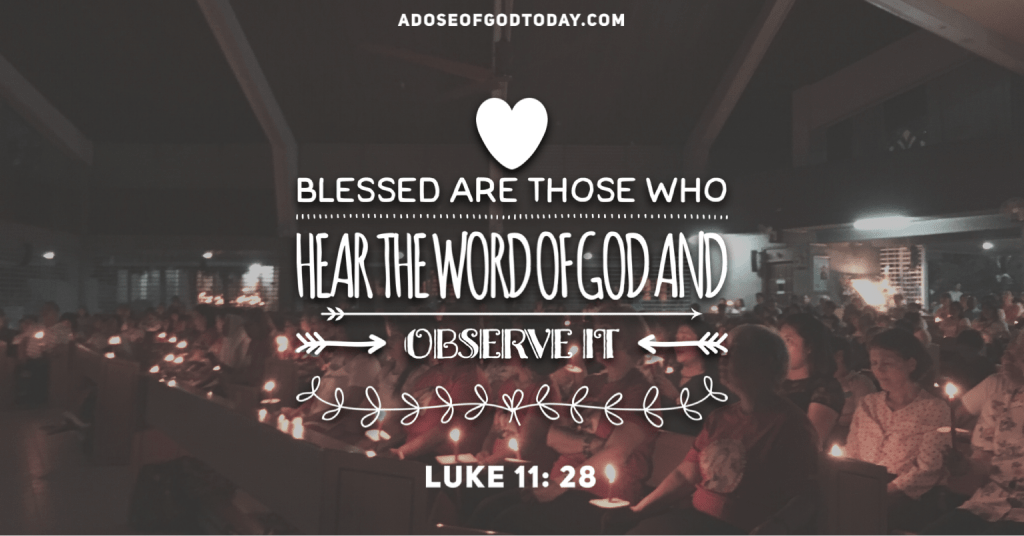
    Thus, the Gospel tells us how faith transforms a person. And so, the woman in the gospel praised Mary, the mother of Jesus for having a great son like him. Likewise, Jesus even praised Mary not just on this basis of her motherhood, but rather for being able to listen to the Word of God, pondering upon it and observing it.

    St. Anselm even affirmed that because of the great devotion of Mary to the Word of God in listening and pondering everything in her heart, the Word was made flesh within her.

    This tells us that Mary’s devotion to the Word of God did not only stop in mere hearing but the word spoken by God transformed Mary herself. Accordingly, Mary has become our best example of a person who did listen, accept and embrace God’s word. It was in that way that Mary found her joy, her peace and her freedom as a person, as a woman, as a wife and as a mother.

    Today, we, who received the gift of faith and the Word of God, through the Holy Scriptures, through the Sacraments, through our community, are also being invited that our devotion to the Word of God will not just remain a mere obligation or not just a part of our speech but will also transform us. Like Mary, let the Word of God and (faith) our human response of love to God become concrete and life-giving.

    let the Word of God and (faith) our human response of love to God become concrete and life-giving.

    Jesus invites us that as we listen to him, who is speaking to us now, we too will be able to accept and embrace His words. His words may become difficult and challenging, risky and time-consuming but also comforting and inspiring, life-changing and liberating. We will surely then find that as we listen and ponder the Word of God in our heart, our actions, thoughts and speech and our person will also be transformed into what God desires us to be.

    Let our experiences of difficulties, anxieties, confusion and fear in this age of pandemic lead us to listen more and deeper to God’s word and to God’s everyday invitations for us.

    Let us be conscious about to the Word of God revealed in this Eucharist and in the Holy Scriptures so that its inspiration, its warmth and power will give light and life in our relationships with our families and friends, and in the many efforts that we make in our studies and in our work. Hinaut pa.

    Jom Baring, CSsR

  • To rest is to celebrate life and give life

    To rest is to celebrate life and give life

    Advertisements

    September 5, 2020 – Saturday of the 22nd Week in Ordinary Time

    Click here for the readings (https://bible.usccb.org/bible/readings/090520.cfm)

    Homily

    To rest is a human need. In all aspects of our life, resting is necessary to make time for ourselves in order to recharge, recuperate and restore. Thus, its value is as important for our physical health and also for our emotional and spiritual life. The Holy Scripture would even affirm such value in our life.

    In the Book of Genesis, God rested on the seventh day but not merely to recharge or recuperate or restore because God does not need this. God must have rested to enjoy and to be more delighted with creation, to look at us with much love and to cherish the wonder of Divine creation. Moreover, it was God’s way of allowing the creation too to grow and become the way God meant it to be.

    This is how the Jewish belief also grew in their spirituality to give much importance to Sabbath, a day of rest and a day for God. Yet, the Gospel today tells us something that was quite contrary to what God has designed Sabbath should be.

    The people had developed many regulations on how to observe Sabbath to the point that one should do nothing at all. Consequently, Jesus was criticized for healing people during Sabbath. This time, some Pharisees complained on why Jesus’ disciples were picking the heads of grain and eating them.

    Such ridiculous regulations were made, believing that Sabbath will be holier by doing nothing at all. With this, Jesus objected and taught something very important to us. The Sabbath or this day of rest and day for God is meant to honor God, to be delighted of the many wonders of the Lord. Hence, Sabbath is meant to be a day of celebrating life and giving life.

    Jesus healed people even during Sabbath because it was a way of celebrating and giving life. To work for your food is a way of celebrating and giving life too.

    Today, we may always remember that as we rest to recharge, recuperate and restore aspects in our life, we are also called to celebrate life and give life. In this way then, resting becomes holy and dedicated to God who delights to see us and cherishes our every movement to be life-giving to others. Hinaut pa.

    Jom Baring, CSsR

  • Will you also leave? : A plea from Jesus

    Will you also leave? : A plea from Jesus

    May 2, 2020 – Saturday of the Third Week of Easter

    Click here for the readings (http://www.usccb.org/bible/readings/050220.cfm)

    Advertisements

    When you want to buy something, how do you choose that thing (cloths, accessories, or gadgets) which you want to buy? Some wise buyers would go through into a selection process before buying. They would consider the quality, its practicality, the price, the evaluation of other buyers, and the specifications of the item.

    However, there are also some of us who actually don’t mind all these steps but would only consider if it is “sabay sa uso” or #trending or popular, used and promoted by famous personalities. Even though they may not be so practical for us but because it’s the trend, we go into that.

    This is not far from what we believe and sometimes spread. I am talking with the fake news that surround us. People tend to believe, spread and adhere to fake news because they have become popular and because many have come to believe in them. We should be very careful then because a popular opinion or belief does not always hold the truth.

    These situations tell us of our tendency to favor and choose things, people, beliefs and principles according to their popularity. The number of people who tend to favor such thing is very influential for us.

    However, this is not the case that happened in the Gospel. Jesus who became popular because of his mighty deeds by healing the sick and multiplying the bread, was becoming unpopular to the people.

    Jesus taught the people that He is the Bread of Life that came down from heaven. Through him, by eating his body and drinking his blood, eternal life will be attained. Yet, the people around him found this teaching difficult to accept and offensive. The teaching of Jesus implied that they were to follow Jesus in his ways and to let go of their old ways. 

    This teaching was understood to be taken with commitment to Jesus. Jesus’ teaching asked them to let go of their old beliefs and renew themselves in God. Yet, they could not let go and accept Jesus fully in their life. They could not believe that God became man and He is with us. They could not believe that God desires mercy and forgiveness of all. Thus, they left Jesus and “returned to their former way of life” because his teachings were unpopular for them.

    Jesus confronted his disciples, “do you also want to leave?” In a similar way, Jesus also asks each of us, “Will you also leave? Will you choose me or return to your former way of life?”

    This is certainly a plea from Jesus to us, not to leave him because he has so many good things for us. Thus, be careful then, when we also start to murmur just like the disciples of Jesus because our murmurs may lead us farther from the Lord. Our murmurs can become bitter complaints that will drag us back to our former way of life, again just like the many disciples of Jesus who no longer walked with him but succumbed to false gods.

    These murmurs in us may tempt us to worship those false gods rather than God, to believe in them rather than in the Word of God, to hold on them rather than trusting in Jesus. These false gods could be our desire to gain power and control, to manipulate and use others. These could also be our own unhealthy behaviors or addictions that we continually keep.

    Advertisements

    We are challenged and called today to choose and commit ourselves in serving and loving the Lord. Choosing Jesus and committing our work, studies, dreams, hopes and our whole life to Jesus may not be the popular thing to do today. Choosing Jesus and following faithfully his teachings is truly difficult as the people complained. Thus, this Eucharist is our way now to renew once again our commitment as we receive the Lord spiritually and sacramentally. This is our opportunity to choose Jesus today! 

    Choose Jesus today then, which means to choose life not death, to choose hope not despair, to chose mercy and love not anger and hatred, to choose humility not aggression and to choose warmth and concern not indifference. Hinaut pa.

    Jom Baring, CSsR

    Join 2,860 other subscribers