How important is our family to us? For most of us, our families are the source of our joy, security, identity, confidence and assurance. But for some of us also, our family can be the source of our deepest pain, traumas and bitterness in life. We cannot deny that it is in the context of our families that we also first experienced “being loved” and “being rejected.”
Talking about family, our Gospel today tells us of Jesus family looking for him. Moreover, it is in this context also that Jesus brought out a new idea of being a family where we shall experience deeper God’s presence and invitations for us.
Jesus asked, “Who is my mother? Who are my brothers and sisters?” In a way, Jesus expanded the meaning of family relationship by pointing out the members of his family. These were those people listening to him, gathered around him to do the will of his Father. Jesus did not reject his immediate family but expanded its essence.
The family that Jesus brought out is beyond blood relationship. This is toward a deeper spiritual family relationship. This calls us to identify ourselves and others to be part of a bigger family of God.
But how do we really belong to this family?
Jesus told us that it is by doing the will of his Father. And the first step of doing the Father’s will is to LISTEN to the Son. Indeed, it is in listening that we also realize and become aware of God’s invitation for us.
It is also clear that Jesus pointed out that his mother, brothers and sisters are those who were gathered around him and together listening to him. Certainly, there is wisdom in listening together, as a community or as family because the process of discernment becomes deeper, more realistic, clearer and empowering when we listen together and discern together on what God wants us to be and what God wants us to do.
Timothy and Titus who were bishops and companions of Paul in building and nurturing the first churches, were individuals who took part in this family of Jesus. They are examples of people who took part in building God’s family by listening first to the will of God and doing it in their lives. Their dedication as well as the time and energy that they spent to build those first Christians Churches in the first century of our history proved that they, indeed, shared and took their role in God’s big family.
For us today, let us allow ourselves to be part of God’s family by listening to Jesus through the scriptures and experiencing again his presence through the grace of the sacraments in our church. As we listen to the Lord and in his invitations for us, let us also discern on how we can actively participate and share our part in building God’s family today, particularly in our own context. Hinaut pa.
Our gospel today reminds us that the first message Jesus ever preached to us is “The Kingdom of God is at hand. Repent and Believe the Good News.” God’s grace is now upon us & before calling us to “Come after Him” in discipleship, we are invited first to repentance & faith. His missionary preaching begins then by calling us all to repent and embrace His Good News. With our repentance & faith in Jesus, God’s kingdom starts, happens & is upon us.
Easy for us to understand this call to repentance and faith as primarily directed toward sinners. But we should never forget God’s offer of grace is intended for everyone, and not only to sinners. Even Jesus himself had lots of difficulties communicating this message to good people than with sinners. Why? Because the hardest people of all to change their ways & believe are the so-called good and righteous people. They simply don’t see any need of conversion. They think that as sick people need healing; only sinners need repentance and faith. But, the call to repentance and faith is in reality a constant call for everyone – an invitation for all, good or bad we may be, that we have to struggle with in life.
For what does repentance & faith mean?
It means to feel dissatisfied with oneself, and thus longing for something better in one’s life. There must be a sense of something is wrong, or at least something is lacking or missing in one’s life – A feeling of discontent with what is happening with the usual status quo – with what is going on with one’s life. To repent is not only to be sorry for what we have done but also what we have failed to do. Usually repentance begins in the realization that we are not what we could or should be; or we are not what we choose to be. A realization that – “Hindi ako naging karapat-dapat”, Dili ako nahimong angayan, dili ko nangin takus.
It also means being true & honest with oneself – to put an end to self-deception, and to confront painful self-realities. Surely, it takes a lot of honesty & courage for a person to line up for confession, admitting one’s guilt, asking forgiveness, and resolving to change. And sometimes, it is more difficult to admit one’s mistake than to be sorry for one’s sins & to ask forgiveness. Easy for us to make excuses & quick to blame others than to admit our shortcomings. Repentance & faith meant to be true to say to oneself: “I am wrong. I am sorry. Period” (no more excuses/blame). Magpakatotoo ka, brother.
Moreover, the call for us to repent & believe requires us to make a decision to change oneself. And this is difficult, for it entails a lot of responsibilities. Human as we are, as much as possible, we tend to escape from making a stance or commitment in life. However, whatever your decision today, whether to choose life or death, to help or exploit oneself or others, to do good or evil deeds, to accept responsibility or blame others, mirrors your very own identity, your conviction and commitment as human persons. As the saying goes, “Kon gusto mo ng pagbabago sa buhay, umpisahan mo sa sarili mo.” God’s grace of change & renewal of life begins by being responsible for oneself.
Tough road it might be to tread, repentance & faith can be & should be a very positive experience. True, to admit that all is unwell, time now to change & be true and more responsible for oneself can be difficult. But it also means to discover something new and better about oneself. It means not being tied up with biases and prejudices, challenging one’s values, opening up to others options and possibilities, and seeing life anew with the eyes of faith. In other words, it offers us an alternative & much better meaning & attitude in life. Repentance & faith then could be an exciting and joyful adventure.
This is what happened to the apostles when they responded to Jesus’ call for repentance and faith. Inasmuch as it staggered them from their old convictions, confronted themselves, left their nets and followed him, it offered them also a new & better Way, Truth & Life – from being fishermen to be now Fishers of men.
Same way as the apostle, the people of Nineveh & even God repented and believed, (by means of, by way of) Via our repentance & faith, God’s kingdom, grace & miracles are here upon & with us always.
Even now amidst pandemic times, the call of Jesus to us remains the same: Repent & Believe the Gospel for the Kingdom of God is at hand. May we continually allow God’s grace & miracle work in us via our repentance & faith in the Gospel of Salvation Jesus is offering us now & always. Amen.
Before this pandemic, when parents usually bring their small children in the Church, I have observed how parents or guardians discipline their unruly children. When a child begins to throw tantrum or just become noisy, they would say this, “Shut up, behave. Father will be mad at you. See… he is there. He will catch you.”
Parents or guardians seemed to incite fear to the children by portraying that Father is terrible when he gets mad. One time, I sat in a corner while waiting for the mass to begin, a mother was trying to control her boy from going around. Since she noticed me, she began to make the boy fearful of my presence telling him that I will get mad. I looked at her and looked at the fearful boy but told the boy rather, “That’s not true. I won’t get mad at you. You go and play.”
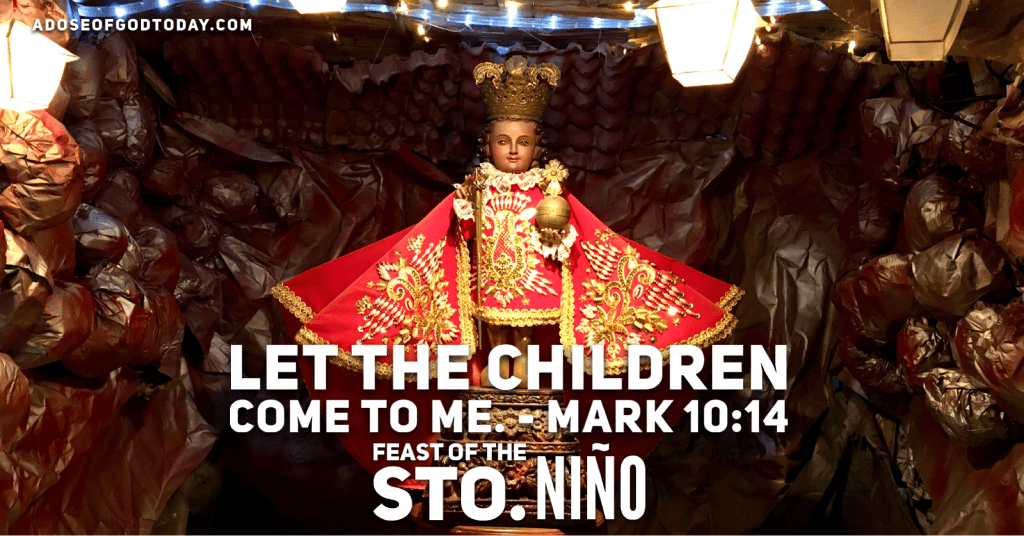
This weird way of disciplining children reminds me of our Gospel today on this Feast of the Sto. Niño from the Gospel of Mark. The disciples scolded the people who brought their children to Jesus that he might touch them. The disciples might have thought that the presence of the children was a mere nuisance and disturbance to the Lord. Considering the culture at that time, children had no legal identity, thus, not of great importance. However, this kind of rejecting attitude towards the small and those whom society thought was lesser, received indignation from Jesus.
Jesus said, “Let the children come to me.” Thus, the Lord condemns such attitude that rejects, ignores and hurts the small and the weak.
That is why, it will also be good for us to be aware, on this feast of the Sto. Niño, of those rejecting, ignoring and hurting attitudes in our community against the small and weak, particularly towards children during this pandemic.
A study by the Save the Children revealed that one in three households around the world reported violence during the Covid-19 pandemic.[1] The study also found that 1 in 6 children suffered violence at home. This study also said that there is an increase of negative feelings and psychological distress when lockdowns were imposed. This explains the significant cases of depression and suicide during this time as reported by Department of Health and World Health Organization.[2]
Moreover, according to UNICEF Philippines Representative, “The Covid-19 pandemic is worsening the incidence of online sexual abuse and exploitation in the country. Children are increasingly becoming victims of circumstances that are harmful to their development and well-being.”[3]
Just few months ago, a girl was raped at home. However, parents were not that concerned on how to take care of their daughter because of poverty. Both parents lost their job when the lockdown was imposed in the city. It was the neighbors who responded and wanted to rescue and help the girl. But then, when the incident was reported, the authorities even suggested not to pursue the case because it will only become troublesome to them and will cost them a lot of money. It was suggested to just settle it with some money and let it go.
What have we become? Have we succumbed to darkness to abuse and oppress the weak among us?
These situations are just few reported examples of rejecting, ignoring and hurting attitudes towards the small and the weak. No wonder why Jesus expressed indignation towards those who prevented the children to come to him. God cares and loves the small and the weak. God desires to embrace and bless them.
Yet, our world and the hearts of others are gloomed by anger, by hatred, by violence, by indifference, by evil. The world is also gloomed by the desire to have power, to gain control and manipulation, to be above others. The world is also gloomed by our dishonest and selfish leaders, by our unjust practices, by our support of the corrupt, by our blind obedience of the violent. Following these rejecting, ignoring and hurting attitudes is letting our hearts be gloomed.
Yet, this is the very world and the very hearts as well that God chose and continues to choose again to be born. God only desires that everyone will be gifted with His light, with His embrace and with His blessing.
Thus, the world may be darkened by our tragic experiences and gloomed by our individual and collective sins; the world may be darkened by our painful and sorrowful experiences and gloomed by indifference and violence perpetrated by many of us, directly and indirectly, God still chooses to bring the light, to give us the grace and to grant us his salvation.
This is what God wants to remind us in today’s feast. In the first reading, Isaiah proclaims the coming of the light because those of walked in darkness will see a great light and those who dwelt in the land of gloom, a light will shine.
In Isaiah’s prophecy, God will cast away the darkness and the land of gloom. But what is this darkness and land of gloom?
It is our sin and guilt. It is our indifference and hatred. It is our pain and sorrow. It is our difficult and overwhelming situation whatever they may be. Darkness is around us. We may not be aware of it, because we might have become so used to it. However, God has come to us to bring light and salvation. Indeed, light is hope. It is God’s forgiveness. It is mercy. It is freedom. It is the fullness of life.
God, indeed, will destroy the yoke on our shoulders that burdened us. This is the yoke of slavery from sin and evil. God destroys them not by violence but through the gentleness of God’s own yoke of friendship, of companionship. Remember, Jesus has offered us to take his yoke. This is what the presence of the Sto. Niño is reminding us now.
God will also smash the rod of the taskmaster. This is the rod of our selfish desires. This shall be smashed by the Lord not through anger and hatred but through God’s gift of peace and mercy. Again, this is what the presence of the Sto. Niño is reminding us now.
Isaiah tells us that a child is born to us, a son is given us. He is Wonder-Counselor, God-Hero, Father-Forever, Prince of Peace . This is the Sto. Niño being gifted to us. As Paul tells us in his letter to the Ephesians, he said, “Blessed be God and Father of our Lord Jesus Christ, who has blessed us in Christ every spiritual blessing in the heavens, as he chose us in him.”
Therefore, we know that we have been gifted with the presence of God among us. Let his presence dispel the darkness in our hearts, the pain of violence in us, the evil of indifference in our hearts. Let this magnet of love, the Sto. Niño rather embrace us, bless us and place his hands on us.
On our part as a Church, as a community and you as parents and guardians, and all those in the position of authority, let us not prevent the children, the small and the weak among us to be closer to Jesus. Let us all bring one another to God by protecting one another, by nurturing and supporting especially the vulnerable, by embracing and accepting one another. In this way, we may become a people of gentleness and of love. Hinaut pa.
Once just right after mass, I saw a child sitting alone on the church floor worried & crying. So, I approached her & asked, “Oh, what happened? Why crying all alone.” Between sobs, she replied: “Father, I thought it was your hand that I reached to get your blessing, but it was the hand of another child. I was not able then to receive your “Amen” – your blessing”.
Her response is not only cute but also touching, since she only aspired to get my hand for a blessing but instead, was deprived of it. So, I told her then, “Don’t worry, Inday. I am here now. You can have my hand for blessings”. After wiping her tears, she took my hands and happily pulled it to touch her forehead for blessings. And she was so happy to hold my hand to walk with me. And more so happy and proud, when I carried her up in my arms until her parents took her… (& perhaps at the envy of other children).
In most of our churches in the Philippines, especially in Redemptorist Churches, it is unavoidable that children and young people would approach us, priests and ask our hand for a blessing after the mass. Different types of children, (big-small, active-weak, shy-gregarious) would gather around the priest with only one desire, that is to receive “Father’s blessings”, while asking: “Bless me, Father”. And I am sure they were not forced (or were not just forced) by their parents to do so, because for children, to be blessed or to be touched in their foreheads by the priest is a great, meaningful and wonderful experience and affirmation. One simple act or gesture of the priest can be a meaningful experience and can bring joy not only to the children but also to their parents, because they are affirmed and appreciated for their child.
Even we ourselves, when we were kids, we really enjoy when somebody affirmed and gave us attention, especially by the priest. I could still remember and never forget of the joy I experienced when the priest gave me attention and affirmation. It was my first confession. I was so small and weak then when I fearfully approached a big Irish Redemptorist priest smiling, had me sit in his lap and piously listen to my first confession. Because of that even in my childhood years, I am so happy and courageous to receive the blessing of the priest, see and talk to them because they know me and I know them, we are friends and they are human as I am. I feel like and I consider myself as I am KASALI, KABARKADA, KABERKS, KAPUSO, AT KAPAMILYA nila Father. One with Father and with the Church, part of the group, friends, family and church.
Even now within our own family, we claim & have our own so-called “fave” priest in our parish church. So also that even now as a priest, I would really appreciate when I am blessed and prayed over by my brother priests, by elders and by my loved ones. And now during pandemic times, I do miss the children attending mass in the church (as much as they also miss being with us in the church).
Like the little children, especially for Filipinos we also need attention, affirmation and blessing. Because for us, to receive blessing is not only a gesture of our respect and reverence but an expression of affirmation, attention, love, and support for all our endeavors in life so far, from somebody we love and respect. When our elders or leaders touch our foreheads to give us their blessings, it is an affirmation, a positive stroking for us that would mean, “I am OK. I am good and am doing fine in life. And above all, I am now blessed & also God’s blessing to others.” That is why… as priest, I really don’t mind and would love to bless or partake God’s blessing to people (both young and old).
As much as we need God’s blessings & demand respect from others, Jesus invites us to love, respect & bless our children, for we are all God’s blessing – Blessed to bless. Like Children, God blessed us to be a blessing to all.
In our gospel today, we hear that while his disciples are concerned with their own importance & proper decorum, Jesus instead insisted on them the importance of little children in God’s kingdom. For Jesus, children are also persons with rights and dignity. Children also enjoy personal relationship with Jesus and the Kingdom of God. They have the right and duty to God’s blessings, to grow in faith – to grow in their own personal relationship with God. It is also their calling to be a disciple – to come and follow Jesus Christ and express their response, by their love and respect, & being a blessing for God & others. That is why, Jesus asserts on us, “Let the children come to me, Don’t prevent them…for the Kingdom of God belongs to them.”
Today, the whole Philippine Church celebrates the feast of the Sto. Niño. We particularly honor today the child Jesus, who became part of our humanity and history. Sto. Nino plays an important role in the history & growth of our Filipino Christian faith. When in 1521 the first Filipino baptized Christians received & accepted the Sto. Nino into their lives & let their children to come & be blessed by Jesus. It gave birth to and flourish our Filipino Catholic faith which we have still live out & practice until now, after 500 years.
As the first Christian gift we received, the image of Sto. Nino becomes the symbol of our Filipino Catholicism, the first sacrament (symbol & means) for us to come to know, love & follow Jesus Christ. Through the Sto. Nino, Filipinos are now blessed with Christian faith & we are now God’s blessing of Christian faith to the world. Through the Sto. Nino, we Filipinos are now indeed blessed to bless others – now Gifted to give faith to the world. So now, as we are blessed by the Sto. Nino, child Jesus, may we be continually blessed & be a blessing to our children & youth of today by taking care & responsibility for the growth of their faith & mission in life, so that they may also be God’s blessings to others & to the coming generation, & thus God’s blessing continues to work & thrive in us & through us in our day to day lives. So be it. Amen.
In the Philippine Daily Inquirer of January 16, 2009, Mr. Ambeth R. Ocampo in his column “Looking Back”, mentioned about the image of the Sto. Niño of Cebu. He wrote: “This image reminds us of the conversion of Cebu in 1521, shortly before Magellan set off to be killed in the Battle of Mactan. It is believed that the image enshrined in Cebu is the same one given by Magellan to Humabon’s wife when she was baptized and renamed Juana.”
In the Philippines, the 3rd Sunday of January, is celebrated as the Feast of the Sto. Niño. It is a feast particular to the Philippines, and very much related to the history of Christianity in this country.
Today’s gospel is taken from Mark 10:13-16. In this section, Mark tells his readers and listeners, what the requirements or conditions are to enter the Kingdom of God. Jesus entered the Kingdom of God by way of suffering and death. This too is the way for every disciple of Jesus. To enter the Kingdom of God, one must be willing to strip oneself of ones ego and false self.
Who are the beneficiaries of the Kingdom of God? Mark mentions four [4] groups of people: a) the children [10:14]; b) the insignificant, marginalized, and “rejects” of society [10:13-16]; c) the poor [10:17-27]; and d) those who have learned detachment [10:28-31].
In today’s gospel, Mark describes Jesus in a very humane and personal way. Jesus got irritated and offended by the way his disciples treated the children that people were bringing to him. Jesus was just so delighted to see these children, that he “tookthem up in his arms, laid his hands on them and blessed them.” And he said: “Truly I tell you; whoever does not receive the Kingdom of God as a little child will never enter it.” [10:15].
What does Jesus mean by that statement? Jesus is neither encouraging nor advocating infantilism. Infantilism is the attitude and behaviour of a person who is already grown up but continues to behave and to act in a childish and immature way. What Jesus advocates is that we adopt the attitude of humbly acknowledging and recognizing our own human limitations and ultimate dependence on God! It is also the attitude of recognizing our interdependence with each other. Jesus tells us not only to live in the realm of our thinking, reasoning, mental analysis, arguing, and excessive worrying. Jesus advocates a balanced life of reason, commonsense, feelings, and faith. Integrating all these essential human characteristics makes us a total human person.
What in a typical child, that Jesus wants us to possess, in order to be admitted into the Kingdom of God? A typical child acts as a total person: open, trusting, sincere, honest and spontaneous! A typical child is aware of his/her need for others and dependence on them. To aspire for the Kingdom of God is to recognize and to accept our dependence on God and our interdependence with one another.
But how is this message of Jesus related to the feast we are celebrating today here in the Philippines? Mr. Ambeth R. Ocampo, says that the image of the Sto. Niño “reminds” us of the conversion of the Filipinos into the Christian faith. But what sort of conversion did we Filipinos have? What kind of faith do we have at present? Is it a dynamic and growth-promoting faith, transforming us into mature Christian-Catholics? Are we a people and nation, worthy to be called, the “only Catholic nation in Asia”? Our devotion to the Sto. Niño is more than 400 years old! Over these years, what are the visible signs indicating that our Christian-Catholic faith is indeed healthily growing and maturing?
Let us take a look at our practices over the centuries which we associate with our devotion to the Sto. Niño.
Which of these we can consider as healthy and growth-promoting to our Christian faith? And which ones are keeping us stunted or retarded, and infantile in our faith? Are our practices expressing our devotion to the Sto. Nino in accordance with Jesus’ teachings; or are some of them infected with superstitions, fanaticism, sentimentalism; and even bordering on paganism and idolatry?
Let us celebrate with deep gratitude to God and to the missionaries, the 500th Jubilee of receiving the gift of the Christian faith! At the same time let us honestly and sincerely ask ourselves: what kind of Christianity, are going to bring and share with our Asian brothers and sisters who have not yet heard about Jesus Christ and his Gospel?





 A DOSE OF GOD TODAY