Category: Weekday Homilies

  • JESUS SOWS IN ORDER FOR US TO GROW WITH HIM

    JESUS SOWS IN ORDER FOR US TO GROW WITH HIM

    January 27, 2021 – Wednesday of the Third Week in Ordinary Time

    Click here for the readings (https://bible.usccb.org/bible/readings/012721.cfm)

    Have you ever wondered why this parable is called the “Parable of the Sower” when in fact Jesus was mostly telling us about the soil and the seeds. It should rather be called as the Parable of the Soil or Parable of the Seeds, isn’t it? But then, it is really not. This is certainly a Parable of the Sower.

    The parable tells us about the Sower, a farmer who planted the seeds on the ground. So, let us discover a bit deeper now the identity of this Sower and his attitude towards the soil and the seeds.

    The Sower of the seeds in the parable is Jesus himself. Jesus comes to the field in order to plant the seed of the Gospel. This the good news that God has come to bring us salvation and to make us joyful forever. Yes, the good news itself is God’s offer of friendship and his gift of salvation.

    However, have you been keen enough to listen to this parable to notice how the Sower sowed the seeds? As the parable tells us, the Sower scattered the seeds all over the place. It was not just in a particular place because there were also seeds that fell on the path, on rocky grounds, and among thorns. This means that the sower was not conscious enough to just scatter the seeds in a particular good soil, prepared well for that purpose of planting. What the Sower did was to scatter the seeds all around and all over the place. This means that the sower sowed generously the seeds without discriminating the type of soil to which the seeds landed.

    Well, this might not be really the case of those sowers during the time of Jesus. They might be more conscious in scattering mostly to the good soil. However, for the purpose of the message of this parable, such attitude of the sower in this story revealed something about the God-Sower in the world.

    Yes, the actions and the attitude of the Sower with the seeds sown and with the soil, really reveals something about that Sower. Jesus tells us that the reason why he came to live among us and to die for us is not just for those who were already righteous and saints. Jesus came in order to let everyone of us, sinners and saints, good people and bad people alike, young and old, rich and poor to feel and know his love and to enjoy God’s gift of friendship.

    This reveals to us God’s generosity to each of us. God knows that we are not deserving of his love, that we are not worthy to be saved by this gracious God. Jesus knows that very well. However, this does not matter to God whether we are deserving or not. What really matters is God’s movement of love for each of us, that we will all be reconciled to God.

    This is what we have heard in today’s first reading from the Letter to the Hebrews. This Letter tells us of the priesthood of Jesus and the sacrifice he had made on the cross by giving himself for our sake. The priests of the Temple of God in Jerusalem would always offer animal sacrifices pleasing to God as an atonement of the sins of the people. However, through the sacrifice that Jesus made on the cross, that became “one sacrifice for sins.” The life of Jesus became the very seed sown to us so that we will grow in friendship with God, reconciled and forgiven.

    Thus, Jesus chooses to sow and plant his love in each of us because God is giving us chances. God gives us the opportunity to change and to choose Him. God gives us the chance to choose life rather than death, to choose to be happy rather than to be angry and sad, to choose to be fruitful rather than to be fruitless, to choose hope rather than fear, to choose freedom from sin rather than imprisonment from it, to choose love rather than hatred. For this reason, Jesus sows in order for us to grow with him.

    This attitude of God gives us the confidence now that even God has hopes for us. God sees hope in each of us. God sees potentials in us. God is so hopeful for you and me that we will not remain drowning by our own fears, failures and sins. This is the good news for us today because Jesus is abundantly sowing his love and mercy for us.

    May I invite you now that as we offer our prayers to Mary, Our Mother of Perpetual Help, who allowed the presence of God to grow in her heart, like her, let us observe few moments of silence in reflecting and relishing the generosity of Jesus, the God-Sower of hope and of many chances. Hinaut pa.

  • Our Share and Role in God’s Big Family

    Our Share and Role in God’s Big Family

    January 26, 2021 – Memorial of Sts. Titus and Timothy

    Click here for the readings (https://bible.usccb.org/bible/readings/012621.cfm)

    How important is our family to us?  For most of us, our families are the source of our joy, security, identity, confidence and assurance. But for some of us also, our family can be the source of our deepest pain, traumas and bitterness in life. We cannot deny that it is in the context of our families that we also first experienced “being loved” and “being rejected.”

    Talking about family, our Gospel today tells us of Jesus family looking for him. Moreover, it is in this context also that Jesus brought out a new idea of being a family where we shall experience deeper God’s presence and invitations for us.

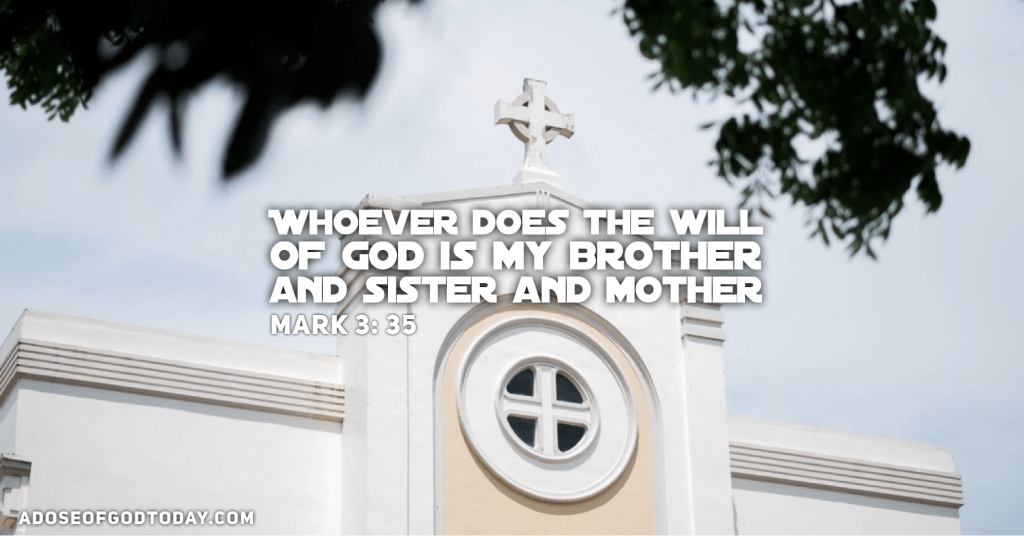
    Jesus asked, “Who is my mother? Who are my brothers and sisters?” In a way, Jesus expanded the meaning of family relationship by pointing out the members of his family. These were those people listening to him, gathered around him to do the will of his Father. Jesus did not reject his immediate family but expanded its essence.

    The family that Jesus brought out is beyond blood relationship. This is toward a deeper spiritual family relationship. This calls us to identify ourselves and others to be part of a bigger family of God.

    But how do we really belong to this family?

    Jesus told us that it is by doing the will of his Father. And the first step of doing the Father’s will is to LISTEN to the Son. Indeed, it is in listening that we also realize and become aware of God’s invitation for us.

    It is also clear that Jesus pointed out that his mother, brothers and sisters are those who were gathered around him and together listening to him. Certainly, there is wisdom in listening together, as a community or as family because the process of discernment becomes deeper, more realistic, clearer and empowering when we listen together and discern together on what God wants us to be and what God wants us to do.

    Timothy and Titus who were bishops and companions of Paul in building and nurturing the first churches, were individuals who took part in this family of Jesus. They are examples of people who took part in building God’s family by listening first to the will of God and doing it in their lives. Their dedication as well as the time and energy that they spent to build those first Christians Churches in the first century of our history proved that they, indeed, shared and took their role in God’s big family.

    For us today, let us allow ourselves to be part of God’s family by listening to Jesus through the scriptures and experiencing again his presence through the grace of the sacraments in our church. As we listen to the Lord and in his invitations for us, let us also discern on how we can actively participate and share our part in building God’s family today, particularly in our own context. Hinaut pa.

  • A Continual Conversion of the Heart

    A Continual Conversion of the Heart

    January 25, 2021 – Feast of the Conversion of St. Paul

    Click here for the readings (https://bible.usccb.org/bible/readings/012521.cfm)

    Have you ever experienced in your life where you thought that everything is well and perfectly in order? Or an experience where we have decided alone to take this path or that direction because we have completely believed in our own capacity and principles? Yet, at the end we found ourselves broken into pieces because all along we were not doing the right thing. 

    Saul or Paul had this kind of experience. Saul really thought that he was a righteous man and that he was a very good man, that he did things well and that he was successful in everything. He thought he was holy and righteous enough for God. He was full of zeal and very convinced of the direction he was taking in life.

    Being a righteous Jew, he wanted to defend the Jewish religion against all its enemies. This made Saul to persecute the followers of the Way (the old name of the Christians) whom he believed to be threats to their established religion.

    Yet, he did not know that he was very misguided, that he was not seeing the right things. In fact, Saul was not aware that he was being blinded by his own self-righteousness and rigidity to the Jewish law by persecuting the early Christians. He was not aware of that but not until he was able to encounter the Lord on the ROAD TO DAMASCUS.

    Remember, the Lord is the Light of the World, it was very symbolic that Saul had become aware of his own blindness when he encountered the True Light, Jesus. When light shone upon him then he became aware that he was in darkness, his spiritual blindness manifested through his physical blindness. That awareness of his own blindness prompted him to seek healing. A servant of the Lord, Ananias was instrumental to Saul’s healing and recovery of sight, thus, he was able to see clearly.

    This encounter with the light, with Jesus is the very experience of conversion of Saul who later on was known as Paul, a symbol of a new beginning and a new mission to fulfill. Paul through that encounter with the Risen Lord transformed his life and re-evaluated everything in his life as a Pharisee and as a person. As a result, he became an apostle to the Gentiles and a very important figure in the history of early Christianity by founding Churches and writing letters in the New Testament.

    This brings us then to the invitation of this feast. We are called to a continual conversion of our hearts – because we have also our own blindness, especially when we think that we are righteous enough before God, thinking that that gives us the power to persecute others and eliminate those who are against us. We can be blinded by our own complacency thinking that going to church even on a regular basis and just by saying our memorized prayers everyday are enough before God. We can be blinded by our arrogance that we can do things perfectly even without the help of God. We can be blinded by our own opinions by insisting that what we believe is true but without minding the facts. We can be blinded also by our own weaknesses when we think that we are already trapped in that weakness and thus, couldn’t move anymore and couldn’t do anything.

    There is always something more and this is what the Lord is telling us today by making us remember that story of conversion of Paul – that being a Christian, our faith in Jesus is not only about the observance of laws and doctrines but also showing mercy to others as what Paul experienced in his encounter with the Risen Lord. And that experience will move us to preach the Gospel – this is basically what our gospel reading is telling us now. Preach the Gospel – your God experiences – to all by our words and example.

    Thus, we are reminded today to COME TO THE LIGHT AND NOT TO BE AFRAID OF HIM – to come nearer to Jesus. We come to him in the hope that we too will become aware of our own blindness – of that self-righteousness, of those arrogant opinions of ours, of that complacency and self-pity in us – so that we will be able to seek healing. When this happens, God will certainly inspire us to become preachers of the good news to all by our words and deeds. Hinaut pa.

  • HE IS OUT OF HIS MIND

    HE IS OUT OF HIS MIND

    January 23, 2021 – Saturday of the Second Week in Ordinary Time

    Click here for the readings (https://bible.usccb.org/bible/readings/012321.cfm)

    Jesus is out of his mind. Surely, he must be. It will be very difficult to understand him, the way he thinks and the way he does things for others. Only a man like him, who never thinks like us, can only do those scandalous actions by forgiving the sinners, touching the lepers, eating and drinking with sinners and unlovable, and siding with the poor, with women and children, healing the sick and giving freedom to those slaved by the devil.

    This was what the relatives of Jesus believed that he has gone crazy. Jesus’ schedule became very hectic because people were drawn towards him. They even found it difficult to eat because of the people’s demand of him. Jesus would always welcome them and accommodate them. That is why, his relatives even thought of locking him up because “he was out of his mind.”

    At that time, they never understood Jesus’ actions and his ministry to the sick and in preaching the Kingdom of God. What they saw in Jesus was that he was merely a son, a nephew, a cousin to them. They failed to see and recognize at that time that there was more in Jesus, that his actions and his words were signs of God’s presence in them.

    However, the generosity of the person of Jesus, expressed through concrete actions of loving was madness in the minds of others. True enough, God has gone mad to love us. St. Alphonsus even said, “God is crazy for love.” God has come in the form of a baby, became human like us, suffered like us and died with us to show concretely to us the divine love that frees and gives life.

    May this madness in God to love us remind us always of that power of loving to heal, to forgive and to give life. Let that madness in God to love us make us in return madly in love with God too, to be madly in love with our commitments in life, to be madly in love with our passion to help others, to inspire and motivate others, to teach and nurture others. Hinaut pa.

  • To bring others closer to the Lord

    To bring others closer to the Lord

    January 22, 2021 – Friday of the Second Week in Ordinary Time

    Click here for the readings (https://bible.usccb.org/bible/readings/012221.cfm)

    An encounter with the Lord leads to discipleship and to be on mission. This is message for us today. But for us to grasp better the message, let us make a step by step discovery.

    First, the call or the invitation is God’s initiative. It means that it is God who calls us and God chooses us to be His servant, to be his disciple. God’s way of choosing is not through the wealth we gathered, or how much power and influence we possessed. God calls us when we are open to him regardless of our profession, status and state in life. This is how Jesus summoned the ordinary 12 disciples and then sent them to proclaim the kingdom and free people from the slavery of sin and evil.

    Second, we need the help of our family, friends, and community to lead us to God. An encounter with God, though that can be very personal but it is essentially always in the context of the community. Thus, seek the help of others. It will be easier for us to recognize God when we have a friend who will help us to see God.

    Third, our God-experience or personal encounter with God is the most wonderful experience we will ever have. Because it is so wonderful that we cannot just keep it by ourselves. Our encounter with God leads us to action – it leads us to follow the Lord and leads us to tell others about what we have seen, heard, felt, and experienced with God. The 12 apostles’ personal encounter with Jesus led them to this point where that encounter moved them to action to become healers, witnesses and preachers.

    Each of us today, whoever we are and wherever we are, as Christians we are called to preach Christ, to preach the Gospel by our life that we may become agents of healing and reconciliation, and bring other people closer to God. This is what it means to become an apostle.

    May we always remember this and become true Christians in the way we live our life, in the way we perform our work and in the way we relate with others and with one another so that we who have experienced God’s goodness will also become instruments in bringing other people closer to God. Hinaut pa.