Category: Feasts

  • VENERATION OF THE CHAIR OF PETER

    VENERATION OF THE CHAIR OF PETER

    February 22, 2021 – Monday, Feast of the Chair of St. Peter, Apostle

    Fr. Manoling Thomas, CSsR

    Click here for the readings (https://bible.usccb.org/bible/readings/022221.cfm)

    Last February 13th, Saturday, part of the celebration of the Lunar New Year, by the Chinese, was the practice of paying respects to their ancestors. This used to be called the “ancestor worship”. But those Chinese who embraced Christianity re- named it to “veneration of the ancestors”. We Catholics venerate and honor the “saints”, those who have gone ahead of us; and have now entered the Kingdom of God. We set aside November 1st, as a day for them!   

    Today’s feast originated from the ancient Roman practice of remembering departed family members. Part of the celebration was a formal meal. An empty chair was reserved during the meal, to represent the ancestors. This ancient Roman practice was “Christianized” after the spread and legalization of Christianity throughout the Roman Empire. This feast originated in the 4th century.
    The “veneration of the chair of Peter” became an occasion for remembering the apostle Peter as “the ancestor in faith” of the Christian community in Rome. Pope Benedict XVI pointed out that this celebration highlights the “privileged sign of the love of God, the eternal Good Shepherd who wanted to gather his whole Church and lead her on the path of salvation.”

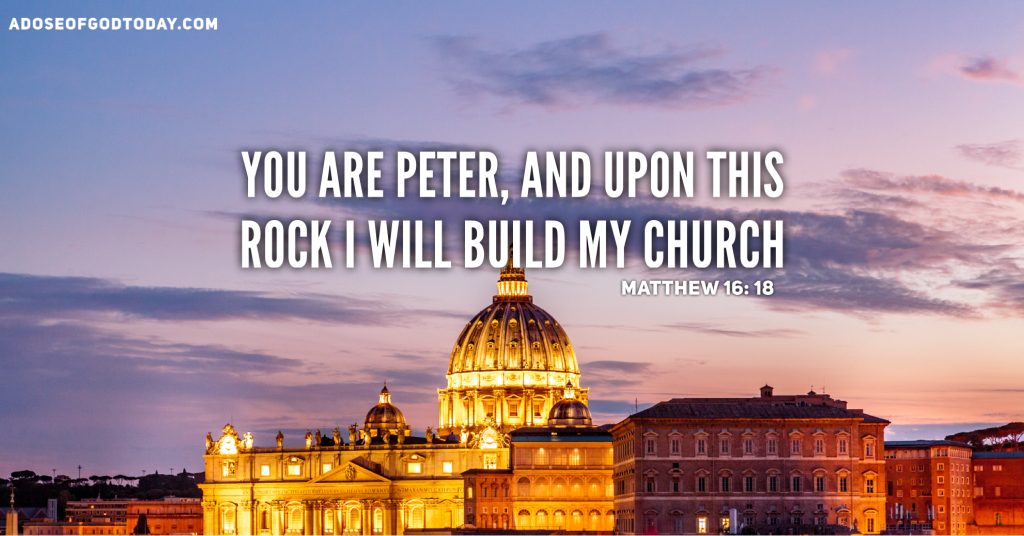
    Peter was chosen by Christ to be the “shepherd of Christ’s flock” [Jn. 21: 15-17]. Jesus called Peter to be “the rock” on which Jesus’ church would be built. [Mt. 16: 18-19]. Peter, in the 1st Reading, advised the other Church elders on how to care for the “flock entrusted to their care.” [1 Pet. 5:1-4].

    The chair represents the authority of St. Peter and his successors. The chair represents the unity of the Church founded on the Apostle Peter.

  • Faith Status

    Faith Status

    February 11, 2021 – Thursday of the 5th Week in Ordinary Time

    Click here for the readings (https://bible.usccb.org/bible/readings/021121.cfm)

    In social media, one may publicly publish one’s relationship status. This is more than just about our civil status or legal relationship status as single, married, engaged, widow or separated person, but more so about a short description of the state of one’s relationship with significant others in the society. And there are many ways people would describe in their profile their own relationship status in social media. Not only the usual “in-love, committed, happily married,” others would even post some double meaning descriptions like, “complicated, looking & searching, available, negotiable, available but non-negotiable, negotiable but non-available” among others.

    All of these are just but reflections that fundamentally as human persons, we are in relationship with others. By nature we are not solitary alone being, but social beings – social animals who are in relationship with others & one another. Our creation story in our first reading today is a reminder that God has created us as related & inter-related with our world & with one another. Lahat tayo ay magkaugnay. And God knows that it is not good for us to be alone, & thus, he looks for our suitable partners in life. Human social being as we are, somehow, we should have our own relationship status in life that would describe the state of our relationship with an-other & others.

    Social being as we are, we should also however, be reminded that we are spiritual being. As much as we are in relationship with others, we are also in relationship with God. If we have a relationship status, we should also have our own faith status that would describe the state of our relationship with God in life.

    We may realize the need for faith status beyond relationship status in our gospel today. Surely Jesus & the Greek woman shares distinct social & relationship status. Di sila magkaugnay. Dili sila mag-abot. By culture, birth, civil status, race, and gender, there are both unsuitable to one another. However, both share the same quality of faith. By their relationship with God, they can relate with one another. They share the same deep faith in God regardless of their relationship & social status, and in effect, healing & miracle happened.

    While we concern ourselves with our social life & relationship status, perhaps we should also consider our faith status? What is the state of our relationship with God? How would we describe the state of our relationship with God? How is our spiritual life?

    Today, we honor our Lady of Lourdes. The apparition of Our Lady of Immaculate Conception at Lourdes, France is a constant reminder of our Mama Mary to us that we do have our spiritual life, that we are in relationship with God, that we have & should grow in our faith status in life & only through then miracles & healing do happen in our world & life.

    May we grow in Faith.

    So Help us God. So May it be. Amen.

  • To Hold and To Encounter the Lord

    To Hold and To Encounter the Lord

    February 2, 2021 – Feast of the Presentation of the Lord

    Click here for the readings (https://bible.usccb.org/bible/readings/020221.cfm)

    The Holy Mass today on this Feast of the Presentation of Lord is popularly known as “Candlemas.” We have the blessing and procession of candles. The candle today is so significant in today’s celebration because of what it signifies. The light in our candle leads us to the “light that revealed salvation to the Gentiles.”

    This light was encountered by two significant personalities in today’s Gospel, Simeon and Anna. The two had been waiting for the Lord’s revelation and his arrival. It was not just the fulfillment of their personal desire but also the fulfillment of God’s promise in the Old Testament.

    This has been fulfilled as it was witnessed by the two in their encounter with the Holy Family that also completely transformed their lives and drew ever more their hearts towards the Lord.

    There are two invitations for us that we discover in the encounter of Simeon and Anna with Jesus in the temple.

    First, like Simeon who was able to hold the young Jesus in his arms, let us allow God to encounter us that we may be able to hold him in our arms. Holding God in our arms is more than feeling his presence but being convinced of his presence in our life. To hold God in our arms also means to be in touched with God, with ourselves and with what surrounds us that include our brothers and sisters and the rest of God’s creation. To hold God is to be welcoming to all.

    Second, like Anna who desired and longed to meet the Lord, let us also have that desire in our heart to meet God whenever and wherever we are at this very moment. Let us remember, if we desire to encounter God, God desires it all the more to encounter us. And may our encounter with Jesus cast out our anxiety, boredom and doubts for his presence brings us joy, freshness and life.

    Like them, we may become convinced in what we believe by translating our faith not just into words but also into concrete actions of love and kindness. Hinaut pa.

  • Showing what we’ve got

    Showing what we’ve got

    January 28, 2021 – Thursday of the Third Week in Ordinary Time; Memorial of St. Thomas Aquinas

    Click here for the readings (https://bible.usccb.org/bible/readings/012821.cfm)

    To show to others what we have in us is not entirely an expression of “showing off” or arrogance. To show off oneself comes from an attitude that only seek attention and affirmation from others. Showing arrogance does not necessarily also show to others the quality of what we have in us. Thus, “to show to others what we have” is a call to be generous towards others. This does not seek affirmation or attention or recognition or even seeking to be above others because of what we have.

    Such attitude is something that the Gospel today is calling us to develop. Jesus said to his disciples “Is a lamp brought in to be placed under a bushel basket or under a bed, and not to be placed on a lampstand?” Jesus challenged the disciples to learn from him and that is to be generous enough to share what they’ve got. The lamp that carries the light is the gift that we have in us. We are the lamp and Jesus is the light.

    This generous attitude of oneself is the very way of life that Jesus showed to us and revealed in our Scriptures. Jesus showed the light of God to the people. That light in Jesus made people to recognise God and brought them towards healing, freedom and life. Despite the resistance of the arrogant and the self-righteous as well as of those who were powerful, Jesus did not hide himself but continued to show the light to the people. His life, indeed, is meant to be shared even in death.

    This was what Jesus was calling his disciples to do. Many will try to put off the light. The disciples may experience fear and will try to hide the light. However, the light shall never be put off for it will continue to shine in the darkness.

    The great St. Thomas Aquinas, a Dominican philosopher and theologian is another example of an person who had been so generous in terms of sharing his wisdom and knowledge to the Church. His scholarly works in philosophy and theology had become foundations in scholarship that helped the Church deepen her knowledge of the faith.

    For us today who have heard these words from Jesus through our Scriptures, we too are called to share generously the gifts that we have in us. As Christians, we have Jesus in us, thus, share the Lord generously to our brothers and sisters through our charity and availability of our presence. Our gifts and talents, resources and capacities are also called to be shared generously because they can also serve as light for those who need our help and assistance.

    By showing what we’ve got, we may add more light into our community darkened by indifference, by loneliness and by death. Hinaut pa.

  • Our Share and Role in God’s Big Family

    Our Share and Role in God’s Big Family

    January 26, 2021 – Memorial of Sts. Titus and Timothy

    Click here for the readings (https://bible.usccb.org/bible/readings/012621.cfm)

    How important is our family to us?  For most of us, our families are the source of our joy, security, identity, confidence and assurance. But for some of us also, our family can be the source of our deepest pain, traumas and bitterness in life. We cannot deny that it is in the context of our families that we also first experienced “being loved” and “being rejected.”

    Talking about family, our Gospel today tells us of Jesus family looking for him. Moreover, it is in this context also that Jesus brought out a new idea of being a family where we shall experience deeper God’s presence and invitations for us.

    Jesus asked, “Who is my mother? Who are my brothers and sisters?” In a way, Jesus expanded the meaning of family relationship by pointing out the members of his family. These were those people listening to him, gathered around him to do the will of his Father. Jesus did not reject his immediate family but expanded its essence.

    The family that Jesus brought out is beyond blood relationship. This is toward a deeper spiritual family relationship. This calls us to identify ourselves and others to be part of a bigger family of God.

    But how do we really belong to this family?

    Jesus told us that it is by doing the will of his Father. And the first step of doing the Father’s will is to LISTEN to the Son. Indeed, it is in listening that we also realize and become aware of God’s invitation for us.

    It is also clear that Jesus pointed out that his mother, brothers and sisters are those who were gathered around him and together listening to him. Certainly, there is wisdom in listening together, as a community or as family because the process of discernment becomes deeper, more realistic, clearer and empowering when we listen together and discern together on what God wants us to be and what God wants us to do.

    Timothy and Titus who were bishops and companions of Paul in building and nurturing the first churches, were individuals who took part in this family of Jesus. They are examples of people who took part in building God’s family by listening first to the will of God and doing it in their lives. Their dedication as well as the time and energy that they spent to build those first Christians Churches in the first century of our history proved that they, indeed, shared and took their role in God’s big family.

    For us today, let us allow ourselves to be part of God’s family by listening to Jesus through the scriptures and experiencing again his presence through the grace of the sacraments in our church. As we listen to the Lord and in his invitations for us, let us also discern on how we can actively participate and share our part in building God’s family today, particularly in our own context. Hinaut pa.