Tag: Weekday

  • Power of Asking Forgiveness

    Power of Asking Forgiveness

    Advertisements

    September 17, 2020 – Thursday of the 24th Week in Ordinary Time

    Click here for the readings (https://bible.usccb.org/bible/readings/091720.cfm)

    Homily

    Why do we come for confession? Why do we seek forgiveness of our sins?

    Many of us today have doubts or have taken for granted the Sacrament of Reconciliation thinking that it does not need for one to confess his or her sins to a priest. Our basic catechism teaches us that the ordained priests are given authority to forgive sins in behalf of the whole church and as God’s representative to his people. It is not the priest that forgives but God. The church listens to the confession of a penitent through the person of the priest. The priest does not give judgement and condemnation but delivers the mercy of God to those who seek for it.

    Indeed, there is wisdom and power behind recognizing one’s imperfections and sins. The recognition of sins is not just be limited within personal realization keep within the self. It only becomes a true realization when sins are confessed to somebody, letting another person know about our sins. The priest in this case represents the church for the person who realizes his or her sins.
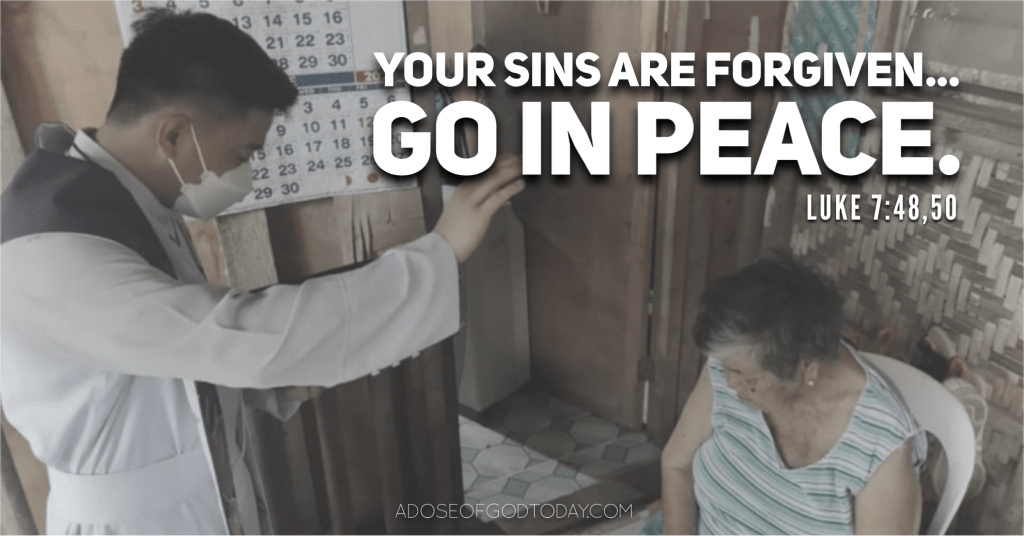
    Once we recognize our sinfulness then it is also God’s opportunity to change our lives and to make us new again. “Recognition and confession of sins” is our humble way of acknowledging that we need mercy and forgiveness, thus, we need God.

    The opposite of this is the denial of ones sins and imperfections. Thus, denial of our need of God and denial of our need of mercy and forgiveness. This happens to us when we have grown righteous. When we begin to think that we have committed no sins, then, we think of ourselves highly to the point of making ourselves above others whom we think as lesser than us.

    This is the story that we have heard in today’s Gospel. The woman who knelt before Jesus represented those who recognized their need of forgiveness. On the other hand, the Pharisee who invited Jesus represented those who do not need forgiveness because they believe that they do not need God.

    Let us see these two personalities to clearly discern God’s invitation for us today.

    The woman who was known to be a public sinner was despised by that Pharisee. He would not even dare talking to her because of fear of being contaminated by her sins. That is why, he felt disgusted with Jesus who allowed this woman to wash his feet with her tears and wipe them with her hair. The woman’s actions were her humble way of recognizing that she was in need of God’s mercy. Despite her sins and the shame that she was bearing, she took the risk to go in public to ask Jesus forgiveness.

    And because the Pharisee thought of himself so highly, never thought that he too was in need of mercy. This attitude of the Pharisee made him condemning of the woman. He was indifferent towards her and saw no hope in her. This will also happen to us when we become righteous and think that we do not need mercy from God. We become persons who easily condemn others. We become persons who do not see hope with those who have failed in their life. We become angry persons and bitter towards others.

    However, Jesus invites us to learn from her. She who recognized her sinfulness, allowed Jesus to transform her life. Her actions towards Jesus was her expression of her affection and at the same time of her need of forgiveness, Jesus who is the face of the Father’s mercy, willingly granted her forgiveness.

    When we become persons who recognize our failures and sins, we become persons who also see hope and life. We become persons who become positive with life and at the same time positive with others. We become happy persons.

    This is what Jesus wants us because recognition and forgiveness of sins allows us to unburden ourselves from guilt. This will also allow God to work in us.

    Thus, do not be afraid of acknowledging ones failures because God always sees hope in us, God does not condemn but grants his mercy and forgiveness to us so that we shall live in peace, freedom and joy. Hinaut pa.

    Jom Baring, CSsR

  • To live brings out pain, yet it bears fruit joy

    To live brings out pain, yet it bears fruit joy

    Advertisements

    September 15, 2020 – Tuesday; Feast of the Our Lady of Sorrow

    Click here for the readings (https://bible.usccb.org/bible/readings/091520.cfm)

    Homily

    To experience pain in life can become devastating and even maddening. Having a toothache can completely destroy your day. Having a headache can affect your daily activities. Indeed, when pain becomes unbearable and frustrating, it affects our daily routine and activities, our work, even our sleep and relationship with friends and family.

    Who would really want to be in pain? As much as possible, we avoid pain. Consequently, the medical science developed pain relievers that would take away slowly or instantly the aches and pains we feel in our body. In fact, a particular field among doctors has been developed to assist patients who will undergo surgeries through the use of anesthesia. Through its use, the patient will have a painless surgery so that he or she will be able to have a quality life.

    However, no remedy can be given to a heart that is bruised, abused, betrayed and/or humiliated. No doctor can apply anesthesia to a deep emotional pain. It can even linger and deepen with time. For such reason, some would succumb to it without any help from others and end their life. They see it as the only remedy to end that deep emotional pain they have been enduring in their life.

    This is the sad part because pain will really be unbearable and life-threatening when it is faced alone. Today, as we celebrate the Feast of Mary, the Our Lady of Sorrows, we are reminded that pain in itself is all part of our life. No one can escape pain. Everybody will surely meet pain in different degrees and aspects of life. And what this feast is reminding us now is the wonder and the beauty in confronting and carrying pain with others.

    Let us remind ourselves at the prophecy of the old Simeon. This old man had been waiting for the appearance of the Christ. When the baby Jesus was brought by the couple, Joseph and Mary to the Temple, behold, Simeon had caught sight of Light, the salvation of the world. However, this child will be responsible for the rise and fall of many in Israel. What he meant, was the rising of the humble, the poor and those marginalized by the society into the heart of God and the fall of the powerful, the self-righteous and the corrupt. For this reason, the infant will be a contradiction. The child will bring change and transformation to all that can be painful to those who seek comfort and power, titles and riches.

    Being a contradiction to the world, the child himself will undergo a terrible pain of betrayal, of dying and of death in which no amount of pain relief medicine or anesthesia can aid. Moreover, the same amount of pain was also given to the mother of the child, to Mary. As Simeon prophesied, “you yourself a sword will pierce.” Mary’s heart will be pierced with so much sorrow and pain as she suffered with her son.

    Every blow to Jesus, Mary also endured. Every insult to her Son, Mary also suffered. And every agony of Jesus, Mary also agonized. However, despite all these gruesome and painful events in the life of Mary, she did not hide. Mary did not escape into dreams. She did not ran away into loneliness and depression. Mary bravely confronted pain by being with her Son, by journeying with him until his last breath.

    Why is that? When people would hide and ran away from pain as what the men disciples did, but, Mary bravely faced that sword piercing in her heart and suffered in silence along with her Son. What gave her the courage? What made her to stand beside her Son and her Lord?

    It was love that sustained Mary. It was her deep concern and affection to the person whom she loved that moved her to be with Jesus and to also suffer with him. And to the suffering Son on the cross, the presence of her mother was the best comfort he had. The presence of Mary was more powerful than any pain reliever or any amount of anesthesia applied to the dying Son. Though, Mary’s presence did not take away the pain, but her presence made Jesus to be more resolved that there is hope in humanity.

    Mary’s presence on the cross is a testament to God that humanity can show so much concern and love to a suffering person. That’s why pain is never the end, suffering is never the last thing in life. The glory of the resurrection of Jesus tells us of that freedom from pain and promise of joy. We can attain that, by being together, by not suffering alone, but by allowing others to suffer with us or by allowing ourselves to suffer with others. Certainly, to live life will bring pain in us, but it will also bears fruit joy because of being with our friends and loved ones.

    Thus, on this feast of Mary, we are also called to be an instrument like Mary, to give comfort to those who are suffering and in pain in many ways, physically, spiritually or emotionally. Let our presence be an assurance of friendship, of love and concern to those who are in terrible pain this moment. For those who are in pain also, never retreat, deny or hide the pain or escape from pain, but allow others to journey with you. Allow those who love you to hold you and to embrace you. They may not take away the pain you are feeling, but let their presence, friendship and love be your source of comfort and confidence in your trying moments.

    May Mary, the Our Lady of Sorrows, pray for us. Hinaut pa.

    Jom Baring, CSsR

  • How blessed am I?

    How blessed am I?

    Advertisements

    September 9, 2020 – Wednesday of the 23rd Week in Ordinary Time

    Click here for the readings (https://bible.usccb.org/bible/readings/090920.cfm)

    Homily

    How do we understand being blessed?

    Usually, when we think of a life that is blessed we think of material wealth and prosperity – like having a good family, a prosperous business, a successful career or a good paying job, or having a good health. We think that being blessed has something to do with success and material possessions.

    Thus, poverty is never a blessing; being persecuted, being sick and being rejected is never a blessing too. If we are experiencing such life, we consider ourselves to be cursed.

    However, what Jesus told us today is quite opposite of today’s standard. Our human understanding of being blessed is different from God. Indeed, there is a need for us to understand blessing and our life from God’s perspective..

    In the Gospel of Luke, Jesus warns those who in the standard of the world are blessed such as the satisfied, the rich, the powerful, the popular and the influential. The danger lies in the attitude of the heart that becomes independent from God, a heart that rejects God’s mercy and love. In fact, Jesus warns us when we tend to accumulate more wealth for ourselves at the expense of the poor, or when we gather fame and influence at the expense of others.

    Such attitude of the heart is filled with arrogance and self-centeredness that has no need of God. True enough, when we are so filled with ourselves and too satisfied of what we have gained and achieved, we don’t need God anymore. Our successes and we, ourselves, have become ‘gods.’ This leads us to worship our achievements, wealth, our power and ourselves. But then, all of these corrupt us because we will never be satisfied. We will thirst and hunger for more wealth, recognition and fame which will also lead to our own destruction and those who are around us and those blocking our way to gain for more, as any form of addiction will also result in this way.

    Indeed, dependence on these forms of material satisfactions is a mere arrogance and a false sense of security. This is actually the promise of addictions, in whatever form that may be, whether addiction to drugs, alcohol, sex, influence and fame, wealth and power (political or economic power).

    However, in God’s perspective those who are poor, sick, persecuted, those who failed and rejected are blessed because it is in their poverty and difficulty that they also realize their weakness and need of God. Such insecurities bring us to understand that we are so small in this world and we are in need of God’s grace. That is why; Jesus addressed these Beatitudes to his disciples, assuring them of his presence. His disciples left their families and jobs. They went to places where sometimes they have to sleep without roof. Authorities ridiculed them and insulted them for following Jesus.

    Thus, the very presence of God in our life is what makes us “blessed.” Since God favors those who are weak, poor, suffering and struggling in life, they are the ones who are blessed because they understand their need of God. God comes to us when we are ready to accept God in our life and to let God be our God.

    Advertisements

    God invites us then, to recognize our own poverty and anxieties because God blesses us with His presence. This is also the message of St Paul present in his first letter to the Corinthians. Though at that time, they must have believed that the “Parousia” of the second coming of Jesus was about to happen during their lifetime as he said, “for the world in its present form is passing away.” Paul reminded the people of the need to be more attached to God rather than to what was material and temporary. Paul recognized the importance of ones dependence to God and complete trust in God’s providence. Through the presence of God present in their life, they were indeed blessed.

    So, how blessed are you? The material wealth that we have gained, the influence and fame that we have received, the successes that we have achieved, our good health, our talents and abilities, our knowledge, intelligence and competence are signs of God’s grace and generosity. When we have these, these may lead us to humble ourselves and to recognize that these are gifts and we ought to share them to others. Thus, if you have received much, share the blessings to those who are in need, if you are enjoying success in life, share the experience with those who failed especially in these trying times of the pandemic. It is in this way that the Kingdom of God will truly be present among us, and that we ourselves become the blessing. Hinaut pa.

    Jom Baring, CSsR

  • True love never goes wrong

    True love never goes wrong

    Advertisements

    September 7, 2020 – Monday of the 23rd Week in Ordinary Time

    Click here for the readings (https://bible.usccb.org/bible/readings/090720.cfm)

    Homily

    True love could never go wrong. The Lord could never inflict any bad thing on anybody. Jesus only desires our wellbeing, our healing, and our freedom. The presence of Jesus among us is the concrete expression of God’s tremendous and empowering love. Perhaps, it is our way of loving that could go wrong because ours is filled with selfishness and of too much self-importance to the point that our way of loving becomes corrupted and vicious.

    This is how St Paul reminded the people in his first letter to the Corinthians. A man living with his father’s wife was no love at all and not something that one should be proud of. Paul called it immorality. Paul also called such action an “old yeast,” a yeast of malice and wickedness.

    This malice and wickedness were the intentions felt by Jesus among the scribes and Pharisees while he was teaching in a synagogue. In this event, Jesus graced the people with his presence by teaching them and to perform in a concrete way how love desires the wellbeing, the healing and the freedom of a person.

    However, the scribes and the Pharisees were more concerned on how to accuse Jesus of something and then put him to death. One could not claim that these people were without love. They must have loved also, yet, their way of loving was filled with selfishness. They became corrupt and vicious. They felt threatened by the presence of Jesus who only desired goodness.

    This tells us too that a corrupt and vicious person will always be threatened by the goodness and kindness, sincerity and truthfulness of others. They felt threatened by the presence of Jesus because the very person of the Lord, his way of life, teachings and works mirrored their incapacities, their corruption, their self-absorption, their malice and wickedness. Through the very person of Jesus, they were confronted and called to be healed and to be renewed.

    Yet, these people could not because they were trapped in that kind of life. They could not because it was too much for them. Thus, with evil intent they have been looking for something to accuse Jesus and bring him to death.

    However, the Lord cannot be stopped from doing good, from giving life and bringing healing to us. The Lord willfully healed the man on a Sabbath day to tell us how ridiculous “a law made by man” can be. Hence, the question of Jesus, “Is it lawful to do good on the sabbath rather than to do evil, to save life rather than to destroy it?”

    This question was directed to those who were with evil intent and those who were seeking to destroy life. Certainly, this is no love at all.

    Today, the Lord also calls us to examine our way of loving and to learn the way the Lord loves. Loving in the way of the Lord would never go wrong. May our way of loving then, be motivated with the desire to bring goodness, healing and freedom. Hinaut pa.

    Jom Baring, CSsR

    Follow Me

    Get new content delivered directly to your inbox.

  • To rest is to celebrate life and give life

    To rest is to celebrate life and give life

    Advertisements

    September 5, 2020 – Saturday of the 22nd Week in Ordinary Time

    Click here for the readings (https://bible.usccb.org/bible/readings/090520.cfm)

    Homily

    To rest is a human need. In all aspects of our life, resting is necessary to make time for ourselves in order to recharge, recuperate and restore. Thus, its value is as important for our physical health and also for our emotional and spiritual life. The Holy Scripture would even affirm such value in our life.

    In the Book of Genesis, God rested on the seventh day but not merely to recharge or recuperate or restore because God does not need this. God must have rested to enjoy and to be more delighted with creation, to look at us with much love and to cherish the wonder of Divine creation. Moreover, it was God’s way of allowing the creation too to grow and become the way God meant it to be.

    This is how the Jewish belief also grew in their spirituality to give much importance to Sabbath, a day of rest and a day for God. Yet, the Gospel today tells us something that was quite contrary to what God has designed Sabbath should be.

    The people had developed many regulations on how to observe Sabbath to the point that one should do nothing at all. Consequently, Jesus was criticized for healing people during Sabbath. This time, some Pharisees complained on why Jesus’ disciples were picking the heads of grain and eating them.

    Such ridiculous regulations were made, believing that Sabbath will be holier by doing nothing at all. With this, Jesus objected and taught something very important to us. The Sabbath or this day of rest and day for God is meant to honor God, to be delighted of the many wonders of the Lord. Hence, Sabbath is meant to be a day of celebrating life and giving life.

    Jesus healed people even during Sabbath because it was a way of celebrating and giving life. To work for your food is a way of celebrating and giving life too.

    Today, we may always remember that as we rest to recharge, recuperate and restore aspects in our life, we are also called to celebrate life and give life. In this way then, resting becomes holy and dedicated to God who delights to see us and cherishes our every movement to be life-giving to others. Hinaut pa.

    Jom Baring, CSsR