Tag: Weekday

  • When sweetness has turned sour

    When sweetness has turned sour

    November 20, 2020 – Friday of the 33rd Week in Ordinary Time

    Click here for the readings (https://bible.usccb.org/bible/readings/112020.cfm)

    Homily

    We must be familiar with a relationship that was so affectionate and loving at the beginning yet has turned cold and abusive later on. We must be familiar also of a friendship that from its fun-loving adventures and source of comfort outside home has become a source of insults, gossips and slandering. There are also organizations that had been inspired to make a difference in the lives of others through service and charity but has become a source of fraud. Elected leaders too could be so promising at the beginning yet later on has become a lapdog and corrupt.

    On a personal level, we could have done something good and enjoyable for ourselves as a way of coping, yet, that something could develop into a bad habit and even into an addiction. These are images and situations of something good and sweet at the beginning but through time has become sour.

    What could have gone wrong? There must be something wrong along the way. This is something that we must recognize in order to warn ourselves and bring our hearts and minds into the center, into God, whose voice echoes today to call us back.

    The Book of Revelation tells us about this. John, in his vision saw an angel and was told to take and eat a small scroll. John was told, “Take and swallow it. It will turn your stomach sour, but in your mouth it will taste as sweet as honey.”

    John tells us of God’s word and promise to us. Indeed, as the Psalm proclaims today, “How sweet to my taste is your promise!” However, for those who turned unfaithful and indifferent towards God’s word and promise will taste a bitter and sour judgment. God also will hold us accountable for what we have done with our life and with our neighbors.

    This is what we have heard in today’s Gospel. The Temple that was built as a house of prayer was turned into a den of thieves. Merchants and others who made business and profit in the temple area desecrated the house of God. They took advantage of those who went to pray there. Just imagine, the businessmen at that time put a high price on every item but with a low exchange rate of money. They made agreement with the Temple authorities where only the animals sold inside the temple area will be accepted as offering and only temple money was accepted in buying and selling. Thus, people needed to change their Roman coin into a temple coin but for a low exchange.

    These businessmen had surely made profit out of the ignorance of the poor. What they were doing was a plain stealing. With this, Jesus was furious. Jesus expressed his righteous anger over these people who became indifferent and profit-oriented. And so, Jesus drove them out of the temple, in the same way he drove out demons from those who were possessed.

    All of this happened not just because of one person or few people but because of many who turned a blind eye to what was unjust and abusive. Many have become indifferent and accepted such abuses and corruption as part of their way of life.

    However, for Jesus, enough is enough! There is an end to everything that is evil and unjust. The righteous anger of God will be delivered upon us. Yet, God’s anger will be a time of renewal and cleansing of our hearts. It is a time of centering and focusing our gaze on Jesus, the merciful Lord.

    Thus, we are invited that as we end this week – to recognize our attitudes that has become indifferent thus leading us to develop forms of addictions or bad habits. Look at our various efforts including our work-attitude in our workplaces and in our ministry if we have yielded also to apathy and abuses. Look at our relationship with one another and with God if we have become cold and sour because of our self-centered heart and self-absorbed ego.

    Let us allow now the Lord to call us and challenge us. Let his voice be heard into our hearts and conscience as we strive to live today to be more like Jesus. Hinaut pa.


  • Be Careful of an Indifferent and Lukewarm Heart

    Be Careful of an Indifferent and Lukewarm Heart

    November 17, 2020 – Tuesday of the 33rd Week in Ordinary Time

    Click here for the readings (https://bible.usccb.org/bible/readings/111720.cfm)

    Homily

    The Book of Revelation warned the Church of Laodicea of its “LUKEWARMNESS.” Laodicea, because it was a center for commerce and finance, and of medical discoveries at the time, became affluent. The Christians living in that City have been influenced greatly by the prevailing culture of the City. The prosperity that they experienced made them to “somehow feel independent from God.” In fact, there must be a feeling that because of their success they did not need God anymore.

    This was how their hearts became lukewarm, passive and indifferent to God’s call of conversion. Relationship with God is a constant calling to grow, and that is to change and be transformed always. Yet, the people did not want to be challenged anymore. The people seemed to become comfortable with their way of life. Hence, the people’s hearts became “rich and affluent that they have no need of anything.” The lukewarm heart of the people led them to reject and ignore God. Their success and wealth became their “new gods.”

    Consequently, the vision of John tells us that when our heart also turns lukewarm and indifferent, God shall spit us from His mouth. However, God does not want this to happen to us. The vision of John tells us that “those loved by God shall be reproved and chastised. We are called to be earnest and to repent.”

    Moreover, the Gospel of Luke tells us about the best example of this, of a person who did not allow himself to stay indifferent and remain lukewarm. This person took the risk to leave behind what was comfortable for him including his bitter past in order to live his life with meaning and with real purpose.

    This man was Zacchaeus, a chief tax collector and a wealthy man. Being wealthy, Zacchaeus could have remained in his seat and not bother anymore to see and meet Jesus. However, he made concrete steps to meet the Lord. He committed himself to change and to repent.

    As a Jew working with the Romans, Zacchaeus must have been despised by his fellow Jews because he represented their oppressors. Being a short man, he must have experienced bullying from his friends. His limitations must have been a subject of discrimination. Yet, he found ways to be on the side of the Romans, and became a trusted man to be promoted as a chief tax collector. Though he was despised by his fellow Jews, being a chief tax collector was his best way in taking revenge to those who maltreated him before. He had power at this time to oppress those who oppressed him. He had the chance now to bully them by making them pay high taxes.

    Yet, deep within, Zacchaeus was restless. He was in search of something that will truly satisfy his longing for acceptance and for unconditional love. His wealth and influence could not satisfy that. Only God and he knew that. That is why, when Jesus was passing by, he did everything to meet the Lord and let Jesus find him. Though he was short, but he did not give up easily. Though it was crowded and people prevented him, yet, he moved to change his perspective. Until he found a tree to climb. That was how the Lord found him and thus, Zacchaeus also found acceptance and unconditional love from God.

    The story of Zacchaeus invites us today not to remain lukewarm in our relationships or indifferent towards others, towards ourselves and towards God. There is no growth in being lukewarm and indifferent.

    As we face life today, do not allow our comforts to control us to become stagnant. Never allow our limitations and painful experiences to drown our hearts into anger and bitterness. Allow rather the Lord to challenge us today, to call us and to move us and to always choose Jesus in all our decisions and actions in life. Hinaut pa.

  • Recognizing God in everything and in everyone

    Recognizing God in everything and in everyone

    November 12, 2020 – Thursday 32nd Week in Ordinary Time

    Click here for the readings (https://bible.usccb.org/bible/readings/111220.cfm)

    Homily

    The Gospel tells us about the question of the Pharisees on the coming of the Kingdom of God. Jesus warns them not to look outside to search for the kingdom of God or to be deceived by people who claim to be god and to be Jesus. This warning of Jesus echoes until today. The kingdom of God, as Jesus affirms, is among us, as brothers and sisters. Thus, the presence of God can be felt and can be found in the very presence of our community.

    Thus, we need to be more alert and more conscious of God’s presence and discerning of God’s voice and ways. We need wisdom, then. Though wisdom cannot be achieved through diplomas, certificates or earned by any master’s and doctoral degrees but a gift given to us through our life experiences, through the relationships we have built with others and with God. To receive the gift of wisdom allows us to recognize God in the presence of our brothers and sisters and in all of God’s creation that surrounds us because wisdom does not discriminate. Certainly, to be wise makes us closer to God because we become friends of God.

    Recognizing God in everything and in everyone is a manifestation that the kingdom of God is being unfolded in our lives that is why Jesus said, the kingdom of God is among you because God is truly with us, in each of us and in everything.

    This is what Paul realized which he wanted to share to his friend, Philemon. Philemon was the master of the slave, Onesimus. Onesimus ran away from his master but Paul wanted him to return to Philemon. Moreover, Paul asked warmly Philemon to receive and embrace Onesimus as a brother and not as a slave. This, indeed, is a sign of the Kingdom of God where one is able to recognize and embrace others as a brothers or a sister in Christ. Paul, certainly, was a discerning man and a wise person.

    Hence, today let us ask God for the gift of wisdom, to make us wise so that we may be able to recognize God’s face and God’s plans for us in our daily lives. Seek for it and desire for it. Hinaut pa.

  • Awareness of God’s Grace calls us to gratitude and graciousness

    Awareness of God’s Grace calls us to gratitude and graciousness

    November 11, 2020 – Wednesday of the 32nd Week in Ordinary Time

    Click here for the readings (https://bible.usccb.org/bible/readings/111120.cfm)

    Homily

    In a conversation with a friend, he told me that he was doing some form of sacrifices because he was asking God of something, to grant his prayer intentions. This really reminds me of our usual attitude in our prayers and in the way we relate to God. We make sacrifices so that God may grant our prayers for healing, for success or for material graces that we need. We also take time to light a candle, to offer a mass intention, to say our novenas and rosaries, even visit churches and shrines, and ask the intercession of our favorite saints so that God will grant our prayers and desires.

    This kind of action is also similar to that 10 lepers in today’s Gospel. They too begged Jesus. They cried out to the Lord to heal and grant them freedom from the curse they endured. Certainly, Jesus listened to them. As Jesus told them to make themselves appear before their priests, on their way, each of them was healed from leprosy and experienced freedom from the curse of that illness. However, out of ten healed lepers, only one leper came back to Jesus. This leper came back to thank and to praise the Lord. This leper may not be fully aware yet, that Jesus is Lord, but he was sure enough that God was working in Jesus.

    Hence, Jesus actually wondered on what happened to the nine lepers who were all Jews like him. The leper who came back was a Samaritan, considered as a foreigner by the Jews. And Jews considered Samaritans as enemies, worthless and good for nothing. Yet, it was this enemy of the Jews, this worthless and good for nothing person who became aware not just that he was healed but also of the grace of healing. Becoming aware of the grace he received, this made the Samaritan leper to also recognize the giver of the grace. His awareness of the grace filled him with joy and gratitude. He must have been running back to Jesus out of joy to thank the Lord.

    However, Jesus indeed wondered about the nine Jewish healed lepers. We would wonder and could also ask, “What could have prevented them to thank Jesus like the Samaritan?” Well, we can only suspect. The nine Jewish healed lepers might have become indignant that the Samaritan was also healed and was given the grace. For them, a Samaritan was not worthy of God’s grace because they were traitors. They might have not accepted that an enemy had been blessed and healed by God. That happy occasion of healing must have turned into bitterness. Instead that the nine should be grateful to God, their hearts turned bitter at the sight of someone whom they thought was not worthy, useless, a mere disturbance in their society, and would only bring nothing good but problems and crimes.

    Because of such attitude, they forgot that everything was a grace and so forgot to express their gratitude to God. God’s generosity is endless yet our memory can sometimes become very short especially when we are filled with bitterness. We always remember to ask, but we tend to forget to give thanks.

    Thus, we should be careful on this. We might tend to think that those who always go to Church are the only ones worthy of God’s grace of mercy. We might tend to believe that our enemies, people we hate, people we don’t like are useless and insignificant. Then, this kind of attitude will only cloud our heart with hate and bitterness instead of gratitude and graciousness.

    Thus, we are called not just to be grateful with what we have but also to be more grateful for others who are also blessed by God. This makes us gracious too. And this also was the attitude of the Samaritan who went back to Jesus to thank him, to praise God and also to follow the Lord.

    This healed leper’s action showed how grateful his faith was. Indeed, he was not just healed physically but also spiritually. Jesus told him, “Stand up and go, your faith has saved you!” This healed leper teaches us today to show our gratitude to God so that we may also become gracious.

    St. Paul’s letter to Titus reminds us about this, he said, “the kindness and generous love of God our savior appeared, not because of any righteous deeds we have done but because of his mercy.” And because of this, Paul urges us to “exercise all graciousness towards everyone.”

    Indeed, by becoming more and more aware of God’s grace in us and in each of us, we may also grow not in bitterness but with a grateful and graceful heart. Hinaut pa.

    Jom Baring, CSsR

  • Friendship brings comfort in our distress

    Friendship brings comfort in our distress

    Advertisements

    November 7, 2020 – Saturday of the 31st Week in Ordinary Time

    Click here for the readings (https://bible.usccb.org/bible/readings/110720.cfm)

    Homily

    When we are in distress, in pain and in great confusion because of some difficult situation in our life, the people who come to share our troubles will surely bring comfort in us. Even when our friends cannot be present with us physically, but, their expression of being with us spiritually also brings confidence in our distressed hearts.

    While Paul was in prison, the people who became his friends never left him. The Philippians who were converts of Paul’s mission travels, remembered him. They had been Paul’s supporters in joys and sorrows. And when Paul was captured by those who were hostile against the Christians, the Philippians made sure to bring aid to Paul in whatever way they can. Paul was being persecuted. His prison cell must had been a terrible place to stay. However, to be alone in there could have been more lonesome and grim.

    That is why, Paul expressed in his letter to his friends, the Philippians, his gratitude to them. Indeed, his friendship with them brought comfort in his distress. Paul said, “It was kind of you to share in my distress.” To be remembered by friends and to have friends who are ready to empathize with us certainly brings confidence in us. Thus, more than the material gifts he received, Paul rejoiced for the gift of friendship with them.

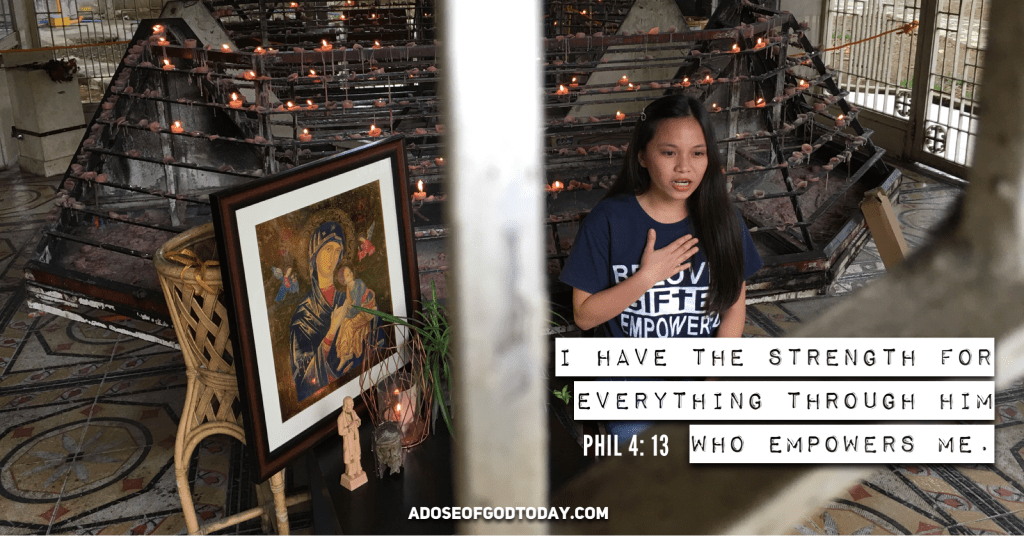
    Moreover, Paul also recognized that what gave him more strength was his friendship with the Lord. Paul expressed with confidence, “I have the strength for everything through him who empowers me.” This is also Paul’s invitation to the Philippians, that they too will grow more in their friendship with the Lord Jesus who shall give them the strength for everything.

    The Lord, indeed, gives us the strength for everything. Paul learned how to adjust in every situation in his life and how to make every difficult situation bearable because of his faith and confidence in Jesus, the Lord.

    This is the invitation for us today, that we become generous givers and gracious receivers of gifts. The Philippians became generous givers to Paul because they had been gracious receivers from Paul’s teaching and preaching. Paul, as well, became a gracious receiver of friendship from them because he had been a generous giver to them.

    This is the very value that Jesus reminds us in today’s Gospel, that we may not be possessed by our resources but become charitable. To become truly charitable is to become trustworthy even in small matters because we do not allow our hearts to be corrupted by the desire to have more and to keep more for ourselves alone.

    Hopefully, we may grow in our consciousness of becoming aware of the needs of others and to be more generous in giving our ourselves to those friends who need help. We may also grow to have a welcoming and humble heart to receive the help from our friends and become grateful more of our friendship. Hinaut pa.

    Jom Baring, CSsR