Tag: Ordinary Time

  • Transformed by Faith

    Transformed by Faith

    October 8, 2022 – Saturday of the 27th Week in Ordinary Time

    Click here for the readings (https://bible.usccb.org/bible/readings/100822.cfm)

    How does my faith in God mold may ways of thinking, behaving and speaking? How does my faith in God play a role in my relationships, in my career and profession, in my studies and endeavors? How does my faith in God transform me as a person?

    These questions would be very good to take into our heart and see how our Christian faith works in our life. Having faith is not limited with doing religious practices and faithfully observing religious obligations. Having faith is not limited on Sundays as well or during seasonal religious celebrations during Holy Week or Christmas only. When faith is only a “part” in our life, then faith becomes our extra-curricular activity.  Faith is a way of life and as Pope Emeritus Benedict XVI said, “faith is our human response of love to God who first loved us.”

    Faith, therefore, is a human response, an active response of love. This response is basically spontaneous, neither obligated nor mandated by any law. It’s spontaneous because it comes from a heart filled with so much love and gratitude to God. Consequently, faith brings us into an intimate relationship with God who calls us and loves us first. “Through faith we become children of God in Christ Jesus,” as St Paul reminds us today in his letter to the Galatians. And because we are made children of God, it is only right that we call each other sisters and brothers and breaking any division caused by hatred and indifference among us. We become one in Christ Jesus. This is what it means to be a Community of Faith.

    Moreover, in today’s Gospel, Jesus reminds us that “blessed are those who hear the word of God and observe it.” And Mary, the mother of Jesus and our mother heard the word of God, accepted and embraced the word in her whole life and let the word to grow within her. This is how faith in the life of Mary transformed her life because the Word of God grew in her heart and was made flesh through her. In that way, the life of Mary became an instrument of bringing God’s presence to all.

    This is also how we are called today as we accept and embrace the gift of faith, to let it grow in our hearts, in our lives and allow the Lord to transform our whole life. May our thoughts, actions, words and our relationships, work and our very person become ways of loving that bring blessing to all. Kabay pa.


  • Are you so stupid? 

    Are you so stupid? 

    October 6, 2022 – Thursday of the 27th Week in Ordinary Time

    Click here for the readings (https://bible.usccb.org/bible/readings/100622.cfm)

    Many must have felt that prayer is an obligation, that it is some kind of a to-do list item or a strict law that one must observe and follow. When I was young, I was taught that I “must and should” pray so that I become a good boy and avoid God getting angry. Many of us have developed ways of praying and different devotional practices like praying the rosary and the various novenas to the saints. Yet, many seemed to believe that prayer is indeed a legalistic duty.

    This must be the reason why many would feel guilty for not doing their prayers or the devotional prayers people think should be observed. With this, a strong desire can develop to “observe such obligation” to the point it can become an obsession. Indeed, we could be caught up by the externals that we would tend to forget what is in the heart. Our motivation then could be only grounded on pleasing others and pleasing God to look more righteous on the outside.

    This was something Paul warned to the Christians in Galatia. The Galatians seemed to be influenced by the false teachings of the Judaizers (Christian Jews) that in order for them to be righteous and become true followers of Christ, then, they must strictly observe as well the “works of the law.” This means that the Galatians must also observe the Jewish practices of circumcision, dietary restrictions and keeping of feasts and holy days. Galatians seemed believed in this that they too must observe such externals so that they will be accepted and justified as righteous followers.

    Paul did not agree with this. This was the reason Paul strongly told them, “Are you so stupid?” It is through faith and the gift of the Spirit that one is graced and not with the “works of the law.”

    In the same way, Jesus invites his disciples to be persistent in prayer. Yet, this does not mean that one is merely obliged to pray as if this is some work to be faithfully done only. Indeed, never did Jesus impose this to the disciples. This allowed the disciples to realize the importance of prayer, not as a mere obligation to observe but as a way of life in developing a closer relationship with God, to an intimate friendship with the Lord. This was something they have witnessed in the life of Jesus who is intimately close with his Father in Heaven.

    Truly, Jesus teaches us to be persistent in prayer and to continuously develop our closeness with the Lord. Jesus gives us these three attitudes of the heart as we pray.

    First, Ask. This brings us into a deeper awareness of ourselves which includes recognizing our sins and failures, our needs and deepest hunger, our deprivations and real intentions. This calls us to become more accepting of ourselves. Only then, that we can truly ask the Lord to satisfy the deepest desire of our hearts, and we shall surely receive the grace.

    Second, Seek. We seek for wisdom and understanding because in the process of asking the Lord, we might become weary and anxious from waiting. Thus, we pray to seek what remains hidden and undiscovered within our hearts so that we will be able to find and recognize the Lord working in our human experiences.

    Third, Knock. When demands from work, from home and from our relationships, and expectations from others begin to suffocate us, we long for a break. When failures, pains and guilt begin to take hold of us, we long for an embrace that will give us assurance of love and mercy. Thus, we pray to knock at the heart of God, most willing to embrace and accept us as we are. Do not be afraid then, to pray in order to knock at His heart. The Lord will certainly open His arms for us for He longs to embrace us. Kabay pa.

  • Praying as Jesus Prays

    Praying as Jesus Prays

    October 5, 2022 – Wednesday of the 27th Week in Ordinary Time

    Click here for the readings (https://bible.usccb.org/bible/readings/100522.cfm)

    We cannot help that sometimes our way of praying sounds like a demand to God. This could happen especially when we feel desperate. Though we believe that asking or begging God’s grace is certainly a way of praying, yet, this is not everything. When our prayers will only be filled with demands and requests for our own needs or wants, then, we might tend to believe that God is like a vending machine who is 24/7 available to grant our whims.

    Prayer is ought to be our way of life as Christians and not just a mere religious practice to observe from time to time or when we only want it. Prayer as our way of life is a constant discernment of the will of God, of getting closer to the very heart of the Lord. This is what a disciple asked of Jesus in today’s Gospel. The disciple witnessed how Jesus lives a way of life in prayer. The disciple must have seen how prayer empowers Jesus and his ministry by being one with the Father in Heaven through prayer.

    Indeed, Jesus taught his disciples how to pray which we know by heart as well. The Lord’s prayer allows us to put our complete and childlike trust to the Father. Such prayer brings us into a greater awareness of God’s presence working every day in our life and a greater awareness of our true needs, particularly of being at peace and reconciled.

    The prayer Jesus taught and his way of life in prayer have a common thing to reveal to us and that is, to be “in the heart of God.” Others may all this as being “in communion with God or to be one with God.”  Being in the heart of God is to be in a state of allowing the Lord to change us, to transform us that includes our thoughts, our desires, our plans and our very way of life.

    Certainly, what Jesus desires for his disciples and for us is to pray as Jesus prays. The very life of Jesus is founded in being in the heart of his Father in Heaven. With this, Jesus constantly seek his Father’s will and desire for him and for the world. This is what Jesus also wants us to learn, that in our prayer, we may also be in the heart of God so that we may be able to discern and identify God’s desire over our impulses, to know and embrace God’s will over our demands and personal wants.

    This is something that Paul wanted Peter to recognize and embrace as well. Paul, in his letter to the Galatians, reminded Peter of his hypocrisy, biases and wrong belief about God’s desire. Peter refused to eat at the table with Christians who were non-Jews. Peter must have believed at the thought that in order to be a disciple of Jesus one must be first a Jew. Paul confronted him about this and called Peter that God is not like that. God is not limited with Jewish practices. God is not even limited among them and not limited on our personal prejudices. Definitely, Peter was challenged by Paul to rather seek the desire of Jesus and not his or a group’s desire. Such way of knowing Jesus’ desire is to be in the heart of God through prayer.

    Thus, this calls us also today to make our prayer as our way of life so that we may come into the heart of God and know better God’s desire over our personal wants and whims. Kabay pa.

  • The Glory of God Alive in Us 

    The Glory of God Alive in Us 

    October 4, 2022 – Tuesday of the 27th Sunday in Ordinary Time

    Click here for the readings (https://bible.usccb.org/bible/readings/100422.cfm)

    Paul recalled how his former way of life was very destructive, violent and filled with hatred. Yet, the Lord had greater plans for Paul. Despite the dark-past story in the life of Paul, God still worked wonders in his life. This was how Paul recollected that moment when Jesus revealed himself to Paul. The encounter of Paul with the Lord became a moment of conversion and transformation. Paul saw how at fault he was. Paul also was able to recognize how blinded he was.

    Such personal realization of sin and darkness in the life of Paul became also the opportunity for the Lord to heal and bring freedom in the heart of Paul. Thus, Paul expressed this encounter in his letter to the Galatians, “[The Lord] called me through his grace.” Indeed, it was grace that saved Paul and transformed his life.

    This moved Paul to give his whole life and undivided heart for the Lord, for his commitment to love others and bring them to the Lord. Consequently, people around Paul “glorified God because of him.” Yes, the people who were touched by him, glorified the Lord because they must have witnessed how God worked wonders in the life of a person like Paul whose history was filled with hatred and bitterness, violence and malice against Christians.

    Indeed, the Lord works wonders in our life when we also begin to choose him, embrace him fully as the Lord chooses us and embraces us despite the mess we have in our life. This is something that our Gospel today pictures about. Mary who sat beside the Lord Jesus and listened to him “chose the better part.” Mary realized at that moment that Jesus came to visit them and so she choose God. However, Martha who was typically anxious and a worrier, made herself busy in preparing things.

    Jesus did not need much serving at that moment. Yet, Martha made herself be overwhelmed with unnecessary concerns and worries. This became the reason why Martha was so distracted and failed to embrace the presence of the Lord at that moment. But Mary, choose the better part. She choose the presence of God at that moment. This transformed the life of Mary, and well, later on also of Martha, as the two became saints.

    Today, the Church also celebrates the Feast of St. Francis of Assisi, a well-loved saint. Certainly, we too glorify God because of his works and example. St. Francis also chose the better part. He chose God who first chose him. Francis, indeed, chose the Lord over prestige and privileges. This was how he lived a simple way of life and an undivided heart for Christ and His Church.

    This is the invitation for us today and that is to also choose the better part, in choosing and embracing the Lord wo has called us through his grace and who visits us today. Like Paul, Mary, Martha and Francis, may we also let the glory of God be alive in us by letting the grace of God transform our heart that may be filled now with grief and sorrow, anxieties and worries or with hatred and anger, bitterness and malice, violence and greed into a heart that is free, at peace and healed. Kabay pa.

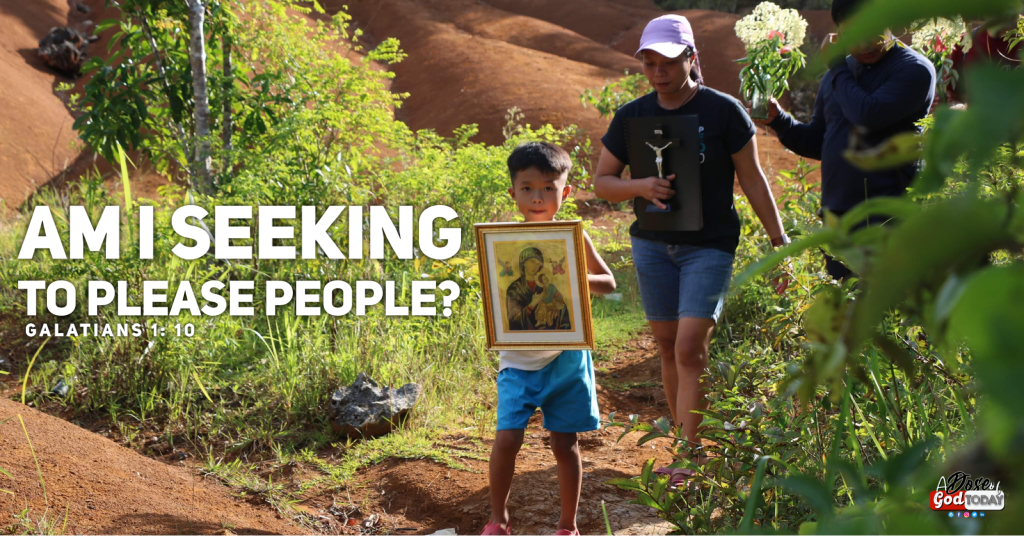
  • AM I SEEKING TO PLEASE PEOPLE? 

    AM I SEEKING TO PLEASE PEOPLE? 

    October 3, 2022 – Monday of the 27th Week in Ordinary Time

    Click here for the readings (https://bible.usccb.org/bible/readings/100322.cfm)

    Do I do good to seek the affirmation of others? Do I do things for others in order to gain their recognition and acceptance? Our past experiences of rejections, not being affirmed, not being recognized and accepted by others, could give us the anxiety. In order to compensate what has been deprived from us such as our childhood need for acceptance, affirmation and recognition could become our hang-ups even when we are already a grown-up.

    We would tend to please others by being good and kind, by doing any demands from others to us, by meeting every expectation from us just to gain their approval and affirmation. We could also display such attitude that would praise another person through our flattery words and extra attention given in order to seek to gain favor. Or, we could be more aggressive by directly demanding from others that we should be affirmed and recognized by soliciting such honor from others.

    What St. Paul asked, “Am I seeking to please people?” sheds light on this attitude of the heart. Paul wrote to the Galatians and reminded them that his presence among them and his ministry to them in preaching the Gospel of Christ was not about seeking their attention or even to please them or any other person. The Galatians who after receiving the Gospel of Christ from Paul was about to seek the approval of Jewish Christians who demanded that the new Christians and not Jewish before should accept first the Jewish Law and its religious practices. Only then that the Galatians will be considered as good Christians and be accepted.

    However, Paul did not agree with this. Such intention is a perversion of the Gospel. Faith in the Risen Lord is not about being able to please another culture and religious belief just to be accepted. The Gospel of Christ being received by Christians is not about pleasing another in order to be welcomed in the community. Faith in the Lord and the Gospel of Christ are the elements that constitute the life of a Christian.

    This is what we have also heard in today’s parable in the Gospel of Luke. The Samaritan did not seek to please others but he did what he should do as a human person to another human person who was in need of help. Jesus used this parable in order to respond to the question of a scholar of the Law on what to do to inherit eternal life.

    Thus, it is by being able to love God though our expression of loving one’s neighbor that we inherit eternal life. The good deeds, kindness and mercy that we do to a person in need is not about pleasing another but an expression of faith and devotion, of love and hope in God. To inherit eternal life is, therefore, also not about to please God in order to gain that favor but in showing mercy. Mere strict observance of religious practices and traditions could become our way of pleasing another like our flattery words and actions to another. If mercy does not flow from our religious traditions, prayers and devotional practices, then, these become our mere attitude of currying favors.

    May our actions, our thoughts, our kindness, goodness and mercy shown to others be our expression of that love of God and not in simply seeking to please others. Kabay pa.