The Book of Genesis speak of the human tendency to be proud and arrogant. And the tower of Babel tells us of this human aspiration to be powerful and become like God, as people said, “Come, let us build ourselves a city and tower with its top in the sky, and so make a name for ourselves.” Yet, this made the people to be exclusive and arrogant.
Indeed, the tower of Babel expressed earthly power and riches. Humanity believed that these things were enough for them to make a name for themselves and become powerful like God who created the world. Hence, as those who built the city and the tower, became exclusive, they also refused God’s command to fill the earth. The people decided to just stay in that place, in that city and not anymore share their knowledge, experiences, graces and riches in other parts of the earth. They have become comfortable there to the point that they did not want to go out from their comforts.
However, it was said that the Lord had seen this and realized as well the evil intentions in the hearts of the people. This was the reason why the Lord scattered them by confusing and dividing them. When they spoke differently, people did not understand and did not care to understand each other.
From here, we realize that our human efforts and aspirations when they only come from greed, pride and arrogance to become great and powerful like God, are certainly worthless. Our mere human success, wealth and power are not the keys to be great in the eyes of God.
This realization brings us then into the message of our Gospel today. Jesus expressed a way of life that was different from the people who tried to build a city and the tower of Babel. Jesus tells us that to be a true disciple of him is not about boasting oneself, of our successes in life, of our influence and power over others. A true disciple, rather, is a person who denies himself for the sake of others, who carries his own cross and follows Jesus. A true Christian then is a person who remains humble before God, who recognizes his/her smallness and dependence, yet, also embraces the presence of God who gives him/her the strength to carry the cross.
Let us remember, that human effort and strength and our successes in life are not evil. In fact, these are gifts from the Lord and not reasons that we become greedy and self-righteous people. What we have received, achieved or accumulated in this life give us the opportunities to be able to share our gifts, our talents and ourselves to our community.
This calls us now that our families, groups, organizations, and communities become inclusive and welcoming. Indeed, to be inclusive and to be hospitable are natural to a Christian home, to a Christian organization or community. May that spirit lead us to give, to share and to reach out even to those who are different from us. Hinaut pa.
The Book of Genesis in the story of Noah with God, we have heard how the Lord renewed the covenant with the whole human family. The Lord God still sees hope in us. And the wonder of this renewal of the covenant with God, as God says, “I am now establishing my covenant with you,” carries with it the call and responsibility to nurture, cherish, develop and give life.
What does it mean? As the Lord renews the covenant, God also demanded an accounting for the life of every animal and an accounting for every human life. This is not a threat from God but rather the Lord wants us to value every life. This is how the Lord wants us to flourish and discover the wonder of life here on earth and be embraced by life itself through the whole creation of God. Every creature of the Lord reflects God’s goodness and love and every human being also reflects and carries God’s image.
Thus, the call to be fertile and multiply must be understood within the context of life, in nurturing, cherishing, developing and giving life. This indeed, calls us to defend life from anything that will suppress life, abuse life and destroy life.
The very covenant that we have with God is a testament of that life and promise of the fullness of life. The rainbow is not just some ideological color, however, it is a biblical sign of God’s presence among us, a sign of life and a sign of renewal.
This calls us further to commit ourselves into that covenant with God so that we too shall become cooperators of God’s action and presence in the world in bringing and giving life. This can be fully expressed in our homes, communities and organizations, and into our relationships. Every time we give hope to those who felt hopeless, every time we give a helping hand to those who need it, every time we give more attention in taking care of animals and of nature – these are simple ways of expressing that covenant and call to give life.
In a way, the Gospel today tells us also how Peter recognized the fullness of life in Jesus as he confessed that indeed, Jesus is the Christ. However, after realizing that Jesus is to be persecuted, will suffer and die, Peter retreated from his commitment to be with Jesus, the Christ.
Like Peter, if we confess that Jesus is the Christ, our Lord and Savior, then, this confession implies commitment and risk. After all, when we commit ourselves to somebody we love, risks and sacrifices are implied.
Thus, as we embrace the covenant God made with us, may we come to fully commit in that relationship with the Lord. Let us therefore, allow our human relationships and relationship with the rest of the created world to be fertile where we can multiply love and multiply life. Hinaut pa.
For the second time, Jesus has to do it again. The blind man still could not see clearly when Jesus touched his eyes the first time. Yet, another interesting part of this healing story was on how Jesus brought the blind man away from people and out of the village and then told the man to go home but not to go back to the same village where he had been.
This tells us that healing may not be instant and that it takes patience because healing is a process. Hence, the man was healed not just with his physical blindness but also of his spiritual blindness. The darkness that covered his eyes prevented him to not just see but also not to recognize. Hence, Jesus told him not to go back to the village of Bethsaida. That village became a symbol of unbelief, sin and rejection of God’s presence. Jesus was not welcomed there because people wanted to remain in their wicked way of life. The people did not want Jesus to change them, to heal them and to renew their life. Thus, going back in that village would only make the man go back to the same cycle of darkness in his life.
Indeed, the healing of this blind man tells something about the disciples and about us today. Jesus has to take the man outside the village with his disciples so that they may see and realize their blindness. The disciples have been with Jesus and have seen great things that Jesus did to the people. Yet, the disciples remained spiritually blind. Their minds were still clouded with doubts and fears. They could have seen something about Jesus but could not see it clearly.
This blind man represented the disciples, no doubt. As Jesus did the healing, notice, that the man was not immediately healed. We may wonder, why was he not healed immediately and completely? Was it because the man doubted Jesus? Or was it because of his lack of faith?
What was only certain was that the eyes of that man were still prevented by some darkness. He still could not see clearly. However, Jesus remained patient with the man. He did not condemn the man for having a lack of faith. Jesus has to do it again so that the man could see clearly and to take away the darkness that covered his eyes.
Jesus was doing the same thing also with his disciples. The disciples were spiritually blind because they have not yet figured out at this moment who Jesus really was. They were still anxious of what to eat and what to do even though Jesus was with them. Hence, Jesus taught something to them through the healing of this blind man.
We too are just like the disciples and that blind man. We could have claimed that we have seen and understood something about our faith, about the Church, about Jesus or even about other people and ourselves, yet, not completely. Not completely and not clearly because we might be prevented by our fears, anxieties, by our pain and trauma or even biases. We might also be trapped in the cycle of self-pity or self-righteousness and arrogance, in the cycle of blaming others over our failures or in bitterness and hatred, or in the cycle of habitual sins, addictions or unhealthy coping mechanisms because we find life already dark and hopeless.
It would be good for us today to identify and recognize aspects and areas in our life that prevent us from truly believing in Jesus, from truly believing that we can be healed, be at peace and reconciled, be free and truthful about ourselves and to what surrounds us today.
Let us be assured also that Jesus will be patient with us. So, let us allow him to touch us even for a second time so that any forms of darkness in our eyes and hearts may disappear and that we may see Jesus clearly among our sisters and brothers, no matter who they may be. Let us allow Jesus to challenge and to bring us out of those unhealthy cycles that only bring us to darkness and blindness. May the grace of healing grant us freedom, peace and life. Hinaut pa.
What and who is it that can easily influence you? Indeed, each of us can be easily influenced by many things and people around us. Sometimes, we may not be aware what really influences our thoughts and hearts because we are not aware of our environment. The popularity of the Social Media, of Facebook, YouTube, Twitter, TikTok and Instagram bring so much influence into our individual lives and even into the consciousness of the society. This is how these social media platforms crept and reshaped cultures, social status, gender, age, even beliefs and values.
However, when one is not also aware of the kind of influences that he or she is welcoming, those influences may bring the person into better or into worst. Moreover, even our own words, spoken or written, can also influence others to become better or to become worst. The rise of fake news and disinformation entertained by many has been very damaging into our culture and relationships. People who are not aware of the sources and the credibility of the reports, are being deceived and in effect brought more damage to the community by spreading them.
Such is the warning that Jesus reminded to his disciples. The Lord firmly warned his friends, “Watch out, guard against the leaven of the Pharisees and the leaven of Herod.” The leaven being used to make the dough to rise, was used as an image by Jesus to depict the silent but cunning influence of the Pharisees and of Herod. The passive yet indifferent, aggressive and oppressive attitudes of the Pharisees and of Herod can become attractive to people who tend to seek recognition and praise and those who tend to worship the powerful and the corrupt, the arrogant and the aggressive.
These tendencies were also present among the disciples. This was the reason why Jesus reminded them when they began to worry of having not enough bread. Even until that moment, they did not yet recognize that the Lord was with them and had already worked wonders by feeding thousands of people. This prompted Jesus to ask them, “Are your hearts hardened?”
Moreover, The Book of Genesis reminds us also of a disheartening event as God regretted and his heart was grieved. God found evil in the hearts of humanity. The hearts has been influenced and consumed by wickedness and evil that God decided to wipe out the earth and reshape it. Yet, Noah found favor with the Lord. Noah was neither influenced nor consumed by evil, but by love and concern. This was how the Lord found hope in us to reshape the earth and renew our hearts.
Today, like the disciples and like what happed in the story of the Book of Genesis, the Lord also calls us to watch out of those distractions that may lead us away from the grace of God and from God’s presence. We may always realize that God is working wonders in us and through us.
Thus, recognize today those wonders that God is doing to you. Let not our hearts be influenced by passivity, by indifference, by arrogance, by aggression or by any fake news about God, about ourselves and about others. Rather, look always of those many wonders that God is doing in our lives. Be influenced by God’s grace in our sacraments. Be influenced by His words in the bible. Be influenced by the Holy Spirit. And as this Valentine’s Day reminds also, be influenced by love and concern and not by hatred and indifference. Kabay pa.
I once encountered an old leper in Mandaue City when I was a first year Seminarian in the college. His name was Tatay Mike. He was abandoned by his own family in the leprosarium in the 60s when leprosy began to appear in his body during his 30s. He was a teacher yet, he was forced to leave his teaching profession and his home but was also abandoned by his family because of fear of contamination.
What is terrifying with leprosy are not just the wounds, but of not being able to feel the pain. Leprosy produces anesthetic-effect in the body. It actually damages the sensory nerves of the person, thus, the inability to feel pain.
Tatay Mike also began to question his own existence. He was filled with suffering both in his body and in his heart. He was wounded, physically, emotionally and spiritually. The abandonment from his family created unspeakable wound in his person. He was always angry at everything and everyone. He would blame God for making him suffer that much. In fact, he asked people to just kill him, to end his life. He too tried to kill himself. He committed suicide not just one, not twice, but many times.
That encounter with him led me and my co-seminarian to become a friend of Tatay Mike. We spent time with him even though he would curse us for being with him. We would visit him every afternoon on Saturday even when he seemed to be always angry at us. Yet, our constant visits to him, changed him slowly. He became more tolerant with us until such a time that he began to open up his story to us.
One Saturday afternoon Tatay Mike blurted out to us, “Gusto nako mamatay! Wala may naghigugma nako! Pait kaayo akong kinabuhi.” (I really want to die. No one has loved me. My life is bitter!) – Upon hearing this painful words of Tatay Mike, it was my co-seminarian who responded and gave hope to him. He said, “Tay, nia man mi nagahigugma nimu. Mao nang kanunay mi mobisita nimu!” (Tay, we are here loving you. That is the reason why we would visit you.)
Tatay Mike shed some tears at this. He told us that it was his very first time being told that he was loved. It was such an emotional encounter but that gave hope to Tatay Mike. And that simple encounter, changed Tatay Mike’s perspective in life. Sadly, Tatay Mike died the following year due to other complications. But at least he died knowing that he too was being loved.
This encounter with this old man seemed to be just an ordinary encounter for me at that time. We went to the leprosarium to visit the patients, not entirely by our own will and desire. As young Seminarians, we went there because we were told to and that was just a part of our seminary formation. If we were given a choice at that time, we would surely not go to the leprosarium to visit and talk to the lepers. We would rather go to an internet café and play computer games.
It was only later that I realized that the seemingly ordinary encounter with Tatay Mike created actually a slow but powerful impact on me as a Seminarian. Tatay Mike must have realized that our presence brought something new and some meaning into his life. Yet, Tatay Mike’s life and our Saturday visits have actually changed me a lot.
Tatay Mike and those Saturday visits taught me that despite the senseless suffering one will have, life is still wort living; that another person’s presence in our life is a testament of God’s faithfulness in us; that our expressions of care and concern could be the last life-line of people who have lost the desire to live.
This reminds me very much of what St. Paul told us in his first letter to the Corinthians that the message he brought to the people was through a “demonstration of Spirit and power.” What does he mean by this? Paul preached the person of Jesus not merely on persuasion and human words but through his very actions. The sincerity of his heart, his kindness and concern shown to the many people were reasons that the people recognized the person of Jesus in the life of Paul.
Similarly, Prophet Isaiah in the first reading reminds us how the Lord has called us into concrete actions of care and concern. The Lord declares, “Share your bread with the hungry, shelter the oppressed and the homeless; clothe the naked when you see them, and do not turn your back on your own… remove from your midst oppression, false accusation and malicious speech.”
When we have the courage, the intention and the desire to express these concrete actions of care and concern, we shall be a light and joy to those who find life dark and bitter. In effect, our commitment to defend the weak and the oppressed will be our source of confidence when we too are in the midst of trials and challenges.
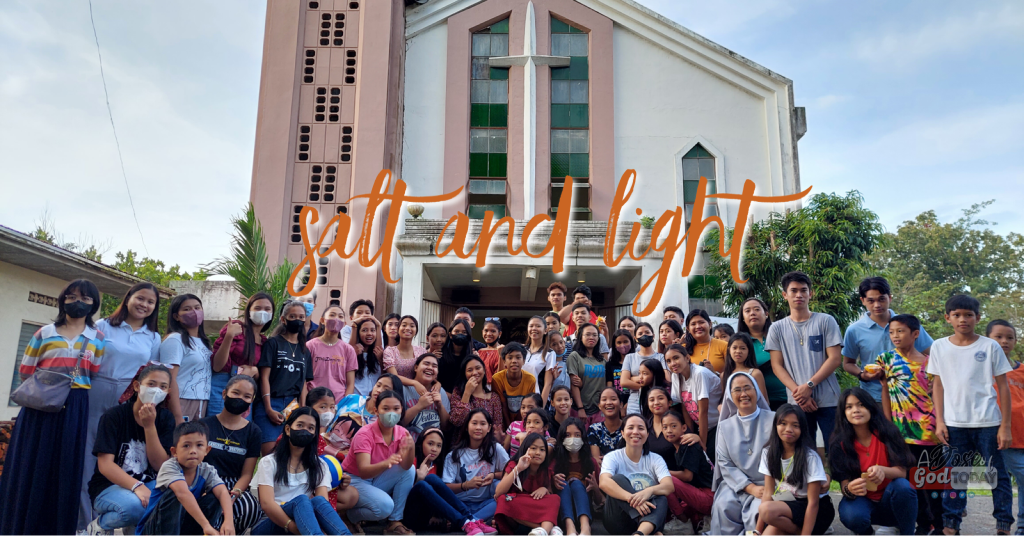
Moreover, Jesus encapsulates what we both heard in the previous readings. Jesus tells us, “You are the salt of the earth. You are the light of world.” The salt because it gives flavor to our food and serves as preservative as well, has become a symbol of bringing joy to our community. The salt which was also a form of compensation to Roman Soldiers in ancient Rome, thus the word salary emerged, has also become a symbol of giving life to those whose lives were deprived of basic needs.
The light that Jesus told us is also not about claiming that we become the source of light. No! As we boldly express our faith in the Lord and of our commitment to defend, nurture and develop life, we will truly give light. How shall we be a light then? By being courageous enough to stand for what is right and just, by defending the weak, by showing our respect to people no matter who they are, by being honest and trustworthy in our work or business, by being committed in our relationships, by giving ourselves and gifts for the sake of others. In these concrete ways of showing care and concern, we will surely become a light for others who find life dark.
Yet, remember, we are neither the source of joy nor the light itself. We are reflections of joy and light. Hence, like St. Paul, we may become like him who brought others to the Lord, to the true source of life, joy and light. Kabay pa.



 A DOSE OF GOD TODAY