Tag: Homilies

  • To rest is to celebrate life and give life

    To rest is to celebrate life and give life

    Advertisements

    September 5, 2020 – Saturday of the 22nd Week in Ordinary Time

    Click here for the readings (https://bible.usccb.org/bible/readings/090520.cfm)

    Homily

    To rest is a human need. In all aspects of our life, resting is necessary to make time for ourselves in order to recharge, recuperate and restore. Thus, its value is as important for our physical health and also for our emotional and spiritual life. The Holy Scripture would even affirm such value in our life.

    In the Book of Genesis, God rested on the seventh day but not merely to recharge or recuperate or restore because God does not need this. God must have rested to enjoy and to be more delighted with creation, to look at us with much love and to cherish the wonder of Divine creation. Moreover, it was God’s way of allowing the creation too to grow and become the way God meant it to be.

    This is how the Jewish belief also grew in their spirituality to give much importance to Sabbath, a day of rest and a day for God. Yet, the Gospel today tells us something that was quite contrary to what God has designed Sabbath should be.

    The people had developed many regulations on how to observe Sabbath to the point that one should do nothing at all. Consequently, Jesus was criticized for healing people during Sabbath. This time, some Pharisees complained on why Jesus’ disciples were picking the heads of grain and eating them.

    Such ridiculous regulations were made, believing that Sabbath will be holier by doing nothing at all. With this, Jesus objected and taught something very important to us. The Sabbath or this day of rest and day for God is meant to honor God, to be delighted of the many wonders of the Lord. Hence, Sabbath is meant to be a day of celebrating life and giving life.

    Jesus healed people even during Sabbath because it was a way of celebrating and giving life. To work for your food is a way of celebrating and giving life too.

    Today, we may always remember that as we rest to recharge, recuperate and restore aspects in our life, we are also called to celebrate life and give life. In this way then, resting becomes holy and dedicated to God who delights to see us and cherishes our every movement to be life-giving to others. Hinaut pa.

    Jom Baring, CSsR

  • The Challenges and graces of what is New

    The Challenges and graces of what is New

    Advertisements

    September 4, 2020 – Friday of the 22nd Week in Ordinary Time

    Click here for the readings (https://bible.usccb.org/bible/readings/090420.cfm)

    Homily

    By this time, most of us have already adjusted with the “new normal.” The change of lifestyle and adopting to new ways of doing things in this time of pandemic must have gradually taken roots into our way of life. Others must have struggled because of this change yet, we have to because it is needed and it is important.

    However, there are many things in our life too that remains unchanged and might not be helpful at all in our relationships. These may include our attitudes, perspective in life and certain beliefs. This could have come from our desire to be secured and assured of today and of what lies ahead of us. Thus, we develop or make a routine so that we become familiar and comfortable in doing things.

    This is the reason why we also settle and become comfortable with traditions. We do familiar things, thinking of the same ideas, having the same perspective, meet familiar people and create familiar events because we have been doing them in the past. In the same way, we also form habitual activities and attitudes.

    However, when we become so absorbed and concerned in doing, thinking, seeing and feeling with what is only familiar, then, there is a danger that we might also resist any changes and to be surprised with what is new. Because we are comfortable of the things of the past, we might believe that invitations of change are threats to our desire to be secured, to be certain and to be in controlled.

    With this kind of attitude towards change and new things, we could also become rigid, close-minded and even unwelcoming to what is new and unfamiliar to us. Yet, God’s invitation to us is always new and geared towards change and transformation of our heart, mind and of our total person.

    In our Gospel today, Jesus tells the Scribes and the Pharisees that “No one tears a piece from a new cloak to patch an old one. Otherwise, he will tear the new and the piece from it will not match the old cloak. Likewise, no one pours new wine into old wineskins. Otherwise, the new wine will burst the skins, and it will be spilled, and the skins will be ruined. Rather, new wine must be poured into fresh wineskins.

    Jesus is actually inviting us to welcome what is new and unfamiliar to us and also to be surprised by the challenges and the graces it brings. Again, this is what he means to the Scribes and Pharisees who complained that while the disciples of John the Baptist and the disciples of the Pharisees fast often and offer prayers, his disciples eat and drink with him.

    Indeed, they wondered why his disciples were not following the old practices of the Jews. However, Jesus was not making an excuse for not doing the tradition. Jesus wanted them to realize that there was greater than the tradition and that was Him. Jesus did not reject what was taught and had been practiced for a long time, but to be more welcoming of the new things that have come. His person and very presence among them was something new and something that everyone should capture and cherish.

    Definitely, the Spirit of God brings freshness in us and God’s invitations may become uncomfortable for us because God inspires change and renewal. Jesus calls us today to be willing and welcoming to his surprises and invitations of change and renewal because he wants us to be renewed and be restored from our old, broken, sinful and habitual ways.

    Thus, I invite you to pause for a moment today, then, reflect and discern this question, “What are those old ways, attitudes, beliefs and habits that I have developed which do not help me, and do not help in building healthy relationships with others and with God?

    As we identify them, let us also ask the grace from the Lord that we may have the courage to face them. Allow also the Lord to change and renew us by embracing the challenges and graces to what new perspective and new life bring. Hinaut pa.

    Jom Baring, CSsR

  • When Jesus got into the boat of failures and frustrations

    When Jesus got into the boat of failures and frustrations

    Advertisements

    September 3, 2020 – Thursday of the 22nd Week in Ordinary Time; Memorial St Gregory, the Great, Pope and Doctor of the Church

    Click here for the readings (https://bible.usccb.org/bible/readings/090320.cfm)

    Homily

    It must have been disappointing and at the same time tiring. Simon and his group caught nothing despite working all night to catch fish. Yet, there was nothing Simon can do. He and his group had to go back to the shore and wash their nets.

    Have you ever been so disappointed with life? You felt tired and exhausted and there were many failures around your life. In spite of your efforts, the enthusiasm and the passion you have shown, yet, life seemed to be so unfair. It was just too overwhelming and you felt surrendering.

    This must have been the feeling of Simon too as he led a group of fishermen. There was nothing, not even a single catch of fish. It was not just a failure but a disaster for a fisherman like him.

    However, it was in this low moment of Simon that someone got into his boat. Jesus got into his boat and began teaching the people. Through that very boat of failure and disappointment of Simon, the Lord transformed it into something wonderful and beyond Simon’s expectation.

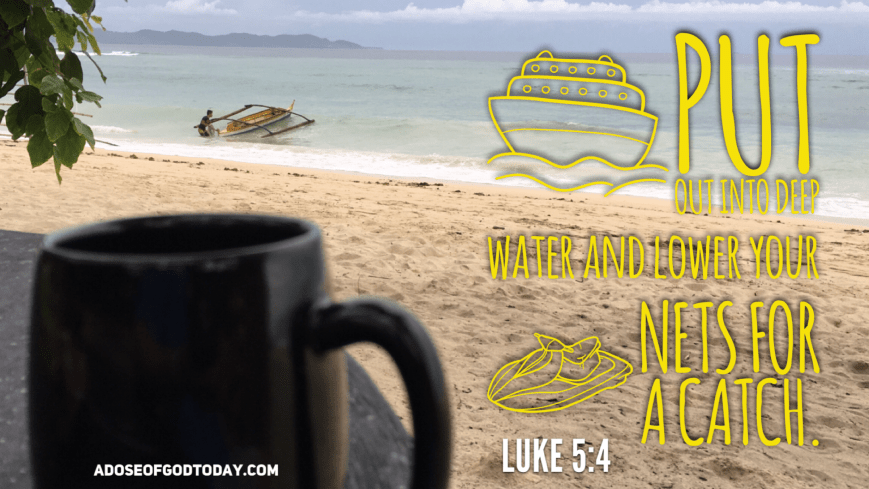
    After teaching, Jesus told Simon something, that could have made Simon to wonder, “Put out into the deep water and lower your nets for a catch.” In Simon’s mind, it was completely absurd as human wisdom and knowledge would tell him that. They had been working all night but caught nothing. However, because it was the Lord who said, Simon trusted the words of Jesus.

    This is what St. Paul said in the first reading, “if anyone among you considers himself wise in this age, let him become a fool, so as to become wise. For the wisdom of this world is foolishness in the eyes of God…” Indeed, by trusting the wise words of Jesus, Simon found something wonderful and life-changing.

    This all started when Simon let Jesus be in the boat of his failures and frustrations. The very presence of God became an assurance to Simon in the midst of the troubles in his life and in the midst of his search of something big in his life. The invitation of Jesus to him was call of faith. To go into the deep water and to lower down the nets was an invitation to dwell deeper into the most essentials in Simon’s life, to lower down his comforts and even pretentions, and to leave behind at the shore his uncertainties, fears, failures, guilt and sins.

    When Simon did all these, what he found was God’s tremendous goodness, deep love and generosity to him symbolized by the great catch of fish. This moved Simon to beg Jesus to depart from him because Simon had become aware of his sins, failures, fears and insecurities. However, this realization became the entry point of Jesus to make more wonderful things in the life Simon.

    Simon was called for a bigger purpose, to a mission where his participation became an important part in the ministry of Jesus. All of these happened because Simon let the Lord to be in his boat, allowed Jesus to challenge him and to change his life.

    This story of encounter with God led to chance and to a mission. Indeed, a real encounter with God or to allow God to be with us in our boats of frustrations and guilt, strips us from our pretentions and masks. Such encounter makes us bare to see how sinful and unworthy we are before God.

    Yet, it is in this moment of humility and honesty that we find God more merciful, loving and forgiving to us.  Once we lay down our guards that God comes to us to make miracles in us – to free and to give a true fulfilling life.

    It is when we own and claim our weaknesses, sinfulness and failures to God that we are also being strengthened, forgiven and empowered by the Lord.

    Thus, these are the invitations for us today.

    • First, allow the Lord to be with us even in our frustrations and failures in life, in our guilt and shame. Never be ashamed to allow Jesus to be in our boats. Let him teach us, to reminds us how much we are being loved.
    • Second, allow the Lord to challenge us and to shake our pretensions for us to discover more ourselves before the presence of God.
    • Third, allow God to bring changes in our life and to make wonderful things even out of our messy and troubled life story.

    May this encounter with Jesus empower us to go on mission by becoming His own instruments of mercy, love, peace and forgiveness. Hinaut pa.

    Jom Baring, CSsR

  • When our words give life and freedom

    When our words give life and freedom

    Advertisements

    September 1, 2020 – Tuesday of the 22nd Week in Ordinary Time

    Click here for the readings (https://bible.usccb.org/bible/readings/090120.cfm)

    Homily

    Our words to another person can become destructive or can become uplifting and life-giving. Those who silently suffer from verbal abuse at home, at school or at work would look at herself or himself terribly. The emotional stress and psychological trauma could affect the entire perspective of a person about himself or herself and about others. Such negativity makes a person to have a low self-esteem, to be depressive, angry and hateful towards himself/herself or/and towards others.

    However, a person who receives enough affirmations, constructive corrections, good counsel and advises from credible and people of good example would tend to become more hopeful and positive in life.

    This tells us how our words play an important part in our development in emotional or psychological and spiritual aspect of our life. Thus, the readings today convey to us how our words can transform the lives of others and of our community.

    The first letter of Paul to the Corinthians tells us how the Spirit of God inspires us to understand the Word of God, “to understand the things freely given us by God.” As a community of faith, we speak on the mysteries of God revealed to us not with words taught by human wisdom, which is limited and can be self-centered, but with words taught by the Spirit which is life-giving and liberating.

    This is how we find the words in the Bible to be always uplifting and inspiring because they are filled with the Spirit of God. In the same way, a parent who lovingly corrects a child for the wrongdoing the child does and without condemnation and insult, builds the character of the child to become a good and better person.

    Such powerful and life-giving words are also heard in our Gospel today. The Gospel of Luke tells us of the experience of the people from Capernaum, a town in Galilee. Jesus who taught the people in the synagogue found him different from the Scribes and Pharisees. Jesus spoke with authority not just with knowledge and familiarity of his teachings. Jesus spoke from the heart, from the wisdom of God that intends to give life to the people.

    Hence, the people found life in his teachings, in his words. This was more manifested when Jesus encountered a man with the spirit of an unclean demon. Through the words of Jesus, that demon was made quiet and was commanded to come out of the man. That demon was surely oppressive to the man by taking out the voice of the person. The person was made a slave by that demon. Yet, through his encounter with Jesus the man was given a chance to be freed and to be healed. Indeed, this is the effect when words give life and freedom.

    Thus, at the words of Jesus, the demon came out of the man without doing any harm to the person. This tells us again how those words of Jesus truly brought life, freedom and healing because Jesus’ intention was of kindness and his words were out of generosity.

    Today, Jesus also calls us to find healing, life, and freedom in his words and presence in the scriptures and in our Sacraments. Hopefully, what we find and receive will also be transmitted into our life that we ourselves will become life-giving and instruments of freedom.

    It would be good then to examine our words and our encounters with people today.

    Let this be the object of our discernment today. Are my words and presence life-giving or condemning? Am I giving freedom or condemnations? Are my words filled with hatred and anger or peace and kindness?

    If we find that our words and presence express more of condemnation, and judgments, of hate and bitterness, allow Jesus to transform us. Allow Jesus to cast out the demon in us that oppresses us and oppresses other. Allow Jesus’ words to make free and at peace so that we too shall learn in giving words to others that are filled with love, life and freedom. Hinaut pa.

    Jom Baring, CSsR

  • Making a sacrifice?

    Making a sacrifice?

    Advertisements

    August 30, 2020 – 22nd Sunday in Ordinary Time

    Click here for the readings (https://bible.usccb.org/bible/readings/083020.cfm)

    Homily

    Who wants a life without suffering, without sacrifices and difficulties? That would be nice, right? We could dream of a life that knows only comfort, that is easy, and that we’ll always feel good.

    There is actually nothing wrong in dreaming a life filled with comfort and without sacrifices and difficulties, to always feel blessed and good. This is a desire from us to feel secured. Nevertheless, the danger lies within a heart that denies sacrifice and suffering as part of our life, and as part of our Christian way of living.

    I remember a story being told to me when I was in college. There was a boy who went out into their garden and found a cocoon. It was so timely that he saw how the cocoon moved. The butterfly was about to come out from its cocoon. However, the butterfly was struggling. The boy felt pity for the butterfly. And so, the boy immediately, ran back to his room, got a pair of scissors. He wanted to help the butterfly and so, with scissors in his hand, he cut the cocoon carefully in order not to wound the butterfly. He was so successful that the butterfly was in her perfect shape and out of her cocoon.

    But then, something was wrong with the butterfly. She did not fly. She couldn’t fly because her wings were too weak. When the boy cut the cocoon, the butterfly lost the opportunity to make her wings strong. She was supposed to go through in that struggle, in that difficulty of coming out from her cocoon. Because of the easy way out, her wings were not made strong to enjoy the wind as she was supposed to fly.

    Advertisements

    In today’s Gospel, Jesus scolded Peter when he denied that Jesus should suffer and die. Even though, Peter confessed that Jesus is indeed the Christ sent by the Father, but then, Peter did not understand the commitment of being sent by the Father. Peter only knew of the victorious image of the Christ who will bring salvation and glory. Peter held on to his belief that in Jesus, there will be only blessings, power, and praises.

    This was the mistake of Peter. He couldn’t accept that Jesus will undergo suffering, persecution and death. He couldn’t accept of a vulnerable and weak God. This caused Peter to be scolded by Jesus and even called Satan because Peter only wanted an easy one, an easy life. Peter only considered what he wanted, not what God desired.

    This is also the consequence when we encounter Jesus. Before this passage of Peter being rebuked by Jesus, the Lord actually asked the disciples, “Who do you say that I am?” This question of Jesus was a question of commitment. And Peter responded this question with conviction. Peter said, “You are the Christ, the Son of the Living God.” Like Peter, if we confess that Jesus is the Christ, our Lord and Savior, then, this confession implies commitment and risk.

    After all, when we commit ourselves to somebody we love, risks and sacrifices are implied. That is why, in the Letter of Paul to the Roman, he reminds us to “offer our bodies as a living sacrifice, holy and pleasing to God.”

    This Sunday, we are reminded neither to fear nor deny the reality of making a sacrifice, of experiencing pain and difficulty in our life. Life is found when we go through the process of struggling. Never cut the cocoon or else there will be no life. When we experience pain, struggles, and difficulties never lose those opportunities because those are ways where we too shall find life, meaning and purpose.

    When we are called to make a sacrifice for others, never fear, because life is brought forth there. Take the example of parents and of mothers especially, giving birth is painful and excruciating, but the beauty of life is found when the baby finally comes out.

    Hence, do something concrete today (this week) that would best express your faith and knowledge of Jesus. Hopefully, by having this consciousness, this will further help us in knowing Jesus all the more because it is in knowing him that we also grow in our faith, in our commitment and relationship with God and with one another. Hinaut pa.

    Jom Baring, CSsR