
Tag: Homilies

  • Working with Jesus

    Working with Jesus

    Advertisements

    September 18, 2020 – Friday of the 24th Week in Ordinary Time

    Click here for the readings (https://bible.usccb.org/bible/readings/091820.cfm)

    Homily

    In today’s Gospel, we are reminded that in the ministry of Jesus, the 12 men disciples were not the only ones who were part of the mission. There were “many others” who were with the Lord and played important roles. They were the women who were always with Jesus who like the 12 disciples, were also disciples themselves.

    The Gospels did not mention that they too preached, but they played significant contribution in the ministry of Jesus, in his travels and in his preaching and healing. These generous women supported Jesus through the use of their resources.

    Why follow Jesus? Why support him in his ministry? Each of them had their own stories with Jesus, stories of conversion and renewal, stories from brokenness to healing, from death to life. Each of them must have this real encounter with the person of Jesus. That encounter must have brought a total change in their life and in the way they were responding to life.

    The Gospel of Luke itself tells us that some of them were cured from spiritual and/or physical illness. The experience of healing made them recognize God in Jesus. That experience too moved them to follow the Lord to know him more and to become more like him.
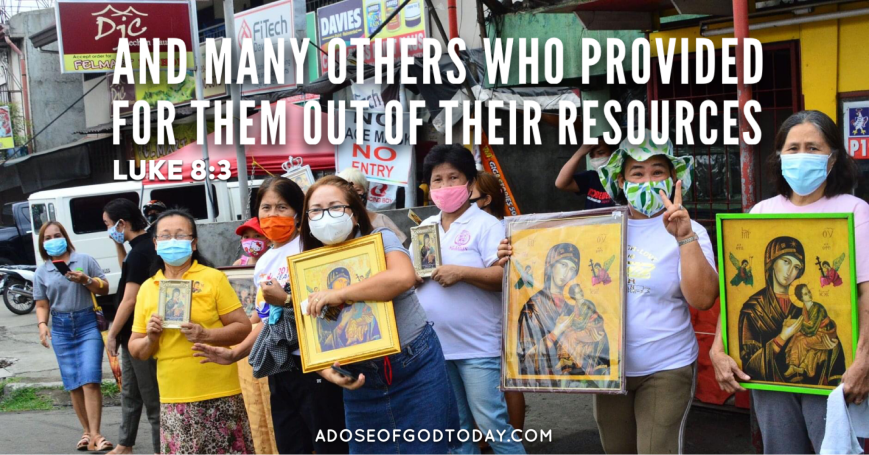
    Surely, there are lessons that we can learn from the women who worked with Jesus in his ministry.[1] And they are…

    1. Responding in gratitude. The women responded with gratitude to Jesus because of the life-changing grace they experienced through him. God surely worked miracles in our life too. Recognize those graces of events and experiences when God made manifest in your life and respond in gratitude to the Lord.

    2. Using one’s talents, capacities and resources to continue the work of Jesus. As the women responded in gratitude, they used their own talents and capacities and including their material resources to support Jesus in his ministry. Never shy and never hesitate also to share what you have to the Lord. Share generously to the Church and to the communities where the work of Jesus is being continued. You yourself also can do that by volunteering or making yourself available in the Church’s many apostolate especially in this time of pandemic. Use your expertise where you are good at and offer them to the Lord.

    3. Making the opportunity of giving by being close to Jesus. The women grabbed that opportunity of giving themselves and their resources so that they will be able to stay close to Jesus. Like the men, they walked with Jesus on the road, they gathered around him while eating, they listened with the people. With this, they learned and knew more about Jesus, about his person, his teaching and his ways. Day by day, they became like Jesus. Make every opportunity in serving the Lord to be your way of being close with Jesus too. The sacraments, the Holy Scriptures and your personal prayers are ways to learn more about Jesus and to become more like him.

    4. Staying with Jesus till the end. The women were the faithful companions and friends of Jesus. When Jesus was arrested, carried his cross, died, and buried in the tomb, these women were always with Jesus. While the men disciples were in hiding, the women attended the dead Jesus. In pain and sorrow, they were with the Lord. Thus, they too were the first ones to witness the glory of the resurrection of Jesus. Hence, as we learn to become like Jesus, stay close with him too. Stay close with those who are in sorrow and in pain in many aspects of their life. By doing that, we also become the presence of Jesus in the lives of others who will bring assurance and confidence through our friendship.

    Hinaut pa.

    Jom Baring, CSsR


    [1] Inspiration from https://www.ncfgiving.com/stories/4-lessons-from-the-women-who-followed-jesus-from-galilee/
  • Power of Asking Forgiveness

    Power of Asking Forgiveness

    Advertisements

    September 17, 2020 – Thursday of the 24th Week in Ordinary Time

    Click here for the readings (https://bible.usccb.org/bible/readings/091720.cfm)

    Homily

    Why do we come for confession? Why do we seek forgiveness of our sins?

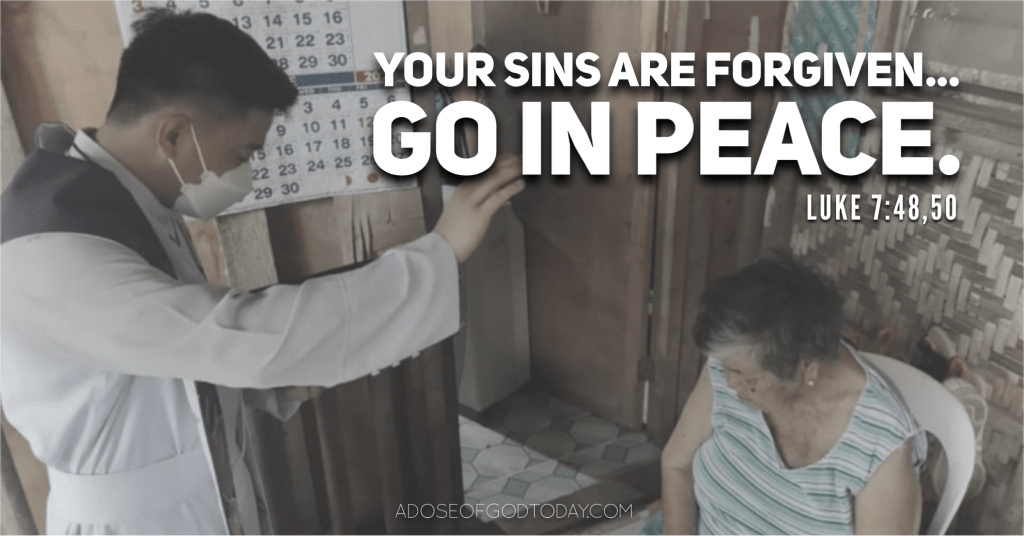
    Many of us today have doubts or have taken for granted the Sacrament of Reconciliation thinking that it does not need for one to confess his or her sins to a priest. Our basic catechism teaches us that the ordained priests are given authority to forgive sins in behalf of the whole church and as God’s representative to his people. It is not the priest that forgives but God. The church listens to the confession of a penitent through the person of the priest. The priest does not give judgement and condemnation but delivers the mercy of God to those who seek for it.

    Indeed, there is wisdom and power behind recognizing one’s imperfections and sins. The recognition of sins is not just be limited within personal realization keep within the self. It only becomes a true realization when sins are confessed to somebody, letting another person know about our sins. The priest in this case represents the church for the person who realizes his or her sins.

    Once we recognize our sinfulness then it is also God’s opportunity to change our lives and to make us new again. “Recognition and confession of sins” is our humble way of acknowledging that we need mercy and forgiveness, thus, we need God.

    The opposite of this is the denial of ones sins and imperfections. Thus, denial of our need of God and denial of our need of mercy and forgiveness. This happens to us when we have grown righteous. When we begin to think that we have committed no sins, then, we think of ourselves highly to the point of making ourselves above others whom we think as lesser than us.

    This is the story that we have heard in today’s Gospel. The woman who knelt before Jesus represented those who recognized their need of forgiveness. On the other hand, the Pharisee who invited Jesus represented those who do not need forgiveness because they believe that they do not need God.

    Let us see these two personalities to clearly discern God’s invitation for us today.

    The woman who was known to be a public sinner was despised by that Pharisee. He would not even dare talking to her because of fear of being contaminated by her sins. That is why, he felt disgusted with Jesus who allowed this woman to wash his feet with her tears and wipe them with her hair. The woman’s actions were her humble way of recognizing that she was in need of God’s mercy. Despite her sins and the shame that she was bearing, she took the risk to go in public to ask Jesus forgiveness.

    And because the Pharisee thought of himself so highly, never thought that he too was in need of mercy. This attitude of the Pharisee made him condemning of the woman. He was indifferent towards her and saw no hope in her. This will also happen to us when we become righteous and think that we do not need mercy from God. We become persons who easily condemn others. We become persons who do not see hope with those who have failed in their life. We become angry persons and bitter towards others.

    However, Jesus invites us to learn from her. She who recognized her sinfulness, allowed Jesus to transform her life. Her actions towards Jesus was her expression of her affection and at the same time of her need of forgiveness, Jesus who is the face of the Father’s mercy, willingly granted her forgiveness.

    When we become persons who recognize our failures and sins, we become persons who also see hope and life. We become persons who become positive with life and at the same time positive with others. We become happy persons.

    This is what Jesus wants us because recognition and forgiveness of sins allows us to unburden ourselves from guilt. This will also allow God to work in us.

    Thus, do not be afraid of acknowledging ones failures because God always sees hope in us, God does not condemn but grants his mercy and forgiveness to us so that we shall live in peace, freedom and joy. Hinaut pa.

    Jom Baring, CSsR

  • To live brings out pain, yet it bears fruit joy

    To live brings out pain, yet it bears fruit joy

    Advertisements

    September 15, 2020 – Tuesday; Feast of the Our Lady of Sorrow

    Click here for the readings (https://bible.usccb.org/bible/readings/091520.cfm)

    Homily

    To experience pain in life can become devastating and even maddening. Having a toothache can completely destroy your day. Having a headache can affect your daily activities. Indeed, when pain becomes unbearable and frustrating, it affects our daily routine and activities, our work, even our sleep and relationship with friends and family.

    Who would really want to be in pain? As much as possible, we avoid pain. Consequently, the medical science developed pain relievers that would take away slowly or instantly the aches and pains we feel in our body. In fact, a particular field among doctors has been developed to assist patients who will undergo surgeries through the use of anesthesia. Through its use, the patient will have a painless surgery so that he or she will be able to have a quality life.

    However, no remedy can be given to a heart that is bruised, abused, betrayed and/or humiliated. No doctor can apply anesthesia to a deep emotional pain. It can even linger and deepen with time. For such reason, some would succumb to it without any help from others and end their life. They see it as the only remedy to end that deep emotional pain they have been enduring in their life.

    This is the sad part because pain will really be unbearable and life-threatening when it is faced alone. Today, as we celebrate the Feast of Mary, the Our Lady of Sorrows, we are reminded that pain in itself is all part of our life. No one can escape pain. Everybody will surely meet pain in different degrees and aspects of life. And what this feast is reminding us now is the wonder and the beauty in confronting and carrying pain with others.

    Let us remind ourselves at the prophecy of the old Simeon. This old man had been waiting for the appearance of the Christ. When the baby Jesus was brought by the couple, Joseph and Mary to the Temple, behold, Simeon had caught sight of Light, the salvation of the world. However, this child will be responsible for the rise and fall of many in Israel. What he meant, was the rising of the humble, the poor and those marginalized by the society into the heart of God and the fall of the powerful, the self-righteous and the corrupt. For this reason, the infant will be a contradiction. The child will bring change and transformation to all that can be painful to those who seek comfort and power, titles and riches.

    Being a contradiction to the world, the child himself will undergo a terrible pain of betrayal, of dying and of death in which no amount of pain relief medicine or anesthesia can aid. Moreover, the same amount of pain was also given to the mother of the child, to Mary. As Simeon prophesied, “you yourself a sword will pierce.” Mary’s heart will be pierced with so much sorrow and pain as she suffered with her son.

    Every blow to Jesus, Mary also endured. Every insult to her Son, Mary also suffered. And every agony of Jesus, Mary also agonized. However, despite all these gruesome and painful events in the life of Mary, she did not hide. Mary did not escape into dreams. She did not ran away into loneliness and depression. Mary bravely confronted pain by being with her Son, by journeying with him until his last breath.

    Why is that? When people would hide and ran away from pain as what the men disciples did, but, Mary bravely faced that sword piercing in her heart and suffered in silence along with her Son. What gave her the courage? What made her to stand beside her Son and her Lord?

    It was love that sustained Mary. It was her deep concern and affection to the person whom she loved that moved her to be with Jesus and to also suffer with him. And to the suffering Son on the cross, the presence of her mother was the best comfort he had. The presence of Mary was more powerful than any pain reliever or any amount of anesthesia applied to the dying Son. Though, Mary’s presence did not take away the pain, but her presence made Jesus to be more resolved that there is hope in humanity.

    Mary’s presence on the cross is a testament to God that humanity can show so much concern and love to a suffering person. That’s why pain is never the end, suffering is never the last thing in life. The glory of the resurrection of Jesus tells us of that freedom from pain and promise of joy. We can attain that, by being together, by not suffering alone, but by allowing others to suffer with us or by allowing ourselves to suffer with others. Certainly, to live life will bring pain in us, but it will also bears fruit joy because of being with our friends and loved ones.

    Thus, on this feast of Mary, we are also called to be an instrument like Mary, to give comfort to those who are suffering and in pain in many ways, physically, spiritually or emotionally. Let our presence be an assurance of friendship, of love and concern to those who are in terrible pain this moment. For those who are in pain also, never retreat, deny or hide the pain or escape from pain, but allow others to journey with you. Allow those who love you to hold you and to embrace you. They may not take away the pain you are feeling, but let their presence, friendship and love be your source of comfort and confidence in your trying moments.

    May Mary, the Our Lady of Sorrows, pray for us. Hinaut pa.

    Jom Baring, CSsR

  • Life and Freedom in forgiveness

    Life and Freedom in forgiveness

    Advertisements

    September 13, 2020 – 24th Sunday in Ordinary Time

    Click here for the readings (https://bible.usccb.org/bible/readings/091320.cfm)

    Homily

    A friend shared her troubles. There have been nights of anguish and sorrow that she was enduring in the past months. The difficult situation of the lockdown and the movement and work restrictions in the City added to her emotional suffering and even heightened the way she’s handling her troubles. There’s so much anger, hatred and self-blame in her heart. Something has triggered her painful memory of the past that relived the physical and emotional abuse she suffered from her father. That painful memory brought fresh anguish and sorrow, as well as those feelings of anger, hatred and self-blame.

    These emotional suffering became episodes of attacks to the point of having sleepless nights and empty feelings during the day. As she said, she could not find a way on how to reconcile things, find peace and realize forgiveness. Her traumatic memory was just too painful to forget.

    Though that memory happened in a distant past but it remains fresh in her mind every time she remembers that. Indeed, this happens when a traumatic memory is merely buried in forgetfulness and covered by pretensions that as if nothing had happened. However, not unless that past of horror is accepted, embraced, confronted and be forgiven and not forgotten, only then, a person achieves peace and reconciliation.

    How important really then, is forgiveness? Is it possible at all to forgive without forgetting?

    This Sunday’s Gospel, the response of Jesus to the question of Peter regarding the number of times to forgive others and the parable he gave to his disciples tell us of God’s invitation to forgive and its important in the way we live our life as Christians and in our desire to live in freedom.

    We have heard Peter how he asked Jesus about how many times he should forgive. For the Jews a righteous man should forgive those who have hurt them for four times. However, Peter exceeded that and made it to seven. He thought he has more than enough. Nevertheless, Jesus responded to him that not just seven times but seventy seven times. The number actually does not matter. What Jesus is saying is that, forgiveness has no limit.

    Why is that? Why forgive without limit? It is even so difficult to forgive even once especially when the person who hurt us is someone we love and someone we trust. As what my friends shared to me, most of our pains are sometimes rooted from our relationships especially when we are betrayed or abused or deceived by a family member or friends.

    The pain and suffering that come from those broken relationships create deep wounds in us. And will forgiveness be possible then? Yes, it is. And forgiveness will always be a call for each of us.

    Hence, unless we find forgiveness in our hearts that begins with accepting and embracing those painful experiences and go on with life, then, we will not be free.

    Remember, forgiveness will make us free. It will not erase the scar of betrayal or of abuse or of deceit in our life but we will be able to stand up, to wipe our tears and go on with life.

    Forgiveness then is not about telling the person, that what he/she did was okay and pretend as if nothing happens. No! Forgiveness is to heal our wounded heart that will make us say to the person, “I forgive you not because of who you are but because of who I am.” This is what the Dalai Lama said.  This means that to forgive is not about to forget. To forgive is not to allow that painful memory to hurt us again in the present and to be freed from grip of violence.

    Forgiveness, then, also is not really for the person who hurt us or those who caused us the pain but rather it is all about us. The pain that we endure will lead us to feelings of anger, hatred and bitterness.  When we linger to these they will lead us to a heart that seeks revenge. This will become our tendency from our belief that by hurting the person back, our anger and hatred will be satisfied. But then, we are wrong because anger and hatred will never be satisfied by violence. Violence will only make us angrier, hateful and bitter person. The more we linger to our pain, anger and hate; they become a cycle that will never end. The Book from Sirach reminds us about this, that wrath and anger are hateful things that we sinners love to hug them tight.

    Advertisements

    This is how a person can create a cycle of violence, of revenge, of anger and hatred mostly directed towards ourselves. We will become prisoner of our own pain. All of these will control our lives, our thoughts and actions. We will never be free. We will begin to become suspicious to our other relationships. We will be afraid of trusting others, of loving others again and even ourselves. We are fearful because we linger to that pain thinking that other people might do it again to us. Hence, the cycle begins.

    This, indeed, is the attitude of an unforgiving person portrayed by Jesus in the parable. The person who was all cleared by the king from his debts became unforgiving and unkind to his fellow servants. Despite the kindness and the forgiveness shown by the king to him, he turned to be filled with hatred and resentment towards those who were indebted to him. He was violent, vicious and hateful. Thus, while causing pain and damage to others because of being unforgiving, he too later on was punished and suffered more.

    This is what Jesus is saying to us now and he wants us to forgive many times because a single un-forgiveness will only make us prisoner of our own pain and hatred. Jesus wants us to be free and not prisoners of anger, hatred, and bitterness or of violence. Jesus invites us to find life and freedom in forgiveness.

    In this way, we may always find reconciliation with God and with those who have hurt us so that in return, we too shall also be forgiven by those we hurt in one way or in many ways. Hinaut pa.

    Jom Baring, CSsR

  • Be Forgiven BY Being Forgiving for God

    Be Forgiven BY Being Forgiving for God

    Advertisements

    September 13, 2020 – 24th Sunday in Ordinary Time

    Click here for the readings (https://bible.usccb.org/bible/readings/091320.cfm)

    Homily

    “To err is human, to forgive is divine.” Easy for us to say these words at times to make excuses for our wrongdoings and to ask forgiveness for our mistakes. However, we also say same words of excuse to refuse forgiveness to those who have wronged and hurt us. “What can I do, I’m only human.” “Pasensya lang, tao lang po.” These words in fact describe not only our human frailty but also our difficulties of forgiving others. Perhaps asking forgiveness is much easier than giving forgiveness. But nevertheless to forgive is indeed difficult, especially whenever it is associated with “forgive and forget”.

    When his disciples asked Jesus how often should we forgive those who have sinned against us, they are just expressing our difficulties in practicing and upholding the value of forgiveness in our lives. Yes, like the disciples we see the value of forgiveness in our lives but we also know how frustrating forgiveness is and can be. In response to this, somehow Jesus in our gospel teaches and offers us something more about forgiveness.

    When he said “not seven times but seventy-seven,” Jesus is telling us to forgive indefinitely. Forgiving others then is not about numbers (counting faults, sins, mistakes and forgiveness) but all about sharing – GIVING your compassion and forgiveness (awa at patawad) without counting the cost or prize. Meaning, though human it is for us to err and to forgive is divine, nevertheless it is also human to forgive. Frail human as we are, we CAN also forgive and be forgiving of others. Difficult and frustrating it may be,  we can humanely and divinely give and share forgiveness with one another. 

    In our parable today about “the forgiven yet unforgiving servant,” Jesus is also teaching us that forgiveness is more than just “forgive and forget”. For Jesus, forgiveness is all about settling account, paying back, being patient, and regaining trust and respect. Meaning  to forgive is not about forgetting but all about evaluating, i.e. to put value and importance to the action-done, the experience-happened and the relationship-built. In other words,  Bigyang halaga at hinidi binabaliwala lamang. So, to forgive is then not about forgetting but rather about remembering – to put value on the whole experience of reconciliation from mistakes as part/member of ones life. It is a decision to give value, importance and responsibility to your action, experience and relationship.  And not to get out, get rid, and get away from our own mess, but to give God, each other and yourself another chance to grow and live life. For instance, the master forgave the servant because the master gives value and respect to the mercy-asked, promised-made and the relationship-renewed between him and the servant.  However the same forgiven servant was unforgiving because he did not value and respect his fellow servant. That is why to forgive is also  for both the aggrieved and aggressor to remember the wrongdoings-done, lessons-learned & restored trust from the mistake. Thus forgiving is about remembering for the sake of healing while forgetting the resentment. 

    Above all, our gospel today directs us to “Be forgiving as we are as we have been forgiven by God”. Let our reason then for forgiving others should be not ourselves (just to feel good) or be others (just to appease them) but be God, who forgives and loves us first and always. Forgive then not for our’s or other’s sake but for God’s sake, as Paul reminds us today that we live and die not for oneself but for God. Forgiveness is God’s grace we received and ought to be shared to others. Let our forgiveness be our offering of gratitude for God’s mercy and forgiveness – in thanksgiving for being ourselves forgiven.

    In the Lord’s prayer, Jesus taught us to ask our Father to “Forgive us AS (same way as) we forgive those who have sinned against us”. This is our cry to the Father to give us another chance in life as we try our best to give ourselves and other’s another chance also in life. Yes, forgiveness is divinely-granted but also humanly-shared for God, not to be forgotten but be remembered for its value in life.

    Pandemic times make us also conscious not only of the mess, struggles and challenges we are in, but also our own mistakes, shortcomings and wrong-doings in life. We realize that we also need not only God’s love, protection and guidance but also His forgiveness and mercy at this time as well. And we can fully enjoy all His graces by also being humanly and divinely enough forgiving and loving to those who have wronged, failed, and hurt us. In other words, we are mercifully forgiven by our being forgiving….. we are loved by our loving.

    Human as we are, yet are blessed and forgiven, may we be and ought to be for God’s sake forgiving to others especially to those who are needing of His compassion and mercy at this time.  So be it. Amen.

    By  Fr. Aphelie Mario Masangcay, CSsR (a former Filipino Redemptorist Missionary for Filipino Migrants in South Korea who, due to immune compromised diabetic condition, stationed back home  in the Philippines for now).