“Being in a society which justice system works for the benefit of the common good, that protects the weak and powerless and the rights of all citizens and not easily intimated and influenced by the rich, powerful and bullies, or to see how a community expresses concern and care to a person in need of help or a neighbor who offers financial assistance to a sick friend, having a co-worker asking how are we and expressing support in times of stress in work, and seeing a couple who after their disagreement ends the day in embracing one another” – are true expressions of the Kingdom of God that is silently growing in us.
It is our call to make sure that the Kingdom of God will grow in us and among us by nourishing and cherishing the values of the kingdom. And where should it begin? AT HOME, among husbands and wives, their children and the whole family.
St. Paul expressed this in his letter to the Ephesians, yet, what Paul said about the subordination of wives to their husbands is not meant to be understood that husbands are masters over their wives who are like slaves. No. Wives are not left without rights and independence, and losing their person and individuality for being a subordinate.
Paul’s expression of marriage here is to be understood in the context of Christ’s relationship with the Church. The sacrament of marriage is the image that we have between Christ and the church. This is even already present in the Old Testament. The covenant between God and the people is to be understood like that of husband and wife.
This is where we could also find today’s invitation. We are called to let the kingdom of God grow in us, starting in our very homes, with husbands and wives, the whole family from which God relates to us in the most intimate way.
Hence, by giving respect to each one, by nourishing, cherishing and taking care of our relationship, by expressing concretely our concern and love for each one at home, by making Christ as the very center of our family life, then, surely like that of a small mustard seed and a small amount of yeast in the dough, the Kingdom will grow silently in our homes.
Yes, the Kingdom of God will certainly manifest in our hearts and homes where we shall also experience joy, peace, safety, confidence, respect, love and concern. Thus, let it grow… let it grow… don’t hold it back anymore… Kabay pa.
Have you ever wondered why this parable is called the “Parable of the Sower” when in fact Jesus was mostly telling us about the soil and the seeds. It should rather be called as the Parable of the Soil or Parable of the Seeds, isn’t it? But then, it is really not. This is certainly a Parable of the Sower.
The parable tells us about the Sower, a farmer who planted the seeds on the ground. So, let us discover a bit deeper now the identity of this Sower and his attitude towards the soil and the seeds.
The Sower of the seeds in the parable is Jesus himself. Jesus comes to the field in order to plant the seed of the Gospel. This the good news that God has come to bring us salvation and to make us joyful forever. Yes, the good news itself is God’s offer of friendship and his gift of salvation.
However, have you been keen enough to listen to this parable to notice how the Sower sowed the seeds? As the parable tells us, the Sower scattered the seeds all over the place. It was not just in a particular place because there were also seeds that fell on the path, on rocky grounds, and among thorns. This means that the sower was not conscious enough to just scatter the seeds in a particular good soil, prepared well for that purpose of planting. What the Sower did was to scatter the seeds all around and all over the place. This means that the sower sowed generously the seeds without discriminating the type of soil to which the seeds landed.
Well, this might not be really the case of those sowers during the time of Jesus. They might be more conscious in scattering mostly to the good soil. However, for the purpose of the message of this parable, such attitude of the sower in this story revealed something about the God-Sower in the world.
Yes, the actions and the attitude of the Sower with the seeds sown and with the soil, really reveals something about that Sower. Jesus tells us that the reason why he came to live among us and to die for us is not just for those who were already righteous and saints. Jesus came in order to let everyone of us, sinners and saints, good people and bad people alike, young and old, rich and poor to feel and know his love and to enjoy God’s gift of friendship.
This reveals to us God’s generosity to each of us. God knows that we are not deserving of his love, that we are not worthy to be saved by this gracious God. Jesus knows that very well. However, this does not matter to God whether we are deserving or not. What really matters is God’s movement of love for each of us, that we will all be reconciled to God.
This is what we have heard in today’s first reading from the Letter to the Hebrews. This Letter tells us of the priesthood of Jesus and the sacrifice he had made on the cross by giving himself for our sake. The priests of the Temple of God in Jerusalem would always offer animal sacrifices pleasing to God as an atonement of the sins of the people. However, through the sacrifice that Jesus made on the cross, that became “one sacrifice for sins.” The life of Jesus became the very seed sown to us so that we will grow in friendship with God, reconciled and forgiven.
Thus, Jesus chooses to sow and plant his love in each of us because God is giving us chances. God gives us the opportunity to change and to choose Him. God gives us the chance to choose life rather than death, to choose to be happy rather than to be angry and sad, to choose to be fruitful rather than to be fruitless, to choose hope rather than fear, to choose freedom from sin rather than imprisonment from it, to choose love rather than hatred. For this reason, Jesus sows in order for us to grow with him.
This attitude of God gives us the confidence now that even God has hopes for us. God sees hope in each of us. God sees potentials in us. God is so hopeful for you and me that we will not remain drowning by our own fears, failures and sins. This is the good news for us today because Jesus is abundantly sowing his love and mercy for us.
May I invite you now that as we offer our prayers to Mary, Our Mother of Perpetual Help, who allowed the presence of God to grow in her heart, like her, let us observe few moments of silence in reflecting and relishing the generosity of Jesus, the God-Sower of hope and of many chances. Hinaut pa.
Who among us here have witnessed the actual growing of a seed, or any plant or of a person? We could have claimed that we have witnessed it just as parents looked closely as their child grows, or just as a farmer tends everyday his plants and animals. Yet, because growing is a process, it takes time and very slow. That is why, we don’t usually see with our own eyes how a seed begins to sprout and becomes a tree, or how a flower begins to grow and bloom or how a person develops physically and grows old. We only notice the gradual changes as time also goes by.
However, thanks to our latest technology because a camera can capture this process of growing particularly of a plant or changes that happen in our nature. Through a photographic technique called “time-lapse” we can witness how a seed begins to sprout, take its roots and come out from the soil and become a full bloom plant. This always amazes me to see that.
I want you to watch this short time-lapse of a growing seed in silence to bring yourself also into reflection and into calmness in the midst of noise, stress and anxiety that are around us today. (Click the link below)
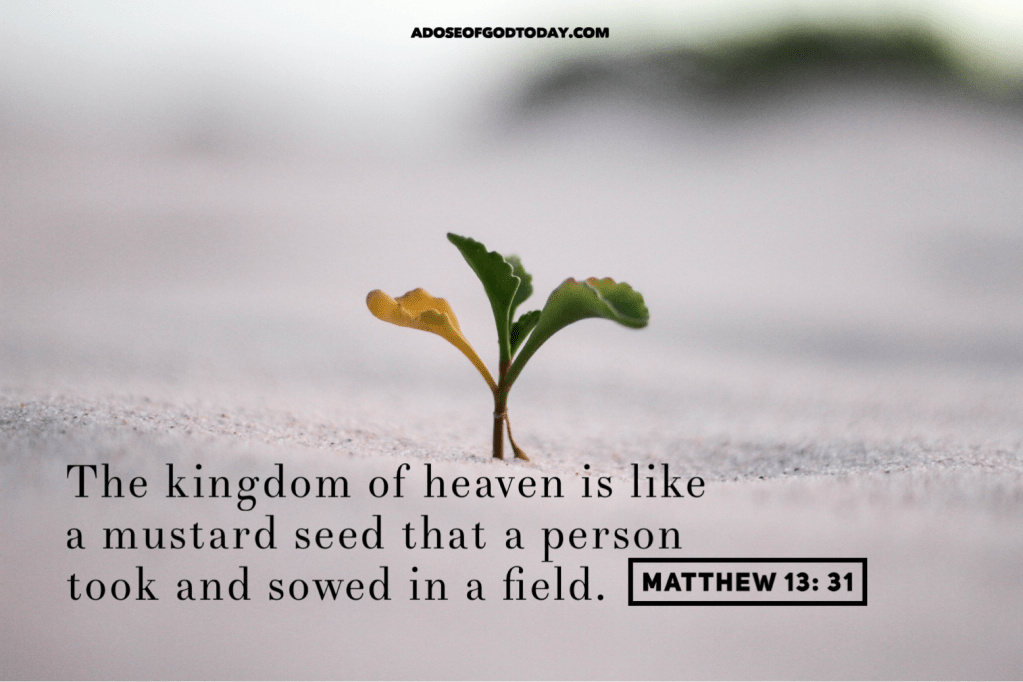
With this amazement and wonder of the process of growing, this brings me into reflection for this Sunday’s Gospel. Jesus tells the people about the three parables of the Kingdom of Heaven. These are the parable of weeds among the wheat, the mustard seed and of the yeast.
In all these three parables, what is common among them is the theme of growing. From here, I would like to invite you that we dwell deeper into these three parables and recognize how God invites us today and how God is growing in us.
I would like to begin with the parables of the mustard seed and of the yeast. Indeed, these are invitations of God for letting us grow, to be mature and to develop.
We understand GROWING or GROWTH to be dynamic. It involves changes, adaptations, shedding off of what was old and transforming into something new. Meaning, growing is a form of transformation.
Both parables, tell us of the process of growth in a non-aggressive way because growth is gradual, silent and calm. Moreover, it is empowering and life-giving.
This reminds us too of the wonder of creation. Creation is silent and relaxed, yet, destruction is noisy, distressful, aggressive and violent. In destruction, there is no growing because it suppresses and destroys. Surely, this is how we would find life distressful, filled with anxiety and worries, because when we do not grow or when we stop growing then, it leads us to destruction.
And this is not what God wants us. God’s desire is that we develop into our full potential as what has God desired us to be. Thus, we are called to continue growing no matter how our hair have turned into white or our wrinkles have become more visible.
Likewise, growing also leads us towards maturity. The first parable of the weeds among the wheat leads us into this invitation, MATURITY. Remember, the owner of the good seeds waited for the wheat to mature before weeding out the weeds, that were sowed by the enemy. To weed out the weeds when the wheat are still young, it will endanger the life of the young wheats. The owner has to wait when the wheat becomes mature and ready for harvesting.
This means that only when we have grown and become mature that we also gain wisdom to recognize what is bad and good, what is unhealthy and healthy, what is from the evil one and what is from God.
This tells us that the Kingdom of Heaven is already in us because God is with us. The seed has been planted on earth as Jesus was born for us. The Lord is already in our hearts as we are being baptized. Moreover, the Kingdom of Heaven is manifested in us when we also become mature in our faith and relationships with God and with others.
How do we recognize that we have become mature? It is by being able to recognize the works of God and the works of the evil one, the works of kindness and the works of selfishness and to choose freely God.
Now, these are the signs as well as the invitations for us to recognize the Kingdom of Heaven and to let God to grow in us.
First, as the mustard seed grows and the flour reacts with the yeast, the kingdom of Heaven also begins in HUMILITY not in any form of aggression or arrogance. It is humble and simple. Thus, the kingdom of heaven can be very present in a family who makes the effort to pray together, in a couple who expresses their faithfulness despite their differences, in a person who shows true concern and generosity to another who is in need of help.
Advertisements
Second, the kingdom of heaven is empowering and life-giving. The kingdom of heaven is present when our community empowers the weak. A community that discriminates, judges, condemns and indifferent never empowers but it oppresses the weak. However, when our community empowers, then it also gives life. Let us also remember that to be able to give life is to give more chances and opportunities for growth. To give life is to give hope. Therefore, our community is truly a kingdom of heaven when we uphold and protect every life to survive and to mature.
As we recognize the Kingdom of Heaven in us today, let us also allow the Lord to grow in us, to bring changes and transformation in ourselves, in our attitudes and relationships and in the way we look at things in life. As we continually grow and become mature, we may also become individually, a person for others and also a community for others that gives life, that gives hope and allows chances and growth for the weak and the helpless. Hinaut pa.





 A DOSE OF GOD TODAY