Tag: Filipino

  • “Bless me, Father”

    “Bless me, Father”

    January 17, 2021 – Sunday, Feast of the Sto. Niño

    Click here for the readings (https://adoseofgodtoday.com/sunday-liturgy/)

    Once just right after mass, I saw a child sitting alone on the church floor worried & crying. So, I approached her & asked, “Oh, what happened? Why crying all alone.” Between sobs, she replied: “Father, I thought it was your hand that I reached to get your blessing, but it was the hand of another child. I was not able then to receive your “Amen” – your blessing”.

    Her response is not only cute but also touching, since she only aspired to get my hand for a blessing but instead, was deprived of it. So, I told her then, “Don’t worry, Inday. I am here now. You can have my hand for blessings”. After wiping her tears, she took my hands and happily pulled it to touch her forehead for blessings. And she was so happy to hold my hand to walk with me. And more so happy and proud, when I carried her up in my arms until her parents took her… (& perhaps at the envy of other children).

    In most of our churches in the Philippines, especially in Redemptorist Churches, it is unavoidable that children and young people would approach us, priests and ask our hand for a blessing after the mass. Different types of children, (big-small, active-weak, shy-gregarious) would gather around the priest with only one desire, that is to receive “Father’s blessings”, while asking: “Bless me, Father”. And I am sure they were not forced (or were not just forced) by their parents to do so, because for children, to be blessed or to be touched in their foreheads by the priest is a great, meaningful and wonderful experience and affirmation. One simple act or gesture of the priest can be a meaningful experience and can bring joy not only to the children but also to their parents, because they are affirmed and appreciated for their child.

    Even we ourselves, when we were kids, we really enjoy when somebody affirmed and gave us attention, especially by the priest. I could still remember and never forget of the joy I experienced when the priest gave me attention and affirmation. It was my first confession. I was so small and weak then when I fearfully approached a big Irish Redemptorist priest smiling, had me sit in his lap and piously listen to my first confession.  Because of that even in my childhood years, I am so happy and courageous to receive the blessing of the priest, see and talk to them because they know me and I know them, we are friends and they are human as I am. I feel like and I consider myself as I am KASALI, KABARKADA, KABERKS, KAPUSO, AT KAPAMILYA nila Father. One with Father and with the Church, part of the group, friends, family and church.

    Even now within our own family, we claim & have our own so-called “fave” priest in our parish church. So also that even now as a priest, I would really appreciate when I am blessed and prayed over by my brother priests, by elders and by my loved ones. And now during pandemic times, I do miss the children attending mass in the church (as much as they also miss being with us in the church).

    Like the little children, especially for Filipinos we also need attention, affirmation and blessing. Because for us, to receive blessing is not only a gesture of our respect and reverence but an expression of affirmation, attention, love, and support for all our endeavors in life so far, from somebody we love and respect. When our elders or leaders touch our foreheads to give us their blessings, it is an affirmation, a positive stroking for us that would mean, “I am OK. I am good and am doing fine in life. And above all, I am now blessed & also God’s blessing to others.” That is why… as priest, I really don’t mind and would love to bless or partake God’s blessing to people (both young and old).

    As much as we need God’s blessings & demand respect from others, Jesus invites us to love, respect & bless our children, for we are all God’s blessing – Blessed to bless. Like Children, God blessed us to be a blessing to all.

    In our gospel today, we hear that while his disciples are concerned with their own importance & proper decorum, Jesus instead insisted on them the importance of little children in God’s kingdom. For Jesus, children are also persons with rights and dignity. Children also enjoy personal relationship with Jesus and the Kingdom of God. They have the right and duty to God’s blessings, to grow in faith – to grow in their own personal relationship with God. It is also their calling to be a disciple – to come and follow Jesus Christ and express their response, by their love and respect, & being a blessing for God & others. That is why, Jesus asserts on us, “Let the children come to me, Don’t prevent them…for the Kingdom of God belongs to them.

    Today, the whole Philippine Church celebrates the feast of the Sto. Niño.  We particularly honor today the child Jesus, who became part of our humanity and history. Sto. Nino plays an important role in the history & growth of our Filipino Christian faith. When in 1521 the first Filipino baptized Christians received & accepted the Sto. Nino into their lives & let their children to come & be blessed by Jesus. It gave birth to and flourish our Filipino Catholic faith which we have still live out & practice until now, after 500 years. 

    As the first Christian gift we received, the image of Sto. Nino becomes the symbol of our Filipino Catholicism, the first sacrament (symbol & means) for us to come to know, love & follow Jesus Christ. Through the Sto. Nino, Filipinos are now blessed with Christian faith & we are now God’s blessing of Christian faith to the world. Through the Sto. Nino, we Filipinos are now indeed blessed to bless others – now Gifted to give faith to the world. So now, as we are blessed by the Sto. Nino, child Jesus, may we be continually blessed & be a blessing to our children & youth of today by taking care & responsibility for the growth of their faith & mission in life, so that they may also be God’s blessings to others & to the coming generation, & thus God’s blessing continues to work & thrive in us & through us in our day to day lives. So be it. Amen.

  • There is more in our Faith

    There is more in our Faith

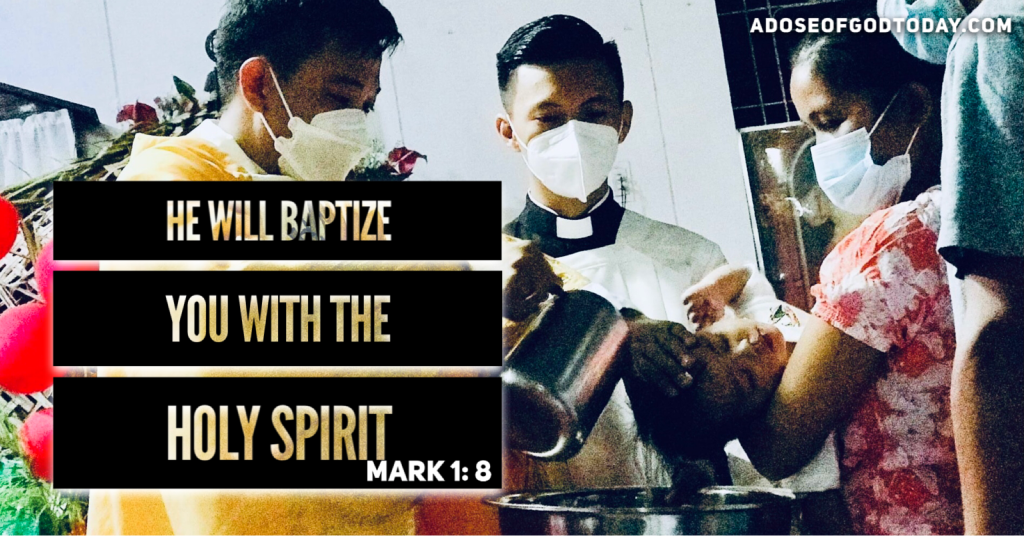
    January 10, 2021 – Feast of the Baptism of the Lord

    Click here for the readings (https://bible.usccb.org/bible/readings/011021.cfm)

    Are Filipinos more religious because of Covid-19? This is the title of the analysis of Jayeel Cornelio, PhD, a sociologist of religion.[1] This article was published in October 25 at rappler.com. The article discussed significant subjects particularly on the survey done by Pulse Asia last September 2020.

    The survey revealed that 51.8% of Filipinos have become more religious during this pandemic. According to Dr. Cornelio, this is not surprising because of two reasons.

    First, we are known to be one of the most religious societies in the world. And according to Pew Research Center, 96% percent of Filipinos find it “necessary to believe in God in order to be moral and have good values.”

    Second, Dr. Cornelio said, “faith is our immediate resource in times of crisis.” Citing another survey by the Veritas Truth Survey, it revealed that 89% percent of the responders of the survey said that faith is “very important” in the fight against Covid-19.

    From here, the sociologist also concluded that because of the “vulnerable social and economic context,” that is, being a third world country, the pandemic promotes a higher religiosity in us. In his words he said, people in poor social conditions such as having “inadequate health care, high incidence of conflict, and unreliable state agencies”  – people feel that they can turn to nothing else but faith in God.

    Indeed, it is when we become vulnerable and poor that we become more conscious of God’s presence. When we become more aware that we have actually nothing and are nothing in this world, that we also begin to realize of that great presence of God.

    A very comfortable life, a rich and powerful lifestyle can easily bring us into the attitude of indifference. It is indifference that prevents us to recognize that God is with us and continues to be present in the world.

    Moreover, at the end of his article, Dr. Cornelio also wrote that “there is so much more to COVID-19 than simply challenging the core of people’s religious convictions. In the end, it’s not just that Filipinos have become more religious because of this crisis. They are also beginning to seek something ‘more’ from their faith.”

    This sociological analysis brings me now to our very identity as baptized Christians. More than this survey of our religiosity, there is also a need to examine ourselves whether we have grown really in our faith, in our relationship with God and with one another. Our faith is not just about kneeling and standing, holding a rosary and saying our novenas. As Dr. Cornelio said, there is something “more” that we begin to seek from our faith. This “more” is something that I invite you now to pay attention as we celebrate this Sunday the Feast of the Baptism of our Lord Jesus.

    To be able to discern this “more” from our faith, allow me to journey with you through the readings and to see how God reveals His invitations for us today.

    In the first reading, Prophet Isaiah proclaimed the presence of the Servant of the Lord. The servant’s identity were described in three points. First, the Lord said,  “he is my chosen one with whom I am pleased.” This servant is loved very much by the Lord God, thus, God’s presence rests upon him. Second, the servant is to bring justice through compassion and gentleness of his presence and not through violence and force. Isaiah described and said, “a bruised reed he shall not break, a smoldering wick he shall not quench.” This servant is hope for those who are hopeless and are suffering. Third, the servant is to open the eyes of the blind and free prisoners and those who live in darkness. The servant who brings hope also brings peace, freedom and new life.

    The Psalm also stated this, “The Lord will bless his people with peace.” Peace here is living in the presence of God who is present in all creation. And the recognition of God’s presence in everything and in everyone brings us to show respect and love.

    This very promise of God is fulfilled and revealed in the Acts of the Apostles and in today’s Gospel. In the Acts of the Apostles, Peter proclaimed that this servant whom God chose is Jesus of Nazareth. He is anointed with the Holy Spirit and power. This is shown in the ministry of Jesus “in doing good” and in “healing the oppressed by the devil.”

    This is what we also find in the Gospel of Mark. The baptism of Jesus was a revelation to us that Jesus is the servant spoken by Isaiah. The scenarios in the Gospel are also very important told to us in three actions.

    First is the “immersion of Jesus in the water” was an expression of complete confidence in the Father. The Psalm proclaimed to us that “the voice of the Lord is over the waters, the Lord, over the vast waters.”  Here, Jesus allowed the power of His Father to embrace him.

    The second action is the “Spirit descending like a dove.” This is the very presence of God allowing our eyes to behold where it rests. The Spirit of God is in Jesus, the Lord who is among us. This tells us of the presence of God not just above us, but here among us.

    The third action is the voice heard coming from heaven saying, “You are my beloved Son, with you I am well pleased.” This has been proclaimed also by Isaiah.

    Indeed, this feast of the Baptism of the Lord tells us something important about our own baptism which we share in Jesus. This is where we also find the “more” in our faith. The “more” in our faith asks us not to be passive-believers but to be active-believers. The “more” in our faith tells us now of four points. These are invitations that you can bring with you today.

    • First, we are all loved. Never forget that.
    • Second, God’s presence is among us. We do not have to look above and seek God’s presence in the clouds. Look around also. God’s Spirit rests here among us.
    • Third, our baptism compels us to bring justice and peace. Isaiah reminds  us that this will be realized not through violence and force but through compassion and gentleness of our presence.
    • Fourth, to bring justice and peace is to also participate in the ministry of Jesus. This ministry is to open the eyes including our eyes blinded by greed, anger and indifference. And to free our hearts imprisoned by hatred, sin and guilt.

    Thus, the “more” in our faith is to make Jesus more present in our actions and words, and more present in our hearts, homes and communities. Hinaut pa.


    [1] See his article in https://www.rappler.com/voices/thought-leaders/analysis-are-filipinos-more-religious-because-covid-19

  • Together We Have and We Can.

    Together We Have and We Can.

    Advertisements

    September 6, 2020 – 23rd Sunday in Ordinary Time

    Click here for the readings (https://bible.usccb.org/bible/readings/090620.cfm)

    Homily

    How come Filipinos manage and remain to be resilient and strong in times of crisis and disasters? How come, Filipinos can easily bounce back and rebuild their lives despite worst life-conditions and terrible events in life? 

    During typhoon Ondoy back September 2009, I happened to be in Belgium finishing my master’s degrees and licentiate in Theology. The above-questions were raised by my professors, colleagues and classmates which even I myself cannot help but also wonder. In response to their questions, I narrated to them a testimony of Ondoy-survivor which was published in Philippine Daily Inquirer newspaper few days after the incident.

    During the typhoon, residents of an apartment seek refuge on the rooftop of their building. As they settle-in, while waiting for rescue and/or for the flood to subside, they started to pray the rosary together even if without their beads but by just using their fingers to count. After rosary, they pulled-out whatever provisions they were able to recover, and shared it with one another. As they had their fill, they began to share their stories – their experiences and backgrounds, hopes and dreams, fears and frustrations, as well as jokes and life-dramas.

    In others words, as answer to these questions, it is because we, Filipinos do and share things together especially during times of life-crisis and difficulties. We are not perfect people. We do have our own shortcomings and limitations. Nevertheless, we do have a common life. We usually live life together as family and community. And particularly, we usually pray, eat and share our stories together in good times and bad times.

    Somehow our Filipino togetherness, our common life as Filipino reflects the values Jesus upholds in our gospel today. For Jesus, Christian life must be lived and witnessed in the spirit of the following morals.

    First, together we pray. Christian life should have and share a common recognition and faith in God. Jesus said, “where two or three are gathered in my name, there am I in their midst.” God’s presence, love and mercy are assured and promised whenever we pray together in His name. Second, together we eat. Christian life should also have and share a common concerns and regards for others. Ours and the salvation of others is our responsibility. Not the judge or the savior, but we are all our brother’s keeper. They are in our watch and it is our responsibility to correct them when they are at fault, feed them when hungry, and take care of them when they need help. And lastly, together we share our life-stories. As Christians, we must also have and share common meanings, ideals and morals in life. Jesus said, “what we declare bound or loosed on earth shall be held bound or loosed in heaven”. Our life as community is the bearer of God’s salvation. God’s grace of redemption reveals itself and happens in and through our community, i.e. in partnership with our life together as community. What we value and give importance in life is sacred before God’s eyes. We also accept what God deems important to our lives which is Love.

    While we do have our shortcomings and still struggling, we cannot deny as Filipino we do possess these values and qualities as people. As reflected in our aspired values of maka-Dios, makatao at maka-Pilipino, we do have the basic orientation towards others (Dios, tao at Pilipino) as well as of doing, sharing and living life together in common. Thus, together we have and we can overcome life-worse crises.

    It was once said that we, human being as like angels, but angels with only one wing. For us to fly and rise, we need one another, we need each other. Together we do our part so that in partnership with God, we can be with Him always.

    Pandemic times has indeed rendered us physically & socially distance from one another and has deeply challenged our common life,  but it would not hinder us Filipinos together to share our Faith by our prayers, our Charity by our food-agape, & our values & meanings by our stories with one another, and with others. As the world struggles with the challenges of pandemic times, we take note of numbers of Filipinos on the frontlines, both here & abroad who raised to the occasion, been responsible and tirelessly sharing to the world all time, talents, and experiences of our common Filipino resiliency and strength by the witness of our faith, charity & stories especially during times of worse life-crises. May our life and faith as Filipino Catholic Christian people & communities be a constant gift and witness now and always to the world especially at this pandemic times. Amen

    By  Fr. Aphelie Mario Masangcay, CSsR (a former Filipino Redemptorist Missionary for Filipino Migrants in South Korea who, due to immune compromised diabetic condition, stationed back home  in the Philippines for now).

    Follow Me

    Get new content delivered directly to your inbox.