In every group or organization there is always this desire that in order to express their identity, there should also be uniformity in language, ways of doing or even appearance. And so we create initiations when there are new members and introduce to them those ways and things so that they become like us, identifiable and one with the group or organization.
This is also true in many cultures, as we belong to a particular culture it is almost expected that we follow what is proper to that particular culture. Anyone who does not follow or adhere to the cultural beliefs, ways, costumes and customs are considered an outsider or foreigner. And so people who want to be identified to a seemingly more superior and cool culture, we try copy and mimic their ways so that we can say, “we belong.”
Though there is nothing wrong with this, however, such desire to make everybody else to look like us or to impose on others our ways of doing before they will be welcomed can also be problematic.
This is what St. Paul in his Letter to the Galatians told us about. At that time, there were some Christian Jews who demanded that those Gentiles who accepted the Gospel of Christ must also follow the religious and cultural practices of the Jewish people. This demand became a tension in those times of the first Christians. For them, one is being justified by the law of Moses.
Nevertheless, Paul, a Jew and a Pharisee himself, reminded the Christian Jews that one is justified not by law but by faith. Thus, Paul said, “For in Christ Jesus, neither circumcision nor uncircumcision counts for anything, but only faith working through love.”
There is no need for that kind of uniformity before the non-Jews will be accepted and welcomed. It is Christ Jesus and faith in him that we are justified and welcomed. Moreover, this faith is expressed in love not in indifference or in our superiority and righteousness over others. Therefore, our Christian faith is not kind of affiliation like in organizations or associations that we create. Our Christian faith is rather a relationship expressed in and through love!
This is what Jesus also emphasized in today’s Gospel as he encountered a Pharisee who was rigid and meticulous over man-made religious practices. Jesus directing at the heart of the matter, rebuked the Pharisee with all frankness, “Although you cleanse the outside of the cup and the dish, inside you are filled with plunder and evil!”
The rigidity and meticulous observance of the law was only a cover-up, a façade of a plunderous and evil heart. But Jesus sees that heart and his words pierces through the heart.
Hence, what Jesus asks of us is not uniformity but consistency in our words and actions, not mere observance of the law but charity and integrity, not in merely being obliged but by being in love. We ask the Lord today that indeed, our faith will work through love. Hinaut pa.
A wise man once said, “Each one of us are angels… But, with one wing. We can only fly by embracing each other.” Reflecting on these words, such wisdom somehow reflects our daily experience and journey of being human and Christian in this life. Human as we are, these words of wisdom affirm our being HOLY – our promise and desire to be holy and sacred in life, as somewhat angel-like. But Holy may we be, these words also reveal our being HUMAN – our limitations and constraints to become holy in life, as one-winged angel.
“Angels with one wing” somehow describes our aspirations and our frustrations of being and becoming Human and Holy in this life, and highlights our experience of loneliness – of being alone in life, and our need for one another as well. However, as these words of wisdom suggest we can only fulfill our longing for sacredness in our human nature, by way of flying via embracing each other.
This calls for us then not to be weighed down by our human limits, but to fly – that is to resolve and commit ourselves to rise up and respond to the occasion and chance to become angels in life. And also this calls us to do the flying together in relationship along and with one another. In other words, we are inter-related. (Magkaugnay). Only by flying-journeying with others – not by walking alone, each and all of us can reach the destination we are promised and we longed for in life, as “angels with one wing.”
Surely our readings today can teach us a lot of things about our life-experiences of being Holy & Human. But aside from the themes of creation, marriage, divorce, adultery, parents and children, our readings today are all about our human need to have a committed relationship in life, i.e. to be in covenant relationship with God and with One another.
We are told in our first reading today that as God created us, He also sees our human need to have a partner in life for “It is not good for man to be alone” and even animals and pets are not enough for us. He ensures a suitable human partner for us in life, so that we can leave our parents and be with our God-given partner in life.
God thus has created us not to be alone and/or be with our parents, but to be with our own God-Given suitable partners, for us to live the life God has created us to be. Jesus in our gospel today reminds us not to block and be a hindrance in letting ourselves and others to come to God and live the life God has called us to be, and challenge us to remain faithful and steadfast in our relationship with one another as we live our life-mission God has called us to be as well.
Both readings give importance to our human need to have and be in a committed relationship as God sees & wills it. More than just having a friendly, convenient, and secure relationship in life, God appreciates that we, human as we are, should be committed to the life God has chosen us to be, and to live such-committed life in relationship with our own suitable partner God has destined us to be with.
In other words, though with one wing, we should be angels – flying, coming to God’s glory, rising up and committing to the occasion to live the life God has called us to be, and by means of interdependence, embracingly flying/journeying in relationship with our God-given suitable partners in life.
Perhaps beyond our concerns for our civil status or even FB Profile status, whether we are Single-Married, in relationship, in love or complicated, we should moreso ask ourselves, “Am I committed to the life God has called me now to be? Am I also in a covenant-relationship with my God-given suitable partner in the journey?” Simply asked, “Am I committed and committing to where I am going and with-whom I am going with toward the life God has chosen me and us to be?”
Nowadays we hear loud noises proclaiming “Walang Forever”, i.e. there is no promise of forever, eternity, constancy and always in life. True it may be for those who cannot commit, who refuse to rise to the occasion but be remain burdened by their limits and choose to be on their own and alone in their own life-struggles, still dependent on their own parents and others.
But “There is forever, always, and eternal life”… for commit-able people, people who can commit, still committed and committing to live the life God has chosen them to be and to the partner they are to be with. We could say also that committed relationships are measured by faithfulness & not by success, for our journey in life is not about gaining heights but moreso about remaining steadfast/faithful in our efforts to fly & journey along with others.
Though not of this world but in this world, Christian and human as we are, we are Holy and Sacred for we are also God’s children and Jesus’ brothers and sisters. And difficult it may be, we can always be holy and sacred in this life, if and whenever we commit to the life God has called us to be and to the suitable partner God has given us to be with.
Again as the saying goes: “Each one of us are angels… But, with one wing. We can only fly by embracing each other.” With these words, may we learn and grow with holiness despite our human limits, in our Christian lives today. Amen.
Before I begin my homily for this morning. I have a short exercise that I would like you to do first. This will hopefully keep you awake and make you more inspired as you start your day today.
So, I would like to invite those who are with their husband or wife, girlfriend or boyfriend to look at the eye of your beloved. Silently say, “I love you!” And for those who single and still waiting, you may close your eyes “na lang” and you may say loudly, “I love you self!” 😍
Being said that, may I present to you this question for reflection, “What does it mean then, to love and being loved?” I am sure you have your own answers to this based on your human experiences of loving and being loved. Yet, for today may I offer you my humble reflections of loving and being loved based on the readings we have on this sixth day of the Mise de Aguinaldo. Let us also see how the Lord calls us to be truly loving and be more confident in being loved.
Our first reading from the Book of Song of Songs wonderfully described to us the relationship between a lover and the beloved. What we have heard from the reading is that it’s filled with excitement (or kilig-moments) because of the longing to see the person being loved.
Thus, the lover calls the beloved in these wonderful invitations. The lover said, “Arise my beloved, come!” The lover is described to be like a small deer who was so excited and in its excitement would peep to have a glimpse of the beloved. The lover also said, “my beloved, see, the winter is past, the rains are over and gone, the flowers appear on the earth.” This calls the beloved to recognize that sorrow and grief is over and to embrace life and freedom. Finally, the lover said, “Let me see you. Let me hear your voice.” This is an expression of intimacy that longs for the beloved.
With these, I therefore conclude, how beautiful and wonderful it is to be in love! – to be filled with love, to be loved and to love! Isn’t it? But, friends, know that I am not just talking about romantic love, thought that’s part of it. Why? Because the Song of Songs by using the images of romantic love, reveals to us now that God is our lover who is more than excited to see us and to be with us. We are God’s beloved. We are the one being loved. And this beautiful Book of Song of Songs invites us to arise from sadness and embrace life. Indeed, the presence of the one who loves us brings comfort as well us life.
In response to God our lover, our Psalm today expresses our hope and longing for God. The people waits for God’s coming whose presence is the strength of the people. In that anticipation, joy can be felt, thus, a calling to rejoice and sing praises to God. This is wonderfully captured in the last verse, “Our soul waits for the Lord who us our help and our shield; for in him our hearts rejoice.”
This has been fulfilled and concretely manifested in today’s Gospel. We find Mary, a person who is filled with so much love, because in her womb, is love. The Gospel story today was right after the annunciation of the angel that Mary shall conceive a son and when she realized that it was indeed true. At that moment, Mary carried in her womb God’s concrete manifestation of love. And the love that Mary carried in her womb completely transformed Mary, her presence, her actions and her words.
At this point, I will be enumerating how Mary responded in loving and in being loved. In each response of Mary, I will be giving questions that would hopefully challenge us to respond in love.
The first response of Mary is, “she set out in haste.” Mary realized the need and assistance of her old cousin Elizabeth. This response of Mary tells us that she is a person who loves and arises for the sake of others. She is a person who loves and responds immediately to a particularly need. And she is a person who loves and moves out of the self. This is evident at how Mary travelled a long way from Nazareth to a town in the hill country of Judah. At that time, Mary possibly walked for about 130 kilometers to reach the house of Zechariah and Elizabeth.
In this first response of Mary, Pope Francis said in his message to the youth of the world, “Mary did not hold back or remain indifferent. She thought more of others that of herself.” And so in our way of loving, “Do we also move in haste in order to respond to the needs around us? Do we take the risk to go out of our own comfort and concerns for the sake of others? Or do we remain unmoved, more focused on ourselves and indifferent?”
The second response of Mary is, “she entered the house of Zechariah and greeted Elizabeth.” Mary cared to enter into the life of others, bringing love. This is how we realize that the very presence of Mary in that house, brought life? How? At the greetings of Mary, the infant in the womb of Elizabeth leaped. It was a joyful reaction of the infant. Indeed, even at hat early moment, the infant John already recognized the fullness of life and love present in the womb of Mary.
And so in our way of loving, “Do our words bring comfort and assurance of love? Or do our words rather, become forms of insults, harassment and bitterness towards others? Does our presence gives confidence and love to others or rather brings fear, trauma and pain?”
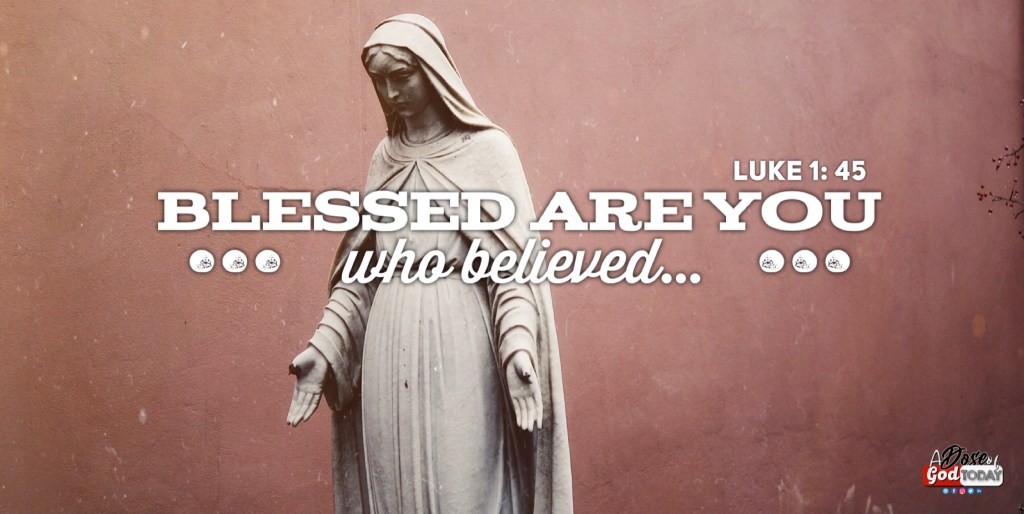
The third response of Mary is, “Mary believed!” As to the words of Elizabeth, she said, “Blessed are you who believed that what was spoken to you by the Lord would be fulfilled.” This tells us that Mary’s faith brings forth life, concern and intimacy, care and gentleness. These become natural for Mary because first and foremost, her faith is motivated and inspired by love. Mary is filled with love. She is confident that the Lord loves her. Indeed, she believed! – because love has been fulfilled in her and that love is slowly taking a human form in her womb.
And so in our way of loving, “Has our faith been inspired and motivated by our love, of being loving and being loved? Does our faith also bring life, concern, care and gentleness? Or rather motivated by fear, guilt, fanaticism or superstition?”
As we bring to mind all these points for reflections, we may all be filled with love and be assured of that love so that like Mary, we too shall dare to move, respond and care for others. As we are about to celebrate the birth of Jesus, the love-made-flesh, may our way of loving then, be life-giving and love-fulfilling. Ok lang? Sana all.
Today, on this first day of Misa de Aguinaldo, the Philippine Church also dedicates this day as the National Youth Day with its theme: “Mary Arose and Went with Haste.”
With this emphasis of the gift of the young, I would like to invite you now that we listen to personal faith story from one of our Youth Animators. He serves as an Altar Server in our Parish and a member of the Human Formation Committee of RYM-Iloilo. Let us welcome, Carl Joseph Cajaban.
As a server and youth member of this parish for the past 6 years, there are various values that I have learned from this church community. I actually started my journey of emptiness not really knowing the significant roles and importance of being a servant of the Lord.
I felt, that there was a time when the Lord Jesus made his way so that I get close to him. Even though I am not worthy to be a servant of our Lord, but gradually I developed my relationship with him through the people who have become significant in my faith-journey. Nanay Ledia is one of the devotees of this parish who has become significant for me as young Catholic. She is the one who initiated and encouraged me to serve Jesus Christ in my youth. She dedicated her time and presence to me to help me be enlightened and know God better.
She once said to me, “Tanan na bagay na madako, naga umpisa sa gamay na butang.” What she said seemed to be very short and simple yet for me, he words meant a lot and filled with meaning. Through her, I realized that there is a God who guides me in the way of sending his instruments to awaken my soul. This has kept committed in the ministries I am involved now in our parish.
However, due to some circumstances in my life, sometimes I feel that I am worthless, pity-worthy, and a useless person. Yet for these reasons as well, I joined this ministry to develop my self-confidence and to be a socially responsible person.
Honestly, this parish community helps me a lot, which is why I continue to serve and praise our God. Moreover, this is how I also realized my relationship with our mother Mary, from whom I have experienced her caring and precious heart. This shows me a mother’s concern who continually guided me to be closer to Jesus.
As I close this short reflection of mine, I would like to encourage other young people to join us in the ministry or in any Church ministry that will bring us closer to Jesus. May our act of service to the Lord and to the Church allow us to grow and become mature.
What we have heard from Carl’s faith story was the wonder of having people and even recognizing ordinary events in life that have directed us towards the Lord.
The experiences of Carl remind us of the readings we have heard today. The Book of Prophet Isaiah tells us of the presence of the foreigners. These foreigners have joined themselves to the Lord. They too have recognized the goodness of the Lord God. This tells us that the Hebrew people who have become their friends created a huge impact in their life because through them, they were led to the one True God.
Indeed, it was the joy that they have experienced from the believers of God that they too were assisted to know God. God even promised in the Book of Isaiah that through the presence of the many peoples, there will be joy in the house of prayer, in the community.
This is what we also find in the Gospel. Jesus recognized the person of John the Baptist, his cousin who became that person for others to know Jesus. John the Baptist led the people to recognize God in the person of Jesus by preparing their hearts and minds. This is how John had become a reflection of the True Light. John never assumed that he was the source of Light. John knew very well who the light was. That is why, through his preaching and way of life, he reflected the light that came from Jesus. John, indeed, is the burning and shining lamp for the people.
On this first day of Misa de Gallo, we are reminded too of the person of Mary who through her, God entered in our human history physically. Through her, Jesus was born for us. Mary too is the shining lamp that leads us to Jesus. This is the reason why we have this 9-day Misa de Gallo in honor of Mary because she leads us to Jesus. She brings us closer to Jesus just as how Mary arose and went with haste to visit and help her old cousin Elizabeth.
With that, today our liturgy is also centered on the theme, “Mary arose and went with haste.” This was after the annunciation of the angel to Mary. Even when Mary knew already that she was pregnant, that did not limit her to only look after herself. Mary saw the need of an old cousin and so she arose from her comfort and went with haste without any doubt or hesitation. What Mary brought was only love and commitment to share the fullness of heart to others.
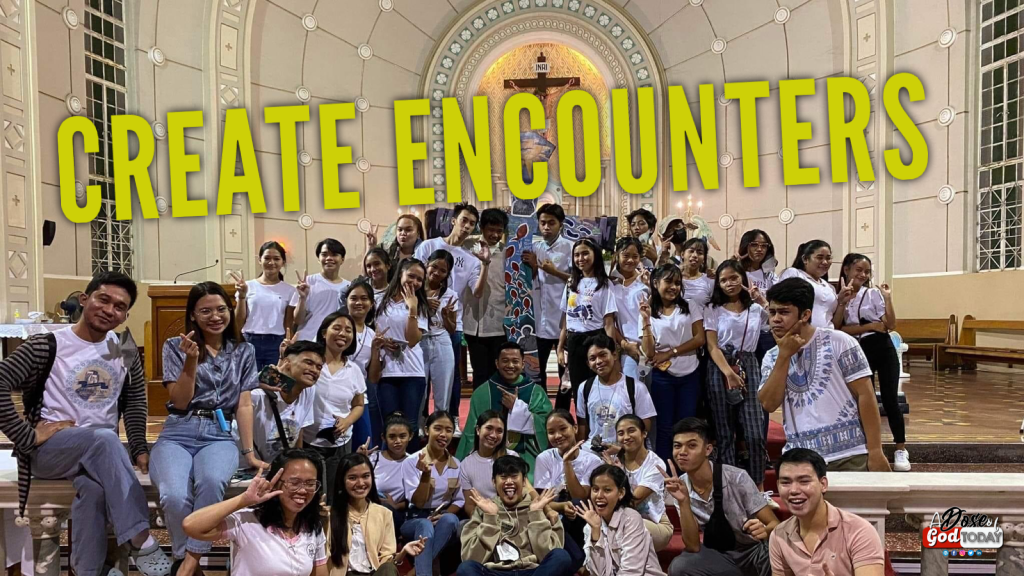
What Mary showed is a movement of encounter. And in every encounter we share life and stories of encounters with God and on how God manifests the divine presence in us and among us. This must be the event as well as Mary dared to encounter her cousin and her husband.
In a way, the faith-sharing of Carl and his story tell us of his encounters with people who have become significant in his faith-journey. Those foreigners in the Book of Isaiah also were able to encounter and know God through their encounter with the Hebrews. The Jewish people who came to believe Jesus, had their first encounter with John the Baptist that also paved the way for them to encounter Jesus ultimately. Such movement of encounter now became the very opportunity for more encounters between a person and Jesus.
This is the invitation for us today particularly to all young people. Considering the way of life of the many young people today, the internet has become a space for encounter, though virtual. In fact, our country Philippines has been branded as the Social Media Capital of the World. As of January 2022, there are about 76.01 millions of Filipinos who social media users.[1] The most active among us are those ages between 25 to 34 years old. Unsurprisingly, the Senior Citizens or those 65 years old and above are part of the 6.5 million social media users. That means, the seniors are not that far behind us!
Again, according to the survey, out of the total population of our country, 82.4% have social media accounts or equivalent to 92.5 million. Majority of us, spend as much as 4 hours and 6 minutes on Facebook daily. But, there is a total of 10 hours and 27 minutes of time being spent by the 76.01 millions of Filipinos on the internet.
I am sure that in this mass, there are also many of you scanning right now, at this very moment, your social media sites through your mobile phones. That only tells us that our mobile/smartphones have become part of our identity, of who we are. Our smartphone, regardless of our socio-economic status, is an extension of ourselves and our connection to the world.[2]
Yet, let us not allow that these will be the cause of indifference among us. Let us not allow that these gadgets will prevent us to become more human and more loving. Do not allow the use of Social Media to make us bitter, pretentious, and source of disinformation and fake news in order to deceive many. Rather, let us maximize the gift of technology by bringing people closer to Jesus through the very gadget in our hands and through the media that we are very familiar with. Indeed, the Lord invites us today, especially the young to be “Gospel Influencers” (to influence through the Gospel) in our own group of friends on Facebook or Instagram or TikTok.
Create encounters with your friends and followers by sharing your God experiences in your social media sites. This include also sharing on how God shows his goodness and generosity to you and your family. Preach to others how God changed your life. Share with others how you have experienced love and forgiveness. Share with your friends the Word of God that has struck you. Share the good news rather than your hatred and bitterness towards others, rather than fake news and misinformation.
Thus, even as young persons, we can be an instrument of hope and love, of transformation and peace by bringing people closer to Jesus. Let us flood the Social Media with love and hope by actively preaching our Christian faith.
But friends, may I also remind you, as we maximize the gift of technology, never forget also the gift of your presence in making physical and personal encounters with people around you, with your family and friends. With that, be a Gospel Influencer by being physically present to people around you just as Mary, our Mother, arose and went with haste to encounter her cousin and to bring the presence of the Lord through her very person.
Lastly, I would like to invite all of you who have your phones right now, after this mass, please take a selfie or grofie with your friends in our Church and share to others the good news that you have received and please use these hashtags, #NYDPh2022 #MaryAroseAndWentWithHaste #FilipinoYouth #StClements #RYMIloilo. Ok lang? Sana all.
There are three kinds of people in today’s parable of Jesus. In each, the Lord calls us to identify ourselves and draws us to be converted to him if we would find ourselves with those who were far from the Lord and did not respond to God’s invitations.
The first are those who rejected the king. These people despised the nobleman that they even sent a delegation to declare their rejection of the king. However, these were same people who wanted to claim the throne. They wanted to rule, gain control and power for themselves. Yet, at the end, when the king finally returned they were slayed and died.
This tells us that our total rejection of God’s friendship and salvation and of our desire to become like “god” means death to us. It is only in embracing the Lord who has come to be with us that we also find the fullness of life and not in being separated from God and from others.
The second are the servants who responded well to the king. They listened and did what the king commanded them. As a result, they became fruitful and were rewarded generously by the king. These servants proved that even in small matters they can be trusted.
This is a response that comes from faith and of the awareness of God’s generosity in us. Each of us is gifted and a steward of God’s gifts. Our faith as well as our person must also grow and become mature that we may become fruitful and productive. This will be evident in our relationships and in our way of life as Christians who invest in kindness and goodness, in concern and love, in understanding and community building.
The third were those who retreated in fear but indifferent. They were represented by the servant who did nothing after receiving the gold coin. He rather retreated in fear and hid. Indeed, the servant showed no response, unmotivated, unenthusiastic and unchallenged. His reason was fear of losing yet he also remained unproductive and un-creative.
Fear is therefore not the right attitude towards God and faith. The spirit of God gives us the confidence and strength yet when fear paralyzes us to become the person God wants us to be, then, this is not from God. The Lord continually calls us to overcome that fear and embrace rather the confidence and strength that God gives us.
We now ask ourselves, how do I respond to God? What do I make of my faith? How do I relate with people? What do I do with the talents, potentials and responsibilities I have?
As we are led today to see and recognize our failures, we may also come closer to the Lord who calls us to be productive, to become mature and to become more welcoming of his many invitations for us. Kabay pa.










 A DOSE OF GOD TODAY