Category: Year 2

  • In our Capacity to receive and embrace

    In our Capacity to receive and embrace

    Advertisements

    September 28, 2020 – Monday of the 26th Week in Ordinary Time (Feast of San Lorenzo Ruiz)

    Click here for the readings (https://bible.usccb.org/bible/readings/092820.cfm)

    Homily

    Look at how the disciples behaved themselves. This passage of the Gospel of Luke tells us how the disciples argued among themselves on who was the greatest among them. They must have been boasting one another about their closeness with Jesus, their great qualities, their faithfulness, on who was the first to be called and who was the favored one among them. Their argument must have been fierce because it reached the ears of Jesus. Jesus heard not just their words but even realized the intention of their hearts.

    At this point, the disciples thought that Jesus’ kingdom will be like those of kings sitting on a golden throne in the palace with a great army, a political king. They believed that Jesus will inherit political power and vast riches and material wealth. Thus, obtaining a position and having a closer relationship with Jesus will give them the security and assurance of a higher and influential position when Jesus reigns.

    Consequently, the argument of the disciples was based on how they could benefit from their friendship with the Lord. As Jesus heard them, he too realized that this was in the heart of the disciples. Jesus had to teach them and to mold their hearts according to God’s desire.

    That’s why Jesus taught the disciples an important lesson through a child. Jesus took and placed the child by his side and said, “Whoever receives this child in my name receives me, and whoever receives me receives the one who sent me. For the one who is least among all of you is the one who is the greatest.”

    Children, at the time of Jesus were considered not important because they were dependent, they have no rights and thus cannot be called as fully man at all. Jesus teaches that in the Kingdom of God, greatness is measured in the capacity to receive God. To receive God is best expressed in welcoming, in embracing and in receiving the least in our community.
    We are called to receive God in the person of those who are the least in our church and society. We are called to aspire to be great but neither in the way that we will be above others, nor to seek a higher position at the expense of others, but in the way of embracing others.

    This capacity to embrace others and embrace God fully was what San Lorenzo Ruiz showed to us. In offering his life, even to the point of death, San Lorenzo was always confident that Jesus was with him. He said, “If I have thousands of lives, all of them, I will offer to God.” This shows us that San Lorenzo had found himself, the kingdom.

    Thus, we shall surely see that when we make ourselves open to receive others, we too shall receive Jesus and Jesus will live in us. This is the reward, Jesus himself. The kingdom of God will be present in us because when we have Jesus, we will be at peace, secured and loved even if we are in the midst of trials and turmoil in life. Hinaut pa.

    Jom Baring, CSsR

  • Take nothing for the journey. Seriously?

    Take nothing for the journey. Seriously?

    Advertisements

    September 23, 2020 – Wednesday of the 25th Week in Ordinary Time

    Click here for the readings (https://bible.usccb.org/bible/readings/092320.cfm)

    Homily

    You are going on a journey and it will take you several days. What would you do? Naturally, you will prepare Your personal effects, clothes and some other things that you think will be useful for your journey. One may carry a book oR two and some nitty-gritty stuff that “might be needed” in some surprising situation.

    However, once you are already in the journey, then, you will realize that there are many non-essential things that you brought with you. This has been my experience too. One time, as I prepared myself for a trip, going to a mission area, I brought “things that I thought were important and essentials.” As I packed my things, I kept putting stuff that “might be needed.” As a result, I had a big and heavy bag to carry for the journey.

    Later on, when I was already in the area, I realized that I have brought many non-essential things which only made my bag heavy and full. I realized too that what I did must have come from my anxiety of “what if.” What if this happens, then, I need to bring extra shoes, some extra shirts, extra food supplies etc. There is some kind of anxiety of the future. I wanted to be prepared always, always ready to respond in some surprising or emergency situations. There is nothing wrong with this. However, the problem lies in the heart that is constantly anxious of what lies ahead and so has become “heavy and full.”

    When our heart is heavy and full, then, the heart becomes grumpy and uneasy, unwelcoming and inflexible. This makes us calculating to the point that we do not want surprises anymore. We only want certainty. Nevertheless, in life, there are many things that we find ourselves uncertain. We might get lost at times and meet strangers. The anxiety to be always certain may prevent us from being surprised and enjoying the wonders that surprises may bring.

    This is something that Jesus wanted to avoid for his disciples. Jesus gave them instruction that as they begin their journey, they were to “take nothing.” Seriously? Well, that’s what Jesus said. So, what was the wisdom behind this?

    Jesus knew that the material things that the disciples will carry will only burden them in their journey. Attachment in those things will make their heart restless. Jesus did not want these men to become anxious of their journey, of what lies ahead. Jesus actually invited his disciples to fully trust in the providence of God, and to be surprised with the graces of God.

    When the heart has more room and lighter because it has no attachments to material possessions or emotional issues, then, the heart becomes more welcoming of others, of surprising events and of ordinary graces. Our heart will be more flexible and understanding of others too.

    Thus, the invitation of Jesus is not about the direction in life but about our attitude in the journey, of not being attached to non-essentials in life. Like the disciples, we  are invited to “travel light” by not taking with us those things in life that might only burden us and make our heart full. Our desire to be always certain and ready, our past issues and pains, our bad habits and hurtful attitudes are some of those “stuff” that must be left behind. Do not carry them with us.

    Jesus invites us today to trust God’s providence and to be surprised by His graces prepared along the way as we meet people and embrace events in our life. In this way, we become more welcoming of God’s presence and accepting of God’s graces.

    …we become more welcoming of God’s presence and accepting of God’s graces…

    As a response, like the disciples too, may our words, our actions, and our very presence become channels of God’s blessings, of peace, and of God’s gift of healing to those who are ill and those who are broken. Hinaut pa.

    Jom Baring, CSsR

  • Working with Jesus

    Working with Jesus

    Advertisements

    September 18, 2020 – Friday of the 24th Week in Ordinary Time

    Click here for the readings (https://bible.usccb.org/bible/readings/091820.cfm)

    Homily

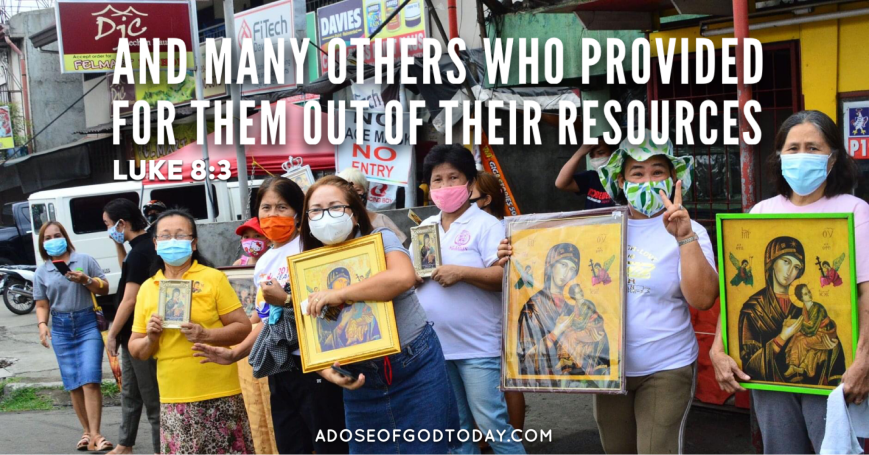
    In today’s Gospel, we are reminded that in the ministry of Jesus, the 12 men disciples were not the only ones who were part of the mission. There were “many others” who were with the Lord and played important roles. They were the women who were always with Jesus who like the 12 disciples, were also disciples themselves.

    The Gospels did not mention that they too preached, but they played significant contribution in the ministry of Jesus, in his travels and in his preaching and healing. These generous women supported Jesus through the use of their resources.

    Why follow Jesus? Why support him in his ministry? Each of them had their own stories with Jesus, stories of conversion and renewal, stories from brokenness to healing, from death to life. Each of them must have this real encounter with the person of Jesus. That encounter must have brought a total change in their life and in the way they were responding to life.

    The Gospel of Luke itself tells us that some of them were cured from spiritual and/or physical illness. The experience of healing made them recognize God in Jesus. That experience too moved them to follow the Lord to know him more and to become more like him.

    Surely, there are lessons that we can learn from the women who worked with Jesus in his ministry.[1] And they are…

    1. Responding in gratitude. The women responded with gratitude to Jesus because of the life-changing grace they experienced through him. God surely worked miracles in our life too. Recognize those graces of events and experiences when God made manifest in your life and respond in gratitude to the Lord.

    2. Using one’s talents, capacities and resources to continue the work of Jesus. As the women responded in gratitude, they used their own talents and capacities and including their material resources to support Jesus in his ministry. Never shy and never hesitate also to share what you have to the Lord. Share generously to the Church and to the communities where the work of Jesus is being continued. You yourself also can do that by volunteering or making yourself available in the Church’s many apostolate especially in this time of pandemic. Use your expertise where you are good at and offer them to the Lord.

    3. Making the opportunity of giving by being close to Jesus. The women grabbed that opportunity of giving themselves and their resources so that they will be able to stay close to Jesus. Like the men, they walked with Jesus on the road, they gathered around him while eating, they listened with the people. With this, they learned and knew more about Jesus, about his person, his teaching and his ways. Day by day, they became like Jesus. Make every opportunity in serving the Lord to be your way of being close with Jesus too. The sacraments, the Holy Scriptures and your personal prayers are ways to learn more about Jesus and to become more like him.

    4. Staying with Jesus till the end. The women were the faithful companions and friends of Jesus. When Jesus was arrested, carried his cross, died, and buried in the tomb, these women were always with Jesus. While the men disciples were in hiding, the women attended the dead Jesus. In pain and sorrow, they were with the Lord. Thus, they too were the first ones to witness the glory of the resurrection of Jesus. Hence, as we learn to become like Jesus, stay close with him too. Stay close with those who are in sorrow and in pain in many aspects of their life. By doing that, we also become the presence of Jesus in the lives of others who will bring assurance and confidence through our friendship.

    Hinaut pa.

    Jom Baring, CSsR


    [1] Inspiration from https://www.ncfgiving.com/stories/4-lessons-from-the-women-who-followed-jesus-from-galilee/

  • Power of Asking Forgiveness

    Power of Asking Forgiveness

    Advertisements

    September 17, 2020 – Thursday of the 24th Week in Ordinary Time

    Click here for the readings (https://bible.usccb.org/bible/readings/091720.cfm)

    Homily

    Why do we come for confession? Why do we seek forgiveness of our sins?

    Many of us today have doubts or have taken for granted the Sacrament of Reconciliation thinking that it does not need for one to confess his or her sins to a priest. Our basic catechism teaches us that the ordained priests are given authority to forgive sins in behalf of the whole church and as God’s representative to his people. It is not the priest that forgives but God. The church listens to the confession of a penitent through the person of the priest. The priest does not give judgement and condemnation but delivers the mercy of God to those who seek for it.

    Indeed, there is wisdom and power behind recognizing one’s imperfections and sins. The recognition of sins is not just be limited within personal realization keep within the self. It only becomes a true realization when sins are confessed to somebody, letting another person know about our sins. The priest in this case represents the church for the person who realizes his or her sins.

    Once we recognize our sinfulness then it is also God’s opportunity to change our lives and to make us new again. “Recognition and confession of sins” is our humble way of acknowledging that we need mercy and forgiveness, thus, we need God.

    The opposite of this is the denial of ones sins and imperfections. Thus, denial of our need of God and denial of our need of mercy and forgiveness. This happens to us when we have grown righteous. When we begin to think that we have committed no sins, then, we think of ourselves highly to the point of making ourselves above others whom we think as lesser than us.

    This is the story that we have heard in today’s Gospel. The woman who knelt before Jesus represented those who recognized their need of forgiveness. On the other hand, the Pharisee who invited Jesus represented those who do not need forgiveness because they believe that they do not need God.

    Let us see these two personalities to clearly discern God’s invitation for us today.

    The woman who was known to be a public sinner was despised by that Pharisee. He would not even dare talking to her because of fear of being contaminated by her sins. That is why, he felt disgusted with Jesus who allowed this woman to wash his feet with her tears and wipe them with her hair. The woman’s actions were her humble way of recognizing that she was in need of God’s mercy. Despite her sins and the shame that she was bearing, she took the risk to go in public to ask Jesus forgiveness.

    And because the Pharisee thought of himself so highly, never thought that he too was in need of mercy. This attitude of the Pharisee made him condemning of the woman. He was indifferent towards her and saw no hope in her. This will also happen to us when we become righteous and think that we do not need mercy from God. We become persons who easily condemn others. We become persons who do not see hope with those who have failed in their life. We become angry persons and bitter towards others.

    However, Jesus invites us to learn from her. She who recognized her sinfulness, allowed Jesus to transform her life. Her actions towards Jesus was her expression of her affection and at the same time of her need of forgiveness, Jesus who is the face of the Father’s mercy, willingly granted her forgiveness.

    When we become persons who recognize our failures and sins, we become persons who also see hope and life. We become persons who become positive with life and at the same time positive with others. We become happy persons.

    This is what Jesus wants us because recognition and forgiveness of sins allows us to unburden ourselves from guilt. This will also allow God to work in us.

    Thus, do not be afraid of acknowledging ones failures because God always sees hope in us, God does not condemn but grants his mercy and forgiveness to us so that we shall live in peace, freedom and joy. Hinaut pa.

    Jom Baring, CSsR

  • How blessed am I?

    How blessed am I?

    Advertisements

    September 9, 2020 – Wednesday of the 23rd Week in Ordinary Time

    Click here for the readings (https://bible.usccb.org/bible/readings/090920.cfm)

    Homily

    How do we understand being blessed?

    Usually, when we think of a life that is blessed we think of material wealth and prosperity – like having a good family, a prosperous business, a successful career or a good paying job, or having a good health. We think that being blessed has something to do with success and material possessions.

    Thus, poverty is never a blessing; being persecuted, being sick and being rejected is never a blessing too. If we are experiencing such life, we consider ourselves to be cursed.

    However, what Jesus told us today is quite opposite of today’s standard. Our human understanding of being blessed is different from God. Indeed, there is a need for us to understand blessing and our life from God’s perspective..

    In the Gospel of Luke, Jesus warns those who in the standard of the world are blessed such as the satisfied, the rich, the powerful, the popular and the influential. The danger lies in the attitude of the heart that becomes independent from God, a heart that rejects God’s mercy and love. In fact, Jesus warns us when we tend to accumulate more wealth for ourselves at the expense of the poor, or when we gather fame and influence at the expense of others.

    Such attitude of the heart is filled with arrogance and self-centeredness that has no need of God. True enough, when we are so filled with ourselves and too satisfied of what we have gained and achieved, we don’t need God anymore. Our successes and we, ourselves, have become ‘gods.’ This leads us to worship our achievements, wealth, our power and ourselves. But then, all of these corrupt us because we will never be satisfied. We will thirst and hunger for more wealth, recognition and fame which will also lead to our own destruction and those who are around us and those blocking our way to gain for more, as any form of addiction will also result in this way.

    Indeed, dependence on these forms of material satisfactions is a mere arrogance and a false sense of security. This is actually the promise of addictions, in whatever form that may be, whether addiction to drugs, alcohol, sex, influence and fame, wealth and power (political or economic power).

    However, in God’s perspective those who are poor, sick, persecuted, those who failed and rejected are blessed because it is in their poverty and difficulty that they also realize their weakness and need of God. Such insecurities bring us to understand that we are so small in this world and we are in need of God’s grace. That is why; Jesus addressed these Beatitudes to his disciples, assuring them of his presence. His disciples left their families and jobs. They went to places where sometimes they have to sleep without roof. Authorities ridiculed them and insulted them for following Jesus.

    Thus, the very presence of God in our life is what makes us “blessed.” Since God favors those who are weak, poor, suffering and struggling in life, they are the ones who are blessed because they understand their need of God. God comes to us when we are ready to accept God in our life and to let God be our God.

    Advertisements

    God invites us then, to recognize our own poverty and anxieties because God blesses us with His presence. This is also the message of St Paul present in his first letter to the Corinthians. Though at that time, they must have believed that the “Parousia” of the second coming of Jesus was about to happen during their lifetime as he said, “for the world in its present form is passing away.” Paul reminded the people of the need to be more attached to God rather than to what was material and temporary. Paul recognized the importance of ones dependence to God and complete trust in God’s providence. Through the presence of God present in their life, they were indeed blessed.

    So, how blessed are you? The material wealth that we have gained, the influence and fame that we have received, the successes that we have achieved, our good health, our talents and abilities, our knowledge, intelligence and competence are signs of God’s grace and generosity. When we have these, these may lead us to humble ourselves and to recognize that these are gifts and we ought to share them to others. Thus, if you have received much, share the blessings to those who are in need, if you are enjoying success in life, share the experience with those who failed especially in these trying times of the pandemic. It is in this way that the Kingdom of God will truly be present among us, and that we ourselves become the blessing. Hinaut pa.

    Jom Baring, CSsR