Category: Sunday Homlies

  • Mustard Seed

    Mustard Seed

    June 13, 2021 – 11th Sunday in Ordinary Time

    + Manny Cabajar, C.Ss.R. D.D.

    Click here for the readings (https://bible.usccb.org/bible/readings/061321.cfm)

    A grieving mother, unable to bear the burden of sadness due to her son’s death, goes to a wise hermit who tells her, “What you need is a special kind of mustard seed. Find a home where there is no grief like yours, get a mustard seed from the garden, bring it to me, then I will show you how to deal with your grief.” Strange advice! But she sets off on this unusual quest.

          The first house she approaches is that of a rich family. Is this by any chance where there’s no experience of grief as I have in losing my son? The woman who answers the door bursts into tears. “You just came to a worse place. Let me tell you about grief!” She describes the tragedy her family suffers. The woman who lost her son listens, amazed that one so rich can meet such a disaster. “My experience makes me the kind of person who may understand.” So, she stays a while, counsels the rich woman who appears able to cope a little better. She goes off to continue her journey.

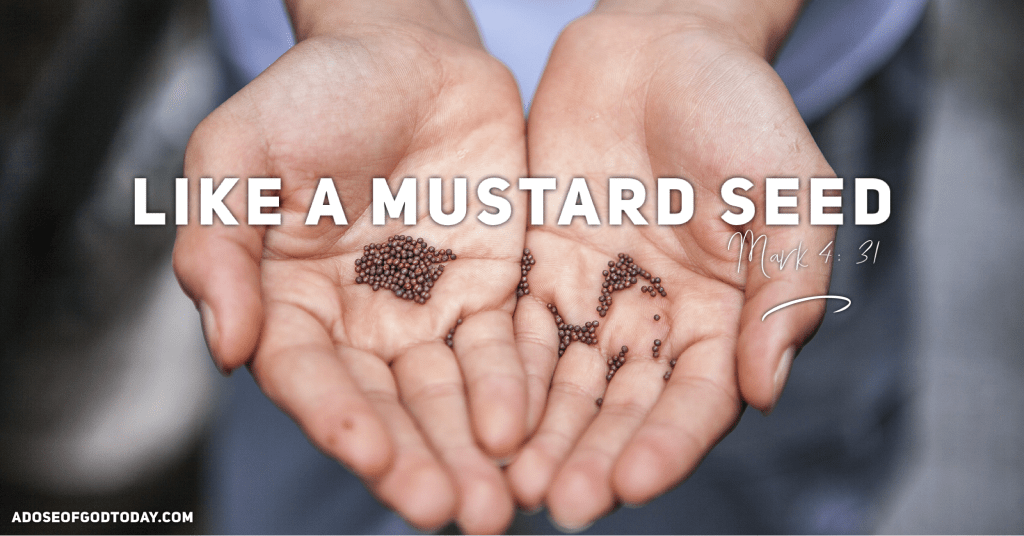
          You guess what follows. The next house is exactly the same: nice on the outside, a sad story inside. Again she leaves but only after helping as best she can. Then, on to the next house of grief; and the next. The curious result is that she gradually forgets her own grief and becomes more focused on helping others. The quest for a mustard seed leads her to where her grief is but a memory while something else grows in its place. Truth emerges in imperceptible ways as in the mustard seed parable.

          The Kingdom of God grows in us like a tiny mustard seed. To find wonder in what is small is as good a place as any to start. Our own start in the Kingdom may be as small as the baptism of a child. But we see the potential in a tiny child introduced with the parents into the life of the Christian community through baptism just as Jesus saw the potential in His disciples entrusted with the next stage of growth. Might it be that, despite our humble beginnings, limitations and failures we too are needed, like the grieving woman who lost her son, as God’s Kingdom continues its mysterious growth? 

          We may not have the chance to do the big, heroic things. But we daily have the chance to do the small ones that show Christian values – the smallest act of kindness, the little gesture we offer a sick friend, the forgiveness we give in our family and to one who injured us. Small seeds, perhaps, but will bear fruit ten, twenty, forty years from now!

          Brothers and sisters, we ask the Lord to transform us into Christ-like holiness, increase our zeal for His Kingdom and instill in us a desire to live for His greater glory. Amen.


  • Me & We: Seed for the Kingdom

    Me & We: Seed for the Kingdom

    June 13, 2021 – 11th Sunday in Ordinary Time

    Click here for the readings (https://bible.usccb.org/bible/readings/061321.cfm)

    A newly-graduated but non-working young millennial, while hanging-out at home and playing with his X-Box video games, was once asked by his mom to buy some fruits for meals. Though he prefers to go to a mall for convenient–sake, hesitantly he went to a nearby market. He tried to find his way looking for the fruit-stand since he was never been to this market before. Eventually he found the fruits he needed to buy at a particular fruit-stand. While paying, he jokingly said to the vendor: “Sir, I cannot help but notice you do look like Jesus Christ.” The fruit-vendor reply: “Others would say the same. But assuming I am who you seem I look alike. Do you have any questions for me?” Up for the challenge, he asked: “If you are said-to be the Christ, the savior of the world, how come the world is still a mess? Have you and God done and is doing something about these mess?” After giving much thought, the vendor answered, “For sure God has and is doing something about these mess – He created YOU.”

    Defensively, he countered: “Me, who am I to fix these mess? I am not rich, not  successful, still no-job. I am nobody, no hero. I am limited”. So the vendor further challenged him, “So what do YOU need then now to fix these mess?” He dreamingly replied, “Well if only I have more power, resources and opportunities, perhaps like in a computer game, I can be who I am and wish to be”. “That’s all?” the vendor disturbed him and then handed him something, “Take this. It got all what you need.” As he received it, he confusingly asked, “A seed? What am I do to with this seed?” The vendor replied, “Well, God has already done and doing something in creating You, and you have the seed now to do your part. It is up to you then whether to plant your seed and work out with God doing your part and growing your seed, OR do nothing with your seed, but complain, and let your world and our world still a mess.

    After Christmas, Lenten, Easter seasons where we celebrate our faith – what we believe, we are now in the Ordinary times of our liturgical year where we celebrate our life in faith, i.e. how we live, practice and witness what we believe. Jesus have much to teach us not only what we believe (Dogma) but how to live & practice what we believe (Moral). We have celebrated our Faith, but now we are celebrating our Faith-Life – our Faith & Life.

    To offer us meaning, inspiration and directions in our faith-life journey, Jesus made use of parables and our common life-experiences as life-lessons to live by. Like in our gospel today, by sharing us the parable of the growing seed and mustard seed, Jesus taught us not only about the Kingdom of God but also HOW to live our present lives along with our faith & mission in God’s kingdom.

    Here Jesus reminds us that nature and our usual human labor or work teach us that “Big things comes from small beginnings”. Yes, the sower & planter might have planted the seed and harvested the fruit but he does not know how the plant grows. And definitely he is not responsible for the seed to grow into full grain & for the smallest mustard seed to be the largest plant with large branches. It takes a lot of work on our part, AND working in partnership with God for us to fully enjoy the fruits of our labor with God. Yes, we can be the sower & planter, but God is the grower.

    With our advanced technology nowadays, we also tend to prefer to have things easy, instant, fast, disposable and convenient. In effect, we become impatient and intolerant with details and processes. We tend to value more the goals, and fruits that we undervalue & even become heartless to the growth-process, labor, and journey it takes. Like the young millennial, we tend to look at and concern more on the end-product and destination, without considering the process to make it and the travel-journey to get there.

    Never satisfied of what we have accomplished now, we rather tend to criticize & complain about our present mess without doing something about it except criticizing and complaining about it.  While we should enjoy & be satisfied to the advantages of what we have today, let us not forget the whole process-journey it takes to reach at this stage of advancement. Same as saying: While you and others enjoys and be satisfied with the fruits of your labor, let us not disregard and undervalue the efforts, work and sacrifices you have done as well as God’s work of creating you and with you for life to be better than before, better than the usual.

    In other words, to do away with the mess in life and to fully enjoy what God has given and can offer us in life now, we have to be RESPONSIBLE participants for God’s grace and work of creating and redeeming our life anew. As a wise man once penned, “Who & what you are is God’s gift to you & the world, who & what you BECOME is your gift to God & the world”.

    Especially during these pandemic times, teach & lead us Lord to cooperate with Your will & plans for us these days so that we may humbly recognize & fully enjoy the fruits of Your works for our betterment & the glory of Our Father’s Kingdom.

    So May it Be. Hinaut pa unta. Siya Nawa. Amen.

  • Bonded by the Lord’s meal

    Bonded by the Lord’s meal

    June 6, 2021 – Solemnity of the Most Holy Body and Blood of Christ

    Click here for the readings (https://bible.usccb.org/bible/readings/060621.cfm)

    In almost every Filipino homes there is a picture of Last Supper near the dining table. Have you ever wondered why in all places such picture of the Lord’s last supper is hanged near the dining table?

    This is because we, Filipinos love celebrations. We like to be part of big party or fiesta. Basically, we are meal-oriented people. We like to eat, and mealtimes are important and meaningful activity for us. Yes, we like to eat, but we like to eat together. We eat not only for nourishment but for companionship as well. For us, eating is not only a usual routine of nourishing our own physical body, but also a common activity of strengthening relationship and bonding. That is why we eat together not for the food, but for the companionship and covenant it brings. Mealtime for us is not only the time to eat, but also the opportunity to encounter – to experience one another.  This is why we don’t like to eat alone. We like to eat with companion, because for us, meals, eating, tables would mean celebrations, table-fellowship, sharing, bonding, rituals, and communion.

    The word ‘companion’ is an interesting word. It comes from two Latin words: cum which means “with”, and panis which means bread. So a ‘companion’ literally means someone whom I share bread with. And it is only a few (not all) you enjoy having meal with. There has to a bonding – a relationship first, which is deepened by the sharing of food and drink. Usually, by inviting a person to a meal, we seal our contracts, we show acceptance and approval. We know that once you are invited to take part in their table – to eat with them, it would mean that you are already accepted.  You become one of them. You belong to them.

    This is why we like the picture of the Last Supper hanging on near our dinner table because we want to be part of Lord’s celebration of life.  Taking our meals in front of the picture of the Last Supper, whatever the food is, whether lechon or bulad or ginamos, would mean we want to be a companion of Jesus and his disciples in their party celebration. This is why it is also particularly difficult for us to not able to attend Holy Mass during these pandemic times, & how insufficient it is, just to take part of the Holy Mass through the live-streaming. In other words, we do like to renew and strength our faith-relationship with Him. We want to be accepted and belong to His community. We like to be part of His family-banquet, His party. And All of these are greatly done and signified until now in our table-fellowship in the Lord’s Eucharist, in our celebration of the Holy Mass. 

    Today, we celebrate the feast of Corpus Christi, the Body and Blood of Christ. Today, we recognize and celebrate Christ’s continuing Presence and His binding promise of love and redemption to us, through His gift of Himself in a form of bread and wine. Our readings today remind us that as in life we feed ourselves with food, the Lord also feed us with His food, not only to nourish us but also to strengthen our covenant relationship with Him. Jesus in our gospel today specially has offered us His body and blood, as our inheritance of God’s manna in the Holy Eucharist. By sharing us Himself in body and blood, Jesus sealed us new covenant-relationship with God. And because of this, we are continually nourished by God’s graces and we are in communion with Christ’s eternal life. In other words, through His body and blood, Jesus is offering us not only God’s food for our faith-life journey but also a meal-time party (or a food trip) with God. That is why every time we celebrate the Holy Eucharist, we are in covenant or in companionship with God, with Jesus, and with one another. Thus, through our table-fellowship as family and community in our celebrations of the Lord’s Eucharist every Sunday and also as Filipino in front of the picture of the Lord’s Supper, we are united with the Lord and we take part with His glory and work of redemption. 

    Perhaps if we say nowadays, “We are what we eat and who we eat with” (Tayo ay ang Anong kinain at sino ang kasama), in attending Eucharist, we as Christian proclaim that through the body and blood of Jesus we are having party-meal (food trip/ breaking bread) with God now and always.

    For those who are not able to receive communion during live-stream Masses, nowadays they pray Act of Spiritual Communion of St. Alphonsus, saying “I desire to receive you into my soul. Since I cannot now receive you sacramentally, come at least spiritually into my heart… Never permit me to be separated from You. Amen.” Such words express our deep desire to be in communion with Jesus, to be part and companion of His eucharistic sacred life.

    During these pandemic times, we pray that we may always be in communion & in companion with our risen Lord, be nourished by His body & blood, and be always united & bonded, not separated from His love & mercy.

    So Help Us God, So May it be. Amen.

  • Three-fold ONE

    Three-fold ONE

    May 30, 2021 – Trinity Sunday

    Click here for the readings (https://bible.usccb.org/bible/readings/053021.cfm#subscribe)

    Once a team of mountain climbers were stranded almost near at the highest peak. As the air grew thin and weather got colder – that made them cold and weak, one of them made a fire. So, together they gather around  the fire and contribute whatever they have to sustain the fire. As they started to enjoy the heat, they share food, as well as their stories and dreams with one another that in effect, sustain and inspire them again. One of them decided to be on his own. So, he took a stick with a fire, and isolated himself from the group. Eventually, away from the group, his fire extinguished and he got sleepy and weak.

    With the team, we get strength and inspiration. Away from the team, we get tired, weak, and dispirited.

    As Christians, we praise God in the name of the Father, Son and the Holy Spirit. We give glory to God Father, Son, Holy Spirit. We proclaim our creed of faith: “I believe in God, the Father…in Jesus Christ… in the Holy Spirit.” At its very core, our Christian faith is Trinitarian – i.e. unlike any other religions, we uniquely believe in God, the Father-Son-Holy Spirit. As we honor today the Holy Trinity, perhaps now we ask: What does it mean to believe in the Trinitarian God?

    First, the word covenant simply would mean, “coming together”. As God making covenant with us, God wants to “come together for us/with us/in us”. In God the Father, we come to believe a “God-for us” who chooses us to be His own people. In God the Son, we come to believe Emmanuel Jesus, a “God-with us” who makes known to us God’s love for us, and how to love God in return. In God the Holy Spirit, we come to believe a “God-in us”, who inspires, directs, and sustains us in life of faith. To believe in the Holy Trinity then is to be in covenant with God, much as God is in covenant with us. Meaning, as God is for us/with us/in us, we must also be people for God, with God, and in God.

    Second, in the Lord’s ascension, we are reminded that the risen Lord is not-finished yet. His mission of salvation for us is still a work-in progress, and is now a product of the concerted-effort, teamwork of the communion of the Holy Trinity. Our salvation is the teamwork and actions OF our God, the Father who chooses us to be His own, THROUGH God the Son who is loving us always, and WITH the God the Holy Spirit who inspires, directs, and sustains us in life. To believe in the Holy Trinity is thus to be IN communion with God. As God acts and works as one for our salvation, so also we must be in sync, in tune with God’s concerted teamwork for our salvation. Thus we not only to give glory to them but also we are to be in sync with the works OF the Father, THROUGH the Son, WITH the Holy Spirit for our salvation.

    Third, as the Lord mandated us to proclaim our faith to all nations, in our gospel today, He particularly challenges us to make disciples in the name of the Holy Trinity. Making disciples while proclaiming our faith to all nations would mean helping ourselves and one another to be in constant covenant with God, and in partnership-communion with God’s work of salvation for us. To believe in the Holy Trinity then is to lead our lives and faith as Church, a Community of faith. As God is and works as Community, we too must also be and acts as Church – a community of Christian faith, living and witnessing God’s being and acting in our lives.

    The Holy Trinity shows us as Church how to be and act as God’s own People. As much as God be and acts together, to have a Trinitarian faith we too must be and act in covenant, in communion and in community with God and one another. As Church then, we must be faithful people for God, with God, and in God – witnessing our faith in sync with the labor of the Father, through the Son, with the Holy, and living our lives as church community making disciples and proclaiming our faith.

    Remember “the community is the bearer of God’s Salvation”. Salvation thus happens in the context of the church, faith-community, and not of individuals. We are God’s own chosen People, not chosen individual. We all are to be in covenant, in communion and in community with Him and His church. With the church, we are strong and inspired. Without and away from the church, we are weak and dispirited. We are to be in His threefold ONE.

    May we, as God’s own, not be separated from the Holy Trinity and God’s church, but instead always be connected and involved with God’s life and labors of salvation for all nations and peoples, even amidst during this challenging pandemic times. Amen.

  • To Be-Relate-Live with the Holy Spirit

    To Be-Relate-Live with the Holy Spirit

    May 23, 2021 – Pentecost Sunday

    Click here for the readings (https://bible.usccb.org/bible/readings/052321-Day.cfm)

    Have you ever experienced a time when you are so caught up with the wonders of the moment that made you say how great it is in your own native language? And then, a foreigner caught up with the same experience as you are having, utter words of how great it is, and also in your own native language?

    Like once, my Filipino friend and I were walking sight-seeing in a street of Brussels, Belgium. We caught sight of a beautiful painting being done in the plaza. In our amazement, we both loudly utter words: Ang Ganda, ano. “Ohh, Such a beauty”. And then a Belgian guy also in wonder say: “Oo nga, napakaganda” (Oh Yes, Beautiful).  All of us (Pinoy and Belgian) where not only caught up with the beauty of the painting, but also with the beauty of the moment where we can communicate and understand each other our appreciation of the experience.

    Perhaps the same experience could be said about a French man who tries to eat Kumtang – a famous Korean beef stew, inside a Korean restaurant with among Koreans, and after tasting it, said: “Masizoyo” (Delicious, Sarap). All understand how great it is, and even a foreigner is able to appreciate it through in the local native language and tongue. In other words, Napa-Koreano sa Sarap. O Napa-Tagalog sa Ganda.

    Our shared experiences of wonders and mutual understanding among diverse cultures somehow describes us the experience of the people and the disciples during the day of Pentecost.

    Church tradition has it that fifty days after His resurrection (ten day after His ascension), on the day of Pentecost, the disciples received the promised gift of Holy Spirit to the church, and inspired them to speak in different languages to proclaim the Good News of God’s salvation. Through the gift of the Holy Spirit, people from different cultures then and until now are able to speak, hear and understand each other’s faith in each other’s own native tongues. Because of such experience, today marks the birthday of the Church – the day of birth, the day when the church becomes alive. The gift of the Holy Spirit is thus very essential in the life of the Church. Like a soul to a body, the church is dead without the movements of spirit, as well as the spirit cannot inspire our life without body, the church. We, the church needs the Holy Spirit to live as well as the Holy Spirit needs our Church to offer us meaning and direction in life. For how does the Holy Spirit works in our lives?

    First, the Holy Spirit makes us experience and witness the present moment. Like being caught up with the beauty of a painting or scenery, with the delicious taste of food, with the wonders of the architectures & building, cooking, or working processes, with the intensity of a good book read, a good drama play or movie, and like the risen Lord made Himself known to his disciples, the Holy Spirit inspires us to situate and appreciate ourselves in the present experience. In other words, the Holy Spirit offers us PRESENCE in the here and now.

    Second, the Holy Spirit compels us to share our inspiration of the present moment with others. Our inspiration then is not ours to keep but to be shared with others. Like falling and being in love, the Holy Spirit moves us to proclaim and communicate our life and inspiration with others in a way that we can understand each other. In other words, the Holy Spirit provides us the LANGUAGE to articulate and communicate our inspiration of the present moment.

    And lastly, the Holy Spirit makes us respond rightly and accordingly to the inspiration-given and shared. Like Jesus giving us the mandate and mission to witness and proclaim our faith to all nations, the Holy Spirit encourages us to lead our lives according to our faith-life inspirations. In other words, the Holy Spirit obliges us a LIFESTYLE – a way of being and becoming human in life.

    Like, as Love is one of its gift, the Holy Spirit inspires us to love and be loved, to express humanly such love with an-other and others, as well as to live our lives as loving and beloved person. In the same way with Faithfulness, the Holy Spirit inspires us to have faith and trust in the risen Lord in life, to express, proclaim, and share our faith with others (regardless of culture and race), and to practice and live out such faith in our daily lives. The Holy Spirit thus concretely offers us PRESENCE – LANGUAGE – LIFESTYLE of Love and Faith in life. That is how essential Holy Spirit is into our day to day lives as Christian and as Church.

    We can only receive what is being offered. And it will be offered us in our life, if and when we allow and invite the Holy Spirit into our very lives now. We can only share what we already have. We welcome then the Holy Spirit into our lives now so that others may feel its presence, relate with its language, & live its lifestyle in our world today. 

    As we celebrate the birthday of the Church, we especially once again invite the Holy Spirit into our lives during these pandemic times, as we pray: “Come Holy Spirit, fill the hearts of your faithful and kindle in them the fire your love. Send forth your Spirit and they shall be created. And you shall renew the face of the Earth.” Amen.