Storms in life may struck us in the form of crisis in our family, friendship, with our health, career, or job or business. This can also be in the form of our personal struggles that we carry alone like the guilt that we hide in our hearts, our fears that paralyze us, our trauma that haunts us day and night.
In this Season of Advent, we are reminded that as we wait for the Lord to come, we might be troubled and our hearts filled with fear. Thus, Isaiah proclaims to us today, “Trust in the Lord forever.” As Isaiah brought a joyful hope to the people of his time, and so he does again to us today. The Prophet, whose words echo until today point us how the very presence of God becomes our strength. Though we wait for God’s coming but God’s presence can be ever felt in the here and now. God sustains us. God strengthens us.
That is why, Isaiah described God as our strong city. God surrounds us. God is beneath us. God is above us. And God is within us. This requires faith in us to trust fully the Lord who is always with us and for us. In trusting the Lord, we shall have peace because God will keep us in peace.
Moreover, as Isaiah calls us to faith by trusting God. The Lord Jesus also calls us to action. To believe and to trust in the Lord is not a mere thought or idea and not a lip-service. This also needs action. Thus, Jesus reminds us today, “to listen to His words and acts on them.”
By cherishing the word of God and imbibing the word into our life, thoughts and actions, then, we become a wise person, whose foundation is God, our eternal Rock. By loving the Sacred Scripture and receiving the Sacraments, we make ourselves more attuned to God’s presence. As we make ourselves available for God, this will mold us to become a person for others and with others.
God invites us today to be with others, to allow others to be part of our life. We shall discover, then, the strength, love and support from our friends, families and communities. To trust in the Lord leads us to become confident that the Lord is with us through the people who surround us.
As we are being tossed by the storm these days, whatever that may be, please take comfort by trusting the Lord who is with us, through our friends, families and the Church. Hinaut pa.
My heart is moved with pity. The words of Jesus must have been ringing into the ears and hearts of his disciples. God is moved. God feels our pain. God feels the emptiness and longing of our hearts. The Book of Prophet Isaiah tells us about this too, “The Lord will wipe away the tears from all faces.” God shall take away our pain and sadness. Again, on this first week of Advent, we take comfort in this promise of God who is with us. The journey of this Advent is to make our heart and mind more confident in God, to be more assured of God’s abiding presence in us.
Hence, the Gospel of Matthew reminds us how Jesus attended, welcomed and healed those crowds who brought the heaviness and hungers of their hearts and different illnesses to him. Jesus cured and satisfied them all. He made the mute speak, the deformed whole, the lame walk, and the blind see.
Moreover, Jesus wanted his disciples to be also moved with pity. Jesus wanted that the hearts of his disciples will also experience the power of being moved by others. To be moved with pity allows us to feel the heart of another. This allows us to understand them, to be in solidarity with them and to journey with them. Such solidarity will lead us into healing and freedom, which is the very experience of those people healed and freed by Jesus.
This means that the journey towards healing, freedom and fullness of life is not achieved when we are alone. It cannot be achieved when we distance ourselves from our friends and family, our community, and from the Church.
That is why, as the heart of Jesus was moved with pity, he too asked his disciples to participate and join with him. His question, “How may loaves do you have?” must have been a question with a deeper meaning. Jesus was not just asking about the number of the physical loaves of bread, but also the availability of the hearts and presence of the disciples. Indeed, that question meant more than loaves.
The disciples responded not just with seven loaves, but also with few fish. This food was all they had, yet, God asked everything. And they all gave them up for others. It must not be easy to give up all you have for the sake of others. That food, if one would think, would not have been enough just for the 13 of them. How could that little they have, feed hundreds of people?
We usually think for ourselves and prioritize our own needs. However, the disciples, out of obedience to Christ, gave everything they had at that moment for the sake of those in need at that moment. This was the beginning of the wonder and amazement.
Those seven loaves and few fish given out of generosity and obedience to Christ were blessed, given thanks, and broken. Those were distributed to all of those who were hungry, to satisfy them and fill their emptiness. Yet, what was blessed, given thanks and broken and was shared became abundant before the eyes of the disciples. As people partake with their bread and fish, people were satisfied and there was more than enough. This was how they collected the left-over that filled seven baskets. The number of fullness.
What had been satisfied were not just those who were hungry but also the givers. Indeed, the journey taken by the disciples to fill the hunger and emptiness of the people became their own journey also to experience both physical and spiritual satisfaction and fullness of life with the people and with the Lord.
Today, Jesus also invites us to be moved with pity that with him and with the disciples, we too shall bring out those little things that we have, and to offer them to God so that many will be able to receive. We shall see the wonder, then, when the small or little things from us are given generously because we will surely be able to respond to the different forms of hungers around us. Hunger is not just limited with physical hunger for food but also for love, for affection, for justice and for peace.
The symbol of seven loaves and few small fish are not just limited with material possessions that we have. These also include our talents, capacities, expertise, our time and effort, our presence and our very person.
While the Lord assures us and promises satisfaction from our own hungers in life, hopefully, we too will be like his disciples who became instruments of satisfying not just ourselves, but also our brothers and sisters. Hinaut pa.
A growing seed makes no sound but a falling tree creates huge and echoing noise. (A quote I got from Pinterest). Creation, indeed, is silent while destruction is loud. In the same way, God growing in us is silent. God’s coming and arrival can only be realized when we too learn to listen in God’s silent coming. The noise of our anger, of our bitterness and pain, of our desperation and anxiety, may prevent us from listening to God’s silent coming. Those noises will only bring us to destruction and not to growth and peace.
The Book of Prophet Isaiah reminds us that a shoot shall sprout from the stump of Jesse, and from his roots a bud shall blossom. It describes to us how the Messiah will come from the linage of Jesse, who was the father of King David. The coming of Jesus as prophesied by Isaiah will be silent as a shoot sprouts and as a bud blooms.
What makes it more fruitful for us is on how such attentiveness to the silent coming of our God brings grace. The Spirit of the Lord shall also bless us with wisdom and understanding, with counsel and strength, with knowledge and fear of the Lord. As the Lord brings peace to us, so shall we also become peace.
Indeed, to become loud, to overwhelm ourselves with distractions whatever that may be, will stop us to see and recognize the Lord. This is how Jesus criticized the attitude of those people during His time who claimed to be the “masters of the world, the wise and the learned.” They make so much noise by claiming the knowledge that they have gained in many years of experiences. Yet, such arrogance prevented them to learn new things and to be welcoming. These attitudes prevented them to receive God’s revelations and invitations.
Jesus reminds us how the Father reveals the mystery of salvation, of His gift of healing and peace to the childlike. Of course, God reveals His mystery to all but only the children and the childlike are blessed to receive God’s blessing, simply because of the qualities of being welcoming, humble and receptive. This is why Jesus said to his disciple, “Blessed are the eyes that see what you see,” because God revealed Himself to the childlike.
This is today’s invitation for us on this Season of Advent. We may have achieved many things in life, we may have gained many experiences already, or we may be carrying many things in our hearts and minds like our concerns and struggles, let us not allow them to overwhelm us in this season. We let go of them so that we will also learn how to see, to listen, to observe and be more attentive of God’s silent revelations in us.
May our eyes that see and ears that listen bring us to peace. Hinaut pa.
Once in a far-flung village, words came that someone from the diocese would come to visit them on a particular day. So, in excited anticipation for the said visit, the whole village decided to renovate their chapel and prepare a rather lavish banquet to welcome their special guest. However on the very day of the visit, no guest arrived, but instead a big writings message on their chapel wall is posted “BEWARE for HE is here. Babala. Nandito siya. Pagbantay, Ania sya.” Dismayed for the non-appearance of their expected guest, the villagers began to blame and distrust one another for the said fiasco and humiliation. Worse is the insulting words written on their chapel walls warning them to be aware of someone present with them but in fact, absent, no show, not there. Nandito daw pero wala naman. Naa daw, pero wala lagi. Weeks after the fiasco, they started to take seriously the message on the wall: BEWARE of the supposed-guest’s presence in their midst, and they began to consider that perhaps that the guest is already with them but they might have missed & fail to recognize him. So they become alert and aware first of the presence of newcomers and migrants in their midst (mga dili ingon nato, pero naa nato), then they become sensitive of each other’s presence & needs, & thus they grow in their concern & respect for one another within their community as they become conscious of someone with them, other than themselves. BEWARE. Babala. Pagbantay then becomes more than just a word of warning but a Wake-up Call for them to be aware, be awake, and be alert of the Presence of one another and of other than beyond themselves. Hindi lamang Babala, kundi Magmasid, magising at magkamalay. And thus, they become WELCOMING community.
We Christians believe that there are three comings of the Lord in our lives: His second coming at the end of time to reign & rule the world, His coming in the end of one’s life to fetch & bring us to our Father, & His coming as He & we live in our lives this day. Any one of these comings can take place at any moment in our life. And what is expected of us is to be welcoming hosts of Lord. Our salvation then is all about the Lord coming to us & we welcoming Him into our lives.
In our gospel today Jesus said: “Beware. Keep alert for you do not know when the time will come. Therefore keep watch for you did not know when the Lord is coming or else he may find you asleep when He comes suddenly. What I say to you, I say to all: Keep awake.” Jesus here is giving us a Wake-up Call to be aware, awake and be alert for coming of the Salvation and Good News that is happening and about to happen in our lives. God has something Better to offer us more in life now and from now on. And behind this promise of salvation in our lives, our Hospitality – welcoming and hosting the Lord as our guest is required. Salvation thus happens when God comes & we willingly welcome Him into our lives. So also, salvation is wasted because of unrecognized & unwelcomed Lord as our guest, & due to clueless insolent unwelcoming people we are as hosts.
To be a good worthy host to our guest, all we have to do and to be then is to be alert, awake and aware – magmasid, magising at magkamalay, so that God’s miracles and blessings are to be revealed & enjoyed in us always anew. Jesus does not want us to sleepwalk through our lives. He wants us to whole-heartedly welcome His comings into our lives by being alert, awake and aware – we hosting His work of God’s promise of salvation for all.
The first Sunday of Advent is the beginning of a new liturgical year. Another year of the Lord and with the Lord is upon and ahead of us. Another promise and chance for us to grow in our faith and love of God through Jesus Christ. As we begin and live through our new liturgical year: to be alert, awake, aware: Magmasid, magising, at magkamalay are the very welcoming attitudes Jesus wants us to be and do for another chance to be and grow with Him in God’s grace.
As Jesus warns us, usually God’s blessings and graces come into our lives as a surprise for we never know when the time will come – when the Lord is coming. Blessed are we then whom the Lord finds not Asleep but Alert, Awake and aware when He comes and arrives into our lives.
Like people waiting at the arrival area in the airport, as we long for the vaccine for cure & immunization, as we celebrate this year our 500 years of Filipino Catholicism, may we brace ourselves to welcome Him for His another coming anew into our lives – conscious, alert, sensitive, & aware not to miss His presence in our midst & thus, be forever blessed by the grace of His love & mercy. Amen.
Advent is a season of “Joyful Waiting.” It is a joyful hope that lifts our spirits. With this first Sunday of Advent, we also begin the new year in our Church’s (Liturgical) Calendar. However, I cannot help but recall the past year. As the new year Liturgical year started in December 2019, we already have experienced frightening calamities. Earthquakes terrified particularly the Central and Southern Mindanao. Quakes continued for weeks that left thousands of people traumatized and terrified. Then, Taal erupted and brought great damages in its neighboring provinces. Then, Covid-19 came and brought fear to us until now. And just recently, typhoons hit our country that greatly affected our brothers and sisters in the Northern Philippines.
From all of these, we saw images in the news and in social media sites how millions of people were waiting to be rescued. Until now, all of us are waiting to be rescued. The typhoon Rolly and Ulysses particularly caused people to climb to their roofs because of the floods. Those frightening situations left our brothers and sisters at the mercy of rescuers.
We could just imagine, that if we too are in their situation, it would be very difficult not to give in to despair. There was so much hopelessness that we have experienced. Is there something to wait joyfully then? Is there something to wait joyfully now?
On a personal level, many individuals also struggle to live because of personal and deep-seated issues. Many young people have succumbed to depression that led to suicidal attempts and ultimately led to the end of their lives. Many are desperate because of their addictions, because of broken and abusive relationships where they are trapped. Many felt hopeless because of their guilt and shame, believing that they cannot be forgiven.
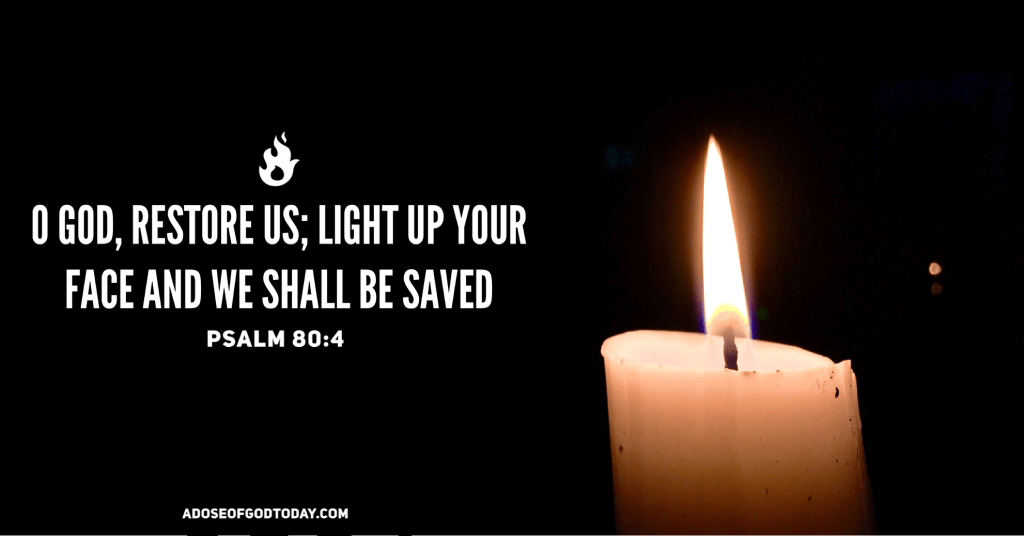
In one way or another, we are all waiting to be rescued. What the Psalm has proclaimed today, is echoing into our hearts, “Let us see your face, O Lord, and we shall be saved.” Thus, despite the frightening, terrifying experiences we have, despite our desperation, we long and we cry deep within that God may show His face to us, so that we will be saved from so much despair and suffering. This Psalm really expressed this hope. This was written during the time of destruction and captivity of Israel. People became miserable and desperate because their enemies brought darkness into their lives.
Yet, their hope for salvation was relentless. In the same way, Prophet Isaiah, in our first reading also expressed this persistent hope for salvation in the midst so much misery. In his desperation, he even sounded to blame God saying, “Why do you let us wander, O Lord? Return for the sake of your servants.” With the people, Isaiah conveyed the feeling of being abandoned by the Lord because of the guilt that they were carrying.
Isaiah expressed the shame and guilt of the people’s stubborn heart, rejecting and killing God’s prophets. Their leaders and the participation of the people of a systemic corruption of life, made Isaiah to proclaim, “you have hidden your face from us, O LORD, and have delivered us up to our guilt.” Isaiah knew this very well. It was indeed very easy to fall into hopelessness and in total misery.
However, Isaiah also expressed in behalf of the people, and in behalf of all of us today, he said, “Yet, O Lord, you are our Father.” In the midst of hopelessness, Isaiah recognized God and affirmed his confidence to God, our Father, who will never ever abandon us. This, indeed, is a relentless hope.
In the same way, Paul expressed in his first letter to the Corinthians, his gratitude for the grace of God bestowed on the people, and also reminded them that “God is faithful.” Yes, God is faithful and cannot deny us and will not break the promise to be with us.
God continues to be present with us in every moment of our life. God blesses us with His presence even in our most difficult and desperate moments. This is what keeps us now to remain hopeful. And the first candle that we lighted on this First Sunday of Advent reminds us of this hope. Indeed, the candle is called a “candle of hope.” However, today this surely has become a “candle of our relentless hope.”
This relentless hope keeps us alive and keeps us burning in our desire to be rescued by the Lord in whatever difficult and misery we are experiencing today. Hence, as Jesus told his disciples, Jesus also says to us today, “Be watchful! Be alert!” Jesus wants us to be always watchful, alert and attentive to his constant revelations for us and attentive to his silent revelations in us. To be watchful and alert is not a mere warning of the dangers that may come, it is also an invitation to have a heightened awareness of God’s presence in our life and in the lives of others.
We are a people who long to see the face of God, who long to feel His loving and comforting presence in our life. Yet, let us also realize that though we long for God, God longs for us all the more. Jesus would surely come and rescue us where we are at this very moment.
Thus, on this first day of Advent, we are all invited to relentlessly hope as we remain watchful of God’s presence in our life and through the life of our brothers and sisters. Hinaut pa.








 A DOSE OF GOD TODAY