Category: Ordinary Time

  • DO What You Mean

    DO What You Mean

    Advertisements

    September 27, 2020 – 26th Sunday in Ordinary Time

    Click here for the readings (https://bible.usccb.org/bible/readings/092720.cfm)

    Homily

    Recently, a Q&A post was logged in Facebook. It asked the question: Is mortal sin forgiven only through sacramental confession? In other words, is it enough just to confess your sin to be forgiven of your mortal sin? The answer was, sacramental confession is normatively but not absolutely required of mortal sin. Meaning, confession can forgive mortal sin but it is not the only one way of forgiving and being forgiven of mortal sins. Saying sorry then is not enough for you have to do something about being sorry to renew faith & trust with others.

    Yes, forgiving mortal sin through sacramental confession is all about reconciliation with God and others, but it is also and moreso about repentance – the whole process of turning from sin and dedicating oneself to amend one’s life & relationships for the better.

    Our readings today have a lot to teach us about repentance. First of all, repentance is more than just changing one’s mind, but it is about making a choice – a stand for ones life. In our gospel, both sons changed their minds, the second did not fulfill what he promised while the first did what was requested which he had initially refused. The virtuous as well as the wicked may also change their mind as our first reading suggests. Although it involves much changing one’s mind, repentance thus requires our choice – to turn away from virtuous or wicked life, as well as to fulfill or neglect our promise.

    Second, repentance is giving oneself and the others another chance. In our gospel today, because he chose to neglect his promise, the second son did not give himself and his father a chance to make things right. The first son however gives himself and his father another chance to make things right again by doing what was requested, even though he did not initially commit at first. In the same way, for the wicked to change his mind and turn away from his wickedness, he gives himself another chance for God to forgive and be merciful to Him, and for himself to lead a virtuous life.

    Third, repentance is about saying what you mean and meaning what you say. It is not only about confessing you sin – just saying you’re sorry, but it is all about Being sorry. Confessing one’s sin is also not only about resolving to change your ways but it is all committing/ dedicating oneself in changing one’s life. Jesus asks about whom among the sons who Did the will of Father. He is not concern with who says Yes or No, but who does the Father’s will. Meaning, God needs doers who mean what they say, live and witness what they preach and believe, rather than preachers who do not do, live, witness what they say and preach.

    Although less appreciated compared to other sacraments, repentance of sin through the sacrament of reconciliation or confession is actually a Gospel – a good news of God’s salvation because it involves the resolve and commitment of the sinner to change one’s life, to give oneself and God another chance, as well as to live his life and dedicate his faith as witness to Christ’s good news to all.     

    St. Francis of Assisi who once said: Preach the Good news at all times, and use words when necessary. This reminds us that everything in our life as Christian – our struggles, hopes, dreams, aspirations, commitments, as well as our repentance of sin is a Life of Witness to the Good News of Christ. Whatever we do and however we live our Christian lives is a testimony to God’s work of salvation. It is ours now to share and preach such gospel to all at all times, not only by our words but also by our actions.

    Remember our God is a God of surprises and another chances who we will come to know if and when we give Him and ourselves another chance of better than usual life through our reconciliation and repentance. Somehow Jesus is saying to us today that it is never too late for us to change our minds, our ways and our lives…. just believe in Him, and be His witness by doing what we mean. This would be the Lord’s  challenge for us now.

    Advertisements

    Today’s pandemic times has indeed been a significant crisis experience for all of us that also requires our important life-adjusting decisions. Difficult as it may be, these times could also be our choosing to give ourselves and God another chance now for a better meaningful than our usual directionless life,  by our living our lives in witness of our faith. Transform, O Lord, our initial refusal, reluctance and neglect to follow you so that we may taste and see the better chance you are offering us now even amidst and through this pandemic crisis in our life. Amen.

    By  Fr. Aphelie Mario Masangcay, CSsR (a former Filipino Redemptorist Missionary for Filipino Migrants in South Korea who, due to immune compromised diabetic condition, stationed back home  in the Philippines for now).

  • Take nothing for the journey. Seriously?

    Take nothing for the journey. Seriously?

    Advertisements

    September 23, 2020 – Wednesday of the 25th Week in Ordinary Time

    Click here for the readings (https://bible.usccb.org/bible/readings/092320.cfm)

    Homily

    You are going on a journey and it will take you several days. What would you do? Naturally, you will prepare Your personal effects, clothes and some other things that you think will be useful for your journey. One may carry a book oR two and some nitty-gritty stuff that “might be needed” in some surprising situation.

    However, once you are already in the journey, then, you will realize that there are many non-essential things that you brought with you. This has been my experience too. One time, as I prepared myself for a trip, going to a mission area, I brought “things that I thought were important and essentials.” As I packed my things, I kept putting stuff that “might be needed.” As a result, I had a big and heavy bag to carry for the journey.

    Later on, when I was already in the area, I realized that I have brought many non-essential things which only made my bag heavy and full. I realized too that what I did must have come from my anxiety of “what if.” What if this happens, then, I need to bring extra shoes, some extra shirts, extra food supplies etc. There is some kind of anxiety of the future. I wanted to be prepared always, always ready to respond in some surprising or emergency situations. There is nothing wrong with this. However, the problem lies in the heart that is constantly anxious of what lies ahead and so has become “heavy and full.”

    When our heart is heavy and full, then, the heart becomes grumpy and uneasy, unwelcoming and inflexible. This makes us calculating to the point that we do not want surprises anymore. We only want certainty. Nevertheless, in life, there are many things that we find ourselves uncertain. We might get lost at times and meet strangers. The anxiety to be always certain may prevent us from being surprised and enjoying the wonders that surprises may bring.

    This is something that Jesus wanted to avoid for his disciples. Jesus gave them instruction that as they begin their journey, they were to “take nothing.” Seriously? Well, that’s what Jesus said. So, what was the wisdom behind this?

    Jesus knew that the material things that the disciples will carry will only burden them in their journey. Attachment in those things will make their heart restless. Jesus did not want these men to become anxious of their journey, of what lies ahead. Jesus actually invited his disciples to fully trust in the providence of God, and to be surprised with the graces of God.

    When the heart has more room and lighter because it has no attachments to material possessions or emotional issues, then, the heart becomes more welcoming of others, of surprising events and of ordinary graces. Our heart will be more flexible and understanding of others too.

    Thus, the invitation of Jesus is not about the direction in life but about our attitude in the journey, of not being attached to non-essentials in life. Like the disciples, we  are invited to “travel light” by not taking with us those things in life that might only burden us and make our heart full. Our desire to be always certain and ready, our past issues and pains, our bad habits and hurtful attitudes are some of those “stuff” that must be left behind. Do not carry them with us.

    Jesus invites us today to trust God’s providence and to be surprised by His graces prepared along the way as we meet people and embrace events in our life. In this way, we become more welcoming of God’s presence and accepting of God’s graces.

    …we become more welcoming of God’s presence and accepting of God’s graces…

    As a response, like the disciples too, may our words, our actions, and our very presence become channels of God’s blessings, of peace, and of God’s gift of healing to those who are ill and those who are broken. Hinaut pa.

    Jom Baring, CSsR

  • God is Generous

    God is Generous

    Advertisements

    September 20, 2020 – 25th Sunday in Ordinary Time

    Click here for the readings (https://bible.usccb.org/bible/readings/092020.cfm)

    Homily

    To seek recognition, affirmation and praise are all part of growing up. We see this among our children as they always try to get the attention of their parents or among the adults around them. Children have their own way of getting attention. However, when parents become indifferent to this need of a child, this could leave a hallow and painful part in the life of a child. Thus, when the child becomes an adult, he or she  would most probably continue seeking recognition and affirmation from people around in order to satisfy that need which the person did not receive from home.

    We could be this person who continually seek to be recognized, affirmed and praised. There is nothing wrong with this need. However, this could also lead us to become bitter, unsatisfied and envious of others despite the talents we have developed or despite the success we have achieved. We would tend to accumulate more and demand for more praises and affirmations to the point of becoming indifferent towards the needs of others.

    The tendency to accumulate more praises and demand for greater reward because of the good qualities we have can only poison our hearts and relationships. This tendency makes our heart unwelcoming to others who need more than us.

    This attitude was what the Pharisees showed at the time of Jesus. They believed that their superiority made them deserving of all God’s goodness and graces. They cannot accept the teaching of Jesus that others could also experience the goodness of God. They despised Jesus for offering God’s forgiveness and gift of healing to the poor, the sick, and sinners. They despised Him because they believed that God’s grace was reserved for them alone.

    This is what we find in the Gospel. It teaches us how God treats all of us, showing concern and compassion.

    This parable speaks of the generosity of the landowner towards the workers. The first ones who were hired on that day felt jealous with those who were hired at the last hour. The first ones worked the whole day and the last ones worked only for an hour. But then, they all received the same wage according to the agreed wage for that whole day work.

    The first ones were disappointed because they thought that those who only worked for an hour did not deserve for that wage. Since they worked hard, they should be above them and those who worked less should not be treated like them. But then, for the landowner, if he will not give the usual wage for those who were hired last then the food that they will bring for their families will not be enough. They will still starve on that day. It means that the parable actually is not about labor issues but of God’s generosity to each of us.

    Indeed, this is what we always believed that when we are more gifted than the others, more intelligent, more educated and so the more we feel entitled, and seeking to have more; and those who are lesser than us, should have less. When we feel that we are more religious, going to church and saying the rosary daily, we might think that we are far better than those who don’t go to church and do not pray. When we feel that our educational achievements, our status in the community, or our material possessions make us higher in dignity than others, then, we might believe that we can just ignore those whom we think as lesser than us, and become indifferent with those who do not belong to our class.

    Unconsciously, we also become like the Pharisees who did not have the sympathy for those who were struggling in life. The poor, the sick and the weak sinners at the time of Jesus can be today’s young people who have been addicted to drugs, to alcohol, to gambling or any addiction not because they are bad but because of family problems, broken relationships and low self- esteem. They can also be our friends or family members whom we continually bully because they are weaklings, untalented and less intelligent than us. They can be people working for us or those who are around us and doing menial jobs just because they did not have much opportunities like you to uplift their life.

    But remember, God relates to us not merely because of the effort that we did but because of “who we are” to Him. God is good to us not because we are deserving but because God is so good and generous. We are all loved by him no matter what, no matter how big our failures were, no matter how serious our sins are.

    Thus, for those who have worked hard, for those who have been so faithful to God, this gospel is not meant to discourage you for working hard, for doing your daily devotion but this is meant for us to know that God is generous also towards those who are less fortunate. And we have the role to lift up those who are less fortunate in this life. For those of us who felt that we are lesser beings, felt unworthy because of our mistakes, failures and sins – this Gospel is truly good news for us because God tells us today that we too are blessed because we are loved. Hinaut pa.

    Jom Baring, CSsR

  • Work FOR What?

    Work FOR What?

    Advertisements

    September 20, 2020 – 25th Sunday in Ordinary Time

    Click here for the readings (https://bible.usccb.org/bible/readings/092020.cfm)

    Homily

    Don’t know if we hear it right. Jesus’ parable today tells us of an owner who paid the same amount of wages to laborers who came first and last. Do you think the owner has been just and fair? Has he paid for what we call today just-wage for an honest day’s work? And Jesus even ends the gospel with a completely non-sense statement: “the last will be first, and the first will be last” simply because for us the first is first, and the last should be last.

    For us today, paying same amount to first and last simply doesn’t seem to be just and fair. Maybe our gospel today is one of those written in the Scripture which is good to hear, but doesn’t make sense, so we don’t bother to follow. This is because we nowadays follow a very different work ethics. First, we always think that there should be seniority in workplace – those who are more senior, experienced, talented should deserve and enjoy more privileges than those who are young, inexperienced and still learning laborers. Second, the more you work the more salary or wage you deserve than those who have less work. That is why we think that our parable today is not fair because we usually connect wage, salary, reward and payment with work…. and work with wage, salary, rewards and privileges. We usually equate work for the money, wage or reward. Everything has its prize. Nothing is free anymore. If you don’t work, you don’t earn. No work, no pay. No pay, no work. And if what you do is not considered as work or labor – like the work of a mother at home – you are  not and should not be paid either.

    This is what Jesus is trying to teach us today in our gospel. Work is not necessarily and always connected with wage or money. Work is more than just receiving or deserving a just payment or wage. There is more value in our human work and labor than just earning money or wage for it. To equate and limit work with wage undermines the dignity of work of God and man. Take for example, the work of mother at home, the work of a priest, a teacher to educate, a doctor to heal, a farmer, a fisherman, and a public servant. Deep inside, we know that the work we do is more than just the wage we receive because we dignify our human labor as our vocation and mission in participation with God’s work.

    Although our capitalistic and consumeristic world today promotes otherwise, Jesus reminds us that human labor is dignified – it is our participation and contribution in God’s work for our redemption and salvation. Perhaps we better reexamine our work ethics – are we in for the money or for the betterment of human world? One thing for sure, in doing God’s work or working with Jesus, there is no seniority, no privileges, no prizes, bonus and rewards, no early comers or latecomers, no DTR – daily time record. But everyone receives equally more than what each of us deserved, for what we receives is not Salary or Wage but God’s overflowing Gift and grace of His Redemption and Love, coming out of His generosity.

    Jesus reveals us here the Generous nature of our God and Father whose thoughts and ways are beyond ours. He is a God we are to discover in our daily work with Him, and not in our thoughts and ways. Ours is a Generous God who always provides us with much graces and blessings we need, and through our dignified work we participate and contribute in His work of blessing us all always. God indeed works in His own unique work-ethics – different and beyond our own.

    Which reminds of a story about a bishop who went for a surprised visit to a newly-built chapel “kapilya”. While appreciating the kapilya, a little girl of ten came and asked the bishop: “How do you like our new kapilya?”. The bishop replied, “It’s very nice.” The girl then said, “You know what? I am part of its construction.” Surprised the bishop asked: “How could you?” The girl proudly responded: “When my father, the head carpenter built this kapilya, I brought him “Lunch”. So I’m part of its construction.

    Perhaps we learn something from the work-ethics of the girl. In building God’s Kingdom, Are we part of the construction and harvest, OR are we just hired-paid laborers? Regardless what, when – be it first or last, senior or neophytes, or where we work – be office or home, we better ask ourselves what are we working FOR?

    Pandemic times have rendered a number of people to lose their own jobs and careers. Difficult it may be, perhaps this can also be ample time for all of us to review our work-ethics, reevaluate our present jobs, and reconsider some career-shifts that would improve & be more in line with one’s own life-vocation & mission.

    Grant us, O Lord the grace to discern Your will for us now as we take part in Your better plan always for our best. Amen.

    By  Fr. Aphelie Mario Masangcay, CSsR (a former Filipino Redemptorist Missionary for Filipino Migrants in South Korea who, due to immune compromised diabetic condition, stationed back home  in the Philippines for now).

  • Working with Jesus

    Working with Jesus

    Advertisements

    September 18, 2020 – Friday of the 24th Week in Ordinary Time

    Click here for the readings (https://bible.usccb.org/bible/readings/091820.cfm)

    Homily

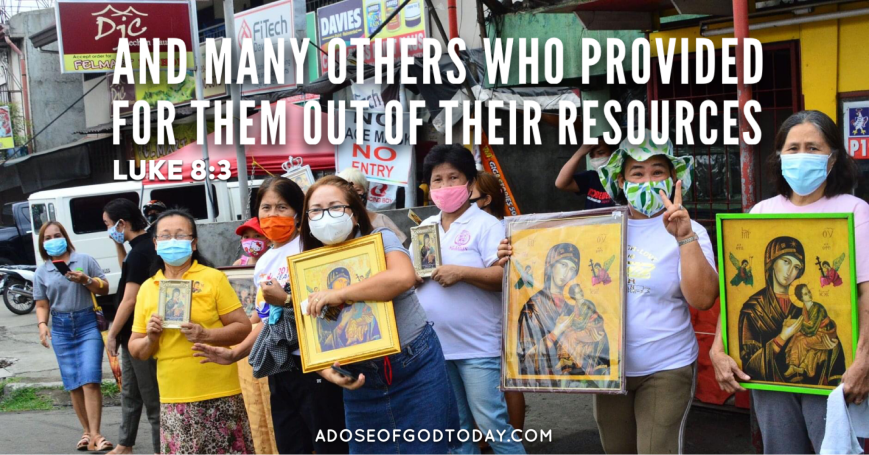
    In today’s Gospel, we are reminded that in the ministry of Jesus, the 12 men disciples were not the only ones who were part of the mission. There were “many others” who were with the Lord and played important roles. They were the women who were always with Jesus who like the 12 disciples, were also disciples themselves.

    The Gospels did not mention that they too preached, but they played significant contribution in the ministry of Jesus, in his travels and in his preaching and healing. These generous women supported Jesus through the use of their resources.

    Why follow Jesus? Why support him in his ministry? Each of them had their own stories with Jesus, stories of conversion and renewal, stories from brokenness to healing, from death to life. Each of them must have this real encounter with the person of Jesus. That encounter must have brought a total change in their life and in the way they were responding to life.

    The Gospel of Luke itself tells us that some of them were cured from spiritual and/or physical illness. The experience of healing made them recognize God in Jesus. That experience too moved them to follow the Lord to know him more and to become more like him.

    Surely, there are lessons that we can learn from the women who worked with Jesus in his ministry.[1] And they are…

    1. Responding in gratitude. The women responded with gratitude to Jesus because of the life-changing grace they experienced through him. God surely worked miracles in our life too. Recognize those graces of events and experiences when God made manifest in your life and respond in gratitude to the Lord.

    2. Using one’s talents, capacities and resources to continue the work of Jesus. As the women responded in gratitude, they used their own talents and capacities and including their material resources to support Jesus in his ministry. Never shy and never hesitate also to share what you have to the Lord. Share generously to the Church and to the communities where the work of Jesus is being continued. You yourself also can do that by volunteering or making yourself available in the Church’s many apostolate especially in this time of pandemic. Use your expertise where you are good at and offer them to the Lord.

    3. Making the opportunity of giving by being close to Jesus. The women grabbed that opportunity of giving themselves and their resources so that they will be able to stay close to Jesus. Like the men, they walked with Jesus on the road, they gathered around him while eating, they listened with the people. With this, they learned and knew more about Jesus, about his person, his teaching and his ways. Day by day, they became like Jesus. Make every opportunity in serving the Lord to be your way of being close with Jesus too. The sacraments, the Holy Scriptures and your personal prayers are ways to learn more about Jesus and to become more like him.

    4. Staying with Jesus till the end. The women were the faithful companions and friends of Jesus. When Jesus was arrested, carried his cross, died, and buried in the tomb, these women were always with Jesus. While the men disciples were in hiding, the women attended the dead Jesus. In pain and sorrow, they were with the Lord. Thus, they too were the first ones to witness the glory of the resurrection of Jesus. Hence, as we learn to become like Jesus, stay close with him too. Stay close with those who are in sorrow and in pain in many aspects of their life. By doing that, we also become the presence of Jesus in the lives of others who will bring assurance and confidence through our friendship.

    Hinaut pa.

    Jom Baring, CSsR


    [1] Inspiration from https://www.ncfgiving.com/stories/4-lessons-from-the-women-who-followed-jesus-from-galilee/