Category: Ordinary Time

  • Praying as Jesus Prays

    Praying as Jesus Prays

    October 5, 2022 – Wednesday of the 27th Week in Ordinary Time

    Click here for the readings (https://bible.usccb.org/bible/readings/100522.cfm)

    We cannot help that sometimes our way of praying sounds like a demand to God. This could happen especially when we feel desperate. Though we believe that asking or begging God’s grace is certainly a way of praying, yet, this is not everything. When our prayers will only be filled with demands and requests for our own needs or wants, then, we might tend to believe that God is like a vending machine who is 24/7 available to grant our whims.

    Prayer is ought to be our way of life as Christians and not just a mere religious practice to observe from time to time or when we only want it. Prayer as our way of life is a constant discernment of the will of God, of getting closer to the very heart of the Lord. This is what a disciple asked of Jesus in today’s Gospel. The disciple witnessed how Jesus lives a way of life in prayer. The disciple must have seen how prayer empowers Jesus and his ministry by being one with the Father in Heaven through prayer.

    Indeed, Jesus taught his disciples how to pray which we know by heart as well. The Lord’s prayer allows us to put our complete and childlike trust to the Father. Such prayer brings us into a greater awareness of God’s presence working every day in our life and a greater awareness of our true needs, particularly of being at peace and reconciled.

    The prayer Jesus taught and his way of life in prayer have a common thing to reveal to us and that is, to be “in the heart of God.” Others may all this as being “in communion with God or to be one with God.”  Being in the heart of God is to be in a state of allowing the Lord to change us, to transform us that includes our thoughts, our desires, our plans and our very way of life.

    Certainly, what Jesus desires for his disciples and for us is to pray as Jesus prays. The very life of Jesus is founded in being in the heart of his Father in Heaven. With this, Jesus constantly seek his Father’s will and desire for him and for the world. This is what Jesus also wants us to learn, that in our prayer, we may also be in the heart of God so that we may be able to discern and identify God’s desire over our impulses, to know and embrace God’s will over our demands and personal wants.

    This is something that Paul wanted Peter to recognize and embrace as well. Paul, in his letter to the Galatians, reminded Peter of his hypocrisy, biases and wrong belief about God’s desire. Peter refused to eat at the table with Christians who were non-Jews. Peter must have believed at the thought that in order to be a disciple of Jesus one must be first a Jew. Paul confronted him about this and called Peter that God is not like that. God is not limited with Jewish practices. God is not even limited among them and not limited on our personal prejudices. Definitely, Peter was challenged by Paul to rather seek the desire of Jesus and not his or a group’s desire. Such way of knowing Jesus’ desire is to be in the heart of God through prayer.

    Thus, this calls us also today to make our prayer as our way of life so that we may come into the heart of God and know better God’s desire over our personal wants and whims. Kabay pa.

  • The Glory of God Alive in Us 

    The Glory of God Alive in Us 

    October 4, 2022 – Tuesday of the 27th Sunday in Ordinary Time

    Click here for the readings (https://bible.usccb.org/bible/readings/100422.cfm)

    Paul recalled how his former way of life was very destructive, violent and filled with hatred. Yet, the Lord had greater plans for Paul. Despite the dark-past story in the life of Paul, God still worked wonders in his life. This was how Paul recollected that moment when Jesus revealed himself to Paul. The encounter of Paul with the Lord became a moment of conversion and transformation. Paul saw how at fault he was. Paul also was able to recognize how blinded he was.

    Such personal realization of sin and darkness in the life of Paul became also the opportunity for the Lord to heal and bring freedom in the heart of Paul. Thus, Paul expressed this encounter in his letter to the Galatians, “[The Lord] called me through his grace.” Indeed, it was grace that saved Paul and transformed his life.

    This moved Paul to give his whole life and undivided heart for the Lord, for his commitment to love others and bring them to the Lord. Consequently, people around Paul “glorified God because of him.” Yes, the people who were touched by him, glorified the Lord because they must have witnessed how God worked wonders in the life of a person like Paul whose history was filled with hatred and bitterness, violence and malice against Christians.

    Indeed, the Lord works wonders in our life when we also begin to choose him, embrace him fully as the Lord chooses us and embraces us despite the mess we have in our life. This is something that our Gospel today pictures about. Mary who sat beside the Lord Jesus and listened to him “chose the better part.” Mary realized at that moment that Jesus came to visit them and so she choose God. However, Martha who was typically anxious and a worrier, made herself busy in preparing things.

    Jesus did not need much serving at that moment. Yet, Martha made herself be overwhelmed with unnecessary concerns and worries. This became the reason why Martha was so distracted and failed to embrace the presence of the Lord at that moment. But Mary, choose the better part. She choose the presence of God at that moment. This transformed the life of Mary, and well, later on also of Martha, as the two became saints.

    Today, the Church also celebrates the Feast of St. Francis of Assisi, a well-loved saint. Certainly, we too glorify God because of his works and example. St. Francis also chose the better part. He chose God who first chose him. Francis, indeed, chose the Lord over prestige and privileges. This was how he lived a simple way of life and an undivided heart for Christ and His Church.

    This is the invitation for us today and that is to also choose the better part, in choosing and embracing the Lord wo has called us through his grace and who visits us today. Like Paul, Mary, Martha and Francis, may we also let the glory of God be alive in us by letting the grace of God transform our heart that may be filled now with grief and sorrow, anxieties and worries or with hatred and anger, bitterness and malice, violence and greed into a heart that is free, at peace and healed. Kabay pa.

  • AM I SEEKING TO PLEASE PEOPLE? 

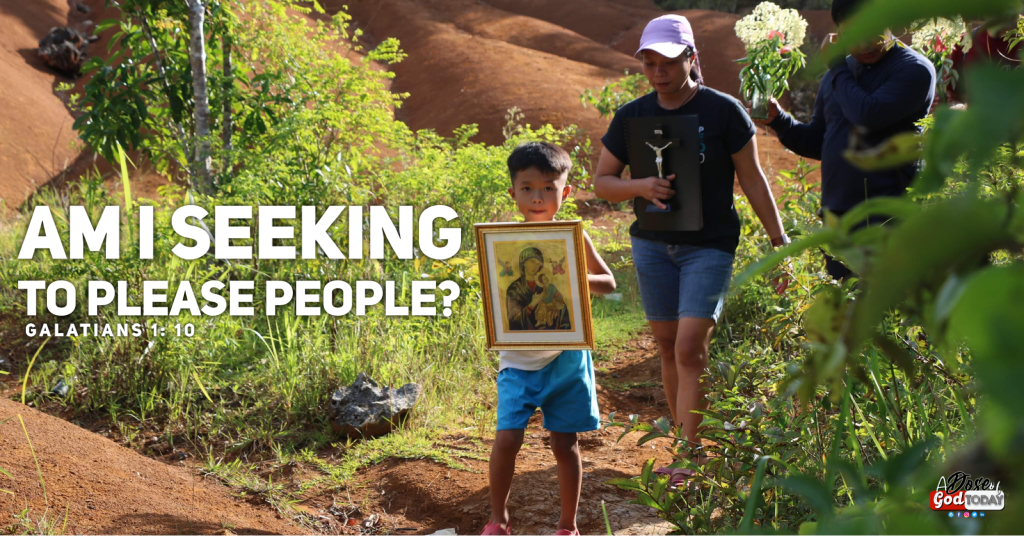
    AM I SEEKING TO PLEASE PEOPLE? 

    October 3, 2022 – Monday of the 27th Week in Ordinary Time

    Click here for the readings (https://bible.usccb.org/bible/readings/100322.cfm)

    Do I do good to seek the affirmation of others? Do I do things for others in order to gain their recognition and acceptance? Our past experiences of rejections, not being affirmed, not being recognized and accepted by others, could give us the anxiety. In order to compensate what has been deprived from us such as our childhood need for acceptance, affirmation and recognition could become our hang-ups even when we are already a grown-up.

    We would tend to please others by being good and kind, by doing any demands from others to us, by meeting every expectation from us just to gain their approval and affirmation. We could also display such attitude that would praise another person through our flattery words and extra attention given in order to seek to gain favor. Or, we could be more aggressive by directly demanding from others that we should be affirmed and recognized by soliciting such honor from others.

    What St. Paul asked, “Am I seeking to please people?” sheds light on this attitude of the heart. Paul wrote to the Galatians and reminded them that his presence among them and his ministry to them in preaching the Gospel of Christ was not about seeking their attention or even to please them or any other person. The Galatians who after receiving the Gospel of Christ from Paul was about to seek the approval of Jewish Christians who demanded that the new Christians and not Jewish before should accept first the Jewish Law and its religious practices. Only then that the Galatians will be considered as good Christians and be accepted.

    However, Paul did not agree with this. Such intention is a perversion of the Gospel. Faith in the Risen Lord is not about being able to please another culture and religious belief just to be accepted. The Gospel of Christ being received by Christians is not about pleasing another in order to be welcomed in the community. Faith in the Lord and the Gospel of Christ are the elements that constitute the life of a Christian.

    This is what we have also heard in today’s parable in the Gospel of Luke. The Samaritan did not seek to please others but he did what he should do as a human person to another human person who was in need of help. Jesus used this parable in order to respond to the question of a scholar of the Law on what to do to inherit eternal life.

    Thus, it is by being able to love God though our expression of loving one’s neighbor that we inherit eternal life. The good deeds, kindness and mercy that we do to a person in need is not about pleasing another but an expression of faith and devotion, of love and hope in God. To inherit eternal life is, therefore, also not about to please God in order to gain that favor but in showing mercy. Mere strict observance of religious practices and traditions could become our way of pleasing another like our flattery words and actions to another. If mercy does not flow from our religious traditions, prayers and devotional practices, then, these become our mere attitude of currying favors.

    May our actions, our thoughts, our kindness, goodness and mercy shown to others be our expression of that love of God and not in simply seeking to please others. Kabay pa.

  • Increase our Faith     

    Increase our Faith     

    October 2, 2022 – 27th Sunday in Ordinary Time

    Click here for the readings (https://bible.usccb.org/bible/readings/100222.cfm)

    “I am losing my faith,” these were the words of my friend who has been in so much difficulties in her life recently. The pandemic affected so much their business and lost their investments. Then, her husband who was her inspiration and strength, her comfort and dearest friend, died of covid-19. She is left alone to take care of their three children and a burden to pay a surmounting debt.  She was frustrated, in deep sorrow and angry at God for letting all these happen to her and her family. She felt lost and confused if God is listening to her and truly present.

    “How long must I endure this?” This was a question from my friend that I cannot also answer. I dare not offer any advice to her because I realized that my words would not be enough to bring comfort to her. I was afraid that I might bring more confusion to her. And so I listened to her and prayed with her to rediscover faith in the midst of those great trials and to find God in her most depressing and grief-stricken moments in life.

    Prophet Habakkuk in our first reading also expressed such distress and hopelessness in the midst of an overwhelming suffering. “How long, O Lord? I cry for help but you do not listen!” Habakkuk seemingly felt the absence of God amidst the misery and violence he had witnessed.

    At this time, the tragedy and suffering of the people were caused by themselves. Prophet Habakkuk lived during the time when their political leaders, their kings, committed grave sins against God and the people. In particular, King Jehoiakim led his people into evil. He was a corrupt and a godless tyrant who murdered his own people, violated the wives of the men who were against him and then seized their properties to be his own.

    This was the situation of their nation under such ruthless leader. And with this, there was also an overpowering foreign kingdom of the Babylonians who threatened smaller kingdoms. There was a coming destruction that Habakkuk had already seen.

    Thus, the prophet prayed in behalf of the people, “How long, O Lord?” The suffering of the people, the violence and misery that they were enduring seemed to be endless. Yet, the prophet still hoped and held on to his faith. This is what we have heard at the end of first reading, “and for the just one, because of his faith, shall live.”

    The invitation of faith is what we have also heard in today’s Responsorial Psalm, “If today you hear his voice, harden not your hearts.” Indeed, God speaks to us and God remains present even in the darkest and most painful story of our lives. That is why the Psalm calls us to sing songs of thanksgiving in God’s presence, to come to God and recognize that God is our God. We are the people he shepherds, the flock he guides. Therefore, we are not the one who is in total control of life, but God, something that could be very difficult for us to understand.

    Such realization is what we also find among the apostles of Jesus, who asked the Lord, “Increase our faith.” The apostles realized the their faith might not be enough to become worthy of Jesus. They became concerned that they might not be in control of their lives and lose their way.  Before this request, Jesus told them of the significance of a person who has faith and that is to be able to lead others to God’s presence and to be able to forgive.

    This was the very context of that plead from the apostles. Their faith might not be enough to lead the people closer to God and might even lead many to evil just like Jehoiakim, the corrupt and godless tyrant. Their faith might not be enough to forgive others because they might turned to become bitter, hateful and vengeful. Their faith might not be enough when great suffering and persecution will come in their life. They might lose their faith.

    Yet, the Lord assured them that even when faith is just as the small size of a mustard seed, that can make wonders in us. This is something that Paul also reminded in his second letter to Timothy. Paul who was already old and was in prison became more confident and assured in his faith despite the persecutions and the suffering he was enduring.

    Paul reminded and comforted the young Timothy of the gift he received. Timothy was gifted with faith. Thus, Paul said, “stir into flame the gift of God that you have through the imposition of my hands” (speaking of the gift of ordination). God gave Timothy power, love, and self-control. This was how Timothy was told neither to be ashamed nor to be a coward to become a witness of the Lord, a witness of God’s presence and of God’s goodness even in the midst of evil and suffering.

    With all of these, this 27th Sunday in Ordinary Time tells us and reminds us that…

    First, faith is our loving response to the Lord who is ever faithful to us and ever present even when we feel that he is not.

    Second, faith is our power and our strength especially in times of hardships or in times of miseries and in times of confusion and great trials.

    Third, faith is not just a mere adherence to creeds or traditional religious practices that we have. Rather, faith is our active response to God who has called us to be his witnesses, to become Jesus’ present-day apostles who shall bring others closer to the Lord through our own experiences of God working in our life. Kabay pa.

  • FOR Love than benefits

    FOR Love than benefits

    October 2, 2022 – 27th Sunday in Ordinary Time

    Click here for the readings (https://bible.usccb.org/bible/readings/100222.cfm)

    Once a boy approached his mother and demanded: “Mom, may I ask now for your payment. Give me now my rewards and prizes”. The mom asked, “Payment, rewards, prizes? For what?”  The boy replied, “for cleaning my room, for preparing the table, for washing the dishes, for passing all my grades, and for tending my brothers and sisters”. “Ahh, see”, the mother continued, “Son, for nine months I bore you in my wombs, for many sleepless nights worrying and taking care of you in your sickness, for washing all your clothes, for cooking your food, for making both ends meet for your food, clothing, and education – all of these things are done for free. I don’t expect payments, rewards, or bonus prizes, from you; not out of obligation but out of my special love for you.

    Perhaps some of us may be like that boy, thinking and considering God – not as our Father or parent, but as our master or boss, whom we work for & who should repay and compensate us of all the good things we have done for Him in life.

    We sometimes do find ourselves – consciously or unconsciously, demand from God payment or rewards for every good deed we have done, and punishment for every wrong or bad deeds we have done. We sometimes think that God should grant us bonus, payments, and rewards for every service we rendered, at the same time should judge and punish those who fail and done disservice. We cannot deny that we do have this kind of mentality – that salvation is due to rewards and punishment based on our deeds and services.

    Jesus in our Gospel today wants to correct this kind of mentality and perceptions. In Jesus times, this mentality of reward and punishment for human deeds and action has been a dominant theology of the Jews. When his disciples asked Him to increase their faith, here, Jesus clarifies to them that their requests must come and base from their deep faith and trust in God, and not in their expectation and aspiration to be rewarded and compensated for their good endeavors.

    For Jesus, it is not right for us to put God in a situation that He is indebted to us, that He has the obligation and responsibility to repay us for our good deeds and to punish us for our wrongdoings. We cannot force or coerce God to grant us His gift of salvation. We have no right to demand payment, bonus prizes, or rewards for our deeds, because the salvation He grants us is not payment or even our wages for our performances & deeds, but His grace, His free voluntarily given gift to us. Meaning, our salvation does not depend on our deeds, but on God’s generosity – not on our performances but on His great love for us.

    Consider then, Brothers and sisters, that God is our Father, our Parent – not our boss, our employer. We are His children, not His employees or workers. We know that children obey their parents because of their deep love and trust in them. We obey and love our parents not because of rewards and punishment but we choose to reciprocate the special love for us. Meaning, we don’t have to earn God’s love, because, like parental love, God has already loved us even in our sinfulness or even if we fail Him with our wrongdoings, and in whatever our performances in life maybe. We obey God’s commandments, we serve Him, not to earn His love, but because He already loves us, and because we love Him back in person and not out of benefits, payments, or rewards.  

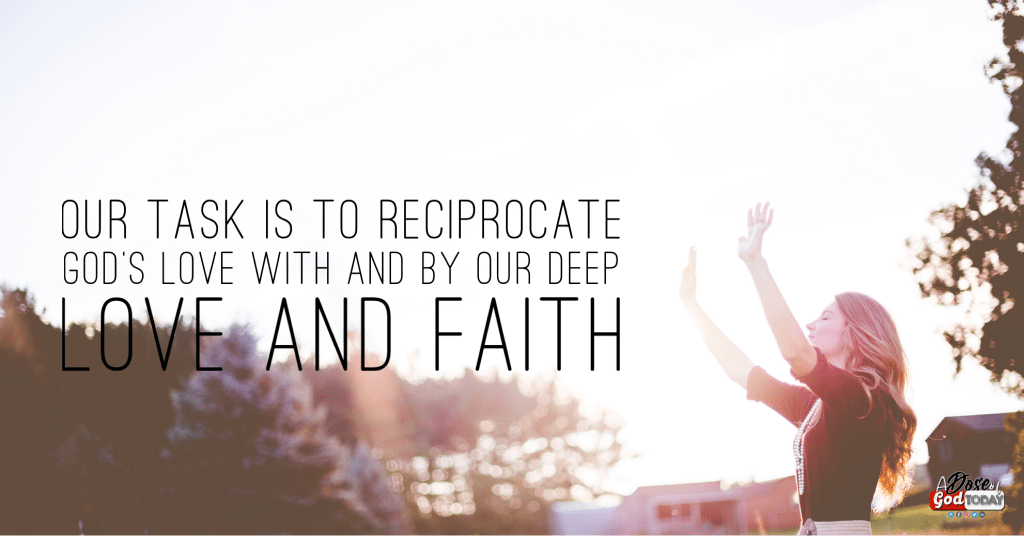
    Brothers and sisters, our loving and generous God, as Parent always longs and hopes that we love and serve Him out of our love and faith, not out of obligation, fear and rewards or punishment. Our task now is to reciprocate God’s love with and by our deep love and faith for Him in person than just by services & functions.

    Lord, grant us the grace to be contented with our Father’s Great Love for us His children, and of our child-like faith and love for Him. Keep our hearts & mind free to love & serve Him as we should & as we choose to be now and always…

    Amen.