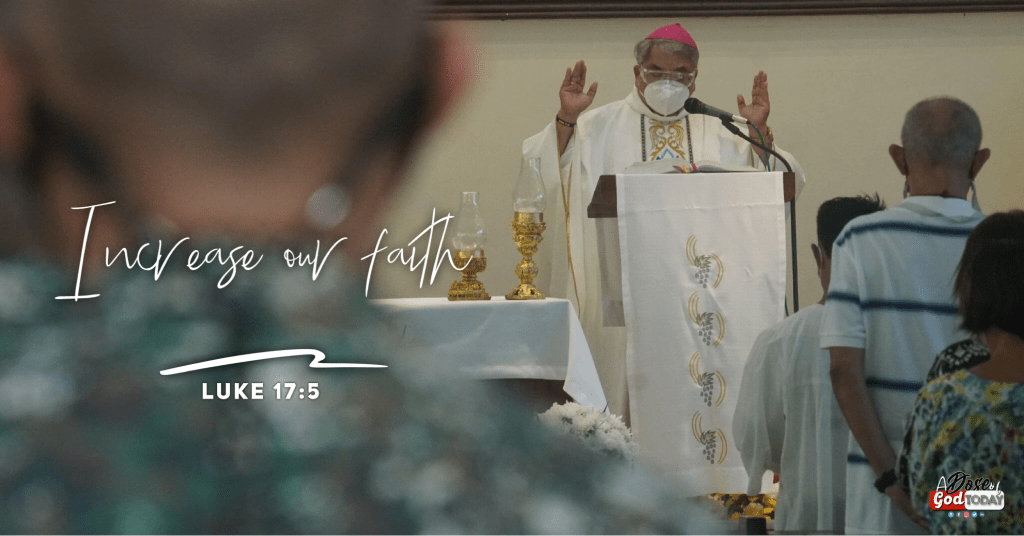
It must have been difficulty and almost an impossible task to do what Jesus said to his disciples. Not to cause another to sin and to forgive one’s brother or sister many times are reasons why the Apostles of Jesus asked him, “Increase our faith.”
The weight of the call of duty of being a believer is so great for it requires commitment of oneself to the Lord and to what the Lord asks us to do and to be. Faith is therefore neither an affiliation to some group or organization nor to be partially accepted and practiced in one’s life. This reminds us again, that faith, is basically our relationship with the Lord who has called us. It is our response to the Lord who first loved us, as Pope Emeritus Benedict XVI said. Thus, faith molds our way of life, our way of thoughts and actions and affects significantly our relationships with each one as a community and those outside of our community.
What the Apostles asked of Jesus to increase their faith is a prayer to grow deeper, closer and more intimately in their relationship with Jesus that will make them more like him.
In a way, Paul expressed this in his letter to Titus. He directed Titus on what qualities to look for in appointing presbyters or elders and bishops in those Christian Communities. These people who shall be God’s steward are called to be Christ-centered and faith-oriented for they represent God and lead God’s people closer to the Risen Christ. This is their call of duty as leaders and as Christians. Hence, being a person that causes people to sin and becoming unforgiving is tantamount to being unchristian, being an unbeliever.
This is the very invitation for us today, that like the Apostles we may also ask the Lord to increase our faith. When we are tempted to give in to our selfish desires that may lead others to also sin, we pray, increase our faith Lord. When we are tempted to resort to violence because of our frustrations, failures and unfulfilled hopes which will affect our relationships with people, we pray, increase our faith Lord. When we are overwhelmed by our anger and hatred that our hearts become unforgiving, we pray, increase our faith Lord. When our heart will also tend to choose to be indifferent, cold and unconcerned of others, not wanting to relate and be involved in the struggles of others, we pray, increase our faith Lord. Kabay pa.
Are you living to die? Or are you dying to live? Do we seek to give life? Or do we suck out life? We have just celebrated All Souls’ Day and remembered the lives of our departed loved ones. We remember not just their life but also how they died. Some may have died in tragic and painful events. Some also may have died peacefully. Remembering their death and being aware also of our own, sooner or later, what gives us hope is the promise of the resurrection, a blessed life that we will share with Jesus.
However, the promise of the resurrection is not just something that will be for the future alone. Its grace and mystery are so vast and beyond any boundaries that we are already being invited in the here-and-now. And so, as we are being invited to hold on to that promise and have a taste of that blessed life in our present context, allow me now to journey with you a bit deeper on this 32nd Sunday in Ordinary Time.
In 2019, I was in a funeral wake of a young professional in his mid-twenties. Because of much pain and hurts that he was experiencing in his young life, he couldn’t endure them. He was helpless and felt hopeless. He felt alone and lonely. All of these directed him to depression until his depression clouded his mind and heart which also led him to kill himself.
Without judging him, such situation brought me to ask myself, how am I living my life right now? Am I letting hopelessness and despair to deprive me to live fully and meaningfully with others?
Back in college, I met a leper in Cebu, an old woman in her 70s, abandoned by her family in her teen-age years when leprosy began to manifest in her body. Yet, despite being abandoned and left alone in the hospital for lepers, she remained hopeful in life by resisting to be eaten up by despair, by emotional hurts, by abandonment and by the very suffering she was enduring. Thus, she even adopted an abandoned baby girl with cerebral palsy whom she named Nancy. She found Nancy in a garbage bin in Cebu. Despite her poverty, she accepted Nancy in her life and let Nancy feel a mother’s love, affection and care. Yet, as Nancy grew up and due to her failing eyesight and old age, she has to let go of Nancy and bring her to a group of Sisters who could provide better the needs of Nancy. Despite the pain of separation and of the loneliness she would endure by losing Nancy beside her, she let her go. In that way, she gave life to Nancy even though she herself struggled to live. She died peacefully in the hospital for lepers knowing that she was capable of loving and being loved.
With this encounter, I also asked myself, am I giving life? Have I tried to give myself in order to give life to others? Or am I just busy living only thinking of myself without any regard and care for others?
In the second book of the Maccabees, we have heard the story of the seven brothers and their mother who were tortured and killed. The king wanted them to violate the law of God. Despite the trials and persecution, the reverence they gave to the law of God made them commit their whole life even up to death. This was their expression that there is more in this life, and that is, the resurrection.
Their story tells us that suffering and persecution, trials even sickness and death are nothing because the righteous, those who are favored by God will be raised up.
This is what Paul also tried to express in his second letter to the Thessalonians. Paul confessed, “The Lord is faithful.” This was his experience and his reminder to the Christians in Thessalonica that amidst trials and persecutions, they too will be confident in God’s faithfulness. Paul also asked for prayers and hoped that the Thessalonians, their hearts, will be directed to the love of God and to the endurance of Christ. Christ is therefore, our strength and confidence in times of trials and the fullness of our joy. This fullness of joy reminds us of the blessed life in the promise of the resurrection.
But let us remember, this fullness of joy or blessed life or the promise of the resurrection begins to unfold today, in our present moment, in the quality of our life and relationships.
This was the failure of the Sadducees, the fundamentalists at the time of Jesus categorically denied the promise of resurrection. For them, this was completely foolish because this was not clearly affirmed in the Pentateuch or the Torah. However, the situation they gave to Jesus of a woman marrying the brothers of her dead husband, one after another death, was a complete misunderstanding of life and the resurrection.
Their denial of the resurrection was a denial of God’s power over death. Their misunderstanding of life that only ends in death expressed hopelessness. And their perversion of one’s life that remains the same if there is ever a resurrection, referring to their question to Jesus, is an insult to the fullness of joy in the resurrection. Resurrection, as Jesus said, is not a state of life that we have now but the fullness of joy and total blessed life shared with the God of hope and of life.
How are we invited now so that the hope of the resurrection shall grow in our hearts, mold our faith and develop the quality of our life and relationships? There are three invitations for us now.
First, live to share hope. This invites us that we ourselves will become an instrument of hope not discouragement or fear. Let our very person and our presence express hope for those friends who may be struggling now, needing support and understanding, company and acceptance. Living to share hope is call from us that we are anchored and secured in our relationship with God, who is our hope.
Second, live to share love. This calls us to go beyond ourselves and beyond our comforts in order to show concretely our love. Living to share love requires our commitment in our relationships which can be difficult, or even painful at times. Yet, it is in truly living to share love that we too experience what life is.
Third, live to share life. This directs us to recognize that we can actually regenerate life, inspire life, defend life and motivate life. Indeed, this is an invitation to us not to suck the life of others, or to abuse, oppress and kill the life of others. All of these are not from the God of life but of evil. Like what Jesus did, this could be quite challenging because living to share life is giving totally our life for the sake of others.
And so, as we are called to live to share hope, love and life, may the God of the Living and not of the dead, bless us with a joyful and blessed life today and tomorrow. Kabay pa.
The presence of our friends in our life truly makes difference. It is usually with our friends that we share our deepest thoughts and dreams, our fears and confusions, our pains and sorrows, our joys and successes. Sometimes, our friends know more about us than our immediate family members. It is because friends allow us to be who we are. Friends give us the space to be fully accepted and embraced. Friends unconditionally support us and understand us because of our shared experiences, shared stories and shared dreams. These are some reasons that connect us intimately with our friends that make our hearts truly grateful.
Paul in his letter to the Philippians also recalled such gratitude in his heart for the gift of friendship he had developed with the Philippians. Paul who was in prison and was in many difficulties while being there and trying to survive, was comforted by the thought that his friends remembered him and cared about him. His friends sent material resources that he would need. This was not just the first time because even during the travels of Paul to preach in other cities, the Philippians expressed their generosity and support by providing his needs for the journey. Paul said it intimately, “it was kind of you to share in my distress.” The thought of being remembered by friends had given Paul assurance and confidence despite the suffering and persecution he faced.
More than this friendship, Paul also expressed that what sustained him was his friendship with the Lord. Paul expressed it in this way, “I have the strength for everything through him (Jesus) who empowers me.” This friendship with Jesus was the very reason of that friendship he had with the Philippians. Hence, Paul wished and prayed that the Lord may also bless his friends in Philippi.
This gives us a picture of our capacity to give oneself, to be generous and kind in order to express our support and love for our friends. Moreover, this also makes our heart to be truly gracious for the gift of friendship we have
This is the invitation that Jesus has for us today. The Lord warns the people of the desire to keep things for the self alone and become self-entitled to many things, which leads to corruption and dishonesty. The Lord also invites us to be generous enough to people in need. Being generous expresses in us the attitude of being trustworthy even in small things. This was how Jesus confronted some of the Pharisees who loved money and loved to enrich themselves in dishonest transactions. This kind of attitude does not develop true friendship but abomination in the sight of God.
Hence, as we make friends, we may truly become generous givers not just in terms of our material resources but also of our presence, understanding and support as our expression of our concern and love for our friends. As friends, we may also become grateful receivers and not “self-entitled-leeches” to our friends who only try the suck out the goodness and kindness of others. Kabay pa.
The master in today’s parable praised his dishonest steward, whom he trusted to manage his material resources. However, the steward was not praised for his dishonesty, of course not, but for “acting prudently.” This steward after hearing that he will be fired, secured his future by dropping out his corrupt practices. Well, not for the benefit of those who owed his paster but for his own benefit. Indeed, it is “prudence” and the “right attitude” at the present moment that Jesus calls us today.
“Prudence” as defined by Meriam-Webster Online Dictionary, is a skill and good judgment in the use of resources or the ability to govern and discipline oneself by the use of reason. So, by being prudent, we don’t do things, decide or act out of our impulses and mere capriciousness, or compulsions or feelings but in having a good judgment by using our reason or mind.
Thus, prudence allows us to be “discerning,” that is, to see and recognize what is God’s and what is not God’s desire.
“Right attitude of the present” is our way of life. This creates positive impacts in the lives of others. Right attitude is neither manipulative nor deceiving nor oppressive. Rather, it has something to do with gratitude and contentment. Therefore, by being grateful and contented of what we have and don’t have, make our heart generous, fair and honest unlike the dishonest steward. He may be prudent but lacking in right attitude.
This is what Paul also reminds us in his letter to the Philippians. Paul strongly exhorted the community of the attitude of those who turned corrupt, oppressive and deceptive of others. In his words, he said, “Their end is destruction. Their God is their stomach; their glory is in their ‘shame.’ Their minds are occupied with earthly things.”
This is a sign that these people were acting out of impulse and selfish desires as long as they feel satisfied. Yet, their end is destruction, not freedom, not contentment, not life. Certainly, such way of life does not lead to freedom and peace. This attitude also affects others negatively because such desire when translated into action can become vicious, oppressive and corrupt. This causes suffering to others.
Thus, as children of the light, the Lord has two invitations for us today. First, to be prudent in our decisions and actions, so be discerning. Second, to learn the right attitude in our dealings with people and in using our material resources. May our thoughts and actions and very person inspire others to be truly generous, fair and honest. Kabay pa.
While Jesus was trying to bring people to conversion, freedom and closer to God, a group of people grumbled and complained because of Jesus’ intentions and actions. The parables of the lost sheep and of the lost coin are images of God searching for those who have lost their way, who distanced from the community and from God. Yet, God longs and desires the presence of those who lost their way and wants to bring them back to his presence. Thus, these two parables tell us how dear each of us in the heart of God. God does not rest and does not surrender until God wins us back and finds us again.
However, such image and nature of God, was received with hatred and hostility by those who wanted “to control God.” The Pharisees and scribes complained and grumbled because Jesus was eating with sinners and being friendly with them. For them, Jesus was not following the law that they revered so much. They did not want a God who forgives and redeems sinners and the lost. They wanted a God who condemns as what their law prescribed.
This was the reason of their grumbling because they wanted a condemning God. Having this kind of God, then, they can easily incite fear among the people and control people according to their agenda and selfish intentions.
That is why, Jesus’ presence was indeed a threat against these people, because Jesus was turning the table against them. Jesus revealed the true face of God, a loving and forgiving God.
Hence, while Jesus tells us of God’s embrace and God’s longing for us, we too are reminded of our tendency to reject God. The Pharisees and the scribes represented that tendency in us to reject whatever is God’s. However, just as the shepherd never stopped until he found the lost sheep and just as the woman searched carefully until she found the lost coin, God also continues to call and invite us, to search and to find us until we allow God to embrace us.
This is what Paul also realized. His letter to the Philippians revealed his past where he thought that he was already in the right path. Yet, Paul was a lost soul believing that righteousness based on the law was enough. However, when Jesus found him, Paul also found himself and gained everything in Christ.
And so, like the tax collectors and sinners, may we have the courage to draw near to Jesus and listen to him and be changed by him. May these parables always remind us of this God who longs and desires for our presence, for our conversion and for our freedom. Moreover, may it move us too to be more embracing, accepting and welcoming of our brothers and sisters who need a lot of understanding and love because of unfortunate circumstances in their life. Kabay pa.







 A DOSE OF GOD TODAY