Category: Marian Homilies

  • Where are you?: God Finding Us

    Where are you?: God Finding Us

    December 8, 2020 – Solemnity of the Immaculate Conception of the Blessed Virgin Mary

    Click here for the Liturgy in PDF File (https://adoseofgodtoday.com/sunday-liturgy/)

    Homily

    “Where are you?” God’s voice must have been echoing in the garden looking for humanity. God’s voice also echoes today in every heart of man and woman, waiting to be heard. Though God knows where we are, but God waits until we show ourselves to Him in humility. This is the very scene that the Book of Genesis is depicting to us on this Solemnity of the Immaculate Conception of Mary, the woman consecrated to God.

    Now, let us see a bit how sin destroys our relationship with God and with one another, and on how grace also restores that relationship and brings new life through the person of Mary.

    Sin leads us to fear. Fear is filled with guilt and shame. This is the reason why Adam and Eve were hiding. Their nakedness tells us of their guilt. Yet, their guilt never assumed the responsibility that they have sinned. As a result, what happened was the chain of blaming. Adam blamed Eve. And Eve blamed the Serpent.

    Because of sin, the intimacy between man and woman was shattered. In the same way, they lost their closeness with God. It was them who distanced from God. Thus, sin makes us to hide yet, it leads to destruction and to death.

    Moreover, in this occasion of the Immaculate Conception of Mary, we are reminded of the original grace in each of us, of that grace given by God to us. In Mary, that grace was preserved. The Gospel of Luke that recounts the annunciation to Mary sheds the light of this mystery.

    What we see in the life of Mary is this –  that grace leads to confidence and faith. Such confidence and faith made Mary to conceive God in her womb. She became pregnant with God. Mary’s willingness and availability for God and for others allowed God to work wonderfully and beautifully in the life of Mary. This reminds us now that grace indeed, overflows and it creates and inspires life.

    After all, God continues to find us not to condemn us and to destroy us but to renew us, to recreate us, to give us the fullness of God’s grace and presence.

    Through the fullness of grace in Mary, God initiates to restore our relationship with Him. This has been fulfilled through the participation of Mary by expressing her freedom that she chose God, she chose grace not sin, and that she chose life and not death.

    How is God calling us now through the Immaculate Conception of Mary?

    First, as the Book of Genesis tells us, God calls and finds us when we try to hide because of shame and guilt. God does that, not to condemn us to death and to eternal misery but to restore and renew us. Allow God to find us.

    Second, when we ty to separate and distance from God, God initiates to come to us to invite us to come closer to Him in humility. Thus, let not our fear, guilt and shame prevent us from seeking God’s mercy. Our sacraments are God’s initiative too to make us ever closer to Him. Allow God to forgive us.

    Third, God desires that we too shall be filled with grace so that like Mary, God’s grace will also overflow in our life. The pregnancy of Mary and becoming the Mother of Jesus, was that overflowing grace of God to Mary. When we choose the Lord today and every day, God blesses us and fills us with grace. Grace makes us discerning and understanding, joyful and generous. Moreover, grace does not only renew us but also grace inspires and creates life through us. Thus, allow God today to fill us with grace. Hinaut pa.

  • Life and Living Life is to Give Life

    November 21, 2020 – Memorial of the Presentation of the Blessed Virgin Mary

    Click here for the readings (https://bible.usccb.org/bible/readings/112120.cfm)

    Homily

    This celebration of the Presentation of the Blessed Virgin Mary has no historical basis. This cannot be found even in the Gospel or in any letters of the New Testament. However, the Church has celebrated for more than a thousand years. There must be something so important and significant in this feast of Mary that moves us to celebrate it year after year.

    This tradition can actually be found in the unofficial scripture called as the Protoevangelium of James. Though this feast is not a historical event, but this is spiritually and theologically important for us. According to that scripture of James, the parents of Mary, Joachim and Anne offered their daughter to God in the Temple at the age of 3 years old. The action of Joachim and Anne was an expression of their gratitude to the Lord. This old couple who was given a daughter in their old age, offered back to God the very gift that they have received from God. The shame of having no child, as it was believed at that time, turned into joy at the birth of Mary.

    Certainly, this joy moved them to give. This was out of deep gratitude to the generosity and faithfulness of God in their life as husband and wife. This sacrifice and offering became the way in the consecration of the life of Mary to God. At a very young age, Mary became aware of God’s presence in her life which she first realized in the life of her parents. This tells us now how God transforms a sacrifice into something wonderful and beautiful. The life of Mary, became the beauty and the wonder that the world longed to see. Indeed, through Mary, a child was born for us, the Emmanuel. Through the life of Mary given to God, life was also given to us, through Jesus.

    This, feast then, actually prepares us to celebrate wonderfully the Solemnity of Her Immaculate Conception and the Birth of her Son, Jesus. That is why, this feast is so significant to us. What we honor after all, is God who consecrated the life of Mary and from whom we too are being blessed.

    Through this feast, we are reminded today that life is not about accumulating things or securing something for oneself. Life and living life is to be able to give life which Joachim and Anne did and which Mary did and ultimately which Jesus did to us.

    This is contrary to what the Pharisees and teachers of the law wanted to happen. They were so concerned on what they could get from others in this life. That is why, they asked a malicious question to Jesus, to trick him and embarrass him. Yet, Jesus knew their hearts. They were filled with malice and selfish desires. This attitude reflected in the very situation they presented to Jesus, of a woman marrying the seven brothers when one after another died without having any child.

    Today on this feast of Mary, as we live life day by day, be more life-giving.

    Thus, as husband and wife, give back to God your marriage life and make God the very center of your marriage so that you will be able to give life to your children and to the community around you. As a family, give to God your joys even your sacrifices and pains so that God can transform you into blessing to others.  As a professional, give to God your work, your passion and even your and failures so that God will bless you to be an inspiration to your co-workers.  As a young person and as a student, give to God your struggles, your dreams, hopes and even your fears and anxieties of the future so that you become an influencer of confidence and trust in God. As a senior citizen, offer to God your good old days, including your good and bad memories, offer your routine and even your illness and uncertainties in life so that you become a witness of God’s faithfulness and generosity. Hinaut pa.

  • To live brings out pain, yet it bears fruit joy

    To live brings out pain, yet it bears fruit joy

    Advertisements

    September 15, 2020 – Tuesday; Feast of the Our Lady of Sorrow

    Click here for the readings (https://bible.usccb.org/bible/readings/091520.cfm)

    Homily

    To experience pain in life can become devastating and even maddening. Having a toothache can completely destroy your day. Having a headache can affect your daily activities. Indeed, when pain becomes unbearable and frustrating, it affects our daily routine and activities, our work, even our sleep and relationship with friends and family.

    Who would really want to be in pain? As much as possible, we avoid pain. Consequently, the medical science developed pain relievers that would take away slowly or instantly the aches and pains we feel in our body. In fact, a particular field among doctors has been developed to assist patients who will undergo surgeries through the use of anesthesia. Through its use, the patient will have a painless surgery so that he or she will be able to have a quality life.

    However, no remedy can be given to a heart that is bruised, abused, betrayed and/or humiliated. No doctor can apply anesthesia to a deep emotional pain. It can even linger and deepen with time. For such reason, some would succumb to it without any help from others and end their life. They see it as the only remedy to end that deep emotional pain they have been enduring in their life.

    This is the sad part because pain will really be unbearable and life-threatening when it is faced alone. Today, as we celebrate the Feast of Mary, the Our Lady of Sorrows, we are reminded that pain in itself is all part of our life. No one can escape pain. Everybody will surely meet pain in different degrees and aspects of life. And what this feast is reminding us now is the wonder and the beauty in confronting and carrying pain with others.

    Let us remind ourselves at the prophecy of the old Simeon. This old man had been waiting for the appearance of the Christ. When the baby Jesus was brought by the couple, Joseph and Mary to the Temple, behold, Simeon had caught sight of Light, the salvation of the world. However, this child will be responsible for the rise and fall of many in Israel. What he meant, was the rising of the humble, the poor and those marginalized by the society into the heart of God and the fall of the powerful, the self-righteous and the corrupt. For this reason, the infant will be a contradiction. The child will bring change and transformation to all that can be painful to those who seek comfort and power, titles and riches.

    Being a contradiction to the world, the child himself will undergo a terrible pain of betrayal, of dying and of death in which no amount of pain relief medicine or anesthesia can aid. Moreover, the same amount of pain was also given to the mother of the child, to Mary. As Simeon prophesied, “you yourself a sword will pierce.” Mary’s heart will be pierced with so much sorrow and pain as she suffered with her son.

    Every blow to Jesus, Mary also endured. Every insult to her Son, Mary also suffered. And every agony of Jesus, Mary also agonized. However, despite all these gruesome and painful events in the life of Mary, she did not hide. Mary did not escape into dreams. She did not ran away into loneliness and depression. Mary bravely confronted pain by being with her Son, by journeying with him until his last breath.

    Why is that? When people would hide and ran away from pain as what the men disciples did, but, Mary bravely faced that sword piercing in her heart and suffered in silence along with her Son. What gave her the courage? What made her to stand beside her Son and her Lord?

    It was love that sustained Mary. It was her deep concern and affection to the person whom she loved that moved her to be with Jesus and to also suffer with him. And to the suffering Son on the cross, the presence of her mother was the best comfort he had. The presence of Mary was more powerful than any pain reliever or any amount of anesthesia applied to the dying Son. Though, Mary’s presence did not take away the pain, but her presence made Jesus to be more resolved that there is hope in humanity.

    Mary’s presence on the cross is a testament to God that humanity can show so much concern and love to a suffering person. That’s why pain is never the end, suffering is never the last thing in life. The glory of the resurrection of Jesus tells us of that freedom from pain and promise of joy. We can attain that, by being together, by not suffering alone, but by allowing others to suffer with us or by allowing ourselves to suffer with others. Certainly, to live life will bring pain in us, but it will also bears fruit joy because of being with our friends and loved ones.

    Thus, on this feast of Mary, we are also called to be an instrument like Mary, to give comfort to those who are suffering and in pain in many ways, physically, spiritually or emotionally. Let our presence be an assurance of friendship, of love and concern to those who are in terrible pain this moment. For those who are in pain also, never retreat, deny or hide the pain or escape from pain, but allow others to journey with you. Allow those who love you to hold you and to embrace you. They may not take away the pain you are feeling, but let their presence, friendship and love be your source of comfort and confidence in your trying moments.

    May Mary, the Our Lady of Sorrows, pray for us. Hinaut pa.

    Jom Baring, CSsR

  • Pregnant with God’s Presence

    Pregnant with God’s Presence

    Advertisements

    September 8, 2020 – Feast of the Nativity of the Blessed Virgin Mary

    Click here for the readings (https://bible.usccb.org/bible/readings/090820.cfm)

    Homily

    Viva Maria! Viva Hesus!

    Mary, indeed, is a key figure in our salvation history. Yet, not one story in the bible that we could find about her birth. The first time we encounter Mary was already at the annunciation of the Angel Gabriel that she was to become pregnant with God.[1]

    Mary’s birthday can only be understood and appreciated through her pregnancy and her presence in the life of Jesus. So, as we joyfully celebrate her birthday today, let us discover God’s invitations for us as we remember the life of the Blessed Virgin Mother.

    The Book of the Prophet Micah tells us how the lowliest among the clans of Judah, Bethlehem-Ephrathah, was chosen by God to become the bearer of the ruler of Israel, who is called Peace.

    Bethlehem was indeed a small town, though the birthplace of David, the great king, but it remained un-influential. Ephrathah is the old name of Bethlehem which was retained by the Jews. These names are indeed symbolic because of the meaning behind them. Bethlehem means the house of bread and Ephrathah means fruitfulness or abundance.

    Micah tells us how the Lord brings abundance of bread, an abundance of life from this lowly place. Certainly, the son that Mary brings to us is the bread of life who brings abundance of love and life into the world.

    The Gospel today from Matthew recalled how Mary was found out to be pregnant and how Joseph planned to divorce her quietly. However, God intervened through an angel telling Joseph not to be afraid for Mary conceived a son through the Holy Spirit, “She will bear a son and you are to name him Jesus (meaning, God saves) because he will save his people from their sins.”

    This particular story of the pregnancy of Mary tells us more of the birth of Mary, of why we are celebrating with joy and gratitude to God the birth of the Mother of Jesus and our Mother too.

    Through the life of Mary, the Lord reminds us and call us in an intimate way to come closer to Him for God gives abundance of peace and life. There are three points that I invite you to dwell on this birthday of our Mother Mary.

    Advertisements

    First, to be humble. God chooses us not because of the great things that we do. Our desire to be great in the eyes of others is futile in the eyes of God. God chooses us because of who we are to God. We are loved though we are not deserving. The clan of Bethlehem-Ephrathah was surely not deserving but in his lowliness God found delight. God finds delight with the unpretentious that is why God found favor with Mary. And Mary responded to God out of gratitude and faith.

    Second, God never forgets us. God’s intervention in human affairs proved how God will do everything to let us know that we are loved. God, through the participation of humanity, and that is through the person of Mary, made the Divine presence be felt and be manifested in a concrete way. Thus, even in times of so much confusion and difficulties around us, never forget and always remind ourselves, God has never forgotten us. God is with us.

    Third, we can be pregnant with God. Yes, Mary’s pregnancy tells us that humanity can be pregnant with God. This means that we are capable of becoming a bearer of God’s presence to others. To become pregnant with God is to welcome God fully in our life where we are promised to be also filled with love, with peace and with the abundance that life with God can give us. In Mary’s pregnancy with Jesus, her heart is revealed that there was no bitterness, no scars of fear or hate, only love, only peace. By allowing the Lord to be with us, we may also become pregnant with God’s presence where our heart shall also be cleared with bitterness, fear and hatred.

    In this way then, we may hopefully celebrate this day of birth of Mary, our Mother, with true joy and gratitude to the Lord for giving us such grace. Hinaut pa.

    Jom Baring, CSsR


    [1] What we only have is the story of her birth that can be found in a Christian-devotional Text called, “The Protoevangelium of James.” In this text, that parents of Mary were named as Joachim and Anne, an old couple who were also graced with a child.

    Follow Me

    Get new content delivered directly to your inbox.

  • Signs and Symptoms not of Covid-19 but of God

    Signs and Symptoms not of Covid-19 but of God

    Advertisements

    June 27, 2020 – Feast of Our Mother of Perpetual Help

    Readings: Isaiah 7:10-17; Revelation 12:1-6,10; John 19:25-27

    Homily

    As the Corona Virus 2019 stole the spotlight, the medical experts warned us of the signs and symptoms of the virus. Accordingly, the virus can cause a range of symptoms to a person from mild illness to pneumonia. Its most common symptoms, they said, are fever, tiredness and dry cough. Others may also show aches and pains, nasal congestion, runny nose or sore throat.

    We are made aware of it and thus, when we begin to have these signs and symptoms then we are advised to seek medical help. It is, definitely, important to be aware of these because through this first step then, we can save lives, not just our life but also of those who are dear to us.

    Moreover, looking at it from a distance, this pandemic is in itself a sign that no matter how much we have achieved in life, or no matter how much power and wealth we have accumulated, we are vulnerable. This pandemic also is a sign that tells us how competent or ignorant, sincere or corrupt, and organized or messy our leaders can be. This pandemic also is a sign given to us how individuals and communities have reached out to those in need.

    With all these signs and symptoms that the Corona Virus Pandemic has brought to us, this allows me to dwell deeper into the feast we celebrate today, the Feast of Mary, Our Mother of Perpetual Help.

    Our first reading is very interesting because it tells us about signs. Usually, we would ask signs from God, but, in this story of Ahaz, King of Judah, it was the Lord who asked a man to ask for a sign. Ahaz’s story seemed to be very good because he did not ask a sign from God. He refused to ask a sign. However, his refusal to ask a sign from God was actually a refusal to believe in God.

    What really happened? Ahaz sold himself to another god, to the King of Assyria. He sold himself because he thought that this foreign power, Assyria will only be the one who can grant immediate protection and salvation for him and his kingdom. Instead of asking wisdom from the Lord on how to lead his people, Ahaz went to the Assyrians and pleased them. The kingdom of Judah at that time was under the threat of two other kingdoms, Syria and Israel. Instead of trusting the Lord to protect and save him, he went to another god, to whom he thought was his savior.

    However, history tells us that as Assyria defeated the enemies of Ahaz, he became a puppet of the King of Assyria. Not only that, the Assyrians imposed heavy taxes to the people and blasphemed the Temple of the Lord by introducing the Assyrian gods.

    This is the reason why it was the Lord himself who offered Ahaz to ask for a sign so that he may believe that God will bring salvation. Yet, even though Ahaz refused, God still promised a sign of salvation. This sign is through a virgin who will conceive a son. This son will be called Emmanuel, meaning, God is with us.

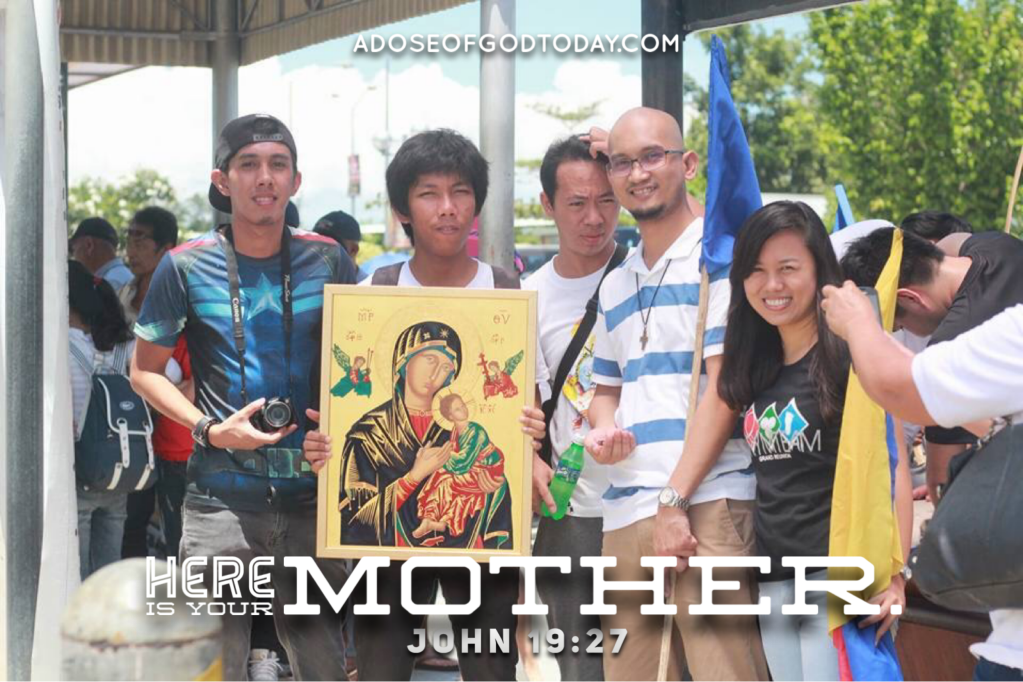
    This is the sign that even in the midst of our own disbelief, doubts and even refusal to believe, God remains with us. God remains our God and continues to be for us and with us. This is a sign of God’s faithfulness in us despite our unfaithfulness. This is a sign of God’s generosity despite our ingratitude. And this is what we celebrate today on this feast of Our Mother of Perpetual Help. The Virgin who is carrying the son, the Emmanuel in her arms, is the great sign that God showed to us.

    There again on the cross, as the Gospel of John tells us, the son showed us his greatest sign of love and faithfulness. The son has come to be with us and on the cross he stretched out his hand for the sake of all. The son, indeed, comes to help us perpetually.

    Jesus is in fact the true perpetual help. Mary is instrumental because through her, God’s sign has been brought to us. She allowed herself to be God’s instrument of help and compassion, to be the mother of the Perpetual Help.

    Even when Jesus was about to die, he assured us to have a mother, that we will not be orphaned and alone. Mary’s presence became the sign of God’s presence among us by becoming our mother.

    This is the reason why we, the Church, would always seek guidance and inspiration from Mary because we feel the identity of being a child to her. The intercession of Mary as a mother, becomes a bridge of faith. It is to lead us to her risen Son, Jesus Christ.

    Thus, this feast that we celebrate does not actually point to Mary. This feast points to the greatest sign, the perpetual help, and who is Jesus himself.

    What is it to you and to me now, to us, who are devoted to Our Mother of Perpetual Help? How shall we express our act of thanksgiving for all the graces and blessings received?

    This feast invites us that each of us and that our community becomes a sign of God’s help and love, compassion and faithfulness. This means that we let our devotion transform our life. It means that our devotion should not only remain a mere devotional practice but must also flow into our actions and words, into our decisions and choices in life.

    Our devotion, then, is call to mission. It is mission because we are sent to become signs and symptoms of God’s goodness. I invite you then this time, to discern for yourself on how you could be a sign and symptom of God’s help and compassion to people around you.

    VIVA MARIA! VIVA HESUS!

    Jom Baring, CSsR