Category: LiturgIcal Year B

  • LET THE CHILDREN COME TO ME

    LET THE CHILDREN COME TO ME

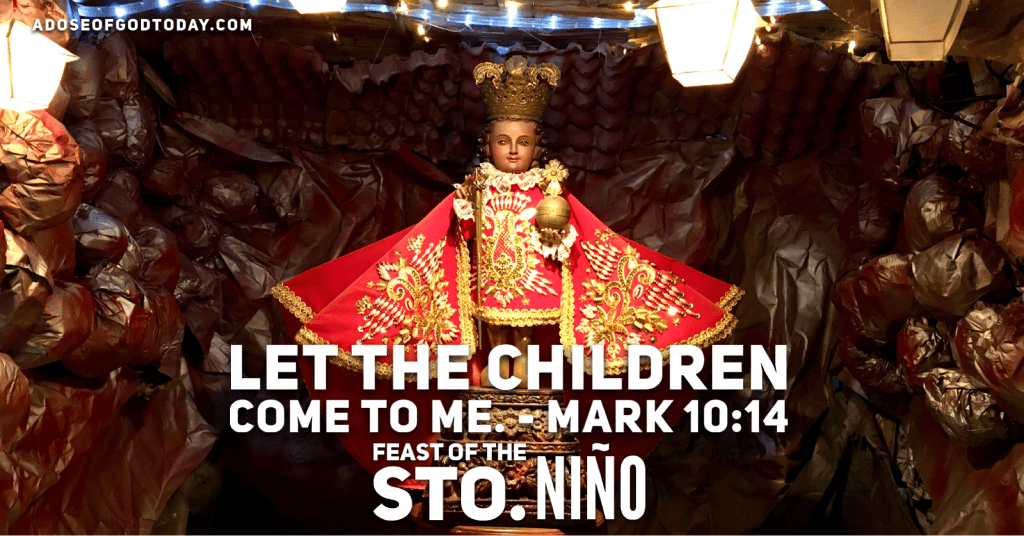
    January 17, 2021 – Sunday, Feast of the Sto. Niño

    Click here for the readings (https://adoseofgodtoday.com/sunday-liturgy/)

    Before this pandemic, when parents usually bring their small children in the Church, I have observed how parents or guardians discipline their unruly children. When a child begins to throw tantrum or just become noisy, they would say this, “Shut up, behave. Father will be mad at you. See… he is there. He will catch you.”

    Parents or guardians seemed to incite fear to the children by portraying that Father is terrible when he gets mad. One time, I sat in a corner while waiting for the mass to begin, a mother was trying to control her boy from going around. Since she noticed me, she began to make the boy fearful of my presence telling him that I will get mad. I looked at her and looked at the fearful boy but told the boy rather, “That’s not true. I won’t get mad at you. You go and play.”

    This weird way of disciplining children reminds me of our Gospel today on this Feast of the Sto. Niño from the Gospel of Mark. The disciples scolded the people who brought their children to Jesus that he might touch them. The disciples might have thought that the presence of the children was a mere nuisance and disturbance to the Lord. Considering the culture at that time, children had no legal identity, thus, not of great importance. However, this kind of rejecting attitude towards the small and those whom society thought was lesser, received indignation from Jesus.

    Jesus said, “Let the children come to me.” Thus, the Lord condemns such attitude that rejects, ignores and hurts the small and the weak.

    That is why, it will also be good for us to be aware, on this feast of the Sto. Niño, of those rejecting, ignoring and hurting attitudes in our community against the small and weak, particularly towards children during this pandemic.

    A study by the Save the Children revealed that one in three households around the world reported violence during the Covid-19 pandemic.[1] The study also found that 1 in 6 children suffered violence at home. This study also said that there is an increase of negative feelings and psychological distress when lockdowns were imposed. This explains the significant cases of depression and suicide during this time as reported by Department of Health and World Health Organization.[2]

    Moreover, according to UNICEF Philippines Representative, “The Covid-19 pandemic is worsening the incidence of online sexual abuse and exploitation in the country. Children are increasingly becoming victims of circumstances that are harmful to their development and well-being.”[3]

    Just few months ago, a girl was raped at home. However, parents were not that concerned on how to take care of their daughter because of poverty. Both parents lost their job when the lockdown was imposed in the city. It was the neighbors who responded and wanted to rescue and help the girl. But then, when the incident was reported, the authorities even suggested not to pursue the case because it will only become troublesome to them and will cost them a lot of money. It was suggested to just settle it with some money and let it go.

    What have we become? Have we succumbed to darkness to abuse and oppress the weak among us?

    These situations are just few reported examples of rejecting, ignoring and hurting attitudes towards the small and the weak. No wonder why Jesus expressed indignation towards those who prevented the children to come to him. God cares and loves the small and the weak. God desires to embrace and bless them.

    Yet, our world and the hearts of others are gloomed by anger, by hatred, by violence, by indifference, by evil. The world is also gloomed by the desire to have power, to gain control and manipulation, to be above others. The world is also gloomed by our dishonest and selfish leaders, by our unjust practices, by our support of the corrupt, by our blind obedience of the violent. Following these rejecting, ignoring and hurting attitudes is letting our hearts be gloomed.

    Yet, this is the very world and the very hearts as well that God chose and continues to choose again to be born. God only desires that everyone will be gifted with His light, with His embrace and with His blessing.

    Thus, the world may be darkened by our tragic experiences and gloomed by our individual and collective sins; the world may be darkened by our painful and sorrowful experiences and gloomed by indifference and violence perpetrated by many of us, directly and indirectly, God still chooses to bring the light, to give us the grace and to grant us his salvation.

    This is what God wants to remind us in today’s feast. In the first reading, Isaiah proclaims the coming of the light because those of walked in darkness will see a great light and those who dwelt in the land of gloom, a light will shine.
    In Isaiah’s prophecy, God will cast away the darkness and the land of gloom. But what is this darkness and land of gloom?

    It is our sin and guilt. It is our indifference and hatred. It is our pain and sorrow. It is our difficult and overwhelming situation whatever they may be. Darkness is around us. We may not be aware of it, because we might have become so used to it. However, God has come to us to bring light and salvation. Indeed, light is hope. It is God’s forgiveness. It is mercy. It is freedom. It is the fullness of life.

    God, indeed, will destroy the yoke on our shoulders that burdened us. This is the yoke of slavery from sin and evil. God destroys them not by violence but through the gentleness of God’s own yoke of friendship, of companionship. Remember, Jesus has offered us to take his yoke. This is what the presence of the Sto. Niño is reminding us now.

    God will also smash the rod of the taskmaster. This is the rod of our selfish desires. This shall be smashed by the Lord not through anger and hatred but through God’s gift of peace and mercy. Again, this is what the presence of the Sto. Niño is reminding us now.

    Isaiah tells us that a child is born to us, a son is given us. He is Wonder-Counselor, God-Hero, Father-Forever, Prince of Peace . This is the Sto. Niño being gifted to us. As Paul tells us in his letter to the Ephesians, he said, “Blessed be God and Father of our Lord Jesus Christ, who has blessed us in Christ every spiritual blessing in the heavens, as he chose us in him.”

    Therefore, we know that we have been gifted with the presence of God among us. Let his presence dispel the darkness in our hearts, the pain of violence in us, the evil of indifference in our hearts. Let this magnet of love, the Sto. Niño rather embrace us, bless us and place his hands on us.

    On our part as a Church, as a community and you as parents and guardians, and all those in the position of authority, let us not prevent the children, the small and the weak among us to be closer to Jesus. Let us all bring one another to God by protecting one another, by nurturing and supporting especially the vulnerable, by embracing and accepting one another. In this way, we may become a people of gentleness and of love. Hinaut pa.


    [1] See https://www.rappler.com/world/global-affairs/one-third-households-globally-report-violence-home-during-coronavirus-pandemic-study

    [2] See report https://www.who.int/philippines/news/detail/10-09-2020-doh-and-who-promote-holistic-mental-health-wellness-in-light-of-world-suicide-prevention-day

    [3] See https://globalnation.inquirer.net/190923/unicef-pandemic-worsening-child-online-sexual-abuse-exploitation-in-ph#:~:text=%E2%80%9CThe%20COVID%2D19%20pandemic%20is,their%20development%20and%20well%2Dbeing.&text=The%20child%20has%20no%20interest%20in%20school%20and%20friends.

  • “Bless me, Father”

    “Bless me, Father”

    January 17, 2021 – Sunday, Feast of the Sto. Niño

    Click here for the readings (https://adoseofgodtoday.com/sunday-liturgy/)

    Once just right after mass, I saw a child sitting alone on the church floor worried & crying. So, I approached her & asked, “Oh, what happened? Why crying all alone.” Between sobs, she replied: “Father, I thought it was your hand that I reached to get your blessing, but it was the hand of another child. I was not able then to receive your “Amen” – your blessing”.

    Her response is not only cute but also touching, since she only aspired to get my hand for a blessing but instead, was deprived of it. So, I told her then, “Don’t worry, Inday. I am here now. You can have my hand for blessings”. After wiping her tears, she took my hands and happily pulled it to touch her forehead for blessings. And she was so happy to hold my hand to walk with me. And more so happy and proud, when I carried her up in my arms until her parents took her… (& perhaps at the envy of other children).

    In most of our churches in the Philippines, especially in Redemptorist Churches, it is unavoidable that children and young people would approach us, priests and ask our hand for a blessing after the mass. Different types of children, (big-small, active-weak, shy-gregarious) would gather around the priest with only one desire, that is to receive “Father’s blessings”, while asking: “Bless me, Father”. And I am sure they were not forced (or were not just forced) by their parents to do so, because for children, to be blessed or to be touched in their foreheads by the priest is a great, meaningful and wonderful experience and affirmation. One simple act or gesture of the priest can be a meaningful experience and can bring joy not only to the children but also to their parents, because they are affirmed and appreciated for their child.

    Even we ourselves, when we were kids, we really enjoy when somebody affirmed and gave us attention, especially by the priest. I could still remember and never forget of the joy I experienced when the priest gave me attention and affirmation. It was my first confession. I was so small and weak then when I fearfully approached a big Irish Redemptorist priest smiling, had me sit in his lap and piously listen to my first confession.  Because of that even in my childhood years, I am so happy and courageous to receive the blessing of the priest, see and talk to them because they know me and I know them, we are friends and they are human as I am. I feel like and I consider myself as I am KASALI, KABARKADA, KABERKS, KAPUSO, AT KAPAMILYA nila Father. One with Father and with the Church, part of the group, friends, family and church.

    Even now within our own family, we claim & have our own so-called “fave” priest in our parish church. So also that even now as a priest, I would really appreciate when I am blessed and prayed over by my brother priests, by elders and by my loved ones. And now during pandemic times, I do miss the children attending mass in the church (as much as they also miss being with us in the church).

    Like the little children, especially for Filipinos we also need attention, affirmation and blessing. Because for us, to receive blessing is not only a gesture of our respect and reverence but an expression of affirmation, attention, love, and support for all our endeavors in life so far, from somebody we love and respect. When our elders or leaders touch our foreheads to give us their blessings, it is an affirmation, a positive stroking for us that would mean, “I am OK. I am good and am doing fine in life. And above all, I am now blessed & also God’s blessing to others.” That is why… as priest, I really don’t mind and would love to bless or partake God’s blessing to people (both young and old).

    As much as we need God’s blessings & demand respect from others, Jesus invites us to love, respect & bless our children, for we are all God’s blessing – Blessed to bless. Like Children, God blessed us to be a blessing to all.

    In our gospel today, we hear that while his disciples are concerned with their own importance & proper decorum, Jesus instead insisted on them the importance of little children in God’s kingdom. For Jesus, children are also persons with rights and dignity. Children also enjoy personal relationship with Jesus and the Kingdom of God. They have the right and duty to God’s blessings, to grow in faith – to grow in their own personal relationship with God. It is also their calling to be a disciple – to come and follow Jesus Christ and express their response, by their love and respect, & being a blessing for God & others. That is why, Jesus asserts on us, “Let the children come to me, Don’t prevent them…for the Kingdom of God belongs to them.

    Today, the whole Philippine Church celebrates the feast of the Sto. Niño.  We particularly honor today the child Jesus, who became part of our humanity and history. Sto. Nino plays an important role in the history & growth of our Filipino Christian faith. When in 1521 the first Filipino baptized Christians received & accepted the Sto. Nino into their lives & let their children to come & be blessed by Jesus. It gave birth to and flourish our Filipino Catholic faith which we have still live out & practice until now, after 500 years. 

    As the first Christian gift we received, the image of Sto. Nino becomes the symbol of our Filipino Catholicism, the first sacrament (symbol & means) for us to come to know, love & follow Jesus Christ. Through the Sto. Nino, Filipinos are now blessed with Christian faith & we are now God’s blessing of Christian faith to the world. Through the Sto. Nino, we Filipinos are now indeed blessed to bless others – now Gifted to give faith to the world. So now, as we are blessed by the Sto. Nino, child Jesus, may we be continually blessed & be a blessing to our children & youth of today by taking care & responsibility for the growth of their faith & mission in life, so that they may also be God’s blessings to others & to the coming generation, & thus God’s blessing continues to work & thrive in us & through us in our day to day lives. So be it. Amen.

  • WOW! ONLY IN THE PHILIPPINES!

    WOW! ONLY IN THE PHILIPPINES!

    January 17, 2021 – Feast of the Sto. Niño de Cebu

    Fr. Manoling Thomas, CSsR

    Click here for the readings (https://adoseofgodtoday.com/sunday-liturgy/)

    In the Philippine Daily Inquirer of January 16, 2009, Mr. Ambeth R. Ocampo in his column “Looking Back”, mentioned about the image of the Sto. Niño of Cebu.  He wrote: “This image reminds us of the conversion of Cebu in 1521, shortly before Magellan set off to be killed in the Battle of Mactan. It is believed that the image enshrined in Cebu is the same one given by Magellan to Humabon’s wife when she was baptized and renamed Juana.”

    In the Philippines, the 3rd Sunday of January, is celebrated as the Feast of the Sto. Niño. It is a feast particular to the Philippines, and very much related to the history of Christianity in this country.

    Today’s gospel is taken from Mark 10:13-16. In this section, Mark tells his readers and listeners, what the requirements or conditions are to enter the Kingdom of God. Jesus entered the Kingdom of God by way of suffering and death. This too is the way for every disciple of Jesus. To enter the Kingdom of God, one must be willing to strip oneself of ones ego and false self.

    Who are the beneficiaries of the Kingdom of God? Mark mentions four [4] groups of people: a) the children [10:14]; b) the insignificant, marginalized, and “rejects” of society [10:13-16]; c) the poor [10:17-27]; and d) those who have learned detachment [10:28-31].

    In today’s gospel, Mark describes Jesus in a very humane and personal way. Jesus got irritated and offended by the way his disciples treated the children that people were bringing to him. Jesus was just so delighted to see these children, that he “took them up in his arms, laid his hands on them and blessed them.” And he said: “Truly I tell you; whoever does not receive the Kingdom of God as a little child will never enter it.” [10:15].

    What does Jesus mean by that statement? Jesus is neither encouraging nor advocating infantilism. Infantilism is the attitude and behaviour of a person who is already grown up but continues to behave and to act in a childish and immature way. What Jesus advocates is that we adopt the attitude of humbly acknowledging and recognizing our own human limitations and ultimate dependence on God! It is also the attitude of recognizing our interdependence with each other. Jesus tells us not only to live in the realm of our thinking, reasoning, mental analysis, arguing, and excessive worrying. Jesus advocates a balanced life of reason, commonsense, feelings, and faith.  Integrating all these essential human characteristics makes us a total human person.

    What in a typical child, that Jesus wants us to possess, in order to be admitted into the Kingdom of God? A typical child acts as a total person: open, trusting, sincere, honest and spontaneous! A typical child is aware of his/her need for others and dependence on them.  To aspire for the Kingdom of God is to recognize and to accept our dependence on God and our interdependence with one another.

    But how is this message of Jesus related to the feast we are celebrating today here in the Philippines? Mr. Ambeth R. Ocampo, says that the image of the Sto. Niño “reminds” us of the conversion of the Filipinos into the Christian faith. But what sort of conversion did we Filipinos have? What kind of faith do we have at present? Is it a dynamic and growth-promoting faith, transforming us into mature Christian-Catholics? Are we a people and nation, worthy to be called, the “only Catholic nation in Asia”?  Our devotion to the Sto. Niño is more than 400 years old!  Over these years, what are the visible signs indicating that our Christian-Catholic faith is indeed healthily growing and maturing?

    Let us take a look at our practices over the centuries which we associate with our devotion to the Sto. Niño.

    Which of these we can consider as healthy and growth-promoting to our Christian faith? And which ones are keeping us stunted or retarded, and infantile in our faith? Are our practices expressing our devotion to the Sto. Nino in accordance with Jesus’ teachings; or are some of them infected with superstitions, fanaticism, sentimentalism; and even bordering on paganism and idolatry?

    Let us celebrate with deep gratitude to God and to the missionaries, the 500th Jubilee of receiving the gift of the Christian faith! At the same time let us honestly and sincerely ask ourselves: what kind of Christianity, are going to bring and share with our Asian brothers and sisters who have not yet heard about Jesus Christ and his Gospel?

  • God’s Beloved: I am & we are

    God’s Beloved: I am & we are

    January 10, 2021 – Feast of the Baptism of the Lord

    Click here for the readings (https://bible.usccb.org/bible/readings/011021.cfm)

    Who are you? How do people define yourself? How do you define yourself?

    Henri Nouwen, a known pastoral theologian and spiritual teacher once said: “We are not what we do. We are not what we have. We are not what others think of us. Coming home is claiming the truth that… I am the beloved Child of the Creator.”

    True indeed, we do tend to define our life by what we do, what we have & what others say about us. In defining ourselves, we do tend to claim & know ourselves & others by our talents, abilities, successes as well as our failures & mistakes. We do tend to see ourselves & others by our backgrounds, possessions, privileges, properties, friends, influences, power, as well as limitations, poverty, and misfortunes. We do tend to characterize ourselves & others by the praises, awards, titles, honor, as well as by the insults, gossips, & comments people say about us. We do tend to name our identity, dignity, reputations, & life-purpose by what we do & not do, what we have & we have not, and what other say & not say about us.

    Though much effort & time we have spent in life to identify ourselves & others by our actions, possessions & feedbacks, we do know deep inside that these standards are limited & limiting. These self-classifications are degrading (ka-menos) to our very person & not who we really are. Eventually we have to claim that we are more than and better than what we do, what we have, & what people say about us. Eventually we need to believe & come home to the reality that we (you & I) are God’s beloved. We need to claim & name ourselves as essentially God’s beloved Child.   

    The chance of claiming & naming ourselves as God’s beloved Child is perhaps the most profound realization & blessing we can give to God & ourselves in life. Even Jesus Himself also have to experience and went through the process of claiming & naming Himself as God’s beloved Child.

    Before launching to His mission of evangelization in sharing to the world the Gospel of Salvation, Jesus must have first gone through a lot of soul-searching as to what is His very identity, dignity, reputation & purpose. Human like us, Jesus also grappled with the basic human question: “Who am I?” and reflected with our tendency to define ourselves by our actions, possessions & feedback.

    And on His baptism by the river Jordan, Jesus came to realize & experience who He really is – God’s beloved Child. Jesus needs to hear the words of confirmation from the Father, himself saying, “You are my beloved on whom my favor rests”. Such words emphasize His very spiritual identity before God and the vision of God’s kingdom.  Here, He is reminded in a very deep way of who he really is, of his very being before God and people – that among anything else, He is God’s beloved Son. This is the very affirmation and confirmation of His being before God.  That beyond what he can do, what he can have, & what people would say about him, Jesus has to listen & honor, and claim & name for Himself that He is God’s beloved son, whom God is well pleased.

    Claiming & naming His being God’s beloved child did not only empower Jesus to now & always proclaim God’s grace of salvation to all in our world, but also serve as the content, process & spirit of His mission. As He claimed & named His very identity before God, Jesus also preached, taught & guided us the Good News that beyond what we do, what we have, & what others say about us in life, we are also essentially God’s beloved children – and that is how valuable & significant we are before God.  And same way with Jesus, we only realize & come to term with this reality by our soul-searching, claiming & naming, affirming & confirming, and until be at home & at rest with our True identity as God’s beloved Children. And only then, we can find more meaning & purpose in life when we regard ourselves & others as ultimately God’s children.

    Today on the Feast Day of the Lord’s baptism, we are reminded of who we are & how significant we really are before God & others, as God’s beloved Children. And we are also reminded on the very day of our baptism when we ourselves are consecrated, affirmed & confirmed to be always God’s beloved Child.

    This year 2021 is also a very important year for the Philippine Church. It marks not only 500 years of Magellan’s discovery of the Philippine Islands in March 16, 1521 but moreso of the first baptism happened in our land and the 500 years – five decades of Filipino Catholic faith. Although for more than three decades we have been colonized by Spanish rules, upon our independence, we did not abandon our Catholic faith but rather remain faithful to our Filipino faith that provides us the cultural values and principles that made us Filipinos as one nation and heritage, and as the only Christian nation in Asia with 86 % Catholic among more than 100 million Filipino people all over the world. In other words, as Filipino nation & society, since then & until now, we identify, define & claim ourselves as baptized Christians, beloved Children of God.

    Perhaps as we begin this New Year amidst pandemic times, the best Message you may hear today is to proclaim to yourself & other that :

    I am God’s beloved – a valued, valuing, & valuable person whom God’s favor rest & God loves now & forever.

    And as Filipino Christians, we proclaim to ourselves & others that:

    We are God’s beloved – a valued, valuing, & valuable people whom God’s favor rest & God loves now & forever. For that is who we are, who you are, & who I am. Amen.

  • There is more in our Faith

    There is more in our Faith

    January 10, 2021 – Feast of the Baptism of the Lord

    Click here for the readings (https://bible.usccb.org/bible/readings/011021.cfm)

    Are Filipinos more religious because of Covid-19? This is the title of the analysis of Jayeel Cornelio, PhD, a sociologist of religion.[1] This article was published in October 25 at rappler.com. The article discussed significant subjects particularly on the survey done by Pulse Asia last September 2020.

    The survey revealed that 51.8% of Filipinos have become more religious during this pandemic. According to Dr. Cornelio, this is not surprising because of two reasons.

    First, we are known to be one of the most religious societies in the world. And according to Pew Research Center, 96% percent of Filipinos find it “necessary to believe in God in order to be moral and have good values.”

    Second, Dr. Cornelio said, “faith is our immediate resource in times of crisis.” Citing another survey by the Veritas Truth Survey, it revealed that 89% percent of the responders of the survey said that faith is “very important” in the fight against Covid-19.

    From here, the sociologist also concluded that because of the “vulnerable social and economic context,” that is, being a third world country, the pandemic promotes a higher religiosity in us. In his words he said, people in poor social conditions such as having “inadequate health care, high incidence of conflict, and unreliable state agencies”  – people feel that they can turn to nothing else but faith in God.

    Indeed, it is when we become vulnerable and poor that we become more conscious of God’s presence. When we become more aware that we have actually nothing and are nothing in this world, that we also begin to realize of that great presence of God.

    A very comfortable life, a rich and powerful lifestyle can easily bring us into the attitude of indifference. It is indifference that prevents us to recognize that God is with us and continues to be present in the world.

    Moreover, at the end of his article, Dr. Cornelio also wrote that “there is so much more to COVID-19 than simply challenging the core of people’s religious convictions. In the end, it’s not just that Filipinos have become more religious because of this crisis. They are also beginning to seek something ‘more’ from their faith.”

    This sociological analysis brings me now to our very identity as baptized Christians. More than this survey of our religiosity, there is also a need to examine ourselves whether we have grown really in our faith, in our relationship with God and with one another. Our faith is not just about kneeling and standing, holding a rosary and saying our novenas. As Dr. Cornelio said, there is something “more” that we begin to seek from our faith. This “more” is something that I invite you now to pay attention as we celebrate this Sunday the Feast of the Baptism of our Lord Jesus.

    To be able to discern this “more” from our faith, allow me to journey with you through the readings and to see how God reveals His invitations for us today.

    In the first reading, Prophet Isaiah proclaimed the presence of the Servant of the Lord. The servant’s identity were described in three points. First, the Lord said,  “he is my chosen one with whom I am pleased.” This servant is loved very much by the Lord God, thus, God’s presence rests upon him. Second, the servant is to bring justice through compassion and gentleness of his presence and not through violence and force. Isaiah described and said, “a bruised reed he shall not break, a smoldering wick he shall not quench.” This servant is hope for those who are hopeless and are suffering. Third, the servant is to open the eyes of the blind and free prisoners and those who live in darkness. The servant who brings hope also brings peace, freedom and new life.

    The Psalm also stated this, “The Lord will bless his people with peace.” Peace here is living in the presence of God who is present in all creation. And the recognition of God’s presence in everything and in everyone brings us to show respect and love.

    This very promise of God is fulfilled and revealed in the Acts of the Apostles and in today’s Gospel. In the Acts of the Apostles, Peter proclaimed that this servant whom God chose is Jesus of Nazareth. He is anointed with the Holy Spirit and power. This is shown in the ministry of Jesus “in doing good” and in “healing the oppressed by the devil.”

    This is what we also find in the Gospel of Mark. The baptism of Jesus was a revelation to us that Jesus is the servant spoken by Isaiah. The scenarios in the Gospel are also very important told to us in three actions.

    First is the “immersion of Jesus in the water” was an expression of complete confidence in the Father. The Psalm proclaimed to us that “the voice of the Lord is over the waters, the Lord, over the vast waters.”  Here, Jesus allowed the power of His Father to embrace him.

    The second action is the “Spirit descending like a dove.” This is the very presence of God allowing our eyes to behold where it rests. The Spirit of God is in Jesus, the Lord who is among us. This tells us of the presence of God not just above us, but here among us.

    The third action is the voice heard coming from heaven saying, “You are my beloved Son, with you I am well pleased.” This has been proclaimed also by Isaiah.

    Indeed, this feast of the Baptism of the Lord tells us something important about our own baptism which we share in Jesus. This is where we also find the “more” in our faith. The “more” in our faith asks us not to be passive-believers but to be active-believers. The “more” in our faith tells us now of four points. These are invitations that you can bring with you today.

    • First, we are all loved. Never forget that.
    • Second, God’s presence is among us. We do not have to look above and seek God’s presence in the clouds. Look around also. God’s Spirit rests here among us.
    • Third, our baptism compels us to bring justice and peace. Isaiah reminds  us that this will be realized not through violence and force but through compassion and gentleness of our presence.
    • Fourth, to bring justice and peace is to also participate in the ministry of Jesus. This ministry is to open the eyes including our eyes blinded by greed, anger and indifference. And to free our hearts imprisoned by hatred, sin and guilt.

    Thus, the “more” in our faith is to make Jesus more present in our actions and words, and more present in our hearts, homes and communities. Hinaut pa.


    [1] See his article in https://www.rappler.com/voices/thought-leaders/analysis-are-filipinos-more-religious-because-covid-19