Category: Homilies

  • Together We Have and We Can.

    Together We Have and We Can.

    Advertisements

    September 6, 2020 – 23rd Sunday in Ordinary Time

    Click here for the readings (https://bible.usccb.org/bible/readings/090620.cfm)

    Homily

    How come Filipinos manage and remain to be resilient and strong in times of crisis and disasters? How come, Filipinos can easily bounce back and rebuild their lives despite worst life-conditions and terrible events in life? 

    During typhoon Ondoy back September 2009, I happened to be in Belgium finishing my master’s degrees and licentiate in Theology. The above-questions were raised by my professors, colleagues and classmates which even I myself cannot help but also wonder. In response to their questions, I narrated to them a testimony of Ondoy-survivor which was published in Philippine Daily Inquirer newspaper few days after the incident.

    During the typhoon, residents of an apartment seek refuge on the rooftop of their building. As they settle-in, while waiting for rescue and/or for the flood to subside, they started to pray the rosary together even if without their beads but by just using their fingers to count. After rosary, they pulled-out whatever provisions they were able to recover, and shared it with one another. As they had their fill, they began to share their stories – their experiences and backgrounds, hopes and dreams, fears and frustrations, as well as jokes and life-dramas.

    In others words, as answer to these questions, it is because we, Filipinos do and share things together especially during times of life-crisis and difficulties. We are not perfect people. We do have our own shortcomings and limitations. Nevertheless, we do have a common life. We usually live life together as family and community. And particularly, we usually pray, eat and share our stories together in good times and bad times.

    Somehow our Filipino togetherness, our common life as Filipino reflects the values Jesus upholds in our gospel today. For Jesus, Christian life must be lived and witnessed in the spirit of the following morals.

    First, together we pray. Christian life should have and share a common recognition and faith in God. Jesus said, “where two or three are gathered in my name, there am I in their midst.” God’s presence, love and mercy are assured and promised whenever we pray together in His name. Second, together we eat. Christian life should also have and share a common concerns and regards for others. Ours and the salvation of others is our responsibility. Not the judge or the savior, but we are all our brother’s keeper. They are in our watch and it is our responsibility to correct them when they are at fault, feed them when hungry, and take care of them when they need help. And lastly, together we share our life-stories. As Christians, we must also have and share common meanings, ideals and morals in life. Jesus said, “what we declare bound or loosed on earth shall be held bound or loosed in heaven”. Our life as community is the bearer of God’s salvation. God’s grace of redemption reveals itself and happens in and through our community, i.e. in partnership with our life together as community. What we value and give importance in life is sacred before God’s eyes. We also accept what God deems important to our lives which is Love.

    While we do have our shortcomings and still struggling, we cannot deny as Filipino we do possess these values and qualities as people. As reflected in our aspired values of maka-Dios, makatao at maka-Pilipino, we do have the basic orientation towards others (Dios, tao at Pilipino) as well as of doing, sharing and living life together in common. Thus, together we have and we can overcome life-worse crises.

    It was once said that we, human being as like angels, but angels with only one wing. For us to fly and rise, we need one another, we need each other. Together we do our part so that in partnership with God, we can be with Him always.

    Pandemic times has indeed rendered us physically & socially distance from one another and has deeply challenged our common life,  but it would not hinder us Filipinos together to share our Faith by our prayers, our Charity by our food-agape, & our values & meanings by our stories with one another, and with others. As the world struggles with the challenges of pandemic times, we take note of numbers of Filipinos on the frontlines, both here & abroad who raised to the occasion, been responsible and tirelessly sharing to the world all time, talents, and experiences of our common Filipino resiliency and strength by the witness of our faith, charity & stories especially during times of worse life-crises. May our life and faith as Filipino Catholic Christian people & communities be a constant gift and witness now and always to the world especially at this pandemic times. Amen

    By  Fr. Aphelie Mario Masangcay, CSsR (a former Filipino Redemptorist Missionary for Filipino Migrants in South Korea who, due to immune compromised diabetic condition, stationed back home  in the Philippines for now).

    Follow Me

    Get new content delivered directly to your inbox.

  • To rest is to celebrate life and give life

    To rest is to celebrate life and give life

    Advertisements

    September 5, 2020 – Saturday of the 22nd Week in Ordinary Time

    Click here for the readings (https://bible.usccb.org/bible/readings/090520.cfm)

    Homily

    To rest is a human need. In all aspects of our life, resting is necessary to make time for ourselves in order to recharge, recuperate and restore. Thus, its value is as important for our physical health and also for our emotional and spiritual life. The Holy Scripture would even affirm such value in our life.

    In the Book of Genesis, God rested on the seventh day but not merely to recharge or recuperate or restore because God does not need this. God must have rested to enjoy and to be more delighted with creation, to look at us with much love and to cherish the wonder of Divine creation. Moreover, it was God’s way of allowing the creation too to grow and become the way God meant it to be.

    This is how the Jewish belief also grew in their spirituality to give much importance to Sabbath, a day of rest and a day for God. Yet, the Gospel today tells us something that was quite contrary to what God has designed Sabbath should be.

    The people had developed many regulations on how to observe Sabbath to the point that one should do nothing at all. Consequently, Jesus was criticized for healing people during Sabbath. This time, some Pharisees complained on why Jesus’ disciples were picking the heads of grain and eating them.

    Such ridiculous regulations were made, believing that Sabbath will be holier by doing nothing at all. With this, Jesus objected and taught something very important to us. The Sabbath or this day of rest and day for God is meant to honor God, to be delighted of the many wonders of the Lord. Hence, Sabbath is meant to be a day of celebrating life and giving life.

    Jesus healed people even during Sabbath because it was a way of celebrating and giving life. To work for your food is a way of celebrating and giving life too.

    Today, we may always remember that as we rest to recharge, recuperate and restore aspects in our life, we are also called to celebrate life and give life. In this way then, resting becomes holy and dedicated to God who delights to see us and cherishes our every movement to be life-giving to others. Hinaut pa.

    Jom Baring, CSsR

  • The Challenges and graces of what is New

    The Challenges and graces of what is New

    Advertisements

    September 4, 2020 – Friday of the 22nd Week in Ordinary Time

    Click here for the readings (https://bible.usccb.org/bible/readings/090420.cfm)

    Homily

    By this time, most of us have already adjusted with the “new normal.” The change of lifestyle and adopting to new ways of doing things in this time of pandemic must have gradually taken roots into our way of life. Others must have struggled because of this change yet, we have to because it is needed and it is important.

    However, there are many things in our life too that remains unchanged and might not be helpful at all in our relationships. These may include our attitudes, perspective in life and certain beliefs. This could have come from our desire to be secured and assured of today and of what lies ahead of us. Thus, we develop or make a routine so that we become familiar and comfortable in doing things.

    This is the reason why we also settle and become comfortable with traditions. We do familiar things, thinking of the same ideas, having the same perspective, meet familiar people and create familiar events because we have been doing them in the past. In the same way, we also form habitual activities and attitudes.

    However, when we become so absorbed and concerned in doing, thinking, seeing and feeling with what is only familiar, then, there is a danger that we might also resist any changes and to be surprised with what is new. Because we are comfortable of the things of the past, we might believe that invitations of change are threats to our desire to be secured, to be certain and to be in controlled.

    With this kind of attitude towards change and new things, we could also become rigid, close-minded and even unwelcoming to what is new and unfamiliar to us. Yet, God’s invitation to us is always new and geared towards change and transformation of our heart, mind and of our total person.

    In our Gospel today, Jesus tells the Scribes and the Pharisees that “No one tears a piece from a new cloak to patch an old one. Otherwise, he will tear the new and the piece from it will not match the old cloak. Likewise, no one pours new wine into old wineskins. Otherwise, the new wine will burst the skins, and it will be spilled, and the skins will be ruined. Rather, new wine must be poured into fresh wineskins.

    Jesus is actually inviting us to welcome what is new and unfamiliar to us and also to be surprised by the challenges and the graces it brings. Again, this is what he means to the Scribes and Pharisees who complained that while the disciples of John the Baptist and the disciples of the Pharisees fast often and offer prayers, his disciples eat and drink with him.

    Indeed, they wondered why his disciples were not following the old practices of the Jews. However, Jesus was not making an excuse for not doing the tradition. Jesus wanted them to realize that there was greater than the tradition and that was Him. Jesus did not reject what was taught and had been practiced for a long time, but to be more welcoming of the new things that have come. His person and very presence among them was something new and something that everyone should capture and cherish.

    Definitely, the Spirit of God brings freshness in us and God’s invitations may become uncomfortable for us because God inspires change and renewal. Jesus calls us today to be willing and welcoming to his surprises and invitations of change and renewal because he wants us to be renewed and be restored from our old, broken, sinful and habitual ways.

    Thus, I invite you to pause for a moment today, then, reflect and discern this question, “What are those old ways, attitudes, beliefs and habits that I have developed which do not help me, and do not help in building healthy relationships with others and with God?

    As we identify them, let us also ask the grace from the Lord that we may have the courage to face them. Allow also the Lord to change and renew us by embracing the challenges and graces to what new perspective and new life bring. Hinaut pa.

    Jom Baring, CSsR

  • When Jesus got into the boat of failures and frustrations

    When Jesus got into the boat of failures and frustrations

    Advertisements

    September 3, 2020 – Thursday of the 22nd Week in Ordinary Time; Memorial St Gregory, the Great, Pope and Doctor of the Church

    Click here for the readings (https://bible.usccb.org/bible/readings/090320.cfm)

    Homily

    It must have been disappointing and at the same time tiring. Simon and his group caught nothing despite working all night to catch fish. Yet, there was nothing Simon can do. He and his group had to go back to the shore and wash their nets.

    Have you ever been so disappointed with life? You felt tired and exhausted and there were many failures around your life. In spite of your efforts, the enthusiasm and the passion you have shown, yet, life seemed to be so unfair. It was just too overwhelming and you felt surrendering.

    This must have been the feeling of Simon too as he led a group of fishermen. There was nothing, not even a single catch of fish. It was not just a failure but a disaster for a fisherman like him.

    However, it was in this low moment of Simon that someone got into his boat. Jesus got into his boat and began teaching the people. Through that very boat of failure and disappointment of Simon, the Lord transformed it into something wonderful and beyond Simon’s expectation.

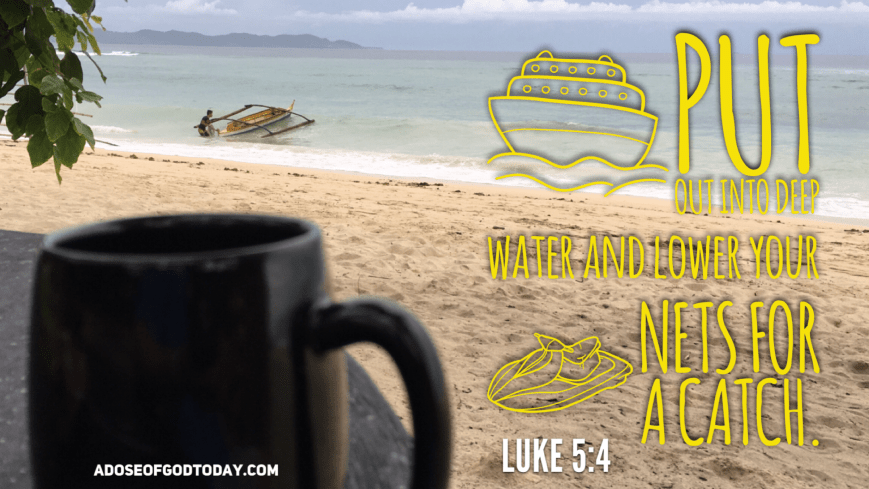
    After teaching, Jesus told Simon something, that could have made Simon to wonder, “Put out into the deep water and lower your nets for a catch.” In Simon’s mind, it was completely absurd as human wisdom and knowledge would tell him that. They had been working all night but caught nothing. However, because it was the Lord who said, Simon trusted the words of Jesus.

    This is what St. Paul said in the first reading, “if anyone among you considers himself wise in this age, let him become a fool, so as to become wise. For the wisdom of this world is foolishness in the eyes of God…” Indeed, by trusting the wise words of Jesus, Simon found something wonderful and life-changing.

    This all started when Simon let Jesus be in the boat of his failures and frustrations. The very presence of God became an assurance to Simon in the midst of the troubles in his life and in the midst of his search of something big in his life. The invitation of Jesus to him was call of faith. To go into the deep water and to lower down the nets was an invitation to dwell deeper into the most essentials in Simon’s life, to lower down his comforts and even pretentions, and to leave behind at the shore his uncertainties, fears, failures, guilt and sins.

    When Simon did all these, what he found was God’s tremendous goodness, deep love and generosity to him symbolized by the great catch of fish. This moved Simon to beg Jesus to depart from him because Simon had become aware of his sins, failures, fears and insecurities. However, this realization became the entry point of Jesus to make more wonderful things in the life Simon.

    Simon was called for a bigger purpose, to a mission where his participation became an important part in the ministry of Jesus. All of these happened because Simon let the Lord to be in his boat, allowed Jesus to challenge him and to change his life.

    This story of encounter with God led to chance and to a mission. Indeed, a real encounter with God or to allow God to be with us in our boats of frustrations and guilt, strips us from our pretentions and masks. Such encounter makes us bare to see how sinful and unworthy we are before God.

    Yet, it is in this moment of humility and honesty that we find God more merciful, loving and forgiving to us.  Once we lay down our guards that God comes to us to make miracles in us – to free and to give a true fulfilling life.

    It is when we own and claim our weaknesses, sinfulness and failures to God that we are also being strengthened, forgiven and empowered by the Lord.

    Thus, these are the invitations for us today.

    • First, allow the Lord to be with us even in our frustrations and failures in life, in our guilt and shame. Never be ashamed to allow Jesus to be in our boats. Let him teach us, to reminds us how much we are being loved.
    • Second, allow the Lord to challenge us and to shake our pretensions for us to discover more ourselves before the presence of God.
    • Third, allow God to bring changes in our life and to make wonderful things even out of our messy and troubled life story.

    May this encounter with Jesus empower us to go on mission by becoming His own instruments of mercy, love, peace and forgiveness. Hinaut pa.

    Jom Baring, CSsR

  • Giving a space for God

    Giving a space for God

    Advertisements

    September 2, 2020 – Wednesday of the 22nd Week in Ordinary Time

    Click here for the readings (https://bible.usccb.org/bible/readings/090220.cfm)

    Homily

    When we allow a person to occupy a space in our life, this also means that we make ourselves open to the person. The person may know our deepest secrets, as well as our deepest pain in life.

    This is how we find our relationships fulfilling and essential in our personal development. Of course, we assume that the person whom we have given the space in our life has the good intention of giving care and love to us.

    However, if the person whom we have given a space in our heart and in our life, betrays us, gives us more pain and stress, then, our relationship becomes hurtful and even toxic for us. This kind of relationship does not help us and would only bring us into desperation.

    Yet, when it is God who asks for a space in our life and in our heart, will we allow God to occupy a space? Are we willing to give up something for God to be in our life?

    God would surely not bring us harm. God only desires goodness and happiness for us. Nevertheless, giving a space for God also requires something from us. We cannot accommodate the Lord when our heart is full, if our life is occupied with many things. What God actually needs is a small space to bring healing and transformation in us.

    This is what we have heard from the readings today. St. Paul in his first letter to the Corinthians, reminded the people of their childish attitudes which actually made their hearts full and unwelcoming to God’s spirit to work in them. The community in Corinth was filled with jealousy and rivalry. Paul called them “infants,” meaning that the people were still exercising their selfish attitudes and seemed to advance their personal interest rather than the interest of the Lord.

    Paul reminded them to become mature by claiming and welcoming the Lord in their life and not to be limited with the influence given by Apollos or by Paul himself.

    Moreover, the Gospel also tells us how Jesus brought healing and transformation into the house of Simon. As it was in any typical Jewish house at that time, the house of Simon, must had been full of people too. His house was not just occupied by his wife and children but also his in-laws, nephews and nieces.

    However, despite this situation, Simon offered Jesus a space in his house. When Jesus was given a space into the house of Simon, Jesus was able to heal his mother-in-law who was afflicted with a severe fever. The miracle of healing happened here. She, indeed, was healed.

    But what was more interesting was the effect of the healing, and that was the transformation which made her to act, to be generous of herself to the Lord and his friends. When she was healed, she got up and waited on them. This means that when she experienced the healing, she served the Lord in her own capacity. This is faith in action and gratitude being transformed into generosity and kindness.

    This is what the Lord is inviting us also today. We may have experienced hurts and pains in our human relationships because those whom we welcomed in our life have caused us troubles, but we are assured that God would only bring healing and transformation in us. God desires that we will be healed in whatever illness and pain we are experiencing today, may it be physical or emotional.

    Thus, we are called to give a space for God by also getting rid of those that are not actually helpful and not necessary. This applies in our personal life, in our relationships, and in our homes and communities particularly. Allow the Lord today to occupy that space and allow him too to heal and bring transformation in us.

    Hopefully, as we also experience the gift of healing, this may lead us to transformation where we are moved to put in action our faith and to make concrete our gratitude to God by becoming generous and kind towards others. Hinaut pa.

    Jom Baring, CSsR