Category: Homilies

  • LISTEN. FOLLOW. LIVE.

    LISTEN. FOLLOW. LIVE.

    January 11, 2021 – Monday 1st Week in Ordinary Time

    Click here for the readings (https://bible.usccb.org/bible/readings/011121.cfm)

    Our Christmas songs that filled the air have stopped playing. Most of our Christmas decorations were all kept and hidden. However, the spirit of Christmas lives on. Our liturgy portrays to us today  how the spirit of Christmas continues to call us towards God as we also begin the first week in Ordinary Time.

    Here in Ordinary Time, we do not celebrate any particular aspect of the mystery of Jesus Christ, our Lord. Rather, what we celebrate during this time, is the mystery of Christ honored in its fullness, especially on Sundays (from the Ordo 2021). This means that in Ordinary Time, we are called to listen, follow and live the invitations of Christ revealed in his public ministry. The mystery of the resurrection is also fully celebrated during the ordinary Sundays.

    Now, our Gospel today from Mark, begins with the invitation to listen and follow the Lord. This call ultimately brings us to live fully the invitation of Christ. Hence, Mark tells us how the Emmanuel, who is Jesus, walks and encounters people as he goes along in his journey. In those encounters of Jesus, the Lord calls and invites people to follow him.

    From what we have heard in the Gospel, we might have wondered if those men, Simon and Andrew as well as James and John followed Jesus immediately without any difficulty. Mark only described to us the symbolic change of ways in following Jesus by leaving behind their “nets” and their “father.”

    Moreover, Mark was actually trying to tell us about the attitude of these men by being able to change their way of life. This is what we have heard today in the Gospel, “Repent, and believe in the Gospel.” And so this was what these men did. They changed their ways by becoming fishers of men and women from being previously fishermen as Jesus invited them, “Come after me.”

    They abandoned their comfort zones in order to go beyond from themselves. They gave up their old attitudes that prevented them to go forward. These include accepting their sins and failures and accepting too that they were in need of God’s mercy.

    Their personal encounter with Jesus gave them the confidence in themselves and faith in the Lord who believed in them. They had been given the courage to believe in their capacities and potentials and to believe in God’s tremendous love for them.

    For us today, the Christmas Season was really an opportunity for us to encounter the Lord intimately in our life through our families and friends and through our Church and even through the difficult and dark situation that we have been through. We went through advent to joyfully wait for his coming and to be more vigilant of God’s presence. We have celebrated the Birth of Jesus to affirm that we are indeed loved beyond our expectation despite being unworthy.

    Hopefully, our Christmas experience had really given us that opportunity of intimate encounter with Jesus. Our encounter with the Lord, just like the first disciples, allows us to be more familiar with Jesus’ voice to follow him wherever he may lead us.

    Thus, allow Jesus to call us today, to motivate us, to inspire us, to give us courage and faith so that he may lead u to change our old ways that prevent us from going forward. Allow the Lord to challenge us and lead us to go out from our comfort zones so that we may become free and happier.

    In this way, we may discover more and more who Jesus is in our life and who we are before God. This is discipleship. This is following the Lord closely. In this journey, we may find more adventures and wonders to un-learn our selfish human ways in order to learn God’s ways. Hinaut pa.

  • Christians are made, not born

    Christians are made, not born

    January 10, 2021 – Feast of the Baptism of the Lord

    by Fr. Manoling Thomas, CSsR

    Click here for the readings (https://bible.usccb.org/bible/readings/011021.cfm)

    The Christmas Season began with the 1stepiphany”, the announcement by the angel to the shepherds about the birth of the Saviour [Lk. 2:8-20]. He is the Messiah and the Lord whom Israel had been waiting for. This we celebrated on Christmas Day. The 2ndepiphany” we celebrated was last Sunday, when the Magi who travelled from the East found the “king of the Jews” through the guidance of “the star” [Mt. 2: 1-12]. This was the revelation by God to the Gentiles, represented by the Magi.

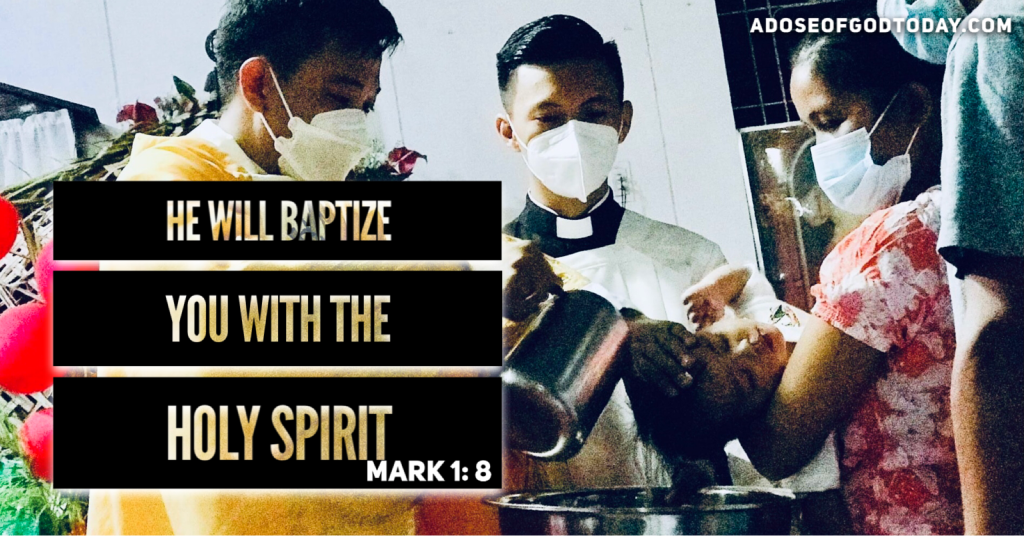
    And today, the feast of the Baptism of the Lord is the 3rd and last of the three “epiphanies” or “revelations” within the Christmas Season. Today, at Jesus’ baptism, God the Father revealed Jesus to us as the Messiah, the one anointed “with the Holy Spirit and with power” [Acts 10:38]. Jesus was sent by the Father to baptize us “with the Holy Spirit” [Mk. 1:8].

    At his baptism, Jesus made a deliberate decision to reach out to humankind. The 1st Reading from the Book of the Prophet Isaiah is applied to Jesus to emphasize this point. According to the Prophet Isaiah, this “servant of God” being empowered by the Spirit of God, will faithfully implement God’s plan. Because of the very close relationship between God and this “servant”, he becomes the “bridge” between God and the people. He becomes the “light” to God’s people and inspires hope in them.

    The four Gospels show us how Jesus exactly fulfilled all these! Empowered by the Holy Spirit after his baptism, Jesus went about to do his mission here on earth. Jesus brought the people and God closer to each other. By his teaching and deeds, Jesus became the source of inspiration, courage, and hope especially among the poor and those abandoned and ignored by society!

    At baptism Jesus was empowered by the Holy Spirit, to enable him to accomplish his specific mission on earth. The same thing happened at our own baptism. The power of the Holy Spirit is there to help us fulfill our specific mission on this world!

    At Jesus’ baptism, the Father confirmed that Jesus is God’s beloved Son, in whom God is well pleased! The same confirmation has been made by God on the day of our baptism! This is how important and significant our baptism is!

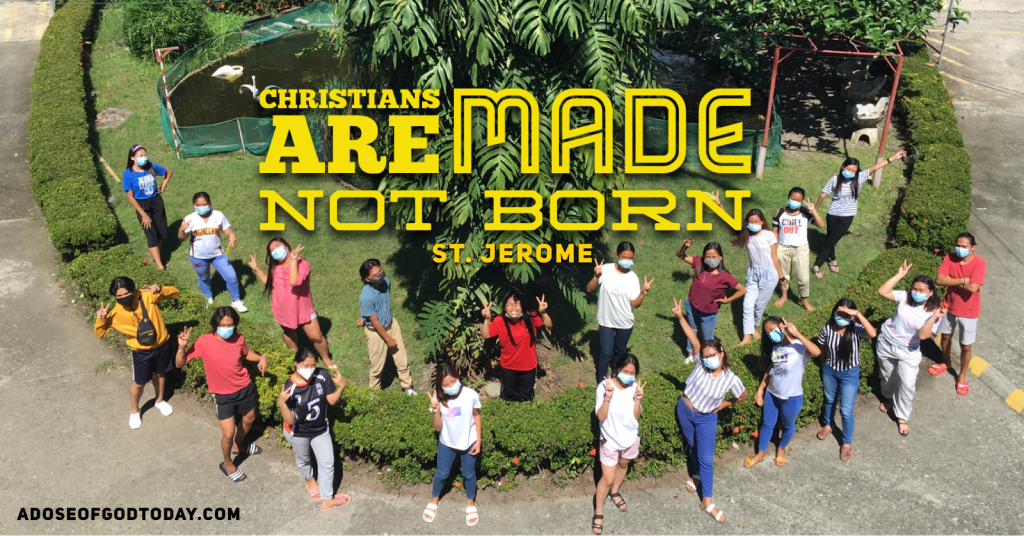
    But our baptism, we did not make of us “an instant and a finished product Christian”! St. Jerome, the one who translated the Bible into Latin, once said: “Christians are made, not born.” From the day of our baptism, we have to continue to grow, to develop, and to mature as a Christian! This growth and development in us, must be seen in the way we live, act, and think; and in our attitudes in life! This ongoing process of growth and development is the process of our Christian maturity! “Christians are made, not born.”

    On the day of his baptism, Jesus made a free and deliberate decision to be God’s “faithful servant” who was to implement God’s plan for humankind and the rest of creation! Becoming and growing as a Christian then is a free decision each one of us must make!

    Most of us, if not all, were baptized when we were still infants. We were not in the position to make that free choice, so our own parents and godparents, made that decision on our behalf. They were supposed to tell us, and to explain to us about the meaning and significance of that decision! As we grow older and mature, at a certain point in our life, we have to freely decide whether we will accept or reject that decision made for us! That is one of the reasons, why during the Easter Vigil Mass and at the Masses on Easter Sunday; we are invited to renew our baptismal vows and promises. This gives us the opportunity to freely choose whether we want to continue on being the “beloved adopted sons and daughters of God” and disciples of Jesus Christ!

    Although this gift is freely offered by God to all, yet it is never forced on anyone! Jesus never forces anyone to continue their discipleship! Our free choice and decision will be respected and honored by God and by Jesus Christ!

    As you continue to mature as a Christian, is your mission here on earth becoming clearer? Do you experience the power of the Holy Spirit helping you accomplish your mission? Are you continuing to grow and mature as a disciple of Jesus? If your baptism is that significant and important, do you know the date of your baptism as you well know your own birthday?

  • There is more in our Faith

    There is more in our Faith

    January 10, 2021 – Feast of the Baptism of the Lord

    Click here for the readings (https://bible.usccb.org/bible/readings/011021.cfm)

    Are Filipinos more religious because of Covid-19? This is the title of the analysis of Jayeel Cornelio, PhD, a sociologist of religion.[1] This article was published in October 25 at rappler.com. The article discussed significant subjects particularly on the survey done by Pulse Asia last September 2020.

    The survey revealed that 51.8% of Filipinos have become more religious during this pandemic. According to Dr. Cornelio, this is not surprising because of two reasons.

    First, we are known to be one of the most religious societies in the world. And according to Pew Research Center, 96% percent of Filipinos find it “necessary to believe in God in order to be moral and have good values.”

    Second, Dr. Cornelio said, “faith is our immediate resource in times of crisis.” Citing another survey by the Veritas Truth Survey, it revealed that 89% percent of the responders of the survey said that faith is “very important” in the fight against Covid-19.

    From here, the sociologist also concluded that because of the “vulnerable social and economic context,” that is, being a third world country, the pandemic promotes a higher religiosity in us. In his words he said, people in poor social conditions such as having “inadequate health care, high incidence of conflict, and unreliable state agencies”  – people feel that they can turn to nothing else but faith in God.

    Indeed, it is when we become vulnerable and poor that we become more conscious of God’s presence. When we become more aware that we have actually nothing and are nothing in this world, that we also begin to realize of that great presence of God.

    A very comfortable life, a rich and powerful lifestyle can easily bring us into the attitude of indifference. It is indifference that prevents us to recognize that God is with us and continues to be present in the world.

    Moreover, at the end of his article, Dr. Cornelio also wrote that “there is so much more to COVID-19 than simply challenging the core of people’s religious convictions. In the end, it’s not just that Filipinos have become more religious because of this crisis. They are also beginning to seek something ‘more’ from their faith.”

    This sociological analysis brings me now to our very identity as baptized Christians. More than this survey of our religiosity, there is also a need to examine ourselves whether we have grown really in our faith, in our relationship with God and with one another. Our faith is not just about kneeling and standing, holding a rosary and saying our novenas. As Dr. Cornelio said, there is something “more” that we begin to seek from our faith. This “more” is something that I invite you now to pay attention as we celebrate this Sunday the Feast of the Baptism of our Lord Jesus.

    To be able to discern this “more” from our faith, allow me to journey with you through the readings and to see how God reveals His invitations for us today.

    In the first reading, Prophet Isaiah proclaimed the presence of the Servant of the Lord. The servant’s identity were described in three points. First, the Lord said,  “he is my chosen one with whom I am pleased.” This servant is loved very much by the Lord God, thus, God’s presence rests upon him. Second, the servant is to bring justice through compassion and gentleness of his presence and not through violence and force. Isaiah described and said, “a bruised reed he shall not break, a smoldering wick he shall not quench.” This servant is hope for those who are hopeless and are suffering. Third, the servant is to open the eyes of the blind and free prisoners and those who live in darkness. The servant who brings hope also brings peace, freedom and new life.

    The Psalm also stated this, “The Lord will bless his people with peace.” Peace here is living in the presence of God who is present in all creation. And the recognition of God’s presence in everything and in everyone brings us to show respect and love.

    This very promise of God is fulfilled and revealed in the Acts of the Apostles and in today’s Gospel. In the Acts of the Apostles, Peter proclaimed that this servant whom God chose is Jesus of Nazareth. He is anointed with the Holy Spirit and power. This is shown in the ministry of Jesus “in doing good” and in “healing the oppressed by the devil.”

    This is what we also find in the Gospel of Mark. The baptism of Jesus was a revelation to us that Jesus is the servant spoken by Isaiah. The scenarios in the Gospel are also very important told to us in three actions.

    First is the “immersion of Jesus in the water” was an expression of complete confidence in the Father. The Psalm proclaimed to us that “the voice of the Lord is over the waters, the Lord, over the vast waters.”  Here, Jesus allowed the power of His Father to embrace him.

    The second action is the “Spirit descending like a dove.” This is the very presence of God allowing our eyes to behold where it rests. The Spirit of God is in Jesus, the Lord who is among us. This tells us of the presence of God not just above us, but here among us.

    The third action is the voice heard coming from heaven saying, “You are my beloved Son, with you I am well pleased.” This has been proclaimed also by Isaiah.

    Indeed, this feast of the Baptism of the Lord tells us something important about our own baptism which we share in Jesus. This is where we also find the “more” in our faith. The “more” in our faith asks us not to be passive-believers but to be active-believers. The “more” in our faith tells us now of four points. These are invitations that you can bring with you today.

    • First, we are all loved. Never forget that.
    • Second, God’s presence is among us. We do not have to look above and seek God’s presence in the clouds. Look around also. God’s Spirit rests here among us.
    • Third, our baptism compels us to bring justice and peace. Isaiah reminds  us that this will be realized not through violence and force but through compassion and gentleness of our presence.
    • Fourth, to bring justice and peace is to also participate in the ministry of Jesus. This ministry is to open the eyes including our eyes blinded by greed, anger and indifference. And to free our hearts imprisoned by hatred, sin and guilt.

    Thus, the “more” in our faith is to make Jesus more present in our actions and words, and more present in our hearts, homes and communities. Hinaut pa.


    [1] See his article in https://www.rappler.com/voices/thought-leaders/analysis-are-filipinos-more-religious-because-covid-19

  • Life is in Jesus

    Life is in Jesus

    January 8, 2021 – Friday after Epiphany

    Click here for the readings (https://bible.usccb.org/bible/readings/010821.cfm)

    When many of us are confined at home because of the pandemic and restrictions in going outside our residence, the rise of the Plantitos and Plantitas (the popular name of those who develop the love of planting) also emerged. Our boredom at home wonderfully bore fruit by becoming more connected with the earth. When we learn how to plant, we also learn how to touch in order to nurture life.

    Touching with the motivation of caring brings wonder and joy in us. This is the reason why many of us find comfort and pleasure in nurturing the life of the plants. More than this, we too are called to nurture human life, to inspire life and heal life. This is what Jesus shows us today.

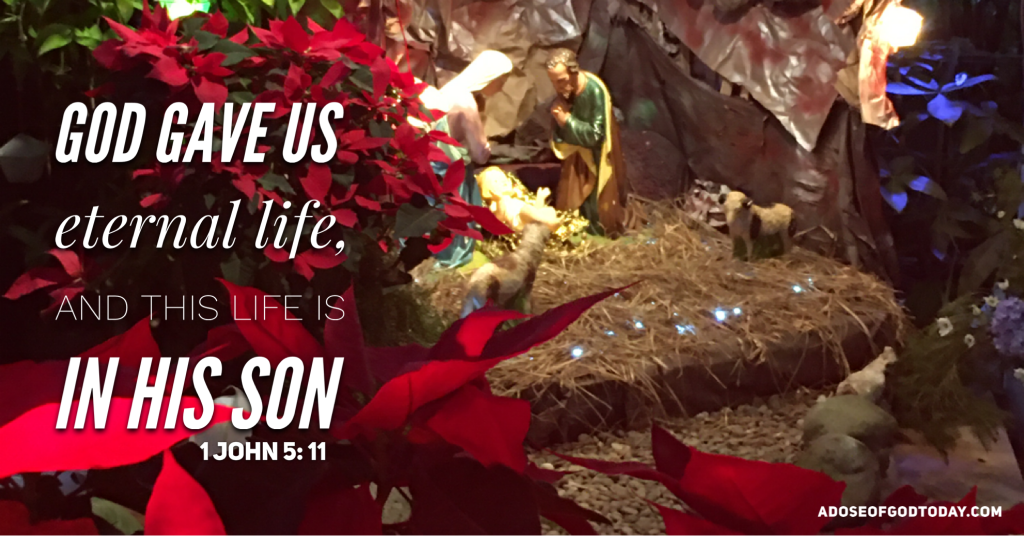
    Our readings today remind us of this. The first reading from the First Letter of John tells us that “God gave us eternal life, and this life is in his Son, Jesus.” We find this life in Jesus, our Lord.

    John mentions two important and recurring words in today’s reading that tell us that life is indeed in Jesus. These words are testimony and possession.

    The word testimony refers to the witnessing of the Father in the life of Jesus. The testimony of the Father to His Son is the confidence of the Father. This also means that the confidence of God in us will be revealed in our life by having Jesus. This is not about giving testimony to God, but God giving testimony to us through the wonders that God can do for us.

    The word possession means our possession of Jesus, the Son of God in our life. Having Jesus is letting Jesus fulfill his promise to us. Having the Lord in our life is allowing the Lord to do what he desires to do in our life.

    Such testimony and possession of Jesus bring us into the Gospel story. A man full of leprosy fell prostrate and pleaded with Jesus. The man asked the Lord to reveal God’s testimony of bringing healing and fullness of life. The man asked, “Lord, if you wish, you can make me clean.” He allowed the Lord to work wonders in him and to let God give testimony through the gift of healing.

    In this way, Jesus touched the man to heal him and bring him that fullness of life. Jesus’ touch surely brought healing and life because his touch was motivated by care and compassion, by love.

    Today, let us be conscious of this invitation to have Jesus in our life and to discover that eternal life or the fullness of life is in Jesus. As we touch people through and by our life, always bring healing and bring life not corruption of life and not violence to life. Allow also the Lord to give testimony to us by making ourselves always open to God’s plan for us. Hinaut pa.

  • God first loved us

    God first loved us

    January 7, 2021 – Thursday after Epiphany

    Click here for the readings (https://bible.usccb.org/bible/readings/010721.cfm)

    The very first time we realize that we are attracted to a person whether physically or emotionally, this gives us a chilling effect (kilig moments). When we are young, meeting and seeing that person gives us the excitement. Moreover, when we have reached a matured age capable of mature loving, the more we also feel the wonder when we also realize that we are in love. This drives us to express our love in concrete ways and leads us to commit that love in a life-long commitment.

    To be loved and to love is what really makes us human. In fact, when we do not feel that we are loved, this makes us also restless and empty. Then, our tendency is to look for ways where we could feel that we are loved. Sometimes, this leads us into unhealthy coping and even in abusive relationships just because of the need to be loved.

    When we are also not conscious of our ways of loving, sometimes it leads us into selfish ways of loving. We might think that what we do are ways of loving, but in fact, they may be ways of keeping others under our control or under our manipulation. These expressions are not God’s way of loving. God’s love for us does not lead us to violence or manipulation. God’s love liberates us and lets us experience the fullness of life.

    This is what John is telling us today. John has been proclaiming to us in the past few days the subject on love. John, today, reminds us that God first loved us. Because God first loved us, we all have the benefit of being loved and to enjoy that reality that we are indeed loved no matter what.

    John’s point is to make us confident that we are being loved first. There is no doubt in that. Take confidence in this! You are loved. I am loved. We are loved.

    Therefore, when we realize this, it moves us too, to love back. God’s love fills us and in our fullness, it naturally overflows in us. That is why, we are also capable of loving others because we are loved. John tells us that our way of loving is patterned from the source of love. Because God’s love does not control and does not do damage to others, our love also liberates others and rather brings healing to those whom we love.

    Be careful when our ways of loving is of control and doing harm to others, then, it is not love and not from God. It is motivated rather by hatred and by lies. The source of this is the evil one.

    Loving, as John also tells us, is not burdensome. That is why, keeping the commandment of God to love, is not heavy at all. How can it be heavy and oppressive when what we do is out of joy?

    Jesus in today’s Gospel expressed such joy in the Scripture that he read, to bring glad tidings to the poor, to proclaim liberty to the captives, recovery of sight to the blind, to let the oppressed go free and to proclaim a year acceptable to the Lord.”

    Love, then, brings healing, freedom and life. May this love fill our hearts today, so that our way of loving will also be transformed into God’s way of loving. Hinaut pa.