Category: Holy Week

  • God’s Caress of Mercy and Friendship – Part 1

    God’s Caress of Mercy and Friendship – Part 1

    (This is the talk given during the Holy Week Reflection on Holy Monday, April 3, 2023 delivered at St. Clement’s Church, Iloilo City.)

    Are we being punished? Are we being condemned because of our sins? Has God abandoned us? Has God given up on us?
    When Covid-19 hit us in 2020, we were all afraid and anxious. The world seemed to stop, and the many restrictions of our movements contributed so much to our feeling of being isolated and helpless. With this health crisis, economically or financially, we were being challenged in many ways. Many have lost their jobs and the most vulnerable among us were those who worked and earned on a daily basis and the poorest of the poor, the homeless and street children.

    Likewise, every day many were haunted by anxiety of being infected by the deadly virus, or we might have been so worried for those family members and friends who were at the frontline fighting against the virus and ministering the infected. Or we might have been sobbing and grieving in those days because we have lost a family member, a close friend, or a colleague because of the virus.

    In total, there are about 761,071,062 cases worldwide of covid infections,[1] and a total of 6,879,644 deaths worldwide as of March 26, 2023. (Last Update)

    On February 24, 2022, Russia invaded Ukraine and this war brought economic challenges worldwide especially of the inflation of oil which affected us here in the country. This war continues until now which already affected 14 Million people being displaced[2] , with 140,000 infrastructures destroyed, with 15,000 people missing and 42,295 deaths.

    Just last February 6, this year, a 7.8 magnitude of earthquake struck southern and central Turkey as well as the northern and western Syria which affected 24 million people[3], 2.5 million displaced persons and 56,00 deaths.

    At the local level, at least in this post-pandemic time, no natural disaster has greatly affected the whole country except Odette in 2021 or any war that has ravaged the country. Yet, what is alarming, aside from the inflation of commodities is the rise of poverty level in the country. According to the recent DSWD Listahan 3, that survey found out that there are 5.6 million Filipino Families living in poverty.[4] In terms of individual persons, there are 2 in every 5 Filipinos who are poor. This is equivalent to 30 million poor Filipinos which is 27% of the 111 million population.

    These are just some figures and images of suffering in the world and beyond these, there are more pain, suffering, and deaths unknown to us, not covered by statistics or by many news media. There are many who suffer in silence.

    Thus, we ask again, are we being punished? Are we being condemned because of our sins? Has God abandoned us? Has God given up on us?

    Talk 1

             God’s Caress of Mercy and Friendship. This is the over-all theme that I would like to share with you tonight. We understand “caress” as an action that expresses, closeness, affection, love, concern and gentleness.

             As Pope Francis said in one of his homilies, “God forgives not with a decree but with a caress.” And with mercy, “Jesus too goes beyond the law and forgives by caressing the wounds of our sins.[5]

    Mercy has touched the Pope so much that he led us into the Jubilee Year of Mercy in 2015-2016. Thus, Pope Francis affirmed that “mercy is God’s identity card[6].” Indeed, Mercy is the name of God.

             Again, Pope Francis in his Apostolic Exhortation called, Christus Vivit  addressed to the Young People and to the Entire People of God, he wrote, “Friendship is one of life’s gifts and a grace from God. Through our friends, the Lord refines us and leads us to maturity.[7] This is how friendship that we have developed helps us to grow and become the person God wants us to be.

             Moreover, an author, Fr. Ronald Rolheiser, OMI, wrote a section of his book with its title, Friendship is Liberating Too, that, “Friendship can save us. Loving, challenging friends who can melt our bitterness and free us from the need to be angry are as critical within the spiritual life… To neglect friendship is to court bitterness and perversion.[8]

             This explains to us how friendship also plays a role in making ourselves free, free from anger and hatred, from bitterness and corruption that will only bring us into isolation and sadness.

             Hence, as I journey with you tonight, let us refresh our hearts and minds with scriptural texts that would bring deeper into God’s caress of mercy and friendship.

             I would like to invite you now to the story of Jonah.

    Jonah 1:1-3

    The word of the LORD came to Jonah, son of Amittai:

    Set out for the great city of Nineveh, and preach against it; for their wickedness has come before me.

    But Jonah made ready to flee to Tarshish, away from the LORD. He went down to Joppa, found a ship going to Tarshish, paid the fare, and went down in it to go with them to Tarshish, away from the LORD.

    Jonah was quite rebellious to God because he was sent by God to do something, which he did not want to do.  If you remember, Jonah did not like this assignment to go to Nineveh because he hated the people. They were Assyrians, the traditional enemies of Israel who oppressed and attacked them. These Assyrians were known to be brutal invaders.

    That is why, Jonah was so against God’s plan of sending him there to call them for repentance. Jonah was anxious that the people might believe in God and thus, God might show mercy to them and spare them from death.  Jonah wanted this people to die. He wanted revenge against these people whom he thought were Godless. This was all because he was angry and he disgusted those people.

    Yet, this is what really happened. When Jonah called the people to repent, they repented and believed in God and that was why, God showed mercy to them and saved them from death.

    Jonah’s attitude may not be far from many of us who cultivate a narrow and vindictive mentality.[9] Like Jonah we too might have asked God, How could you love worthless, good for nothing people Lord? How could you show mercy to those who do not even recognize you as God? How could I also be merciful to them when they oppressed my people?

    We might also find ourselves wishing suffering and death to those whom we hate, especially those who have caused us so much pain. We might have wished and cursed those people who did something terrible to others too. When a violence and or a crime is done to an innocent, we might have demanded also the same violence and crime to perpetrators. Like Jonah, we too might have believed that justice is attained through a gruesome death to our enemies. Like Jonah, we also could tend to believe that God should not show mercy to those who have hurt us, to our enemies and people who did terrible things to the innocent.

    Yet, with Jonah, the people of Nineveh and God, there is something very interesting here. Jonah was totally honest to God about his thought and feelings against Nineveh. Jonah was comfortable enough to complain to God, to express his dismay and anger over this people. Jonah even tried to escape from God and argue with the Lord. And the Lord God, listened to him, the Lord God accompanied Jonah and allowed Jonah to grow and become mature as a person and as a prophet by being able to recognize his own limitations and biases against others. The Lord challenged Jonah to see beyond himself, beyond his pain and frustrations and to recognize that God’s mercy and friendship are for all.

    Now, this exchange between Jonah and God expressed closeness and intimacy and that is evident in Jonah’s confidence to express himself before God. Is it not friendship at all? It is! Jonah was a friend of God. God is Jonah’s closest friend. And it is in this friendship that Jonah was called, challenged and was transformed. In a way, Jonah was the first to receive that caress of mercy and friendship with God which the Lord wanted Jonah to share with the people of Nineveh.

    This helps me to realize now that God’s mercy and friendship are not limited to any group of people. God is a God of everybody, of bad and good people, of sinners and righteous, of criminals and law-abiding citizens.

    God showed this concretely to us in the person of Jesus, the ultimate sign of God’s mercy and friendship with us. Pope Francis reminds us, “Friendship is so important that Jesus calls himself a friend: ‘I do not call you servants any longer, but I call you friends.’(Jn 15.15)[10]” Thus, in Jesus, the Father tells us that we are never abandoned, that there is always hope and goodness in each of us no matter how broken we are, and sinful we have turned to be. God always sees goodness in us, because we too are God’s friends.

    This is the same invitation that we have heard from Jesus when he addressed the adulterous woman brought by the scribes and Pharisees. Like Jonah at the beginning, the scribes and the Pharisees were filled with so much hatred and anger. This made them to become condemning towards the woman. With this attitude, they refused to give another chance and opportunity for the woman to change and to redeem herself.

             Thus, they wanted to stone her to death as what “the law” told them to do. But what did Jesus do? Listen now to the Gospel of John chapter 8, verses 7 to 11.

             John 8:7-11

    But when they continued asking him, he straightened up and said to them, “Let the one among you who is without sin be the first to throw a stone at her.”

    Again he bent down and wrote on the ground.

    And in response, they went away one by one, beginning with the elders. So he was left alone with the woman before him.

    Then Jesus straightened up and said to her, “Woman, where are they? Has no one condemned you?”

    She replied, “No one, sir.” Then Jesus said, “Neither do I condemn you. Go, and from now on do not sin anymore.”

    This is what Jesus showed to the woman. Jesus said, “I do not condemn you. Go and sin no more.” God has delivered his judgment, showed His mercy and offered friendship. Jesus freed the woman and was commanded to sin no more and not to go back to her old sinful self. She had, surely, found her way to freedom and peace in Jesus.

    Pope Francis in his homily on this Gospel story said, “Jesus forgives. But here, there is something more than forgiveness because Jesus goes beyond the law. Though Jesus was pure and the only person who is worthy to cast the first stone against the woman, but Jesus did not because he showed mercy.[11]

    Mercy, as the Pope says, is difficult to understand. “Mercy does not erase sins. It is God’s forgiveness that erases our sins. But then, mercy is the way in which God forgives.[12]

    Thus, unlike the scribes and Pharisees, Jesus saw more in the person of that woman. The limited awareness and refusal of the Scribes and Pharisees to see more, prevented them to discover that there was always hope in every sinner, and that there was more in a person’s weakness and imperfection. This is how Jesus defends us, sinners from the just condemnation of death.[13] Again, (because) God always sees goodness in us and offers us his friendship that we may be renewed and find peace in his presence.

    PRAYER

             God of Mercy and Friendship, I am confident that it is not your desire to punish and bring us to condemnation, but to caress us with your love. Allow my heart to be ever closer to you, to grow in faith and affection towards you. As you see goodness in me, let me also see the goodness in others that I may learn to caress with mercy and friendship. Amen.


    [1] https://news.google.com/covid19/map?hl=en-PH&mid=%2Fm%2F02j71&gl=PH&ceid=PH%3Aen

    [2] https://www.google.com.ph/search?q=war+in+ukraine

    [3]https://www.google.com.ph/search?q=earthquake+in+turkey+and+syria

    [4] https://www.rappler.com/nation/filipino-families-living-in-poverty-2022-dswd/#:~:text=Sign%20in%20to%20listen%20to%20groundbreaking%20journalism.&text=MANILA%2C%20Philippines%20%E2%80%93%20There%20are%20over,Welfare%20and%20Development%20(DSWD).

    [5] Pope Francis, The Name of God is Mercy: A Conversation with Andrea Tornielli, translated by Oonagh Stransky (New York: Random House, 2006), xii-xiii.

    [6] Ibid, 9.

    [7] Pope Francis, Christus Vivit: Post-Synodal Apostolic Exhortation of the Holy Father Francis to Young People and to the Entire People of God (Philippines: Paulines, 2019), n. 151, 64.

    [8] Ronald Rolheiser, OMI., “Friendship is Liberating Too,” in Forgotten Among the Lilies: Learning to Love Beyond Our Fears (USA: Doubleday, 2005), 34-35.

    [9] Jonah, Introduction, The New American Bible.

    [10] Pope Francis, Christus Vivit, n. 153, 65.

    [11] Jonah, Introduction, The New American Bible, xvi.

    [12] Ibid.

    [13] Ibid.

  • Knowing and believing the person we love

    Knowing and believing the person we love

    April 5, 2023 – Wednesday of the Holy Week

    Click here for the readings (https://bible.usccb.org/bible/readings/040523.cfm)

    Judas sold his friend and teacher. The Gospel recounts to us that one of Jesus’ close friends sold him to the chief priests. Why would Judas do that to the person who only showed kindness and generosity to him and to the people?

    Judas though, was chosen to be one of the close friends of Jesus and disciples had these two attitudes that motivated him to betray the Lord and to sell him for thirty pieces of silver.

    First, Judas never believed that Jesus is the Lord and the Messiah, the Son of God who is sent into the world to redeem the world and save the people from their sins and evil ways. Judas never believed in Jesus but only thought that Jesus was a mere teacher. Thus, Judas never called Jesus as Lord but only Rabbi, which means teacher.

    Second, Judas did not have a close, personal and intimate relationship with Jesus. Because Judas never believed in Jesus as Lord, it also followed that Judas had never developed that close relationship with the Lord. Judas actually failed to build true friendship with Jesus and so failed to recognize God in Jesus.

    These attitudes of Judas may also be present in us. When we do not believe or refuse to believe in Jesus as our Savior and Lord, who has come to love and forgive us, then, we too shall have the difficulty of not being able to build a personal relationship with God. Failure to recognize God in our life leads us to an estrange relationship with God.

    This is also true with our human relationships. Failure to believe in the person, to a friend, to your beloved, to your husband, or wife  or child will lead us to a distanced relationship. This failure in knowing the person and building personal and intimate relationship with the person will lead us to easily discard the person. It will be easy for us to hurt them, to cause them pain, to cheat on them, to betray them, to leave and abandon them – because after all, we are never committed in that relationship.

    Thus, we are called rather now to know better the person that we are in relationship with, our friends, our beloved and all those people around us because it is in knowing them that we also come to recognize their importance and believe in them. And again, this shall also move us to commit ourselves in that relationship by developing a close and intimate relationship with others and with God.

    May Our Mother of Perpetual Help guide and inspire us in our relationships and to truly believe in Jesus and to build personal and intimate relationship with him. Kabay pa.

  • Take a Stand

    Take a Stand

    April 5, 2023 – Holy Wednesday

    Click here for the readings (https://bible.usccb.org/bible/readings/040523.cfm)

    Worse than their disobedience – for eating the forbidden fruit, Adam & Eve commit the sin of not taking responsibility for their actions. When God asked them why they disobeyed Him, they blame not themselves but rather each other & the snake. Simply put, they don’t own up their promise & responsibility for their actions. They don’t take responsibility for their mistakes. In effect, sin happens & sinfulness abounds – remains to exist. Same way, whenever we don’t own up our promises & our actions, & most especially continue not to take responsibility for our mistakes, we hurt ourselves; we hurt one other; we hurt others; & we ultimately hurt God & our Lord Jesus Christ.

    Today is Holy Wednesday, also known as Spy Wednesday, because of the treachery & betrayal of Judas Iscariot. As this story preludes the suffering, eventual persecution & death-caused by Judas’ betrayal, the passion of our Lord is about & also caused by irresponsibility of the other disciples. When Jesus told them that one of them would betray Him, they, even his betrayer, asked, “It is’nt me, is it, Lord?” Here they concerned themselves not so much of taking responsibility for Jesus & defending Jesus, but rather on suspecting who among them is the said betrayer, except themselves. Rather than taking responsibility for Jesus, they concern much on their self-image & finger pointing for someone to blame.

    With this, Jesus said: ‘You said it’, “Sugid mo, sinabi mo”. Here Jesus is not about who is the betrayer, but asking His disciples-then & us-now to take a stand & be responsible for our promise & action to Him. So, rather than be concerned about whether you & I, or one of us is & has been a Lord’s betrayer to blame, Jesus wants us to CLAIM & SAY to ourselves: “IT IS NOT ME” (period). By our sins, yes, we may have at times betrayed him, but this time on we may promise ourselves: NOW, I choose not to betray you, Lord. I stand & take responsibility for You, whatever may happen.”

    Today is more than just about our possible betrayal & abandonment of the Lord, but moreso, about our commitment in owning up & taking responsibility to follow and stand for the Lord in our lives, so that we may not remain a burden but rather be His responsible disciple of His passion.

    So Be it.

  • Remembering, Reconnecting, Responding

    Remembering, Reconnecting, Responding

    April 2, 2023 – Palm Sunday of the Lord’s Passion

    Click here for the readings (https://bible.usccb.org/bible/readings/040223.cfm)

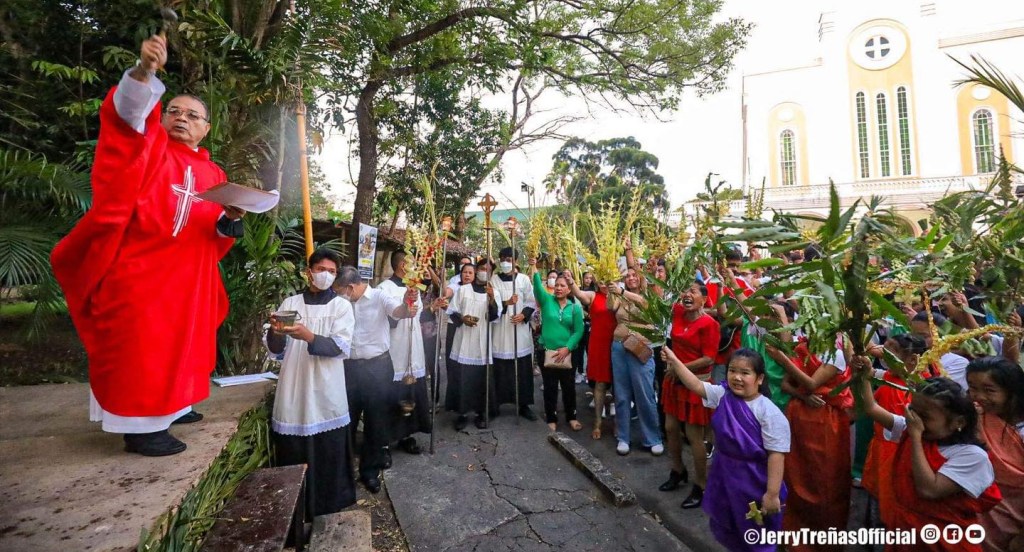
    On this Palm Sunday of the Lord’s Passion, we blessed our palms to remind us of Jesus’ triumphant entry in Jerusalem, only to be handed over to death. He was arrested, tortured, abused and humiliated, carried his own cross to Calvary, crucified while onlookers waited for him to die hanging on that cross. The palms that symbolized Jesus, revered to be king, but riding on a donkey, culminated in that shameful and painful death on the cross.

    Thus, as we enter the Holy Week and being reminded fn the story of the suffering and death of Jesus, there are three invitations that I would like to share with you today. These three invitations will hopefully guide us in our journey in life with Jesus.

    First, REMEMBERING. To remember a painful memory is not easy. When we do this even with our painful memories in the past, of the trauma, shame and guilt that happened to us, we feel discomfort. Some may even try to escape to forget that painful memory. Yet, this is what we do now as we remember, recall and recover the story of Jesus who after preaching to the people the Kingdom of God and making difference into lives of the distressed, the sick, the lonely, the sinners and abandoned, was being betrayed by his own disciple, denied by a friend, and left alone on the cross.

    In our remembering, we honor the pain, the shame and the guilt that surround in the story of Jesus as well as in our own stories. As Jesus struggled to find meaning in his suffering as expressed in his words, “My God, my God, why have you abandoned me?” let us also find meaning and God’s presence in our own painful and shameful stories.

    Despite the pain and the seemingly absentee-God as we face our own suffering as individuals and as a people, let us also allow the Spirit to bring us further in this journey. This is the second invitation.

    The second is RECONNECTING. In remembering the passion and death of Jesus it also allows us to remember our own stories, we may realize how far we gone away from our painful past. In our attempt to forget, cover and bury what was shameful and filled with guilt, we could have pretend as if nothing was wrong or nothing happened.

    We let the words of Prophet Isaiah be our prayer, “Morning after morning, he opens my ear that I may hear,” so that we may be able to listen well to the voice of God speaking within us and through our human experiences. As we reconnect with the past, we also reconnect with our emotions that may still be overwhelming for us. We reconnect with ourselves and find our re-connection with God who has been with us all along even in our darkest moments in life.

    Photo from JerryTreñasOfficial Facebook

    In reconnecting, we bring our heart and mind into prayer, into contemplation even when we are faced with difficult life experiences and situations that may be challenging to comprehend. In prayer and contemplation, we give ourselves to God just as Jesus gave up his spirit to the Father. This is where we are called to grow in our confidence and faith in the Lord who promised to be with us always and who shall never ever leave our side. And this confidence brings us into the third invitation.

    The third is RESPONDING. Jesus even at his death proved that God’s power of love and mercy outdone human sin and death. Even in death, Jesus responded to bring life and freedom. The Gospel described that “the veil in the sanctuary of the Temple was torn into two from top to bottom. The earth quaked, rocks were split, tombs were opened, and the bodies of many saints who had fallen asleep were raised.” This was how the death of Jesus made the heaven opened for all and brought hope to the dead.

    Hence, as we remember and reconnect, let our heart be filled with God’s presence to empower us by finding healing and freedom, life and renewal. This only means that we won’t allow any painful or shameful memory to dampen our spirit into hiding and pretensions. Do not settle to seek temporary comforts but rather go beyond and seek the Lord. The Lord desires our reconciliation and healing and so let us embrace that grace offered by the Lord to us, as Jesus gave up his spirit for us.

    To respond then, is to be able to get out beyond ourselves and become life-giving, spirit-inspiring and heart-renewing. Kabay pa.

  • Home for Holy Week

    Home for Holy Week

    April 10, 2022 – Palm Sunday

    Click here for the readings (https://bible.usccb.org/bible/readings/041022.cfm)

    For us Filipinos, there are three occasions in the year that we come home, get together, and spend quality time with our family: Christmas, All Souls’ Day, and Holy Week. These are the moments when and where us, Filipinos BE with each other, that is where and when we experience, encounter, and meet each other again as family and community which usually lead to renewal, deepening and strengthening of bonding and relationships among family. While during Christmas, we are with our family and friends, and during All Souls’ day, with our family and relatives remembering our beloved dead members of the family, Holy Week is particularly our time and space with God.

    Today, Palm Sunday marks the beginning of our Holy Week this year of Faith. These days in this week of this year of faith is our time and space to BE with our God. This week is our God-time and God-space. Particularly this week is more than just our chance to be with God but more so God’s chance to be with us. Meaning, this week is not only our time and space with God but more so GOD’s time and space with us. It is more like God must be first and foremost Be with us rather than We must be with God. The center or focus of this week then is not ourselves but God. This week is not about us and ourselves but about HIM and His being with us now. This is our chance then to experience, encounter and meet God in His own terms and not on our own terms. The best attitude then is to let Him set the agenda, activities, schedules, and venue of this week. Meaning, to let Him take the steering wheel – let Him drive your life this week – let God be God, not be a god as we want or need Him to be.

    To do this and make the best of this week, allow me to suggest some appropriate approaches.

    First, RECALL. As I have said, this is not about us but about Him. So, once again be reminded, that is to put into mind – God’s story with Us which is the Jesus story. We are to call again and remember (to make it member or part of ourselves) what God did, does and is doing to us through the life and mission of Jesus Christ. So, time and space to Recall, Remind, Remember God’s story with us through Jesus rather our story with God.

    Then, REFLECT. This is an invitation to mirror back or reflect back God’s story with and along our faith-story with God now. In other words, Manalamin. To look and see our faith-life experience from the point of view of God’s story and less from our own perspective. Meaning, Be moved. Be disturbed. Be influenced. Be shaken. Be challenged. Be transformed by God’s story, presence, words, movements, plans, agenda and will for us, you and I now.

    And above all, RESPOND to what, when, how, when and where God is calling, inviting, and leading you now in whatever faith-life commitment you choose to be. Meaning, whether you are ordained, married, professed, or baptized Christian, be a BETTER Christian as you choose and committed to be.

    We begin Holy Week today. Recall, Reflect, and Renew what God did, does and is doing in You and Us now by being with God, not in our own terms but in His own terms.

    May we, you and I have a blessed and inspired week ahead.

    So Be it. Amen.