Category: Saints

  • Guardian Angels

    Guardian Angels

    Advertisements

    October 2, 2020 – Friday of the 26th Week in Ordinary Time

    Memorial of the Holy Guardian Angels

    Click here for the readings (https://bible.usccb.org/bible/readings/100220.cfm)

    Homily

    Do we all have guardian angels? Yes. Our Catholic tradition believes in the existence of angels. Just 3 days ago (September 29), we celebrated the feast of Archangels Michael, Raphael and Gabriel. They are the only angels being named in the Bible because of the great importance they played in the history of our salvation. Moreover, there are multitude of angels aside from them as it is also written in the Holy Bible in both Old and New Testaments.

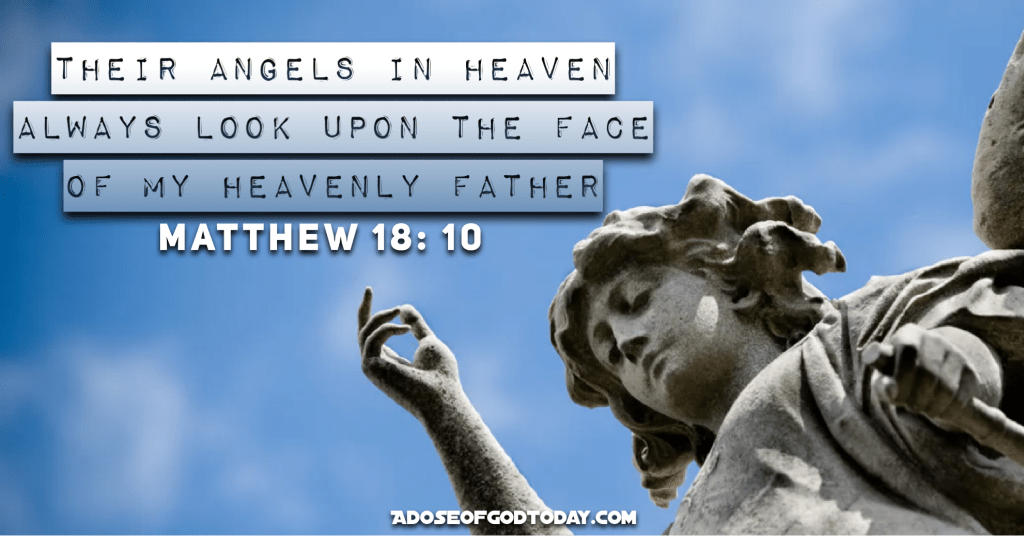
    In today’s Gospel, as we celebrate the feast of Guardian Angels, Jesus reminds his disciples of the angels who protects and guides the “little ones.” These angels always look upon the face of the heavenly Father, meaning, they too are very close to God. This closeness suggests that angels are indeed powerful intercessor of the “little ones” to God, the Father.

    As we celebrate this beautiful devotion to the Guardian Angels, let us see a bit deeper God’s invitation for us today through the Gospel.

    The question on “Who is the greatest in the Kingdom of heaven?” seemed to be a recurring concern among the disciples. They must have been very curious to know about this that at one time they were arguing on who was the greatest among them. They wanted security in the kingdom and they wanted assurance. Each of them showed to one another how worthy they were. However, this only revealed their self-entitlement. But then, the kingdom of heaven is not something that will be rewarded like a form of compensation to a person.

    The kingdom of heaven is a sheer gift of God to us. And this gift is given to the “little ones” and not to the self-entitled and assuming people, and most especially not to controlling and dominating people whose intention is to subdue others in order to gain more for themselves.

    The “little ones” are disciples of the Lord who in their smallness embrace God’s grace. These little ones trust in the providence of God. Thus, the “little ones” are symbolized by the image of a child. Each of the disciples, like us today, is called to become childlike. Nevertheless, not that we become children once again, but that we learn the qualities of children by being dependent to God and trusting God’s love. Moreover, like the children, we are called to be welcoming and embracing to the many surprises of God for us.

    As we become like children, Jesus also calls us “not to despise” the “little ones,” the other disciples of the Lord, the least in our community, the poor and the sick because they too are God’s “little ones.” God’s “little ones” have protectors and powerful intercessors who are angels. These angels are indeed mighty for they are always near God, looking upon the glory of God. This suggests the intimacy of the angels being shared with God because of their closeness. They surely, are our most influential friends before God.

    Hence, today, as we are called to acknowledge our guardian angels, acknowledge also that each of us has one who is always there on our side. We do not have to know their name or even assign name to our guardian angels. God intends that they remain nameless to us because naming them means having control over them. Our guardian angels are higher beings than us and we can never have control over them.

    Our Guardian Angel’s presence with us is enough assurance that God is also with us. As we grow our devotion to our Guardian Angel, may each of us become each other’s guardian angel in human form. Protect, guide, and bring those people around us to be closer to God. May our friends and family members will truly feel God’s presence in us and through us. Hinaut pa.

    Jom Baring, CSsR

  • Front-liners at home

    Front-liners at home

    Advertisements

    October 1 , 2020 – Thursday of the 26th Week in Ordinary Time (Memorial: St. Therese of the Child Jesus)

    Click here for the readings (https://bible.usccb.org/bible/readings/100120.cfm)

    Homily

    As the Corona Virus Pandemic continues to bring disorder in our way of life and as we continue to be limited in our movements especially with our religious practices essential to our faith, some parents and grandparents have expressed their worries as to the faith formation of the young generation. The Holy Eucharist and other public celebration of the Sacraments including catechetical gatherings intended for the younger generation, remain to be banned from the vast majority. Though many cities have been allowed to have the public religious gathering by 50% of the building/Church’s capacity, yet, minors and Senior Citizens are still discouraged to be present physically.

    This poses a concern as to how we continue the moral and spiritual formation of the young and the continual spiritual nourishment of the older ones. Consequently, the Church have found ways on how to reach out to those who are excluded particularly now through the use of social media. Yet, this might not be enough since not everyone can access it and the Church’s programs may not be appealing to the young.

    More than ever, the Church is in need of the “active participation” of parents, grandparents and young adults to be at the frontline in terms of moral and spiritual formation of the younger generation.

    Today’s Gospel reminds us of this mission we share from the 72 disciples sent ahead by Jesus to the cities where he intended to visit. They were Jesus’ front-liners at that time. Jesus sent them ahead to announce to them that God’s Kingdom is at hand. They were to prepare the hearts of the people who have been longing to see God and to experience good things from the Lord as what our Psalm proclaims today.

    Thus, the 72 disciples were told to bring peace to every household they visit. Even if there was the possibility of being rejected by those who were not ready, they were still to bring peace. As they were told to stay with those who welcomed them, the disciples were told to accept their hospitality and also to bring healing to those in pain, wounded, and sick.

    These were ways of nurturing those hearts who were longing to see God, to bring hope to those who were in despair and give hope to those who find life difficult and miserable.

    This is also the call to each of us now especially with you parents, grandparents and adults who live among and with the younger generation. Your presence is needed even more now to be those disciples of the Lord in your own context, that is, to be front-liners at home.

    You have this very important role to play to serve as front-liners, to prepare the hearts and mind of the younger ones, to nurture and develop their young faith and relationship with God.

    St. Therese of the Child Jesus, whose feast we celebrate today, reminds us of the mission we share with one another. St Therese is even called as the Patron of Mission even though she herself stayed most of her life inside the convent. Her little ways, her compassion and thoughtfulness to her sisters, her prayers and devotion were her ways of participating in God’s mission.

    Thus, for all of us too, we do our little and humble ways in participating in God’s mission. Parents, grandparents and adults, again, do your little ways in educating and nurturing the younger ones. Be welcoming to their different responses and be accepting to their ways of doing things and in relating with God. Affirm them and appreciate their efforts.

    But remember, to nurture and to develop one’s relationships with God is not done through “imposition” or by “force.” Never impose and never use force in nurturing the young ones. They learn by example. They admire through our sincere words and actions. They see and recognize God through us.

    In this way, we may be able to truly bring peace in our homes and bring healing into the hearts of our own family and friends. Hinaut pa.

    Jom Baring, CSsR

  • HOW TO BE YOU, PO?: ON THE FEAST OF ARCHANGELS

    HOW TO BE YOU, PO?: ON THE FEAST OF ARCHANGELS

    Advertisements

    September 29, 2020 – Feast of Archangels Michael, Raphael and Gabriel

    Click here for the readings (https://bible.usccb.org/bible/readings/092920.cfm)

    Homily

    How to be you, po? This is a youthful expression of admiration to a person and desire to become the person being admired. The admired person may have shown great talents, goodness and kindness that touched and inspired others or some other good qualities.

    The feast that we celebrate today, though they are not human beings like us, but spirits, Archangels, have something to teach us, as these angels reveal qualities that we can develop as we relate with one another and with God.

    Let us discover a bit who these archangels are and what they reveal to us and about God.

    The three are particularly called “Archangels” and not just “angels” because of the great importance behind their ministry. Their ministries are also revealed through their names.

    In particular, the name “Michael” means “the one who is like God.” The Book of Revelation mentions Michael and his angels fighting against the dragon identified as the Devil and Satan. Michael, the angel who fights against the Devil and protects the people shows the might and power of God. Thus, the ministry of Michael tells us how goodness will always defeat evil, and how God overpowers the Devil.

    Gabriel will always be remembered because of the role he played in the birth of Jesus. The name “Gabriel” means “the strength of God.” At the annunciation to Mary, Gabriel revealed how the strength of God was manifested in the ordinary life of Mary and in the smallness of the birth of a child. Gabriel also announced the birth of John that revealed how God showed power through the childless old couple, Zechariah and Elizabeth. This child will prepare the way of the Prince of peace. The ministry of Gabriel reminds us that the strength of God is found even with the small, even with those that the world thought to be insignificant.

    Raphael brings healing to people. Hence, the name “Raphael” means “God’s remedy.” In the Book of Tobit (see chapter 12), Raphael healed Tobit from his blindness and freed Sarah from a demon that tormented her. The ministry of this archangel tells us how God touches us to bring healing to us, to our wounded hearts, to our tired bodies and tormented spirits.

    Celebrating this feast today, this calls us too that as we seek the intercession of these Archangels, we should also learn from them and develop those characters that these Archangels possess.

    Thus, like Michael who is called the one who is like God, we are called to also protect others, to defend others especially the weak and the least in our community, and not to let darkness and evil to win. As individuals and as a community, we do our best with the help of God’s grace to counter our evil desires and the evil intentions of those who are corrupt and abusive.

    Like Gabriel, who is the strength of God by announcing the coming of the Lord, we are also called to announce Jesus to all but first we are called to always welcome and embrace Jesus in our life. Jesus, as he was born as an infant, his presence may also appear in ways we do not expect. Be mindful then, of God’s ordinary and everyday revelations.

    Like Raphael, who is God’s remedy, we are also called to be instruments of healing to the wounded, to those who are in pain, to the suffering by being able to touch them. Touch others with your kindness and concern, with your friendship and love as God touches us with his presence. Hinaut pa.

    Jom Baring, CSsR

  • In our Capacity to receive and embrace

    In our Capacity to receive and embrace

    Advertisements

    September 28, 2020 – Monday of the 26th Week in Ordinary Time (Feast of San Lorenzo Ruiz)

    Click here for the readings (https://bible.usccb.org/bible/readings/092820.cfm)

    Homily

    Look at how the disciples behaved themselves. This passage of the Gospel of Luke tells us how the disciples argued among themselves on who was the greatest among them. They must have been boasting one another about their closeness with Jesus, their great qualities, their faithfulness, on who was the first to be called and who was the favored one among them. Their argument must have been fierce because it reached the ears of Jesus. Jesus heard not just their words but even realized the intention of their hearts.

    At this point, the disciples thought that Jesus’ kingdom will be like those of kings sitting on a golden throne in the palace with a great army, a political king. They believed that Jesus will inherit political power and vast riches and material wealth. Thus, obtaining a position and having a closer relationship with Jesus will give them the security and assurance of a higher and influential position when Jesus reigns.

    Consequently, the argument of the disciples was based on how they could benefit from their friendship with the Lord. As Jesus heard them, he too realized that this was in the heart of the disciples. Jesus had to teach them and to mold their hearts according to God’s desire.

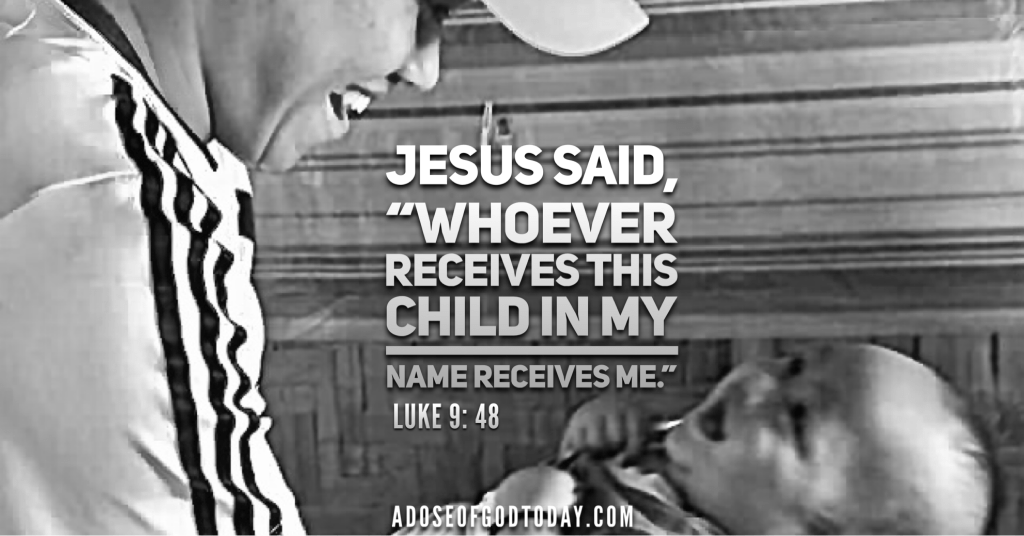
    That’s why Jesus taught the disciples an important lesson through a child. Jesus took and placed the child by his side and said, “Whoever receives this child in my name receives me, and whoever receives me receives the one who sent me. For the one who is least among all of you is the one who is the greatest.”

    Children, at the time of Jesus were considered not important because they were dependent, they have no rights and thus cannot be called as fully man at all. Jesus teaches that in the Kingdom of God, greatness is measured in the capacity to receive God. To receive God is best expressed in welcoming, in embracing and in receiving the least in our community.

    We are called to receive God in the person of those who are the least in our church and society. We are called to aspire to be great but neither in the way that we will be above others, nor to seek a higher position at the expense of others, but in the way of embracing others.

    This capacity to embrace others and embrace God fully was what San Lorenzo Ruiz showed to us. In offering his life, even to the point of death, San Lorenzo was always confident that Jesus was with him. He said, “If I have thousands of lives, all of them, I will offer to God.” This shows us that San Lorenzo had found himself, the kingdom.

    Thus, we shall surely see that when we make ourselves open to receive others, we too shall receive Jesus and Jesus will live in us. This is the reward, Jesus himself. The kingdom of God will be present in us because when we have Jesus, we will be at peace, secured and loved even if we are in the midst of trials and turmoil in life. Hinaut pa.

    Jom Baring, CSsR

  • When Jesus calls, he brings wonders in our life

    When Jesus calls, he brings wonders in our life

    Advertisements

    September 21, 2020 – Feast of St. Matthew, Apostle and Evangelist

    Click here for the readings (https://bible.usccb.org/bible/readings/092120.cfm)

    Homily

    Have you ever come to a point where you felt so unworthy, useless and even felt disgusted with yourself because of something wrong that you have done before? This happens when we have a deep consciousness of our own sinfulness, imperfections and weaknesses. Yet, when we also tend to focus to what is only wrong and ugly in us, we also begin to lose self-confidence, self-worth and self-value.  We also begin to underestimate our capacities and ourselves.

    In relation to this, the way we relate with God is also affected because we would tend to relate with Him as someone who would judge us and punish us for what we have done. Then, we relate with God in fear and guilt rather than in love.

    This kind of attitude was very strong during the time of Jesus. Sinners had no place in the Jewish society. When a person is poor and sickly, they believed that God punished him/her for the sins the person committed or committed by his/her parents in the past. People believed that sinners must be driven away from the community.

    This is the reason why lepers were untouchables, or the paralytics, the lame and the blind were despised by the “normal people,” because they were sinners and were punished by God. The seemingly normal people who were identified as the Pharisees and Scribes maintained a status quo that separated them from the sinners. These people would not touch any known or public sinners. They would not join them in any celebration. They forbid those sinners from entering the synagogue and the Temple. They disowned the sinners, treated them as less-humans, despised them and condemned them.

    Thus, every sinner felt unloved, unwanted and condemned. However, this is not the case with Jesus. Jesus turned the condemning culture upside down. Jesus went away from the rigid, judgmental and unforgiving Pharisees and Scribes. He surprised them with forgiveness, mercy and love.

    This is what has been proclaimed in today’s Gospel as Jesus called Matthew, a tax-collector to follow him. Matthew, since he worked with the Roman rulers and collected tax among his fellow Jews, was considered a public sinner. His fellow Jews despised and prohibited him to enter the synagogue and the temple and even to mingle with his fellow Jews. Matthew, like any other sinner, was condemned and excommunicated by the Jewish society.

    For the Jews, no righteous Jew shall talk to him or touch him. Yet, Jesus did all these things. Jesus talked to Matthew, touched him and even dined with him, made him a friend and called Matthew to be one of the disciples. This tells us how Jesus calls and brings many wonders in the life of a person who responds.

    Jesus proclaimed his message to everyone as he said, “I did not come to call the righteous but sinners.” This tells us that God is a God of forgiveness, of many chances, of healing and freedom. Jesus understands the struggle of a sinner though he was not a sinner himself.

    The letter of Paul to the Ephesians tells us that each of us has been given the grace according to the measure of Christ’s gift. As Matthew, the sinner was given the grace of forgiveness and acceptance, and so we are. The presence of God is the grace that liberates us from whatever burden, shame and guilt that we are suffering from.

    Hence, we should be careful then, when we feel the temptation to appear righteous and superior. Jesus said that he did not come for the righteous but for the sinners because righteous people do not need God. In fact, when we feel too righteous, we become arrogant. Arrogance keeps us away from God and would make us deny God’s mercy.

    This is the invitation for us today. We are called to humble ourselves by acknowledging our sinfulness. This moves us then, to recognise our need for God, need for forgiveness and healing. And when we recognise God in our life, then, we also allow God to transform us, to change our lives, to call us and to touch us like what happened to the public sinner, Matthew. As he allowed Jesus to call him, Matthew’s life was changed forever who became an apostles and an evangelist. Matthew, through his past life, brought many people to know Jesus until today.

    Hopefully, this kind of attitude towards ourselves and towards God, our attitude and treatment to those who failed, committed mistakes and have wronged us, may also become more like Jesus – that we may become welcoming of other sinners like us, by forgiving those offenders like us, and by promoting healing and reconciliation and not condemnation and destruction of sinners and offenders like us. Hinaut pa.

    Jom Baring, CSsR