A wise man once said: “We are like a bottle of medicine where God puts a label on it: SHAKE WELL BEFORE USING”.
Like a good wine drink or a sumptuous dish, some good things in life are at their very best if and when they are well-shaken, cooked, stirred and well-processed. Same thing could be said to us, Christians. Human as we are, we prefer not to be disturbed, on distress and discomfort. However, we are at our best selves not when we are pure, perfect or unblemished. Usually our greatness lies in these moments of struggles and sufferings – when we are shaken and disturbed by life’s misfortunes and trials. Saints become saints and great not because they are perfect but because, despite their imperfections and life-struggles, they remain steadfast witness to faith and medicine to others. Like a bottle of medicine, for us to be effective medicine to others, sometimes we need to be disturbed by God from our comforts and shaken vigorously by the trials and sufferings of life. We are meant to be shaken well before using.
So when things are rough and tough; and when life seems so hard and confusing perhaps we are being shaken by God in order to BE BETTER FOR others – a better person, witness and Christian for others. Just like what Jesus said: “When these things happen, stand up and raise your head for your salvation is near.”
Usually during Eucharist, after the homily, we stand up and renew our faith by saying the words: “I believe in God, the Father Almighty..” These words are the very foundation of our Christian faith and of our Eucharistic celebration. By professing our Christian faith, we renew our Christian commitment and we articulate our witnessing to God’s salvation through our Lord Jesus Christ.
There are moments, however that we express our faith without any serious intentions and commitments. There are moments that some would even say these words halfheartedly and without sense & spirit at all. Like a memorized formula, saying those words without meaning it. Worse, others cannot even memorize those words. I remember once, during Baptism and Easter Vigil Mass, where we usually renew our faith, when the priest: “Do you believe in God the Father?”, rarely you would hear a loud response: “I do believe”. Others would not even respond at all, as though they don’t care if we and they believe at all.
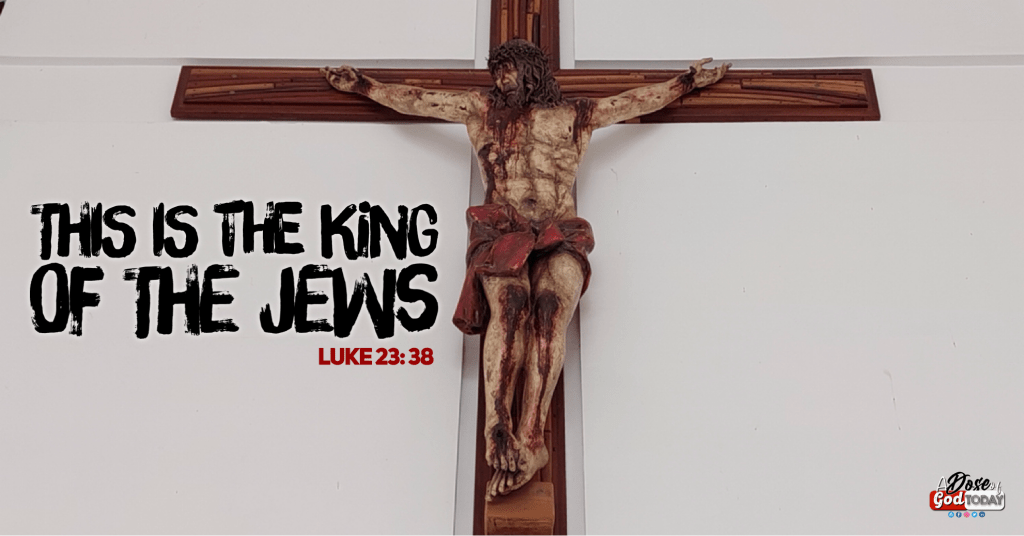
Today, we celebrate the solemnity of Christ the King. We honor the kingship of Jesus Christ in our lives today. However, we hear from our gospel today that Jesus, our King is not only a crucified king but also a king who is rejected, insulted, dishonored, and humiliated by the people. We cannot deny in our gospel today that Jesus Christ is a harassed, rejected, disgraced, maltreated, and persecuted King. Indeed, they proclaimed Jesus as King, but a Redeemer king who cannot even redeem and save himself – a king without a throne, and worse crucified on a cross.
We do need to seriously reflect our gospel today, for it challenges us to deeply understand our faith not only on his Kingship but most of all our faith in Jesus himself. We might ask ourselves: “Do we really acknowledge and believe Jesus as Christ the king?” or “Are we like, Pontius Pilate who admits or not, because others say so?” “Before me, who is Jesus? Who do I say Jesus is?”. Or perhaps ask ourselves: “who and what do I believe and worship? Is it God whom we believe and worship? Or we rather believe and worship our life, work, honor, wealth, and others than God himself?”
This is a concrete call for us Christians to look deeply into our own personal commitment to what and who we really believe in. We honor Jesus today, our Christ and our King whom people have persecuted, humiliated, maltreated and rejected. “Would you still consider him as your King? Would you recognize and bear witness to Him as your king? Or would you reject, dishonor, and persecute him again like what others did and are doing today?”
God’s kingdom then does not rest only the kingship of Christ but on our authentic witnessing and commitment of our faith in Jesus Christ. As His Witnesses now, we consider Jesus as our King, not only because of what he has done but most of all on His own commitment towards the Father and for the salvation of all. God’s kingdom and the kingship of Jesus Christ do not only mean name, power, and prestige of Jesus but moreso our heartfelt and wholehearted profession, proclamation, witnessing and commitment to God’s salvation through our faith in Jesus Christ. The kingdom of God then requires our total and authentic commitment to Christ, as Christ commits himself to us & our Father.
Again, here in our celebration today, we Christians are called to proclaim and witness our faith in Jesus Christ. As Jesus bears witness to his great love to the Father, we are also invited to the same total and wholehearted dedication and faith in Jesus. Brothers and sisters, as Christians, we should not be ashamed to express and proclaim our faith to ourselves, to each others and to others. As Filipino Catholics, we look also forward now to the next 500 years of our Christian faith & witnessing here & abroad.
As we end and about to begin a new liturgical year, let our eucharist today be another beginning to renew our faith, that is to make our faith better than ever. Amen.
Whenever death & disasters happen in our lives, we cannot help but raise the question about the end-time or the end of the world. Ever-present war, pandemic, famine, pestilence, super typhoons, tsunami, hunger, earthquakes, flooding, landslides, and countless death-crimes in life render us anxious and helpless towards our coming future. Our worries about the coming end-times are not only felt around us but also within us. We are not ignorant as to how it feels when our world seems have broken and ended whenever we experience heartache as to the death and loss of our loved ones, or failed in our studies, business endeavors, plans and dreams, or diagnose with serious illness and others. Even worse, Scripture and Jesus himself warns us of these coming end-times as inevitable and surely to happen to our human life.
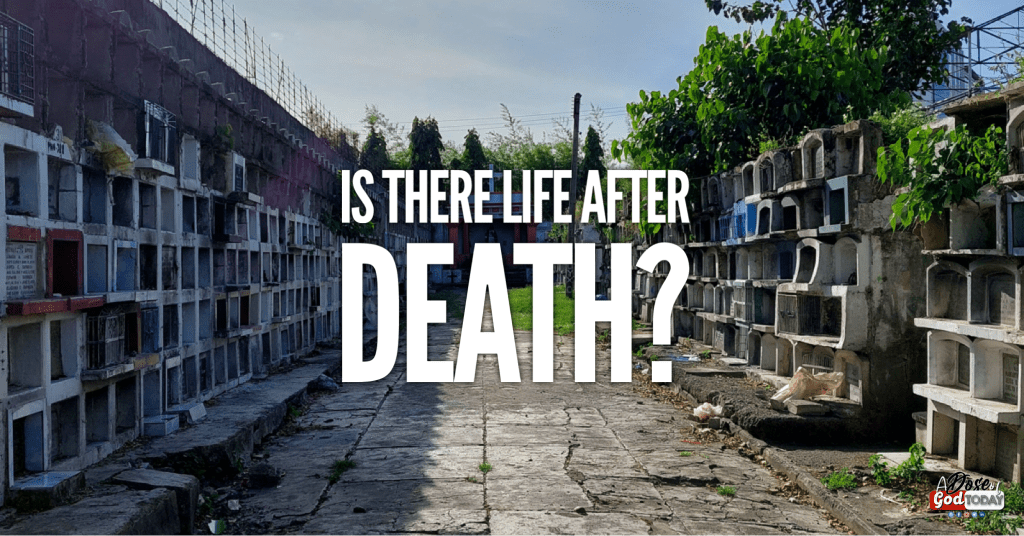
Related with our uncertainty about end-time are the questions: “What’s the point? What’s the meaning of all these life-endeavors? Is there hope in life?” And above all, at its very heart, raises the question: “What now… and then? Is there Life AFTER Death?”
A wise man once said: “The question should not be: ‘Is there life after death’ but rather ‘Is there life BEFORE death’?
True enough, while life-disasters and death surely to happen in life, we should concern ourselves less about what happen to us after life, but rather more so concern about how we live our life before our inevitable death. Regardless whether there is life after death or not, we should never forget the fact that there is life before death that we are still now in. If we come to think of it, we are still now here alive for a reason and purpose to be in this world. It is for us now, as we live this life, to discover and fulfill in life our real reason and purpose to be and live. Our task and concern in life is to live our life now before death to the fullness of our very life-purpose.
Life Before Death would also mean that the greatest loss in life is not death, but what dies inside us while we live. Sadly there are people nowadays who have reasons to die than to live, and people who are still alive but dying and already died inside. Though painful, confusing and disheartening, our experiences of disasters and loss should move us still alive to deeply discover and enable the very reason and meaning of our life-existence. For Jesus, life-death and disasters are not only about end-times or world’s end, but more so about the opportunity for us to testify, that is, to rise to the occasion,…. stand up and witness in life our faith in God through Him, and…. to live-up to our very life-purpose and reason in life. In other words, Jesus is saying to us, that these things will surely happen to us, but with a reason and for a purpose. So, we should consider more our life now before death, rather than our life after death, and as He promised, “By your perseverance in life, you will secure your lives.”
Practical advice then to ponder: Whenever disaster strikes and happens in life, ASK NOT , “Why is this happening TO me?” but rather, “why is this happening FOR me?” Because…. Asking, “why is this happening TO me?” leads to unhealthy self-doubt, blame, guilt, anger, and inner death. Asking, however, “why is this happening FOR me?” leads to meaning, purpose, challenge, responsibility, and resolution.
As we grapple then with the concern about our experience of death & disasters in life, as per advised, ask not: “Why is this happening to me?”, “Is there life after death?” but rather ask, “Why is this happening FOR me?”, “Is there life before death?”, “Do I have or am I having a life now before my death?”. With this, we may be more hopefully grounded to live our lives by its very reason, meaning and purpose, as well as to be a living testimony and witness of our Christian faith, and God’s grace to our present world.
Last week and even week before last, we cannot help but find ourselves thinking about our experiences of death & life. Not only we were remembering our dearly beloved departed brothers & sister, we are also praying for the souls in purgatory & souls of those who have recently died of Covid pandemic, victims of natural disasters, & about all the 150 plus youth who died in Itaewon Stampede for a Halloween party in South Korea. Yes, we cannot help but reflect on such a waste of lives of many young people who are supposed to be enjoying & having fun on a costume party Halloween Event, which they don’t even believe, ending in tragedy on harrowing deaths of plenty.
In such experiences of death, dying & waste of lives nowadays, yes indeed, we do find ourselves questioning about our life as it is & our life yet to come. Somehow, we ask ourselves what is life all about. “Is there a life after death? What happened to those who have died? Was their life sensible before their death? Is our lives now sensible before our death? Is there, are we living or do we have a life before death?”, are just but some questions we are confronted with, as we make sense & find meaning from our recent experiences of loss & grief.
Somehow our readings today are offering us some perspectives as to how we grapple with these questions.
By our faith in God, the witness of suffering & martyrdom of the Maccabeans testify to the reality that there is more to life & death than what we have and are experiencing it. For people of deep faith, there is resurrection, eternal life, and life-beyond life & death. Paul exhorts us faithful people to be steadfast & enduring in our faith in God who loves us dearly & in Jesus who journeys with us in life. And in our gospel today, Jesus is telling & teaching us that resurrection, eternal, life-beyond life & death is not all about who are we married to in life, but moreso about it is about how we have been faithful & fruitful to the life we have committed to in life, since our fullness of joy lies in the full glory of our Lord – not ours, as our Psalms proclaims.
In our life as Christian believers then, we are called not only to be happy and successful, but above all to be faithful & fruitful. Faithfulness & fruitfulness then IS life-all about, and less on our happiness & successes. Our life here & now thus is all about fullness of God glory through the faithful & fruitful witness of all who believes in our Lord Jesus Christ.
Beyond the questions about the meaning of our experiences of life & death while we are still alive here & now, lies the call & challenge for us to be faithful & fruitful in our faith in God. Eternal Life – Life Beyond then is all about God & about how we have been faithful & fruitful in life we are having now.
As once penned by a modern-day spiritual guru Henri Nouwen: “The real question is: “How can I live so that my death will be fruitful for others?” Our life we have here & now then IS OUR CHANCE to do thing right before God & others.
Perhaps while we are still now alive here in this life, consider these very words of St. Paul that inspired one of Pilipino church song entitled: “Pag-aalay ng Puso”:
“I expect to pass through this world but once. Any good therefore that I can do or any kindness that I can show to any fellow creature, let me do it now… for I shall not pass this way again….”
Minsan lamang ako dadaan sa daigdig na ito, Kaya anumang Mabuti maaring gawin ko ngayon. O anumang kabutihan ang maari kong ipadama, itulot ninyong magawa ko ngayon ang mga bagay na to. Nawa’y hwag ko tong ipagpaliban, O ipagwalang-bahala, sapagkat di na ko muling dadaan sa ganitong mga landas.
A man once approached an elderly priest and asked, “Father, how come it seems that God does not speak to His people anymore? He used to speak so beautifully with such power and clarity to our prophets and apostles. But why is it that God seems no longer talk to us His people? Nagtatampo ba siya sa atin? Is he isolating Himself from us?”
For a minute the priest was just in silence, shaking his head as though he was in pain. He replied in time, “My son, it is not that God no longer speaks to us His people. Hindi sya nagtatampo sa atin. He is not isolating Himself from us. It is just that… no one these days can stoop down low enough to listen to Him. No one… can stoop down…low enough… to listen to Him these days.
At times, we also find ourselves like that man sharing the same question: “Why and how come God no longer speaks to us His people?” As we go through our lives doing our daily affairs, we do feel and experience at times the silence and absence of God. Nagtutulog ba ang Dios? Is God asleep? Nagtatampo ba ang Dios? Is God sulky? Is He isolating or distancing Himself from us?
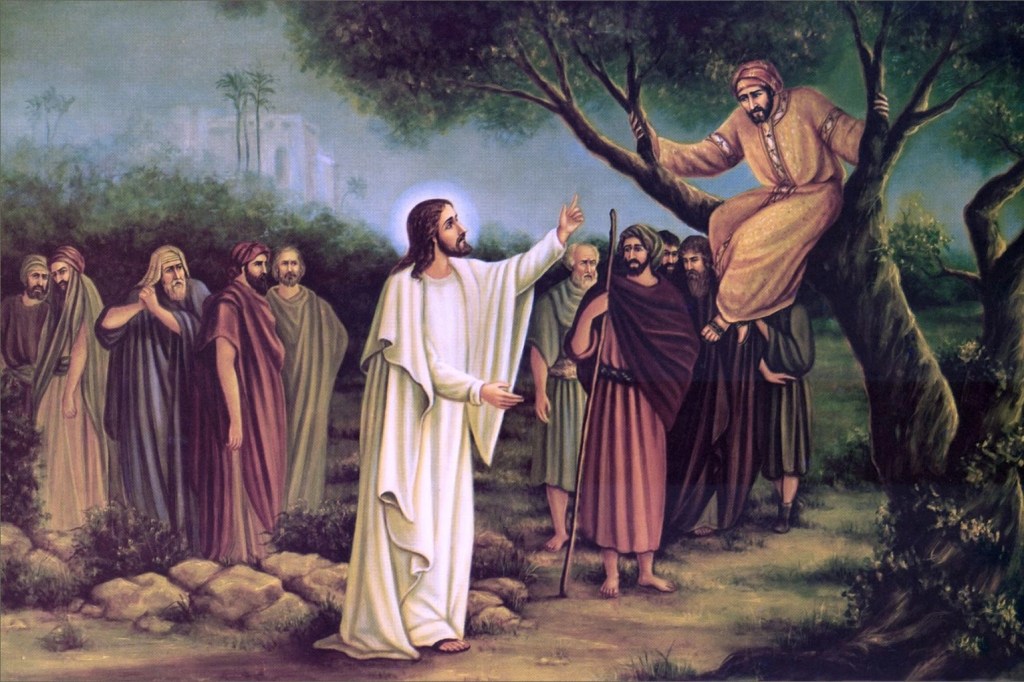
Zaccheus in our gospel today must have felt and experienced the same silence and absence of God in his life. While doing his usual work of collecting and counting money in the treasury, Zaccheus must have asked the same question about God no longer speaking to His people. He must have also wondered about the silence and absence of God in our lives.
To the extent, that when he heard that Jesus is passing by, he decided to close his office, climbed up a tree, hoping to have a glimpse of Jesus, whom he must have heard of as godly person. Actually, he doesn’t want to be involved. He only wanted to “observe” Jesus and the crowd. So, while waiting for Jesus on the tree, perhaps he must be back then thinking about his favorite topic: his work, his money collections, his usual affairs & concerns.
As he passed by the tree, Jesus saw Zaccheus and asked him to “come down and hurry for I must stay in your house today”. Somehow Zaccheus got more than what he bargained for. All he wanted was just a glimpse to observe Jesus. Now, he got an audience and a home visit from Jesus. And, what is required of him is just to come down from the tree, invite Jesus in to his house, and take part in the life and mission of Jesus.
So how come and why God is no longer speaking to us His people? Why do we at times felt and experience the absence and silence of God?
Perhaps because, like Zaccheus, we become so concerned and comfortable about our day-to-day worldly affairs of being and striving to be always at the top of things and people. Like Zaccheus, perhaps we also don’t want to get involve and participate. We rather observe than serve the Lord and others. And like Zaccheus, we rather remain “at the top of all things” in our comfort zones, being labelled and stereotyped by others, – instead of being recognized as not only as Abraham’s descendant but more so as God’s children. So, why God no longer speaking? Perhaps it is because we are no longer stooping or kneeling down low enough to listen to Him.
The invitation of Jesus to Zaccheus: “To come down and hurry for I must stay in your house today” is a wake-up call also for us today: “to stoop down low enough to listen to Him”. For us then to experience the presence, voice, and lambing of God, instead of his absence, silence and tampo, we must learn to humbly listen to Him through His son Jesus Christ & be involve in His affairs.
This is a reminder that in life at times, we become too-far, too-high, too-much, too-numb, too-away, too-distant from God that we cannot anymore see, hear, feel, and experience Him. It is like our phones might be fully-charged but we have weak signal and out of coverage.
However, rest assured, like Jesus, God is always reaching-out to us, wanting to be in contact with us whatever happens, “for the Son of Man has come to seek and to save what was lost”. All we have to do & required of us is to come down from our pedestals & comfort zones, invite Jesus into our lives and eventually participate in His ever-present life & mission in our lives. In other words, Stoop Down… Low Enough… to Listen to Him.
Perhaps we may ask ourselves: “when was the last time I stoop or knelling down low enough to listen to Him?”
We learn last Sunday the most simple and very effective prayer of the tax collector: “O God, be merciful to me, a sinner” or simply the Jesus prayer: “Lord, have mercy”. May we also learn today from the prayer of prophet Samuel: “Speak, Lord, your servant is listening”.
Before Our Father, may we find ourselves listening in humility & poverty, so that God can contact-trace & reach-out to us for the better of us always.





 A DOSE OF GOD TODAY