Category: Bishop Manny Cabajar, CSsR, DD

  • THE CALL TO MISSION

    August 1, 2021 – Feast of St. Alphonsus Ma. de Liguori

                                                                                                 + Manny Cabajar, C.Ss.R. D.D. – Bishop Emeritus of Pagadian

    Can you recall occasions in your life, which you can call moments of discernment or conviction or moments of decision? Alphonsus had that experience. With clarity and finality, he decided to respond to the Father’s call to mission.

                Alphonsus belonged to a rich nobility in Naples, in Southern Italy. He was a very gifted musician, painter and sculptor. At the age of 16 he was already a doctor of both canon and civil law. As a young, brilliant and successful lawyer in 17th century Naples, he was handling an important case for the Duke of Tuscany. But most likely because the judge was influenced, the judgment went against him. It was shocking. For three days, he would not eat nor leave his room. Then he began to visit the Hospital of the incurables, the equivalent of our AIDS patients today. There he had an inspiration. He heard the Lord say to him, “leave the world and give yourself to me.” He interpreted this as telling him to leave the social class to which he belonged and to become a pastoral priest. He called his experience a vision – a moment of clarity and decision when he knew exactly what God wanted him to do and felt ready and willing to do it.

    While praying and meditating in the cave of Scala he noticed the poor goatherds in the hills and had compassion for them. Not only were they marginalized by society, they were also neglected by the Church. Thereafter, he decided to spend his whole life preaching the Word of God to the most abandoned poor. He founded the Congregation of the Most Holy Redeemer, whose members are more popularly known as the Redemptorists. Drawing inspiration from Alphonsus the Redemptorists try to preach the Word of God to the poor, especially the most abandoned and try to go where many in the Church would not want to go.

                What motivated Alphonsus in his self-sacrificing life? It was no other than the son of a carpenter who also experienced a moment of decisive action when, at about 30 years old, he emerged from his hidden struggle to be his authentic self. Looking around him the carpenter’s son saw a culture of egotism in the pursuit of power, wealth and prestige often at the expense of the poor. It was a culture deeply steeped in sin. Searching for a model to follow he could only find his cousin, John, who was a simple and honest man but a fearless preacher proclaiming a message of powerlessness, simplicity, and humility and demanding of others and of himself to let go of all that was false and inauthentic. So, he went all the way from Galilee to Judea and lined up with sinners to be baptized by John at the river Jordan. His baptism was significant as it was a moment of definite decision, a radical option to accept the call to mission. It signified that a new time has begun in which God would reach out to the poor in a new way through a carpenter’s son. Jesus was His name.

                In lining up for baptism like a sinner, Jesus set aside all exemption. He lined up before someone who would be beheaded for his convictions. Jesus would also die for his convictions. That was a horrific decision and commitment to a non-violent struggle that will win salvation for all. But it had its consolation. God manifested His presence in a form of a dove and a voice was heard, “This is my beloved son in whom I am well pleased.” The human Jesus needed that affirmation. God so loved the world that he sent his only begotten Son who would reverse the conventional way of doing things. Instead of using power to destroy enemies, He would become poor and powerless, like his cousin, John, allowing his enemies to apparently destroy him.

                In the first 300 years of the Church’s life, baptism and ordination to a leadership role, were a very serious commitment. Leadership in the Church was a passport to martyrdom in the tradition of John and Jesus. Christianity opposed the values of the world and the human leaders espousing those values. That’s why authorities saw the Christians as a threat and wanted to silence them through cruel persecution. A huge  change took place in the 4th century when the Bishop of Rome crowned Constantine Emperor. Christianity became the official religion of the Empire. Bloody persecutions ceased. Many bishops and priests became partners of kings and princes and were given titles like “Prince-Archbishop,” “Your Grace,” “Honorary Prelate.” The Church gained power and prestige but sadly lost some of her prophetic freedom. The irony was that it now became harder to follow Jesus as a Suffering Servant.

                Today, are we not victims still of a similar situation? Don’t we see vestiges of power, prestige and wealth in the Institutional Church to which we also belong?  Don’t we see that what we criticize in the Church’s leadership also lurks in our communities and in ourselves as individuals? In our prayer, don’t we often court power, prestige or wealth for ourselves or our families? We need a serious soul-searching as community and as individuals to help us see that the challenge of our baptism is to let go of all control, of all wealth and privileged positions. Many are afraid of this challenge. To let go is not easy. But let us remember that when we face the challenge in big or small things we validate our baptismal promise!


               Can we not do that? Of course, we can. Just as the Spirit empowered Jesus at his baptism, the same Spirit empowers us and makes a dwelling place in us in a special way at baptism. We take courage from this. If we connect with the Spirit in us through prayer and meditation we can let go of all directing of God. We can open ourselves up and say, “Speak Lord my heart is listening.” Meditating and being still in the center of our being surely helps. It is when we are still at the center that we can hear our own inner wisdom blending with the wisdom of the Spirit. It is when we are still that God speaks to our hearts, telling us what he really wants us to do now.

                We find our efforts at being still and silent at prayer quite frustrating at times, but we don’t give up. We keep struggling at it because at some time we don’t expect the truth will surface from the Spirit within us, like a bubble rising to the surface of a calm sea indicating there is a diver below. Dear confreres and friends: remember this about prayer and meditation – they dispose us in decisive moments to accept our baptism and its consequences just as it disposed St. Alphonsus to hear the truth within and follow Christ in seeking and doing God’s will through preaching His word among the most abandoned poor no matter what the cost was for himself. St. Alphonsus’ constant union with God through prayer empowered him to follow the Lord with fidelity and zealously proclaim the good news of the Kingdom to the poorest of the poor. Amen. 

  • SHARING

    SHARING

    July 25, 2021 – 17th Sunday in Ordinary Time

    + Emmanuel T. Cabajar, C.Ss.R. D.D.

    Click here for the readings (https://bible.usccb.org/bible/readings/072521.cfm)

    A boy gets his lunch left-over boxed up to take home. As he leaves the restaurant he ignores an old man begging. Feeling a sudden guilt, he gives him some coins. “How about the box, I’m hungry?” the old man begs. To part with his burger isn’t that easy, but compassion prevails. The boy gives it to the poor old man who smiles with gratitude.

    In the gospel a boy gives his lunch to Jesus, which allows Jesus to do something extra-ordinary – feeding the crowd. This miracle is repeated at the Last Supper and at every Mass where Jesus gives Himself and makes us sharers in his body and blood. St. Ignatius of Antioch calls this “one bread that provides the medicine of immortality, the antidote for death, and the food that makes us live for ever in Jesus Christ.” This food unites us intimately with Jesus and heals us, body and soul. It gives us strength for our spiritual journey. Do we hunger always for this bread of life?

    The feeding of the crowd demonstrates God’s kindness to us. He gives generously. He gives more than we need so that we may also share with others, especially the most deprived. God multiplies the little that we have, like the boy’s lunch, for the good of others. Do we trust in God’s provision for us? Do we share freely with the poor? Jesus is still looking for simple people, like you and me, who are willing to make selfless sacrifices that He may convert small love offerings into His glory. May our hearts be open to such kindness and generosity!

             Lord, satisfy the deepest longings of our hearts and feed us with the finest food!

             Brothers and sisters, generosity makes us joyfully share our God-given gifts with others. Amen.

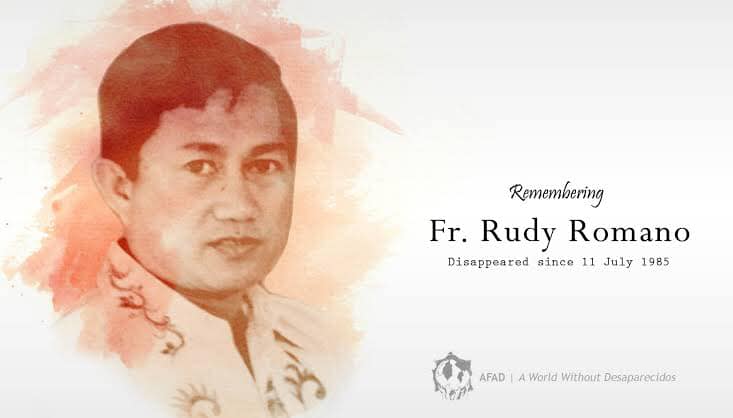
  • HAIN KA NA IGSOON: REMEMBERING FR. RUDY ROMANO, CSsR

    HAIN KA NA IGSOON: REMEMBERING FR. RUDY ROMANO, CSsR

    + Emmanuel T. Cabajar, C.Ss.R. D.D.

    Fr. Rudy Romano was abducted by the military in the outskirts of Cebu City. He became a ‘desaparecido’ victim among so many in the country during the Martial Law regime. After fruitless years of struggle to find him, it was felt that, for the sake of his agonizing relatives and friends, a closure had to be made. Without proof of his death the Redemptorists decided to celebrate a funeral Mass for him.

            Thirty-six years have gone by since his disappearance. But many still remember him as a missionary priest who felt for the poor, especially the most abandoned and marginalized. To be poor is to be voiceless and Rudy offered himself to be their voice and courageously advanced their valid cause and noble aspirations. That is why many regarded him as a martyr for the cause of the poor and oppressed. He was willing to pay the price in taking sides with them.

            I have fond memories of Fr. Rudy. He was two years ahead of me at St. Alphonsus Theologate in Cebu City but we were classmates in some subjects. Common interests often brought us together. Instead of taking a midday siesta we would often do carpentry work or develop photographs in the dark room or give some haircut to a confrere. We used to call him affectionately ‘the scientist before his time’ due to his inventiveness and creativity. The many gadgets he invented attested to that. Out of copra sacks he made backpacks for us and assembled portable cooking tripods for our excursions and long treks in the hills of Busay, Mt. Manungal, Balamban and Toledo.

            However, more than anything else, I personally remember Fr. Rudy as a preacher of the Word of God. He dedicated a large part of his pastoral work to the ministry of the Word. He was engaged in the rural missions. He tried to develop Fr. Fil Suico’s visionary intuition into some concrete missionary method. I saw some of his missionary footprints in Northern Mindanao, from Iligan to Gingoog. One early morning, as I was jogging in Mambajao, Camiguin Island, I saw a stone marker at a junction. Engraved on it was an expression of local people’s sentiments, ‘Handumanan sa Misyon” with Fr. Rudy’s name on it.

            The preaching of the Word of God has the capacity to act as a light of truth that illumines the concrete situation that the people live at the moment. Being rooted in the Redemptorist tradition of prophetic announcement of the Good News, Fr. Rudy preached like an artist, knowing how to make simple and ordinary words come to life in the people’s here and now. That is why the Word of God springing from his inner conviction touched the wounds, the injustices, the victims, the exploited while causing the ire of powerful arrogant perpetrators. If we must keep the memory of Fr. Rudy alive, the reason must be that the prophetic preaching he tried to practice is still very relevant today.

            Our mission is never simply to preach on majestic pulpits billowing with incense as if the Good News were floating on the clouds. We have to proclaim the Word in a way that enlightens, awakens, challenges even if it annoys and opens up wounds and surface conflicts so long as it brings healing to people who hunger and long for the experience of God’s saving power. This kind of preaching pierces real human life but cannot get along with the powers of darkness and evil. This is the kind of preaching we must do and this has to be rooted in prayer and trust in a compassionate God.

            This commemoration of Fr. Rudy Romano offers the Redemptorists a timely and relevant challenge. Are we prepared to shake ourselves up and force us to look honestly at our own preaching in parishes, shrine churches, and retreat houses today? Are we willing to wrestle with the Word of God and be fully engaged with the world’s complexities and be open to the ongoing revelation of God in the signs of the times? Are we willing to ensure that the Word takes on flesh as Good News for the poor and the needy? Are we prepared to always speak and stand for the truth even if it would mean losing our privileges and financial stability and security?

            Undoubtedly, this stance would find echo in those who love the truth and who truly love the poor. Blessed are we if we are true to the Gospel!

    (A song composed by Bishop Manny Cabajar for Fr. Rudy)

    HAIN KA NA IGSOON

    Hain ka na igsoon ning dugay nang panahon?

    Hain ka na igsoon? Gamhanan patubagon!

    Nganong ikaw gidumtan, gisakmit sa dautan?

    Mao ba ni ang bayranan paglaban sa uban?

    Nganong ikaw igsoon gidid-an sa katungod?

    Nganong gipasipad-an, gidan-ok sa kalisud?

    Dili gyud mi moundang kon di ka makaplagan.

    Kalingkawasan barugan: pangandoy sa tanan!

         Bangon mga igsoon,  tanlag ang pagasundon!

         Nasud pagamugnaon, kaisog magbaton!

         Asdang mga kauban, lihok sa katarungan,

         Nasud may kagawasan, padulngan sa tanan.

    Nganong ikaw gidumtan, gisakmit sa dautan?

    Mao ba ni ang bayranan paglaban sa uban?

    Nganong ikaw igsoon gidid-an sa katungod?

    Nganong gipasipad-an, gidan-ok sa kalisud?

    Dili gyud mi moundang kon di ka makaplagan.

    Kalingkawasan barugan: pangandoy sa tanan.

         Bangon mga igsoon, tanlag ang pagasundon,

         Nasud pagamugnaon, kaisog magbaton.

         Asdang mga kauban, lihok sa katarungan.

         Nasud may kagawasan padulngan sa tanan.

         Hain ka na igsoon, hain ka na igsoon,

         Hain ka na igsoon, hain ka na?

  • Trust in God

    Trust in God

    July 11, 2021 – 15th Sunday in Ordinary Time

          + Emmanuel T. Cabajar, C.Ss.R. D.D.

    Click here for the readings (https://bible.usccb.org/bible/readings/071121.cfm)

    Jesus sends his disciples to announce the Good News of God’s Kingdom and cast out demons and heal the sick. With a great deal of trust and courage they obey Jesus and venture into the unknown. They take nothing and go two by two in their mission. The disciple is never alone as the Lord chooses another to accompany him. Because of their “yes” the Lord’s message spreads and the world begins to change.

           Evaluating the dismal results, a parish evangelization team realizes that focusing on mission logistics leads to the message becoming buried. Getting engrossed with the means leads to neglect of the Good News!     

          Fidelity to the core of our baptism allows God to carry out His mission through us. We don’t have to worry about material needs. The almighty opens the hearts of believers to provide for His preachers. The important thing is to obey the Lord and proclaim the Good News. We preach His Cross and find consolation and joy in our trials. 

           We accomplish God’s work as community and always with reference to His will to preach the Kingdom of God. In His name, we cast out demons and heal the sick!

           Heavenly Father, we do not rely on human resources in our ministry. You will always provide for whatever it takes to be Your humble and faithful disciples. We trust You in word and deed as one Body of Christ, united in spirit and in truth. We receive communion with fervor and allow You to make us channels of Your healing love so that others may find hope, freedom and life in the Kingdom You prepare for all of us.


    Brothers and sisters, we witness to the joy of the Gospel in word and in deed. Amen.

  • DO NOT BE AFRAID

    DO NOT BE AFRAID

    June 20, 2021 – 12th Sunday in Ordinary Time

    + Emmanuel T. Cabajar, C.Ss.R. D.D.

    Click here for the readings (https://bible.usccb.org/bible/readings/062021.cfm)

    The bacteria that caused the bubonic plague in the middle ages claimed 25 million lives – about three-fourths of Europe’s population. The survivors wondered where God was in this disaster. “Where are you, Lord? Don’t You care?” Today the Covid 19 virus causing the pandemic poses similar questions on God’s role and presence in this global havoc and tragedy!

    Indeed, when we feel drowned by misery we often cry out, “Where are you, Lord? Don’t You care?” We don’t seem to recognize the Lord’s abiding presence even in the midst of storms, adversity, sorrow, temptation! Yet, He is always by our side with blessed assurance, “Why are you afraid? Have you no faith?” “It is I, do not be afraid.” When the Lord calms our storm and calls our name, we have to realize that great indeed is His loving mercy that elicits faith and longing to entrust to Him all our needs and cares.

    Loving Father, our faith is Your gift, empowering us to relate to You with trust by accepting Your life-giving word. Your love strengthens our faith, enabling us to do justice and act with kindness to the poor and voiceless even in the face of trials and difficulties. How blessed are we whenever we allow Your love to rule in our heart and mind goading us to choose what is good and in accord with Your will!

    Brothers and sisters, may the Lord deepen our faith in His redeeming power and love. May we always recognize His abiding presence with us and take courage in doing His will in all circumstances. Amen.