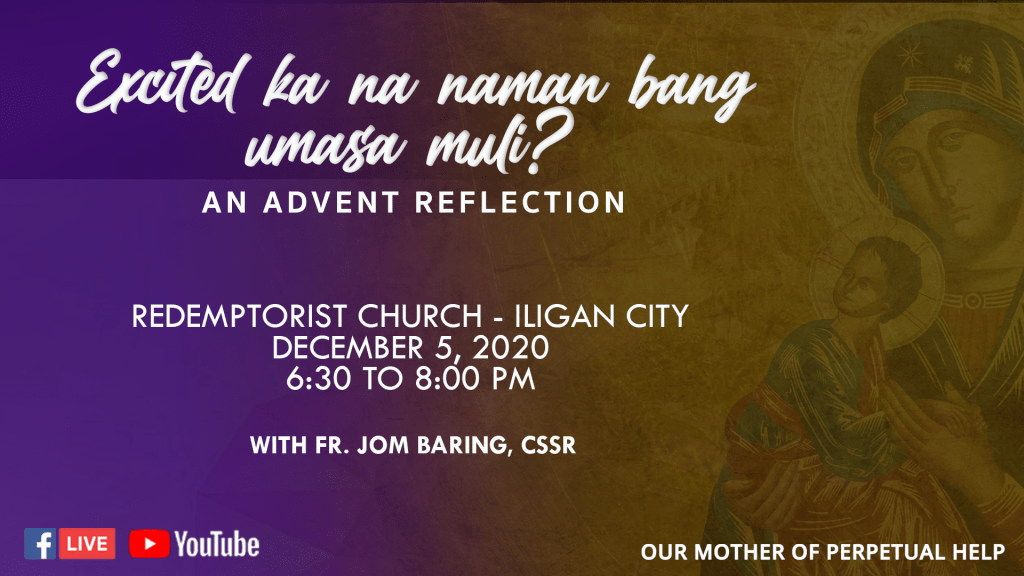
This Advent Reflection invites us to dwell deeper on the importance of our presence and of God’s presence in our life and in the life of others. The excitement to hope again calls us to hold on to hope, to be hopeful and to be the hope for others.
To look for comfort once in a while is a human necessity. To take comfort when we are experiencing stress from work allows us to relax. To take comfort when our relationship becomes suffocating allows us to gather our mind. To take comfort when we are sad, sorrowful and suffering allows us to breath, to be heard and to be embraced. For this very reason we seek the things that we know would give us some comfort like the presence of our friends and family members, the people who care and love us. Others can also take comfort even from small and simple things like eating their favorite dish, going to a fun-filled place, taking a vacation in a peaceful beach or just retreating into the recesses of their rooms and personal space.
Some forms of comfort too would sometimes develop into unhealthy habits and even addictions. In the search of experiencing comfort and joy, we could also fall into traps. We may believe that it is the comfort that we have been looking for, yet, because it is easy and can be made available then we settle for it. This is the case when we begin to foster a cycle of habit, the early stage of addiction, and later on will also become a compulsive behavior in us. This can compulsion can be in any form. This is not limited to chemical substances but also in relationships and in our attitudes to material things. Thus, those that become excessive in us can be forms of obsessions and addictions that are actually expressions of our desire to be comforted.
Such desire to be comforted brings me now into the theme on this Second Sunday of Advent. Today, we light the second candle, which is the candle of peace. Is it not that we indeed desire peace – peace in our hearts, peace in our homes, peace in our communities? This desire for comfort which peace will bring to us, is what we also hear in our readings today.
The first reading from the Book of Isaiah wonderfully proclaimed to us God’s response to the people who longed for peace. “Comfort, give comfort to my people, says your God. Speak tenderly to Jerusalem and proclaim to her that her service is at an end, her guilt is expiated.” This passage was proclaimed to the people of God who were exiled to Babylon and were made slaves. They were in a foreign land, captives of foreign masters, removed from their homeland, subjected to suffering and misery. Indeed, they longed for comfort in midst of darkness and sin which can only come from God.
But, at last, the exile shall come to an end, for God is faithful and merciful. The sins of the people were forgiven and peace shall be theirs.
This promise of God to give comfort to the people shall be delivered by God himself and not just by any messenger. God comes to comfort the people because God’s presence means peace. That is why, Isaiah tells us too that when God comes, God will be like a Good Shepherd to us. The Lord will gather us in his arms, carry us in his bosom and lead us with care.
These images of God’s actions tell us that God also longs for us. God longs to be closer with us. God desires to be really with us. This is peace. This is the true comfort that we too are looking for.
Moreover, in order for us to be more welcoming and accepting of God’s comfort, Isaiah tells on what to do. What Isaiah proclaimed was also re-echoed in our Gospel today, through the person of John the Baptist. It says, “prepare the way of the Lord, make straight his paths.”
John reminds us that salvation is possible, that peace and freedom from sin is possible. Thus, comfort of peace will dawn on us when we start recognizing our sinfulness rather than the sins of others. Peace is felt when we humble ourselves before God to accept that we are in need of mercy.
However, we too might feel impatient with God because we expect that we should be comforted right away and immediately when we need it. Peter in his second letter reminds us today also, he said, “Do not ignore this one fact, beloved, that with the Lord one day is like a thousand years and a thousand years like one day. The Lord does not delay his promise, as some regard “delay,” but he is patient with you, not wishing that any should perish but that all should come to repentance.”
Therefore, as we welcome the Lord to come and comfort us with peace, let us also make ourselves ready by preparing our heart. Let us reflect today, “What are my unhealthy habits or even forms of obsessions and addictions that prevent me from welcoming God? What are my un-confessed sins, my selfish tendencies and desires that are keeping me away from my true self, from others and from God?
As the candle of peace has been lit, may this promise of God to us today, ignite for our desire to be comforted by God’s presence dwelling among us. Hinaut pa.
A story once told that day after Christmas, after all the parties and celebrations, words came out that the Bambino – “the Child Jesus” in a parish church went missing. Parishioners became quite concerned then for nobody can account for the whereabouts of their beloved and now missing Bambino. Perhaps it has been stolen and worse – desecrated by some unbelievers. Days after the incident, resigned with the sad fate of their missing Bambino, a father with his crying boy came to the parish church and brought back with them the missing Bambino. Rejoiced for the return of their missing Bambino, they asked the boy what really happened. The boy said, “My friend and I visited the baby here last Christmas night. The Bambino was sad and all alone. Nobody was with Him except us. So we decided to invite and bring Him home, and brought Him in our chapel where together we could happily play and be with Him”…
We may at times become so engrossed with & worried about the season of the celebration that we miss the Reason of the celebration itself. We at times concern ourselves more with the “how” that we fail the “why” we celebrate.
We are now into Advent Season, at the 2nd Sunday of Advent. Advent is all about preparation, preparation for the coming event – the once again visit and arrival of our Lord Jesus Christ into our lives. Advent is then not the event but the preparation of the coming event. Our gospel today introduced us John the Baptist as the herald and messenger who prepares the way of the Lord. He was predicted to be the one who announces the coming of the Lord into our lives. He prepared his whole life and other people’s lives to welcome the Messiah into our lives. John the Baptist then is not the Gospel but only the precursor – the beginning of the Gospel of Jesus Christ the Son of God. In other words, He is not the Groom but Best Man of the Groom who paves the way for the celebration of Wedding.
Like John the Baptist, we Christians, followers and believers of Christ today are called to be heralds, messengers and announcers of the gospel of the Lord’s coming into our lives. We are to prepare ourselves and the world for the once again & anew visit and arrival of our Lord into our day to day lives. As last Sunday reminds us, we are to “Be alert, awake and aware” for the coming Event. This is the “How” we are to be for the Lord’s coming. And the very “Why” – the reason and gospel of Christmas is Incarnation.
God is wanting to be with Us always. God choose to be like us so that He can come & visit us, stay with us and be with us in our lives forever. How He wishes then that when He comes and arrives, we come prepared with our whole hearts and being to welcome Him to COME IN and allow Him to Be with us.
However, like the story of the missing Bambino, we may become so engrossed with the preparation that we miss the event itself – bogged down with the season that we miss the reason of celebration. It is like leaving the expected guest all alone on his own in the living room while we just go back to our own affairs after joyfully welcoming him, – or the best man who is so engaged with his formal attire that he missed to bring the wedding ring for the weeding. Or like Martha, we become so concerned with what to do for the Lord as He visits that we fail to be with Him. Or worse, we might just left Him behind on His own, neglected – allowed only when needed.
Christmas is not all about us welcoming the Lord but moreso about “Immanuel” God-being with Us – the Lord coming and staying into our lives. We may have been planning to joyfully welcome and celebrate His coming visit but do we allow Him to come in stay and be with us? Pinatuloy mo na, papatirahin mo ba Siya sa Inyo? Or will he just remain a guest and temporary settler/squatter of our home?
2nd Sunday of Advent proclaims the message of God’s Love. This is to remind us that as active and passive verb, Love means both to love & be loved. God loves us & we are beloved by God. We should love God in return & God should beloved by us as well. Again like at the arrival area in the airport, We wait for God but God also waits for us to recognize & let Him into our lives now.
During this Advent season, may our hearts be more willing and open to welcome the Lord once again & anew into our lives, not just a visiting guest but a welcome member of our home & family, community & church to partner & accompany us to the coming challenges ahead during these pandemic times.
Dayon, Tuloy po kayo. 어서 오시. Come in, Lord Jesus & Stay with us now and always. Amen.
December 5, Fr. Mario was ordained to the priesthood. He has been a Redemptorist priest for 24 years. A HAPPY AND BLESSED ANNIVERSARY FR. MARIO! God is faithful, indeed.
The miracle of making the blind see has been foretold by the prophets. This is even a recurring theme the Bible. Our first reading from Prophet Isaiah told us that the Messiah shall open the eyes of the blind. It says, “And our of gloom and darkness, the eyes of the blind shall see.” God grants healing to our blindness and insights to our spirit.
In our gospel, what I find interesting was the perseverance of the two blind men. They had been following Jesus, crying and shouting, “SON OF DAVID, HAVE PITY ON US!” They did not just appear from nowhere but they had been following Jesus. And if you have noticed, these two blind men were one of those who truly recognized Jesus as the Messiah despite their physical blindness. These men did not see physically the face of Jesus or see personally his other miracles. They were dependent on others who conveyed to them the person of Jesus.
It is good then for us to look closely at this particular scenario of the two blind men meeting Jesus. The two were very desperate. They have been crying out loud, saying, SON OF DAVID, HAVE PITY, HAVE COMPASSION, HAVE MERCY ON US! Yet, Jesus seemed not to hear them. But the two persisted and still followed the Lord. But, when Jesus was about to enter a house, they were able to catch up with him, and the two seized that opportunity.
At that moment, Jesus himself asked them, “DO YOU REALLY BELIEVE THAT I CAN HELP YOU? THAT I CAN HEAL YOU?” Without their complete trust in the Lord, Jesus cannot do anything. Surprisingly, both of them were eager in responding, YES, LORD, WE BELIEVE IN YOU! AND WE TRUST IN YOU!
The trust of these blind men allowed Jesus to TOUCH them gently and lovingly. And their eyes were opened. What they received was more than physical sight, they gained insight too by seeing the Lord. That experience overwhelmed their hearts with joy and gratefulness. Despite the command of Jesus not to tell others about it, they cannot but share to others what they have experienced.
Jesus indeed is the Messiah and the two blind men taught us that we will only recognize the Lord through the eyes of faith, of complete trust in the Lord even if the Lord seems not to hear our prayers or seems to have not seen our difficulty in life. However, with fervent prayer and unwavering trust in God who loves us, God will also ask us, “DO YOU REALLY BELIEVE IN ME?” It is only when we put our complete trust in the Lord, that we allow him to touch and heal us.
Today, we are reminded to be aware of our own blindness. I am sure, there can be areas of blindness in our lives that need healing. We all struggle with weakness and disability of one kind or another, in ways where we are broken and vulnerable. These can be in terms of our own relationship with friends, family members or co-workers and even within ourselves. It is good that we identify our own blindness and ask the Lord to touch and heal us. Let this be our prayer now, to be persistent in that, that the Lord will heal our own blindness so that we will see him and know him clearly.
In this way, we will surely be able to celebrate Christmas with a heart filled with joy and gratitude in the Lord who touches and heals us. Hinaut pa.
Storms in life may struck us in the form of crisis in our family, friendship, with our health, career, or job or business. This can also be in the form of our personal struggles that we carry alone like the guilt that we hide in our hearts, our fears that paralyze us, our trauma that haunts us day and night.
In this Season of Advent, we are reminded that as we wait for the Lord to come, we might be troubled and our hearts filled with fear. Thus, Isaiah proclaims to us today, “Trust in the Lord forever.” As Isaiah brought a joyful hope to the people of his time, and so he does again to us today. The Prophet, whose words echo until today point us how the very presence of God becomes our strength. Though we wait for God’s coming but God’s presence can be ever felt in the here and now. God sustains us. God strengthens us.
That is why, Isaiah described God as our strong city. God surrounds us. God is beneath us. God is above us. And God is within us. This requires faith in us to trust fully the Lord who is always with us and for us. In trusting the Lord, we shall have peace because God will keep us in peace.
Moreover, as Isaiah calls us to faith by trusting God. The Lord Jesus also calls us to action. To believe and to trust in the Lord is not a mere thought or idea and not a lip-service. This also needs action. Thus, Jesus reminds us today, “to listen to His words and acts on them.”
By cherishing the word of God and imbibing the word into our life, thoughts and actions, then, we become a wise person, whose foundation is God, our eternal Rock. By loving the Sacred Scripture and receiving the Sacraments, we make ourselves more attuned to God’s presence. As we make ourselves available for God, this will mold us to become a person for others and with others.
God invites us today to be with others, to allow others to be part of our life. We shall discover, then, the strength, love and support from our friends, families and communities. To trust in the Lord leads us to become confident that the Lord is with us through the people who surround us.
As we are being tossed by the storm these days, whatever that may be, please take comfort by trusting the Lord who is with us, through our friends, families and the Church. Hinaut pa.











 A DOSE OF GOD TODAY