Tag: Word of God

  • Sweet and Sour

    Sweet and Sour

    November 18, 2022 – Friday of the 33rd Week in Ordinary Time

    Click here for the readings (https://bible.usccb.org/bible/readings/111822.cfm)

    One of the popular Filipino dishes is “Sweet and Sour” which could be of fish, pork or chicken mostly. Even in any celebration, one could have this dish. Its sweetness and the sourness and the balance of the two would usually what gives us satisfaction in our appetite. However, there is another “Sweet and Sour” that is neither of fish, pork or chicken, but the Word of God. This is the sweet and sour that John in his Book of Revelation talked about.

    John had this visions where he took and swallowed the small scroll which contains the Word of God. Its taste was sweet as honey on the mount but sour on the stomach. This tells us about God’s word and God’s desire for us as revealed in the Holy Scriptures.

    God’s word may sound nice and wonderful to our hearing yet when we are called to absorb and practice it into our life and daily affairs, God’s word many become sour or even bitter. Why? Because God’s word would challenge us, disturb us and reprove us of our wrongdoings, of our wrong beliefs, of our selfish tendencies or our evil intentions.

    This was what John was told to do – to prophesy again about many peoples, nations, tongues and kings. The call to prophesy is not to tolerate any evil deeds or pamper powerful people with flattery words but to disturb them, their indifferent hearts and from their comforts.

    This is what we witnessed in today’s Gospel. Jesus entered the temple area and saw the disgrace and desecration done to the holy temple. Jesus could not tolerate it anymore or turn a blind eye once more to the corruption and abuse going on perpetrated by the merchants and temple authorities.

    The temple became “a den of thieves” where merchants imposed high prices of temple commodities such as the animal-sacrifices. Because of their monopoly and connivance with the temple authorities they had the control of the supply and demand and thus can easily manipulate the prices and exchange rates of foreign coins to temple coins.

    This was corruption and abuse against the ordinary people whose main intention was to pray to God. Thus, these money-motivated merchants and temple authorities desecrated the holy temple through their corrupt and unjust practices. Jesus stood up against this and drove them out of the temple area. Because of this also,  the chief priests, scribes and leaders of the people became more hostile against Jesus. They wanted to kill him because he was bad for their business.

    Today, the Lord calls us now – to take the Word of God be integrated into our life. This tells us that our Christian faith is not just a segment or a mere part of our life. Rather, our faith in the Lord encompasses our whole life and whole person.

    Thus, we are called to integrate it into our daily life, thoughts, actions, dreams and hopes. With this, we too are called to let the Word of God challenge us and to disturb us when we have become cold, indifferent and unjust. We too are called to uphold honesty, justice, fairness and compassion in our work, business, studies and relationships that we may become true Christians today. Kabay pa.

  • The Word of God is Living and Effective

    The Word of God is Living and Effective

    January 16, 2021 – Saturday of the First Week in Ordinary Time

    Click here for the readings (https://bible.usccb.org/bible/readings/011621.cfm)

    We find wisdom in the Bible. We find guidance and direction in our life in the Bible. We find answers to questions in life and we find comfort in times of crisis from the Word of God in the Bible. However, when one carefully listens also to God’s heart and mind in the Bible, we too are being challenged, disturbed and even scandalized the way God reveals His message and presence to us.

    In today’s Gospel, we are reminded on how Jesus challenged, disturbed and scandalized some self-righteous Pharisees. Jesus called and made friends with people whom the Jews like the Pharisees hated. These were the tax-collectors who worked under the Romans and other known sinners. The action of Jesus by being with them, mingling and making friends with them was an insult to their old age belief of condemnation against the sinners.

    However, Jesus was here to save the lost, forgive the sinners and bring back life to the dead. Jesus revealed, “I do not come to call the righteous, but sinners.” It must be very difficult to reconcile Jesus’ mind and heart to our own judgmental and condemning mind and heart. What we desire is revenge and hatred towards those we hate and those we ostracize for not following our standards.

    Yet, God has his own way of making everyone be reconciled to him. God’s presence revealed in God’s word made flesh, that is Jesus, truly shows mercy and bestows grace.

    The Letter to the Hebrews reminds us of this that we too should “come confidently to the throne of grace, to receive mercy and to find grace for timely help.”

    The tax collectors and the sinners have come confidently to Jesus and they received mercy and the grace of friendship with Jesus who renewed and transformed their life forever.

    From all of these, we find how the Word of God does not only tell us stories of the past or events that happened in history. The Word of God indeed, continues to touch us today as we listen again to God’s voice speaking to us in today’s scriptures.

    Again, the Letter to the Hebrews tells us, “The Word of God is living and effective sharper than any two-edged sword, penetrating even between soul and spirit, joints and marrow, and able to discern reflections and thoughts of the heart.”

    Thus, as we read and listen and allow our hearts to be filled with God’s presence through the Bible, let us allow also the Lord to challenge us, to disturb and scandalize our heart that has become cold and stiff. Let the living and effective Word of God bring forgiveness and peace in our hearts, as well as mercy and grace that will transform our way of life and relationship with one another. Hinaut pa.

  • When our words give life and freedom

    When our words give life and freedom

    Advertisements

    September 1, 2020 – Tuesday of the 22nd Week in Ordinary Time

    Click here for the readings (https://bible.usccb.org/bible/readings/090120.cfm)

    Homily

    Our words to another person can become destructive or can become uplifting and life-giving. Those who silently suffer from verbal abuse at home, at school or at work would look at herself or himself terribly. The emotional stress and psychological trauma could affect the entire perspective of a person about himself or herself and about others. Such negativity makes a person to have a low self-esteem, to be depressive, angry and hateful towards himself/herself or/and towards others.

    However, a person who receives enough affirmations, constructive corrections, good counsel and advises from credible and people of good example would tend to become more hopeful and positive in life.

    This tells us how our words play an important part in our development in emotional or psychological and spiritual aspect of our life. Thus, the readings today convey to us how our words can transform the lives of others and of our community.

    The first letter of Paul to the Corinthians tells us how the Spirit of God inspires us to understand the Word of God, “to understand the things freely given us by God.” As a community of faith, we speak on the mysteries of God revealed to us not with words taught by human wisdom, which is limited and can be self-centered, but with words taught by the Spirit which is life-giving and liberating.

    This is how we find the words in the Bible to be always uplifting and inspiring because they are filled with the Spirit of God. In the same way, a parent who lovingly corrects a child for the wrongdoing the child does and without condemnation and insult, builds the character of the child to become a good and better person.

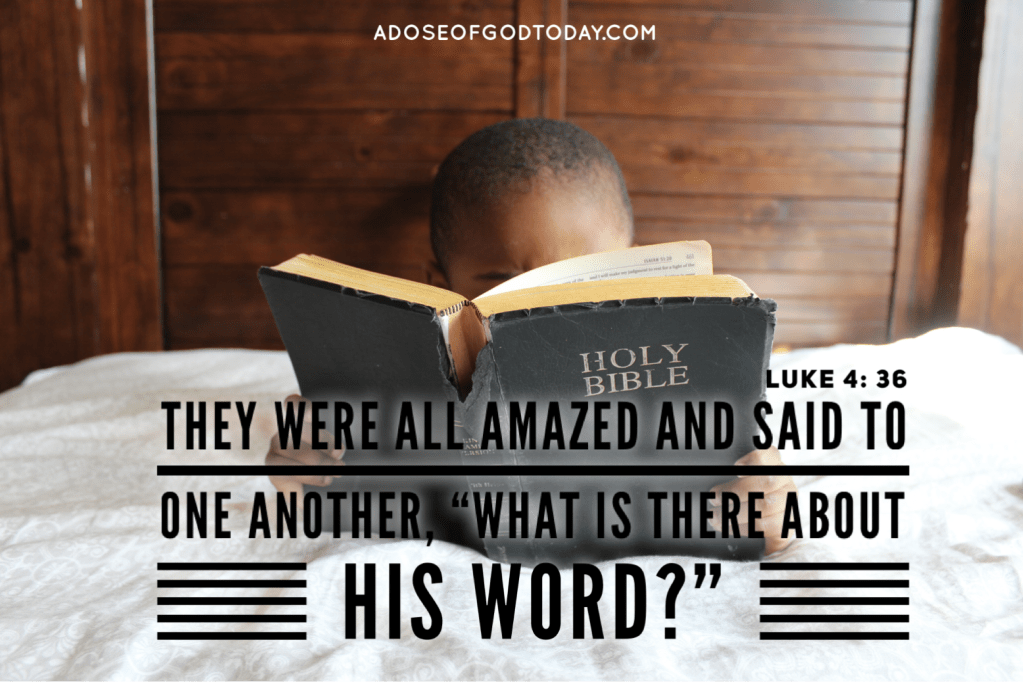
    Such powerful and life-giving words are also heard in our Gospel today. The Gospel of Luke tells us of the experience of the people from Capernaum, a town in Galilee. Jesus who taught the people in the synagogue found him different from the Scribes and Pharisees. Jesus spoke with authority not just with knowledge and familiarity of his teachings. Jesus spoke from the heart, from the wisdom of God that intends to give life to the people.

    Hence, the people found life in his teachings, in his words. This was more manifested when Jesus encountered a man with the spirit of an unclean demon. Through the words of Jesus, that demon was made quiet and was commanded to come out of the man. That demon was surely oppressive to the man by taking out the voice of the person. The person was made a slave by that demon. Yet, through his encounter with Jesus the man was given a chance to be freed and to be healed. Indeed, this is the effect when words give life and freedom.

    Thus, at the words of Jesus, the demon came out of the man without doing any harm to the person. This tells us again how those words of Jesus truly brought life, freedom and healing because Jesus’ intention was of kindness and his words were out of generosity.

    Today, Jesus also calls us to find healing, life, and freedom in his words and presence in the scriptures and in our Sacraments. Hopefully, what we find and receive will also be transmitted into our life that we ourselves will become life-giving and instruments of freedom.

    It would be good then to examine our words and our encounters with people today.

    Let this be the object of our discernment today. Are my words and presence life-giving or condemning? Am I giving freedom or condemnations? Are my words filled with hatred and anger or peace and kindness?

    If we find that our words and presence express more of condemnation, and judgments, of hate and bitterness, allow Jesus to transform us. Allow Jesus to cast out the demon in us that oppresses us and oppresses other. Allow Jesus’ words to make free and at peace so that we too shall learn in giving words to others that are filled with love, life and freedom. Hinaut pa.

    Jom Baring, CSsR

  • The Word of God nourishes and challenges us at the same time

    The Word of God nourishes and challenges us at the same time

    Advertisements

    June 5, 2020 – Friday 9th Week in Ordinary Time; Memorial of St. Boniface

    Click here for the readings (http://www.usccb.org/bible/readings/060520.cfm)

    The Holy Scriptures or the Bible is of great importance and gift to our Christian faith. The Second Letter of Paul to Timothy tells us that the scriptures will give us wisdom that leads to salvation, through faith is Christ Jesus. This means that by knowing and developing a relationship with Jesus brings us to freedom being experienced as individuals and as a community, as a church.

    Paul reminds us too that “all scripture is inspired by God.” As this is inspired by God, the Bible teaches us how God reveals the Divine Plan of Salvation. Hence, God in his great love for us has become man like us to feel what we feel, that God may be in solidarity with us.

    Moreover, the scriptures also refute error and corrects us. It means that the bible is not merely a passive literary work of some people, but it confronts us of what is wrong with us, of what is unjust and oppressive, of what is sinful. The scriptures then, bring us to be closer to God’s presence and to understand better the wisdom of God working in our life.

    Consequently, the scriptures serve as our guide to follow closely the Lord in our life. This is what Paul shared with Timothy. Following the Lord gives us peace and confidence in what we do yet this will also bring us challenges and difficulties as Paul experienced persecution from people who rejected Jesus.

    Paul was inspired by the Lord and committed his life to God. This was how Paul’s heart was captured by God. Paul’s heart gladdened at the revelation of Jesus to him which made Paul to be converted. This is what we have heard from the Gospel today, “many people came to Jesus and listened to him gladly.”

    That gladness came from that revelation of God, of God speaking to us. As Jesus spoke to Paul, Paul could not keep silent then. This was how Paul turned from being a brutal persecutor to a life-giving apostle of the Lord.

    Today, the Lord invites us that as we celebrate the Liturgy of the Word, let us also listen gladly to the Lord.

    Thus, let us allow the Lord to speak to us, to nourish us and at the same time to teach, correct and challenge us. Let the Lord confront us of our passivity and indifference towards others, of our sin and guilt, to confront us when we only settle to what is only comfortable and beneficial for us and to confront our hearts and conscience when we choose to keep our eyes blind from an unjust system.

    In this way, we may become Christians who like St Paul and St Boniface who were martyred because of what they preached, to also become a light and inspiration in this time of pandemic where our religious freedom is also being tested. Hinaut pa.         

    Jom Baring, CSsR