Tag: Wisdom

  • How would I feel at the success of others?

    How would I feel at the success of others?

    February 26, 2025 – Wednesday of the Seventh Week in Ordinary Time

    Click here for the readings (https://bible.usccb.org/bible/readings/022625.cfm)

    How would you feel at the success of others? Of a friend or classmate who is so popular in your group? Or with your spouse who has been receiving a lot of appreciation from your relatives? Or sibling who has been so successful with his/her business? Or a colleague or workmate who was just promoted recently?

    When we are truly secured and grounded as a person, we will surely be happy at the success of others and celebrate with them. We will be inspired and excited particularly with people who are close to us. Yet, it can also happen that at the outside we express happiness, but inside having a feeling of insecurity, jealousy and worst resentment and envy. While looking at the success of others, we could have wished and believed that “it should have been me” or “that should be mine.”

    This becomes a reality in us when what we saw in others was something we really want for ourselves. Others have enjoyed it, while we don’t. This becomes more intense when we too have the tendency to “compare ourselves and compete with others.” To some degree, it’s okay, yet to some extent as well, it can be damaging to ourselves and to our relationships with others.

    With this, let us explore our readings today and discern how God’s invitations are revealed and manifested in our human experiences.

    In the Gospel of Mark, the disciples seemed to be worried that there was another man who was capable of healing others through the name of Jesus. They stopped the man because they felt that it was not right since he was not ‘one of them’ and did not belong to their special group. Their worries reached to their feeling of insecurity. They value so much their reputation and image before other people. Thus, the disciples seemed to be entitled by the fact that they were Jesus’ disciples. It was their own way of asserting that they were the only persons who were knowledgeable and capable.

    Remember, days before this event, the disciples also felt troubled because they were unable to heal a boy who was possessed by a mute spirit. Jesus himself had to intervene to heal and free the boy from the evil spirit. He reminded his disciples that it can only be done through prayer.

    With that failure and brewing insecurities and self-entitlement of the disciples, these made them to be unwelcoming and jealous at the success of others, of those who were not part of their special group. Other people seemed to go to that person because he was able to drive out demons in the name of Jesus. The disciples felt uneasy because of this. As a consequence, they failed to recognize how God also works in the life of other people.

    Yet, as a teacher and Lord, Jesus constantly formed his disciples to purify their intentions and their hearts. The response of Jesus to them came from a heart that was secured, confident and most especially, wise. In Jesus’s wisdom, he was not worried about the man who did healing miracles in his name. Jesus was more worried for his disciples who felt insecure, entitled and envious.

    Hence, Jesus wanted them to understand that God’s favor and grace is not limited to a particular and special group of people. God reveals the Divine-Self even to those whom we do not expect. For a disciple to understand this, he or she needs wisdom and not entitlement or mere recognition. This is what we have heard from the first reading. The Lord will embrace those who seek wisdom, says the Book of Sirach.

    As the Word was made flesh, and so is wisdom, personified in Jesus. This was the reason why the man who did the healing miracles was actually wise, because he sought Jesus in his life. By seeking wisdom, God embraced him by making him a healer in the name of Jesus. Jesus wanted also his disciples to realize this, and that was to always seek Him because he is wisdom.

    Wisdom, then, helps us to see how God works not just through us but also through the people and the whole creation around us. Wisdom makes us more aware of God’s presence among us. Wisdom makes us welcoming of God and others.

    Thus, Jesus invites us today to learn from him, from his wisdom that constantly seeks the presence of God. This wisdom is not envious at the success of others but sees it as God’s revelation of Divine-Self in others. This wisdom allows us to recognize the face of God in the lives of our brothers and sisters, whoever they may be.

    There are two invitation for us today.

    First, learn to celebrate the success of others – that we may be able to truly express our joy by acknowledging the hard work and sacrifice that others have to make or the grace that God has given to that person. Yet, when we feel jealous about it, then, learn to accept it and to sleep over it.

    Second, seek wisdom rather than praise. This also begins by humbly recognizing and owing our own inadequacies and inconsistencies. This will hopefully lead us to understand better ourselves and able to discern Jesus’ invitations to growth and maturity for us.

    May Mary, Our Mother of Perpetual Help, guide us to Wisdom and brings us closer to Wisdom. Hinaut pa.

  • OVERCONFIDENCE AND ITS TENDENCIES

    OVERCONFIDENCE AND ITS TENDENCIES

    February 24, 2025 – Monday of the Seventh Week in Ordinary Time

    Click here for the readings (https://bible.usccb.org/bible/readings/022425.cfm)

    What would happen when we become “overconfident”? How would such attitude affect our relationships, work or any endeavors in life? In one way or another, you might have already met a person who was so overconfident or perhaps that has become also our very own attitude. Overconfidence portrays towards others the ability to over-estimate our capacities, knowledge and talents. In fact, it is a kind of “cognitive bias” meaning having “the tendency to act in an irrational way because of our limited ability to process information objectively.[1]” This means that we create and believe a different reality from people around us.

    This would explain why when we become overconfident, we believe that we know more than others even with those who are actually experts. We could easily brag or boast ourselves and the achievements or experiences that we have as if ours were so unique and exemplary. Thus, we focus more on ourselves and putting the spotlight directly at us. It is not new then, that we would usually exaggerate things in the way we talk and we do things. It is a kind of proving others that we are indeed “so capable.”

    However, being an overconfident person, it would also be so difficult for us to accept criticisms or corrections. As a result, it is easy for us to find someone or something to blame for the failure or the mistake that may happen. Moreover, we would tend to make poor decisions because we don’t acknowledge what is really happening. It is also true that we find it hard to adjust or to learn new things and new ways because we have become fixated to what we already have and know.

    This is how an overconfident person could impede team or community building because we don’t listen and accept other perspectives and knowledge. We become annoying to the point that people around us would not really believe in us. In a relationship, an overconfident person can also easily dismiss a partner’s opinion, needs and concerns. This will later create more issues in the relationship.

    These are just few scenarios when we become overconfident. Yet, it is also important that we become grounded and we learn to accept our limitations so that we continue to grow, mature and be more wise.

    And so, let us discover today how such attitude also affected the disciples of Jesus in their ministry and realize how “prayer and wisdom” play significant contributions in our Christian life.

    Some of the disciples of Jesus were arguing with a crowd of people and some scribes. It happened that a man brought his son possessed by a mute spirit. However, the disciples couldn’t do anything.

    Before such event, the disciples were already sent by Jesus to help in the ministry. They have been given the authority to heal the sick and drive out demons. They were successful in their previous interventions. Yet, this time. They were unable to do so.

    It was not surprising at all how Jesus responded to their question, “Why could we not drive the spirit out?” Jesus answered, “This kind can only come out of prayer.”

    So, what happened to the disciples then? We can only presume that the disciples, indeed, forgot that the power to heal and give freedom to the possessed come from God alone. They who had been so successful in their previous healing miracles must have thought that those were made possible because of their own abilities and power.

    The disciples somehow over-estimated their human strength and abilities. They became overconfident to the point that they argued with people instead of asking the grace from the Lord in prayer. They must have been trying to heal the boy in their name and forgot Jesus. This was the reason why Jesus blurted out, “O faithless generation, how long will I be with you?

    Yet, after giving freedom and healing to the boy, Jesus has to remind his disciples the importance of self-awareness, of being able to accept one’s limitations and to truly recognize God’s powerful presence. Being able to do so will make us wise. The Book of Sirach reminds us of this. “All wisdom comes from the Lord… and prudent understanding from eternity.

    These are now the invitations for us today.

    First, overconfidence makes us only stupid and truly incapable and not wise. This will rather prevent us to grow as a person and to develop healthy relationships.

    Second, it is in humble acceptance of our limitations and weaknesses that we become truly wise. Indeed, we become open to learn and unlearn things.

    Third, prayer makes acknowledge that true power comes from God. We are able to bring healing, life and freedom because we make ourselves instruments of God’s grace. Hinaut pa.


    [1] Kassiani Nikolopoulou, What Is Cognitive Bias? Definition, Types & Examples, publishes on Nov. 11, 2022 (https://www.scribbr.com/research-bias/cognitive-bias/#:~:text=Cognitive%20bias%20is%20the%20tendency,%2C%20people%2C%20or%20potential%20risks.)

  • SEARCHING AND SETTLING DOWN

    SEARCHING AND SETTLING DOWN

    October 13, 2028 – 28th Sunday in Ordinary Time

    Click here for the readings (https://bible.usccb.org/bible/readings/101324.cfm)

    Have I settled down? Have I found what I am looking for? Do I find fulfillment and contentment with what is happening in my life now? With my work? In my relationships? Or am I restless and still searching, unable to settle down? Do I find emptiness and meaninglessness with what I do and with I have?

    Indeed, when we have reached an age of maturity and finds ourselves still searching and longing for something worthwhile and meaningful for our life, we might find ourselves restless and anxious. As a result, we could be shifting a course one after another, or changing jobs one after another or ending a romantic relationship and starting a new one without any fulfillment in those relationships. Our mind keeps changing. We are confused what we really like and what we don’t like. At times, we would just let others tell us what to do but later on regret because we never wanted it.

    However, such restlessness would also allow us to refine our intentions and see better ourselves. This also means that we need help from others to accompany and guide us in searching and finding what we are meant to be and to do. In fact, St. Irenaeus famously said, “the glory of God is a human being fully alive.” Having our full potentials, expressing and giving fully and freely what we are meant to be and to do would reveal the glory of God in us.

    In today’s readings, this need and reality is revealed to us. And so, let us see how God unfolds his invitations and challenges for us.

    Jesus, in the Gospel of Mark, encountered a man who in his heart knew already what he wanted. He asked the Lord, “What must I do to inherit eternal life?” This man must have been respected and adored by many. He was a good man, religious and a pious Jew. He followed the commandments of God. He too was rich. Having such kind of character and wealth, people must have looked up to him. However, he too was restless. He was in search of something more meaningful and more worthwhile perhaps, over his routine in life.

    The Gospel told us, that Jesus looking at him, loved him and said, “You are lacking in one thing. Go, sell what you have and give to the poor, and you will have treasure in heaven; then, come and follow me.

    Nevertheless, the words and demands of Jesus were too radical and difficult for him to accept. He must have understood that and knew that that was the way, yet, he couldn’t. This made the man sad. He went away and did not follow Jesus because he had many possessions. The many things he possessed prevented him to be free.

    This makes us realize now that what we have achieved, accumulated, gathered or saved in this life won’t give us the true assurance of contentment in life. We may have the best job and position in our company, but remains unhappy. We may have gained many degrees and have spent a number of years in our profession but we feel empty. We may be so comfortable in life, doing so well with our business, yet, we feel restless when we are alone. Or we may have also been married or committed ourselves to religious life, having spent a number of years, yet, at the end of the day we couldn’t deny that our heart is still longing for something more. And this can be tiring or at times overwhelming.

    When we are in this kind of crossroad in life, this is also an opportunity for us to see clearly ourselves and see God. What we need is a heart that seeks wisdom able to discern and choose what to keep and what to let go.

    This is what the first reading calls us today. The author of the Book of Wisdom says, “I pleaded, and the spirit of wisdom came to me.” Wisdom is proven to be better than power and wealth, even with health and beauty. With wisdom, it leads us to what is lasting and fulfilling.

    This is what we also discover with the Word of God, filled with wisdom, as revealed in our second reading. The Letter to the Hebrews tells us that “the word of God is living and effective, sharper than any two-edged sword, penetrating even between soul and spirit, joints and marrow, and able to discern reflections and thoughts of the heart.

    Hence, there are three points that we can bring today as our take-aways.

    First, come closer to Jesus. Like the man in the Gospel, take the courage and the boldness to come closer to Jesus, to encounter him, that we too might be able to look at his eyes and realize how much Jesus loves us. This should give us the assurance and confidence above everything else. We can do this as we come closer to the Sacraments of the Church. The Holy Eucharist and the Sacrament of Reconciliation would surely bring us closer to Jesus and to ourselves.

    Second, seek for wisdom. Wisdom is a gift and through the Word of God revealed to us this gift is given. There are also people who can help us and seek wisdom for us to be able to see and understand better our heart. This may help us to discern well and choose  what will give us true fulfillment.

    Third, let go of those that are possessing us. As wisdom will help see and discern our heart, let wisdom allow us to take action by letting go whatever is  possessing us, of those that prevent us to be free. Unlike the man in the Gospel, we may not go away feeling sad because we are unable to let go, but rather take the risk of letting go and following Jesus freely and gladly.

    May these challenges bring us closer to Jesus and allow us to create and develop lasting relationships as we tread the path of life God calls us to be, wherever we are now and whatever is our status. Hinaut pa.

  • Keeping God in our Heart

    Keeping God in our Heart

    Advertisements

    June 20, 2020 – Saturday, Immaculate Heart of the Blessed Virgin Mary

    Click here for the readings (http://www.usccb.org/bible/readings/060820.cfm)

    What is it that you consider as the dearest for you? Or who is it that you consider as the closest to your heart?

    Yesterday, we celebrate the Solemnity of the Sacred Heart of Jesus and today, the feast of the Immaculate Heart of Mary, his mother. The Sacred Heart of Jesus reminds us that God is indeed loving and forging, compassionate and merciful. And in that heart, we are the closest to God. We are God’s dearest people.

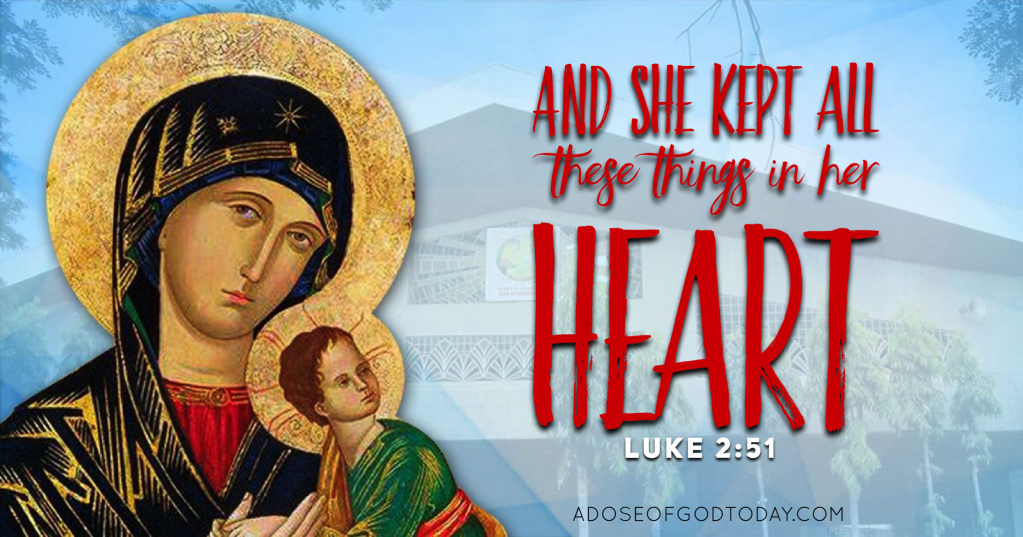
    In this feast, the Gospel of Luke tells us who is the dearest and closest in the heart of Mary. This is where we could also find the strength of Mary. Just look at the image of Our Mother of Perpetual Help. Her son Jesus carried by her left arm also rests on her chest where her heart is.

    Mary had been confused and afraid at the annunciation of the Angel. At that moment she too must have felt overwhelmed at God’s unfolding in her life. The events surrounding the birth of her son must have made her more confused at the amazement and joy she experienced. There were many events there that must be beyond her expectation.

    In today’s Gospel, we were told how the young boy Jesus spent his days in the temple sitting among the teachers. But the words of the young boy Jesus, “Why were you looking for me? Did you not know that I must be in my Father’s house?” has left Mary and Joseph baffled. They must have felt the pain of the seemingly indifferent words of Jesus after their days of anxious finding of him. Those words were difficult to understand at that time.

    However, just like at the annunciation, at the visitation of the Shepherds in the manger and now here, she kept all these things in her heart.

    With all the complexities, strangeness and difficulty to understand the situation, Mary has kept the Lord close to her heart. She kept all those revelations from the Lord close to her heart that she may be able to understand them in the way God desires them to be understood.

    This was how Mary would always find wisdom and strength because with the many events that happened in her life, she might not be able to bear them all. Mary will surely remained confused, afraid and unable to decide and do anything if she chose to distance herself from the Lord by reacting out of impulse or mere emotions.

    Keeping all those things in her heart” really means that she tried to understand how God was uncovering and revealing to her the plan of salvation. Mary realized that God reveals Himself every day. Mary did not want to miss all of them. Consequently, she sought the best way of understanding them by not reacting to every event through mere emotion or just out of compulsion.

    Hence, Mary did not react out of anger or even disappointment in front of the young Jesus. Though she did not understand his words, but she must have felt that there was something deeper in there. God must be behind it. Thus, in her confusion, she kept all those things in her heart, to ponder them, to seek wisdom and understanding in the way God wants her to understand them.

    But most of all, Mary was able to do that because within her heart, God is there already. She has welcomed the Lord and allowed the Lord to be always in her heart. This led her into that kind of understanding from God’s perspective and so she responded to every invitation of God for her, willingly and lovingly.

    This is how we find Mary’s presence captivating in our Christian faith because her very life is an example of a perfect communion with God. This how we also find comfort in her, as a mother, because her human heart is touched by God’s heart.

    Advertisements

    Today’s feast, God’s invitation for us also is to grow in that area, that like Mary, our heart too will be more welcoming to the Lord and to allow the Lord to be in our heart. This is an invitation to make God as the closest and dearest in our heart. It is in this way that we shall also find understating, wisdom and strength in the many infoldings of events that happen to us everyday.

    In particular, these days of the pandemic has made us feel uncertain of the coming days and anxious of the present. Many of us felt insecure materially, emotionally and perhaps also spiritually by now. However, do not waiver, do not remain stunned by these difficult days, remain vigilant instead by pondering and keeping all the things in our hearts.

    May I invite you then, as we find our ways on how to live and adjust ourselves with the “New Normal” set aside a time to ponder, to listen deeper and carefully to the many events and circumstances happening in our life now. As we allow God to be closer to our heart and seek the Divine wisdom, we may also become more welcoming of the presence of others, more connected with people around us as Mary is to us. Hinaut pa.

    Jomil Baring, CSsR