Tag: Weekday

  • Is the gate to heaven really narrow?

    Is the gate to heaven really narrow?

    October 26, 2022 – Wednesday 30th Week in Ordinary Time

    Click here for the readings (https://bible.usccb.org/bible/readings/102622.cfm)

    Paul in his letter to the Ephesians gave his instructions on how our relationship with the Lord can mold our human relationships and lead us to share Christ’s presence in heaven. Hence, it is in a family relationship that respect, care and concern, responsibility and love must grow as an expression of our Christian faith. Paul also mentioned in master-slave relationship the values of service, devotion, respect and sincerity. However, such relationship must be understood within the context of Paul’s time and culture. Later, we know and realize that no human being must be a slave to another human being. This is a call to give our utmost respect and love to the human person and human dignity, who is created in God’s image and likeness.

    Indeed, these instructions of Paul tell us that faith in the Risen Christ, therefore being a believer, should also mold our relationships with one another. It is very important to remember then, that giving and showing respect, no matter what our status is, to each one, is an expression of our true concern and love. Paul wrote earlier, reminding us to live in love, because living in love is living in Christ.

    Thus, faith in Jesus is not merely expressed in our religious practices. Faith is not even enough to declare that we have faith, or observance of the minimum days in praying or worshipping. Being a believer entails our total commitment to Jesus that requires a constant change of heart and mind according to the way of life of Jesus.

    This is the reason why a man asked Jesus, “Lord, will only a few people be saved?” Jesus’ teaching and way of life seemed to be too difficult to accept and follow. Thus, it is unpopular and out of trend.

    The people believed in a distant, angry and vengeful God. Yet, Jesus introduced to us a God who dwells among us, whom we can intimately call Abba-Father, who offers us friendship, a God who forgives and gives hope to the sinners and the hopeless, who touches the sick and the embraces the despised,  and a God who finds delight with the humble and unassuming.

    Such teaching must be very difficult to accept because people were used to believe in a distant and vengeful God that would also justify their way of life, culture and traditions – that favor the arrogant and powerful, the corrupt and the bullies.
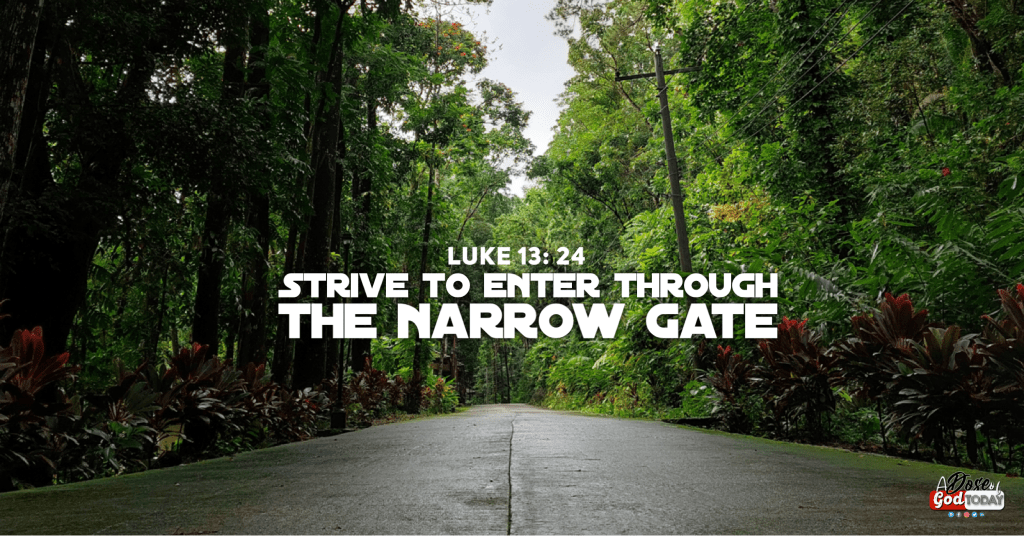
    The gate of heaven seemed to be “narrow” then, because it demands a change of lifestyle, culture, tradition and belief, hence, a change of heart and mind. It seemed to be narrow because Jesus’s way of life disturbs our complacency and arrogance, and his way of loving destroys indifference and anger in our heart.

    That is why, the Lord never tires to call us and never stops to desire that we join with Him. And as God calls us, we too are invited to let our faith-relationship with God mold our person and human relationships with one another that will lead us to God’s presence. Kabay pa.

  • Let it grow… let it grow…

    Let it grow… let it grow…

    October 25, 2022 – Tuesday of the 30th Week in Ordinary Time

    Click here for the readings (https://bible.usccb.org/bible/readings/102522.cfm)

    Being in a society which justice system works for the benefit of the common good, that protects the weak and powerless and the rights of all citizens and not easily intimated and influenced by the rich, powerful and bullies, or to see how a community expresses concern and care to a person in need of help or a neighbor who offers financial assistance to a sick friend, having a co-worker asking how are we and expressing support in times of stress in work, and seeing a couple who after their disagreement ends the day in embracing one another” – are true expressions of the Kingdom of God that is silently growing in us.

    It is our call to make sure that the Kingdom of God will grow in us and among us by nourishing and cherishing the values of the kingdom. And where should it begin? AT HOME, among husbands and wives, their children and the whole family.

    St. Paul expressed this in his letter to the Ephesians, yet, what Paul said about the subordination of wives to their husbands is not meant to be understood that husbands are masters over their wives who are like slaves. No. Wives are not left without rights and independence, and losing their person and individuality for being a subordinate.

    Paul’s expression of marriage here is to be understood in the context of Christ’s relationship with the Church. The sacrament of marriage is the image that we have between Christ and the church. This is even already present in the Old Testament. The covenant between God and the people is to be understood like that of husband and wife.

    This is where we could also find today’s invitation. We are called to let the kingdom of God grow in us, starting in our very homes, with husbands and wives, the whole family from which God relates to us in the most intimate way.

    Hence, by giving respect to each one, by nourishing, cherishing and taking care of our relationship, by expressing concretely our concern and love for each one at home, by making Christ as the very center of our family life, then, surely like that of a small mustard seed and a small amount of yeast in the dough, the Kingdom will grow silently in our homes.

    Yes, the Kingdom of God will certainly manifest in our hearts and homes where we shall also experience joy, peace, safety, confidence, respect, love and concern. Thus, let it grow… let it grow… don’t hold it back anymore… Kabay pa.

  • Imitating God by living in love

    Imitating God by living in love

    October 24, 2022 – Monday 30th Week in Ordinary Time

    Click here for the readings (https://bible.usccb.org/bible/readings/102422.cfm)

    We constantly hear that God is love and that through love we are all created in God’s image and likeness. Also through love, God sent His only Son to redeem the world. Though we often read or listen about this fundamental grace of love in our faith to the point that it is somehow treated like a cliché, the grace of love and the act of loving remain constant call for us.

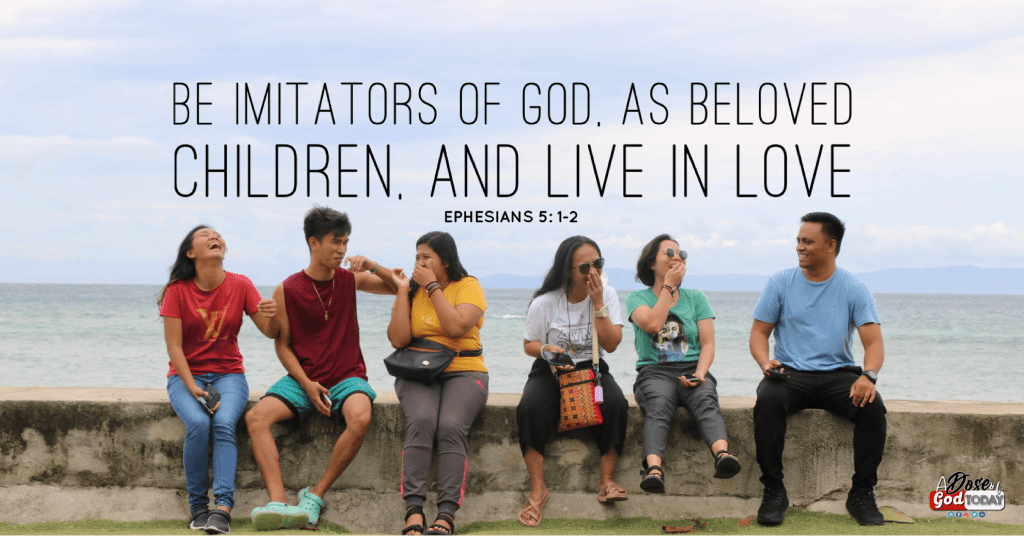
    This is what Paul wrote in his letter to the Ephesians, reminding and calling the believers in that city to “be imitators of God and to live in love.” What Paul means about imitating God is not in the way of becoming “like god” or “being god” which may connote “domination, overpowering and subjugating” others.

    Rather, what we are all called to imitate is the way of LOVING, hence, Paul said, “live in love.” What kind of love is this then?

    This is love that sacrifices one’s life for the sake of others. Such love never corrupts others or brings others to danger or to evil. This love has the capacity to offer life so that others may also have life.

    This is love that generates life and does not suppress the life of others. This means that this way of loving brings inspiration and motivation for others to live fully because of the love they receive.

    This is love that frees or unburdens others because such love only desires freedom, peace, reconciliation and the fullness of life. This also means that this way of loving forgives and heals.

    These are all God’s way of loving of which the Responsorial Psalm also calls us today, to behave like God and that is to be able to learn love-sacrificing, love-generating and love-freeing ways of God.

    In fact, in today’s Gospel, Jesus showed this to us as he healed a woman. Thus, Jesus showed kindness and compassion to the woman who was suffering for 18 long years. Jesus’ kindness and compassion went beyond the restrictions of human law. Though, the local leader of the synagogue was indignant to Jesus’ way of loving, yet, this did not stop Jesus to truly express his love so that the woman may have life.

    With that, Jesus freed her from that suffering by touching her. Through his touch, an expression of his way of loving, he freed the woman from the spirit that crippled her over those many years.

    By this way of loving of Jesus, the Lord restored her hope to live by giving her the fullness of life expressed in the way the woman responded to Jesus. The woman got up, stoop up straight and was glorifying God. This was an act of thanksgiving from a heart filled with so much love.

    However, the people who were indignant to Jesus and furious over his actions of loving, never understood how love works and manifests in the life of those who love and in need of love.

    Therefore, this is how we are called today, and that is by concretely expressing our way of loving, by not being afraid and not hesitating to love. In this way, we may truly imitate God who is all love. Kabay pa.

  • We all have been Graced

    We all have been Graced

    October 22, 2022 – Saturday 29th Week in Ordinary Time

    Click here for the readings (https://bible.usccb.org/bible/readings/102222.cfm)

    Do I feel inadequate? Do I feel insecure in one or many aspects of my life? Do I feel lacking in confidence and self-trust? Do I feel lacking in faith? The feelings of insecurities and insufficiencies from ourself could have come from our tendency to compare oneself from what others have and dwelling so much to the things we do not have. We could also have this belief when we too are constantly told that we are hopeless and that nothing is good about us. This can be very true to people especially with those who were subjected to humiliation and abuse that happened at home, at school, at work or even in our communities.

    This affects so much a person to the point that he/she can no longer see and recognize anything good in himself/herself or even outside the self. Certainly, when we fall into this trap, there is a need for us to be helped and to be reminded of who we are really. This is an invitation to discover and re-claim our person and the graces that we all have according to the measure of Christ’s gift.

    This is the good news for us today. St. Paul in his letter to the Ephesians, addressed and reminded the Christian in the city of Ephesus of the graces they have received from the Lord. Christ who is the source of gifts, graces us individually. St. Paul described it further, “he (Christ) gave gifts to all… that he might fill all things.”

    What Paul tells us is God’s desire that we may all be filled through his gifts. This is something we can discover and ought to recognize and claim. We have been graced indeed, particularly of God’s presence, of the gift of faith and of the gift of friends and community.

    Hence, Paul reminds us also to grow in our knowledge of the Son of God, in Jesus. In knowing Jesus and recognizing how the Lord works in us, then, the more we shall also discover his gifts, his invitations for growth and come to know more ourselves. Knowing Jesus then, is also an invitation to our self-maturity, to our own growth in mind, in heart and in spirit. This is the significance of Paul’s hope, that we may not remain infants who are easily carried away by human trickery, deceit and abuse.

    The hope to fully grow and therefore, become fruitful is the invitation that we also have in today’s Gospel parable of the fig tree. The owner who expressed hopelessness in the fruitless tree wanted it to be cut down. Yet, in the person of the gardener, he intervened and promised to cultivate the tree. The gardener saw hope in the fig tree. Indeed, there was still hope for the fruitless tree. Perhaps, the tree was not taken care of in the past many years. It was left uncultivated and unfertilized. The promise of the gardener is an act of giving more attention to the tree, of taking care of it and of not giving up on it.

    This is also an invitation for us. We may come to give more attention to the gifts the Christ has given us, to cultivate, nourish and develop our gifts, whatever they are. We may also consciously know Christ more and encounter the Lord in our life and in the life of others so that we may grow in our knowledge of him and in our knowledge of ourselves so that we may have our fill and the fullness and fruitfulness of life. Kabay pa.

  • UNITY: How are we called to unite in the Spirit?

    UNITY: How are we called to unite in the Spirit?

    October 21, 2022 – Friday 29th Week in Ordinary Time

    Click here for the readings (https://bible.usccb.org/bible/readings/102122.cfm)

    Is unity in itself a good thing? Unity in itself is something neutral and it depends on how such unity is to serve its purpose. When thieves, corrupt leaders, those who want to advance their self-interest and people with evil intentions unite, then, this will surely be a bad thing. Such unity will bring destruction, violence and death. When people who desire to serve others, those who dream for a better world, people who work hard to earn an honest living and people who have faith in the Lord unite, then, this will bring goodness, abundance, hope and peace.

    Thus, it is also not enough to call and invite Christians to simply have unity because this can be for evil or for God. Just like what the Pharisees and lawyers at that time of Jesus, despite being faithful to their religious traditions and practices even to minutest details, their unity was nothing before God. Jesus confronted their hypocrisy because within their hearts lie the evil intentions of self-interest, of seeking power and influence, of indifference and corruption.

    So, what kind of unity then, are we called to have? St. Paul in his letter to the Ephesians expressed this kind of unity and the intentions behind the call to unite.

    Paul called the Ephesians and calls us as well today, to “strive to preserve the unity of the Sprit through the bond of peace.” This is an invitation to be conscious and to seek the gift of unity that comes from the Holy Spirit manifested in peace. This can be experienced within the context of our families, organizations, communities, nations and the whole Church.

    The unity that the Spirit brings will surely flourish when we also lived fully what God called us to be. And this is how Paul invites us further today so that we will be united in the Spirit, to become one body and one spirit.

    First, to be humble. Grace is received by a humble heart not with an arrogant heart that only thinks of the self.

    Second, to be gentle. It is in gentleness that we are able to nurture affection and closer relationship with one another for it makes us understanding. Therefore, true unity of the spirit is not achieved through violence, cruelty or deception.

    Third, to be patient. This allow us to let God work in us, and allow our natural process of growing in the spirit by being able to discern, to listen to God and each other. Unity of the spirit is not being fostered by being impulsive and having no time to discern and listen.

    Fourth, to be loving. Love and its concrete expressions through self-scarifying service to others and to God that unity of the spirit is being given a face. Thus, it is not in indifference, not in being distanced and unconcerned that we become loving and united in the spirit.

    Kabay pa.