Tag: Weekday

  • Mary, Source of Help to the Young

    Mary, Source of Help to the Young

    Advertisements

    June 22, 2020 – Monday 12th Week in Ordinary Time

    5th day of Novena in preparation for the feast of Our Mother of Perpetual Help

    Click here for the readings (http://www.usccb.org/bible/readings/062220.cfm)

    A week ago I met few members of the Redemptorist Youth Ministry here in our Parish to review our youth programs and align them to adapt in this current situation. It was a moment of reconnecting with them as this Corona Virus Disease brought disorder to our lives. Somehow meeting them gave me also an opportunity as a pastor to realize how they have been coping and adjusting themselves in this “new normal.”

    They have learned a lot and made more connections with their families as the quarantine gave more chances to them to be with their families. Sadly, because also of the lockdowns and quarantines some of those who are working among them have lost their jobs, their business and felt uncertain of their employment status.

    However, despite these challenges many of them also found ways on how to go beyond from themselves and be in service of others. This is what I find wonderful because the present difficulties did not prevent them to be for others. Thus, they volunteered in their Barangay to distribute the relief goods and the Social Amelioration Program from the government. Though they received ungrateful responses and offensive reactions and complaints from people, with those whom they served, these did not stop them to volunteer.

    During the Enhanced Community Quarantine also, a friend asked me to pray for a young person who is suffering from depression. She seemed to be so sad that her suicidal thoughts became frequent. People around her became disturbed and anxious of her situation because her posts in Social Media reveal her consciousness of ending her life.

    A week ago also, one of my Redemptorist brothers shared with me how one of his former students ended his life by hanging himself. He remembered his student very well but did not see any hint that this would happen to him.

    Few year ago also, when I was barely a year-old ordained priest, a father brought to me her daughter to help her. His college student daughter according to him was possessed by an evil spirit. She changed voices and seemed to be so angry. She also claimed to see ghosts around that haunted her day and night. However, when I talked to her personally without the presence of her father, everything was revealed. She was in depression. She was bullied at school. She was traumatized by the separation of her parents and was in deep pain for being left behind by her mother.

    These are just my few encounters with my co-young people who are facing with issues and challenges in their life.

    On this fifth day of our Novena to Our Mother of Perpetual Help, we are invited to reflect with the young people today with our theme, “Our Mother of Perpetual Help: Source of Help to the Youth of today confronted with so many issues and challenges.”

    There are countless students who come to the novena on Wednesdays and offer their prayers before the Icon of Our Mother. I witnessed this, not just here in Davao but also in Cebu, in Iloilo and most especially in Baclaran. Students would write their petitions to the Mother to help them find ways to pay for the tuition fees, or their rent, or to pass their board exams. Many also would go to the Mother as they were in trouble with their love life, friends and family or when they experience anxiety at school and at home. Many also would ask petitions to the Mother to help them find a job, for material blessings and courage as they embark into another phase of their life.

    What is it that draws these young people to Our Mother of Perpetual Help?

    Many times the young are misunderstood by those people around them. This misunderstanding must be rooted from the gap between generations where the older ones insist that the young is so much different from their ways when these older generation were ones young. Thus, there is always a tendency among the older generations to impose their ways to the young. Hence, in such situation there will be no room anymore for a young person to be himself or herself. This become a source tension, a source of misunderstanding and a source of judging.

    Moreover, young people who are at the comfort of their families would sometimes find home to be unwelcoming. Home is supposed to be where we can really be, where we feel most secured, loved and cherished. Yet, many of our homes are broken and wounded. Parents who became irresponsible and abusive cause so much pain, anxiety and hopelessness to the young. Family members who have grown to become indifferent to one another could sometimes bring a confused and traumatized young person into desperation. These unwelcoming situations at home do not provide opportunities for a young person to be listened to, to be heard and to be understood.

    Last December during Christmas day, my niece shared to me how a friend of her spent the Christmas Eve at 7/11 because her home was not anymore a home. Despite the presence of others at home, she felt alone. While we were enjoying the company of our loved ones at home in that most joyful night, a young person spent the night alone.

    That is why, Mary’s presence is so captivating because she listens. She does not react out of impulse or emotion. Mary does not judge.  She understands because she discerns. The Gospels would tell us that Mary would keep everything in her heart. The very presence of Mary is a comfort and a source of help indeed.

    Jesus, in our Gospel today, reminds us not to pass quick judgments but rather to be more discerning. To be discerning is to be welcoming because we allow God to be part on how we approach a person or a situation by also looking at ourselves. Jesus warns us when we become self-righteous, an attitude that believes that we are exempted of any fault and failures. Thus, to discern then is a humble way of acknowledging our own shortcomings and failures so that we will be able to relate with others in a loving and compassionate way.

    Advertisements

    Our devotion to Mary, then, calls us also to become more discerning in our relationships. Parents are called especially to be more discerning of their words and actions as they provide opportunities for growth to the young. Relate with them as friends not as superiors who will impose your ways to them. Caress them with your comfort and avoid judging quickly their ways and actions.

    Thus, as a community devoted to Mary, let us be more discerning that we may become more understanding and compassionate to the young who are especially confronted with so many issues and challenges.

    Hopefully, in this way then, we as devotees of Our Mother of Perpetual Help, we too will become a source of help to the young. Hinaut pa. Viva Maria! Viva Hesus!

    Jom Baring, CSsR
  • Keeping God in our Heart

    Keeping God in our Heart

    Advertisements

    June 20, 2020 – Saturday, Immaculate Heart of the Blessed Virgin Mary

    Click here for the readings (http://www.usccb.org/bible/readings/060820.cfm)

    What is it that you consider as the dearest for you? Or who is it that you consider as the closest to your heart?

    Yesterday, we celebrate the Solemnity of the Sacred Heart of Jesus and today, the feast of the Immaculate Heart of Mary, his mother. The Sacred Heart of Jesus reminds us that God is indeed loving and forging, compassionate and merciful. And in that heart, we are the closest to God. We are God’s dearest people.

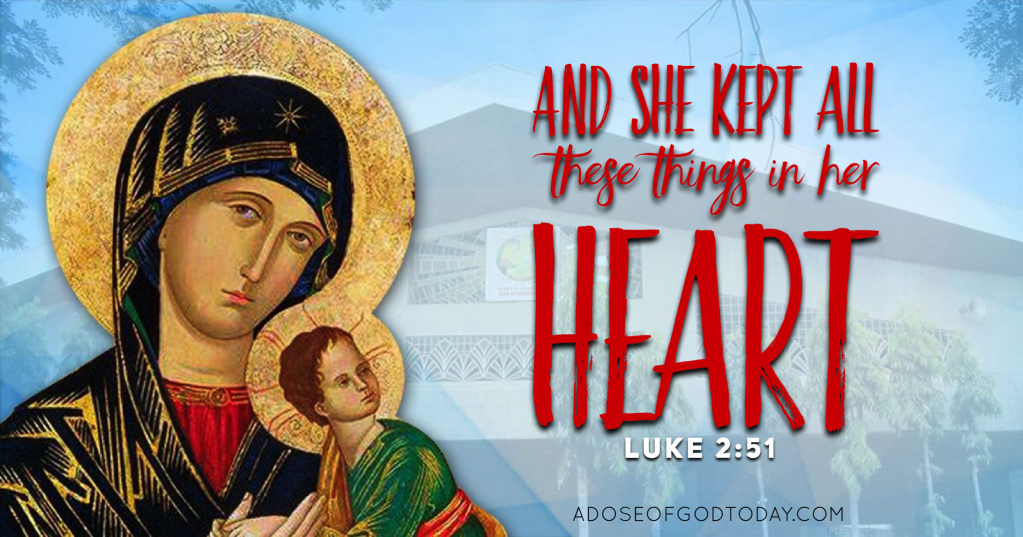
    In this feast, the Gospel of Luke tells us who is the dearest and closest in the heart of Mary. This is where we could also find the strength of Mary. Just look at the image of Our Mother of Perpetual Help. Her son Jesus carried by her left arm also rests on her chest where her heart is.

    Mary had been confused and afraid at the annunciation of the Angel. At that moment she too must have felt overwhelmed at God’s unfolding in her life. The events surrounding the birth of her son must have made her more confused at the amazement and joy she experienced. There were many events there that must be beyond her expectation.

    In today’s Gospel, we were told how the young boy Jesus spent his days in the temple sitting among the teachers. But the words of the young boy Jesus, “Why were you looking for me? Did you not know that I must be in my Father’s house?” has left Mary and Joseph baffled. They must have felt the pain of the seemingly indifferent words of Jesus after their days of anxious finding of him. Those words were difficult to understand at that time.

    However, just like at the annunciation, at the visitation of the Shepherds in the manger and now here, she kept all these things in her heart.

    With all the complexities, strangeness and difficulty to understand the situation, Mary has kept the Lord close to her heart. She kept all those revelations from the Lord close to her heart that she may be able to understand them in the way God desires them to be understood.

    This was how Mary would always find wisdom and strength because with the many events that happened in her life, she might not be able to bear them all. Mary will surely remained confused, afraid and unable to decide and do anything if she chose to distance herself from the Lord by reacting out of impulse or mere emotions.

    Keeping all those things in her heart” really means that she tried to understand how God was uncovering and revealing to her the plan of salvation. Mary realized that God reveals Himself every day. Mary did not want to miss all of them. Consequently, she sought the best way of understanding them by not reacting to every event through mere emotion or just out of compulsion.

    Hence, Mary did not react out of anger or even disappointment in front of the young Jesus. Though she did not understand his words, but she must have felt that there was something deeper in there. God must be behind it. Thus, in her confusion, she kept all those things in her heart, to ponder them, to seek wisdom and understanding in the way God wants her to understand them.

    But most of all, Mary was able to do that because within her heart, God is there already. She has welcomed the Lord and allowed the Lord to be always in her heart. This led her into that kind of understanding from God’s perspective and so she responded to every invitation of God for her, willingly and lovingly.

    This is how we find Mary’s presence captivating in our Christian faith because her very life is an example of a perfect communion with God. This how we also find comfort in her, as a mother, because her human heart is touched by God’s heart.

    Advertisements

    Today’s feast, God’s invitation for us also is to grow in that area, that like Mary, our heart too will be more welcoming to the Lord and to allow the Lord to be in our heart. This is an invitation to make God as the closest and dearest in our heart. It is in this way that we shall also find understating, wisdom and strength in the many infoldings of events that happen to us everyday.

    In particular, these days of the pandemic has made us feel uncertain of the coming days and anxious of the present. Many of us felt insecure materially, emotionally and perhaps also spiritually by now. However, do not waiver, do not remain stunned by these difficult days, remain vigilant instead by pondering and keeping all the things in our hearts.

    May I invite you then, as we find our ways on how to live and adjust ourselves with the “New Normal” set aside a time to ponder, to listen deeper and carefully to the many events and circumstances happening in our life now. As we allow God to be closer to our heart and seek the Divine wisdom, we may also become more welcoming of the presence of others, more connected with people around us as Mary is to us. Hinaut pa.

    Jomil Baring, CSsR

  • Looking At Ourselves Closer for the Father Sees

    Looking At Ourselves Closer for the Father Sees

    Advertisements

    June 17, 2020 – Wednesday of the 11th Week in Ordinary Time

    Click here for the readings (http://www.usccb.org/bible/readings/061720.cfm)

    Jesus warns us about our narcissistic tendencies. We might not be aware of our tendency to draw other people’s attention to us. Indeed, there is a need for us to purify our every motivation and action so that we will live free and become true Christians.

    Jesus takes this seriously as he reminded his disciples in today’s Gospel. To follow Christ is not to seek the attention of others, or to seek praise and approval of those people around. A disciple of the Lord does not need to put up a billboard and announce to the people what he/she has done and accomplished.

    The Lord is more concerned with our heart so that we don’t have to pretend to be someone else we are not. This happened with those who were called hypocrites in the synagogues that Jesus was talking about. These people pretended to be the best person in their community. They proclaimed and told people how good they were. They did all these to seek recognition from the people. Indeed, they craved for people’s attention and approval because they too were hungry for power and control.

    People who constantly seek the attention of others and their recognition ultimately manipulate others so that they will be in control and will become powerful. Yet, it is also a revelation how these people are so insecure of what they have and of what they don’t have.

    As people who seek God, we are rather called to be more confident with Him, and with our relationship with God. Our generous actions, good deeds, our prayer and religious practices must flow from that relationship. Deepening one’s relationship with God should be our primary motivation and not in boasting oneself.

    This relationship with God should also lead us to recognize God’s generosity and faithfulness in us despite our failures and sins. This will hopefully inspire us to respond with gratitude to God. To become a grateful person certainly makes us a generous person both in our words and actions. This will make us true to ourselves, closer to people around us and to God.

    Remember, God sees us. God is very aware of what we do. God is not blind. The Gospel today reminds us of this that God sees us in secret and repays us with His faithfulness. Though God does not do policing but God watches us only with delight. Therefore, as God sees us, we may truly be a delight in God’s eyes through our generous actions and words.

    With this, Jesus invites us today to look closely at our behaviors and attitudes, practices and devotions if these are helping us to be closer and to be more like Jesus or if these are moving us away from God and from others.

    Advertisements

    To remind ourselves about this, let us ask ourselves with these questions, “Who is being honored and served by my good deeds, generous actions and religious devotions? Is it myself or is it God? Do they lead me closer to God and others or do they rather make me more indifferent towards God and others?

    In our hope to grow daily in our consciousness of God’s presence in our life in these difficult times, we may always seek the Lord and find strength and confidence in Him. May our actions and words become expressions of our gratitude to God who has never ever left us for God finds delight in us. Hinaut pa.

    Jom Baring, CSsR

  • To Become Persons of Encouragement

    To Become Persons of Encouragement

    Advertisements

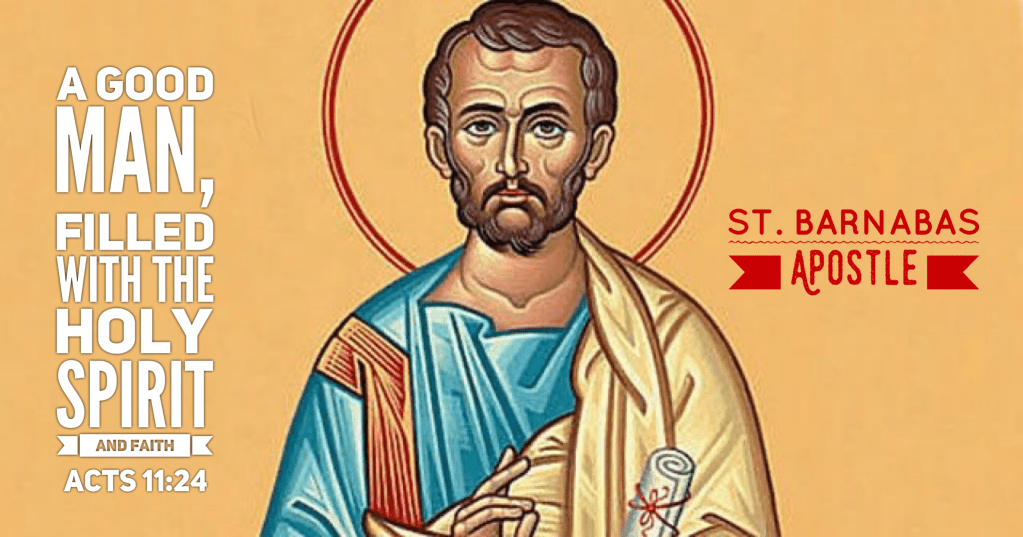
    June 11, 2020 – Feast of St. Barnabas, Apostle

    Click here for the readings (http://www.usccb.org/bible/readings/061120.cfm)

    People who encourage others would always bring support and growth because encouragement nurtures confidence and hope. Parents who would give generous encouragements to their growing children would find children to be happier and lively. Teachers who would also express words of encouragements to their students would find them animated to perform well in their studies. 

    This is also true among employers or corporate heads. A supervisor or manager who is generous in expressing encouragement to his/her workmates or colleagues or employees would surely find people around him or her to work confidently and competitively in a healthy way. Thus, a person who is being looked up by many as a leader and expresses words and actions that unite people, that heal division and reconcile differences, creates a space that bring people to work together. However, when a leader or any authority figure becomes vicious in his or her speech or acts unfaithfully from his or her duties, promises and words, then, he or she promotes unwarranted conflicts and stress to people.

    Moreover, when words of encouragements are expressed whether at home, at school or at work, they lessen unnecessary stress, avoid unnecessary conflicts and rather promote self-confidence, trust and hope. 

    This attitude of encouraging others had been shown to us through the person whose feast we celebrate today. St. Barnabas, an apostle, was a man of encouragement. During his lifetime, in his ministry, he never forgot to encourage people around him. In fact, it was through his encouragements, together with St. Paul, that they helped and nurtured the early Church to grow and to mature. It was in the Church of Antioch, through Barnabas too, that the Church realized that indeed, it is Catholic or universal in its nature. In Antioch, Jews and Gentiles lived together. Despite the differences in culture, language, and history, the Church became one in faith but so dynamic and vibrant in living together as Christians. 

    It was in Antioch also, that we, believers of Jesus, were first known as “Christians.” Thanks to that attitude of Barnabas because his encouragements to the first Christians made them confident in living together and become reconciled with one another. In fact, the name Barnabas means, “the son of encouragement.”

    The Acts of the Apostles reminds us of the attitude of Barnabas that he was “a good man, filled with the Holy Spirit and faith (Acts 11:24).” This tells us that when we welcome and allow the Holy Spirit to satisfy us, then, we also become discerning on how the Holy Spirit works in the life of those people around us. Certainly, we become familiar to the movements of the Spirit and become welcoming to God’s invitations for us.

    This calls us now to become welcoming of others. We shall surely see more opportunities of growth and rooms for developments for ourselves and for those people around us. Accordingly, we see more value in expressing encouragement rather than in blurting out destructive criticisms that may only damage one’s self-confidence and the hope to redeem oneself after a failure. We also see more value in expressing encouragement rather than in making threats that would incite violence and indifference toward others.

    Thus, on this feast of Barnabas, each of us is being reminded and called to be more welcoming of the Holy Spirit in our life so that our hearts and minds will be filled with wisdom, understanding and compassion particularly in these trying times where this pandemic has caused so much stress and anxiety in our life. 

    We may  become then, persons of encouragements that promote growth, confidence, trust and hope in our own context; whether at home, at work, or wherever we are called to be. Hinaut pa.

    Jom Baring, CSsR

  • WHICH VALUE SYSTEM DO WE FOLLOW?

    WHICH VALUE SYSTEM DO WE FOLLOW?

    Advertisements

    June 8, 2020 – Monday of the 10th Week in Ordinary Time

    Click here for the readings (http://www.usccb.org/bible/readings/060820.cfm)

    (This article is not a usual weekday homily as one may find this too long. This was first used as a recollection material given to a group Redemptorist Seminarians.)

    As we live our Christian vocation and commit ourselves to Jesus, the Redeemer, we encounter both joys and sorrows in our life. We also encounter temptations and challenges as disciples of Jesus. The world that we live in, the environment that we are situated with both provides challenges and opportunities for growth in our commitment to God and to our Christian Faith. 

    It would be very good then to make ourselves aware of the dynamics present in our world and in particular, in our small environment. It would be advantage to examine and be made aware of the “value systems of the modern world” that offers easy and comfortable alternative for us in living our Religious and missionary vocation and Christian Vocation in general.

    But then, we should also ask honestly ourselves, will these value systems bring me closer to myself, to my neighbors and to God? Or will they only lead me farther?

    These are the Value Systems of the Modern World.

    1. Happy are the rich and powerful, those who possess plenty because they can have whatever they want and do things instantly.
    2. Happy are the popular and pompous because they all have the praises and attention of everyone now.
    3. Happy are those who do not care of other people’s suffering for they will not be affected by such trouble.
    4. Happy are those who only stay in their own comfort zones and do not dare to give them up for they feel secured there.
    5. Happy are the aggressive; for they will get anything they want, no matter what.
    6. Happy are the proud and the arrogant because inferior people will bow on them.
    7. Happy are the bullies and haters because they will have a lot of fun over other people’s pain and weaknesses.
    8. Happy are those who do not speak up and stand up for justice, who choose not to see and hear oppression and injustice for their lives will be out of trouble and there will be no persecution from the powerful.

    These value systems are, indeed, attractive and tempting because they promise security but false security. They seemingly promise comfort and happiness for a moment but nothing for tomorrow. These values keep us away from becoming true disciples of Jesus. These are rather values of an UNBELIEVER, a secular person who rejects God’s goodness and the beauty and wonder of his/her neighbor.

    Advertisements

    Let me share with you THIS REFLECTION ON the Sermon on the Mount by Sharla Guenther

    We use the word bless a lot but perhaps we don’t know what it really means.

    If someone sneezes we usually hear someone say, “bless you!”  It is not completely clear why we say that but the word ‘bless’ is a positive word.

    Jesus had been walking with his disciples always teaching and talking with them.  More and more people would see Jesus and follow him because they could sense there was something special about him.  The way he spoke and what he spoke about captured everyone’s attention.

    This was one of those days when people had been following and Jesus decided to stop on a hillside with his disciples and taught those who wanted to listen.

    Jesus made ten points in the first part of his sermon known as the beatitudes.  All except one of these points start with the word blessed.  So we should probably figure out what the word means before we continue.

    To be blessed is to be more than happy.  

    Life does not always go our way, or the way we plan and expect it to be. Because of this, it does not make us happy. However, being blessed is being full of joy on the inside even if things are not perfect. Being blessed is to be grateful in life even if there are also things or aspect in our life that may seem to be lacking. 

    Thus, to be blessed is a deeper joy because we know, as believers, that the spirit of God lives in us.

    Now let us see each one the Beatitudes and the invitations for us.

    1. Blessed are those who are poor in spirit for theirs is the kingdom of heaven.  Being poor in spirit means that we are not attached to all the stuff that we have.  That you understand that God has given you all the great things or blessings and we should be very thankful and even willing to give them up or share them with others.  All our things on earth do not matter because we cannot take them with us to heaven, which will be more amazing than we can imagine.
      • To be poor in spirit also means to become confident in the providence of God, in his grace upon us. It invites us then to grow in that confidence but at the same time also to embrace the feeling of our insecurity. Hence, it is okay to feel inadequate, to feel our poverty, to feel our emptiness and lacking in something. Remember, it is when we are empty that God can also fill us. God will not be able to fill us up when we are already full of many things.
      • Chairman Cha in a K-Drama entitled Clean with Passion For Now, said, “To fill up, you must be empty and in order to grab, you must let go.”
    2. Blessed are those who mourn, for they shall be comforted.  Mourning is when we are really sad. Perhaps you have cried because you got hurt or someone you knew died, but this is different from that.  This is being very upset about those people who have not heard about God or being upset about the sin in our life.  We might not think about these things very much yet but as we get closer to God this will bother us and that’s okay.  God promises to comfort us when we need it.
      • To mourn and be sorrowful of our personal sins is not about ‘being guilty.’ Guilt only leads us away from the mercy of God and from the chance of renewing our life. Guilt makes us imprisoned of our own failures and sins. To mourn is to be truly sorry of our sins with the intention to be transformed by God. To mourn accepts God’s forgiveness and allowing ourselves to be led and transformed by God in the way God want’s us to be.
    3. Blessed are the meek for they shall inherit the earth.  Being meek is being patient and gentle, not easily angered and not thinking of ourselves too highly.  A bad example of this in the Bible was the Pharisees.  They would make sure people knew that they were fasting and praying and seemed proud about what they were doing for God.  Except God is looking for us to do these things without putting on a show for others but doing it just for God, not for approval from others.
      • This is an invitation for us to grow in humility, to seek God’s favor and not our own favor, to seek God’s glory and not our personal glory. Our person, our talents, intelligence and many gifts are not instruments to merely boast oneself but ways for us to recognize better our God, the giver of gifts. Thus, be mindful when we will tend to draw attention and recognition from others, when we become conscious of our self-image that we also become arrogant and worst will refuse to be corrected or criticized by our friends. 
    4. Blessed are they who hunger and thirst for righteousness: for they shall be filled.  Being righteous is impossible on our own.  Can we always do the right for God?  No, and God knows that.  We can do our best to do the right thing and if we don’t, we can always ask forgiveness and be renewed.  The verse not only asks us to try to be righteous but to hunger and thirst for it.  Have you ever been really hungry and thirsty?  To be truly hungry and thirsty you might have to go without food or water for more than a day or two. God wants us to need and feel like we’re starving for righteousness and He will fill us up with it.
      • This invites not to remain passive in our baptismal vows but to live our vows pro-actively. It means that we are called to exercise righteousness with full consciousness. Yet, let us also remember that at times we may fall asleep, but then, be always aware of your attitudes so that you will also be able to wake up again. In other words, make it your heart’s desire to live your Christian life with honesty, sincerity and gratitude.
    5. Blessed are the merciful: for they shall obtain mercy.  To have mercy is to be loving and kind to others.  This does not mean just being loving and kind to your family and friends but also to those whom you might not know and even those you don’t like. Those who are ready to forgive the offense of others, shall be forgiven. The merciful tastes the forgiveness of sins and innumerable blessings of this life.
      • This invites us to always exercise mercy as the hallmark of our Christian vocation in the way we relate with ourselves, with our family and friends and enemies. This calls us more when we are ask to show mercy to those who have offended us or who have sinned against us.
    6. Blessed are the pure in heart: for they shall see God.  Being pure is like having a clean heart.  Like the heart inside of us, it pumps blood and keeps us alive and if something is wrong with our heart, we won’t work right.  Jesus is talking about the place where we think and make decisions, why we do things, and our thoughts.  If we keep our mind, thoughts and decisions full of good, God says we’ll understand Him more as we see Him better in all things and in every people we meet. This is a call for sincerity in our words, deeds and piety.
      • This invites us now to examine our intentions and motivations. What is really in my heart now? What is it that keeps me going? Or what is it that prevents me from accepting myself fully and welcoming God in my life? Or what is it that keeps me bothering now, which disturbs me a lot? Hopefully, in treating those questions, they too will lead us in purifying our intentions so that we too shall see God clearly, ever working in our lives.
    7. Blessed are the peacemakers: for they shall be called the children of God.  The simplest way to explain this is someone who makes peace.  Helping others to get along would be a big part of it.  The second part of this beatitude says: then you will be called the children of God.  Being God’s child would mean that you truly are a part of God’s family and that you’re starting to be more like Him; just like when we are with our parents. This is an assurance that God is indeed our Father for God is a God of peace.
      • This invites us too to seek peace in our hearts and minds, peace in ourselves. If we do not have peace, then, how can we become peacemakers? What we can only give is that something we have at present. Thus, seek peace, let God give you that peace so that in return then, you too will be able to make peace with others and inspire others for peace.
    8. Blessed are they who are persecuted for righteousness’ sake: for theirs is the kingdom of heaven.  God knows that being who He wants us to be is not the way the world acts.  By doing the opposite of the world we will be made fun of or worst, because people don’t understand why we don’t do things only for ourselves.  By living a life that does things for others confuses the way the world thinks.  A lot of people in the world want beauty, money, fame and attention and don’t care about others as long as they get what they want.  This is opposite to the life God wants us to lead.  Doing the right thing isn’t easy but God wants us to know that the kingdom of heaven is waiting for us if we can get through the tough times in this life.
      • It invites us now to always seek God’s desire for us, God’s desire for me. God’s desire may not be popular. God’s desire for us may be different from what others desire for us or from our own desire. Always seek that and be ready to let go of other desires because it is in following God’s desire that we shall also find the fulfillment. But remember this, in seeking and following God’s desire, others may not like it or we may not like it too, we might be facing oppositions from our friends and family and even our very selves. 

    God calls us to be different than the rest of the world.

    The beatitudes end by saying that we should rejoice and be glad because by following these we will receive great treasures in heaven.

    God promises that we will be blessed when we follow these teachings but it won’t be easy.  We all are still figuring out how to do these things, but don’t be discouraged.  God calls us to be different than the rest of the world.

    Keep in mind that the beatitudes are impossible to do without God’s help.  He wants to help us and to become a big part of decisions you make and in all that you do. Give to God, then, that opportunity to work in you and through you.

    Advertisements

    Remember, Jesus didn’t give us these beatitudes and then wants us to fail.  He wants to give us something to aim for.  He wants us to do our best and give us a life full of blessings not just for tomorrow in heaven but even today.

    For a deeper reflection, let this contemporary interpretation on the Beatitudes challenge and lead us closer to the Lord.

    Jesus’ Beatitudes Today

    1. Blessed are you who recognize your need of God because you will give yourself to the providence of God’s love to direct your life.
    2. Blessed are you who feels sorrow for your sins against God and your brothers and sisters and to repent, because you will find true comfort from God’s loving forgiveness.
    3. Blessed are you who choose not to live by your selfish tendencies but will give yourself to God because you will find and have the important things in your life.
    4. Blessed are you when you truly desire to please God and not others or yourself alone because that deepest desire of yours will be fulfilled.
    5. Blessed are you who love, care, serve others, heal the wounded and comfort the sorrowful because you too will surely be shown mercy.
    6. Blessed are you as you dedicate your life sincerely in doing the will of God because in that pursuit you will have a deeper understanding of being God’s beloved.
    7. Blessed are you who strive to promote peace and reconciliation because you yourself will become a witness and instrument of God.
    8. Blessed are you when you stand for what is right, just and true even in the midst of accusations, insults and persecutions because you will have an everlasting joy with God.

    Jom Baring, CSsR