Tag: Tuesday

  • Be Careful of an Indifferent and Lukewarm Heart

    Be Careful of an Indifferent and Lukewarm Heart

    November 17, 2020 – Tuesday of the 33rd Week in Ordinary Time

    Click here for the readings (https://bible.usccb.org/bible/readings/111720.cfm)

    Homily

    The Book of Revelation warned the Church of Laodicea of its “LUKEWARMNESS.” Laodicea, because it was a center for commerce and finance, and of medical discoveries at the time, became affluent. The Christians living in that City have been influenced greatly by the prevailing culture of the City. The prosperity that they experienced made them to “somehow feel independent from God.” In fact, there must be a feeling that because of their success they did not need God anymore.

    This was how their hearts became lukewarm, passive and indifferent to God’s call of conversion. Relationship with God is a constant calling to grow, and that is to change and be transformed always. Yet, the people did not want to be challenged anymore. The people seemed to become comfortable with their way of life. Hence, the people’s hearts became “rich and affluent that they have no need of anything.” The lukewarm heart of the people led them to reject and ignore God. Their success and wealth became their “new gods.”

    Consequently, the vision of John tells us that when our heart also turns lukewarm and indifferent, God shall spit us from His mouth. However, God does not want this to happen to us. The vision of John tells us that “those loved by God shall be reproved and chastised. We are called to be earnest and to repent.”

    Moreover, the Gospel of Luke tells us about the best example of this, of a person who did not allow himself to stay indifferent and remain lukewarm. This person took the risk to leave behind what was comfortable for him including his bitter past in order to live his life with meaning and with real purpose.

    This man was Zacchaeus, a chief tax collector and a wealthy man. Being wealthy, Zacchaeus could have remained in his seat and not bother anymore to see and meet Jesus. However, he made concrete steps to meet the Lord. He committed himself to change and to repent.

    As a Jew working with the Romans, Zacchaeus must have been despised by his fellow Jews because he represented their oppressors. Being a short man, he must have experienced bullying from his friends. His limitations must have been a subject of discrimination. Yet, he found ways to be on the side of the Romans, and became a trusted man to be promoted as a chief tax collector. Though he was despised by his fellow Jews, being a chief tax collector was his best way in taking revenge to those who maltreated him before. He had power at this time to oppress those who oppressed him. He had the chance now to bully them by making them pay high taxes.

    Yet, deep within, Zacchaeus was restless. He was in search of something that will truly satisfy his longing for acceptance and for unconditional love. His wealth and influence could not satisfy that. Only God and he knew that. That is why, when Jesus was passing by, he did everything to meet the Lord and let Jesus find him. Though he was short, but he did not give up easily. Though it was crowded and people prevented him, yet, he moved to change his perspective. Until he found a tree to climb. That was how the Lord found him and thus, Zacchaeus also found acceptance and unconditional love from God.

    The story of Zacchaeus invites us today not to remain lukewarm in our relationships or indifferent towards others, towards ourselves and towards God. There is no growth in being lukewarm and indifferent.

    As we face life today, do not allow our comforts to control us to become stagnant. Never allow our limitations and painful experiences to drown our hearts into anger and bitterness. Allow rather the Lord to challenge us today, to call us and to move us and to always choose Jesus in all our decisions and actions in life. Hinaut pa.

  • God’s grace is a sheer gift not earned

    God’s grace is a sheer gift not earned

    November 10, 2020 – Tuesday of the 32nd Week in Ordinary Time

    Click here for the readings (https://bible.usccb.org/bible/readings/111020.cfm)

    Homily

    As Jesus reminded his disciples that a master need not be grateful to his servant and so is God need not be grateful to us. Like the servant in today’s Gospel, we too do not earn anything. Our good works and even expression of our devotion do not merit anything.

    Do you think that this is too bad? Well, if our mindset believes that our relationship with God is like when we are working, that what we do must be compensated with some wages, then, this really looks bad. However, our relationship with God is not something like this where we do good works, love others and love God, do our prayers and Church obligations and expect something good in return from God. God has no obligation whatsoever to us. We do not need to be compensated for our good works on earth.

    Nevertheless, our relationship with God  is entirely based on “grace.” God’s grace is not a compensation to us, not a reward and not a merit given to us. God’s grace is a sheer gift given to us because God is generous, because God is pure love.

    If God would rate and give points to the way we live our life, all of us may fail for God’s standard is not like ours. However, this sheer gift of God’s grace is given to us as God’s expression of love. It is not that God is indebted also to us because we adore and worship God, but because God’s love naturally overflows and God indeed is the fullness of love.

    Thus, just as Jesus reminded again his disciples, we too are “unprofitable servants,” yet blessed and loved by God. Should we not be grateful then?

    We are called to be grateful. This is our response to that pure gift of grace from God. Paul tells us that as the grace of God has appeared to us, then, we are to live our lives having self-control not driven by our selfish-intentions and impulses, to be honest in our words and deeds and to live a holy life. In this way, then, we are to express our gratitude to the Lord who is all good and generous to us for God is full of love. Hinaut pa.

    Jom Baring, CSsR

  • God has so much to offer for us

    God has so much to offer for us

    Advertisements

    November 3, 2020 – Tuesday of the 31st Week in Ordinary Time

    Click here for the readings (https://bible.usccb.org/bible/readings/110320.cfm)

    Homily

    God has so much to offer for us. In God’s infinite love for the world and for every creature, God became man and expressed in a loving service the love that redeems and gives the fullness of life. The Letter of Paul to the Philippians contains this early Christian hymn to Jesus, the Lord. In this hymn, God’s desire for us to have the fullness of life, the Son became man and lived a human life. The Lord “emptied himself” to show us how Jesus did not cling to his divinity so that we will be able to see his face.

    God broke the barrier that separated us from him. Because we cannot come near to God, and God came to be with us. This is how the loving service of Jesus became more life-giving. He was most willing to offer his life so that we may have the fullness of life.

    This is what our Gospel also reminds us today. The parable that Jesus gave reinforces this desire of God to offer us the fullness of life. As the master of the house also called the presence of the poor and the crippled, and blind and the lame and of those living in the highways and peripheries, God also invites us the wounded and the brokenhearted, the sinners and guilty. All of us.

    God, certainly, has so much to offer us. However, just as the invited guests found excuses not to go to the banquet, we could also become dismissive and indifferent to God’s daily invitations for us. Our lame excuses of having other affairs, of having fears and anxieties, of having other priorities, in overwhelming our hearts with anger and hatred, in filling up our mind with selfish intentions,  and in clinging to our habitual sins will surely prevent us to joyfully accept God’s invitation.

    God calls us to empty ourselves from all these unnecessary distractions and to fill our hearts and mind with God’s presence so that we may grow in that desire of God to experience the fullness of life in the here and now with our community. Hinaut pa.

    Jom Baring, CSsR

  • Small Things with great impact

    Small Things with great impact

    Advertisements

    October 27, 2020 – Tuesday of the 30th Week in Ordinary Time

    Click here for the readings (https://bible.usccb.org/bible/readings/102720.cfm)

    Homily

    Never underestimate a small act of kindness or a simple gesture of love and affection. This can create a great impact to another. Just imagine the comfort you can bring by just listening to a person, or by just assuring your presence to a grieving person or by sharing your small resources to a person in need.

    Thus, even in these simple and ordinary acts and gestures, the kingdom of God becomes more present and alive in us. In fact, Jesus reminds us in today’s Gospel that the Kingdom of God is like a mustard seed or like a yeast mixed to some flour. A small mustard seed becomes a large bush where birds dwell and take shelter. A yeast also reacts chemically to the flour and makes a very good dough for bread.

    These are images on how small things create great and significant impact. Indeed, the Kingdom of God begins with small things. Jesus is even telling us that the kingdom is not of grandiosity and majesty,  not characterized by flamboyance and extravagance. The Kingdom of God is rather characterized by sincerity and love, by simplicity and gentleness.

    This is how we are also reminded today that the Kingdom of God is not too far from us. God’s kingdom is among us and easily be made present in us only if we are conscious about it. Today, Jesus calls us to make the kingdom more alive and present in us, among our families and friends, communities and workplaces.

    To be able to practice it concretely, then, make the effort in showing kindness and generosity to people around you, both in words and actions. Express gentle words of comfort and assurance to a friend who is struggling at this moment. Express a generous action by being available to a person in need. Share your resources according to your ability who ask for help. Be more considerate and understanding to a struggling or sick family member. Gather them together to pray. Pray also for those who asks for prayers. And do it with gentleness, with sincerity and kindness in your heart.

    Certainly, the Kingdom of God will also silently grow in us and among us and will be more alive and present in our life. Hinaut pa.

    Jom Baring, CSsR

  • Our Experiences of Waiting

    Our Experiences of Waiting

    October 20, 2020 – Tuesday of the 29th Week in Ordinary Time

    Click here for the readings (https://bible.usccb.org/bible/readings/102020.cfm)

    Homily

    We must have experienced in many ways the reality of waiting. These days, many have exercised their patience to wait for the arrival of their item ordered online. Others may have experienced to wait outside before they can enter a establishment because of the enforced health protocols. Others may be waiting for their medical result that causes anxiety because it may not be too good. Others too may be waiting to be given attention by their loved one and be given a chance to be loved again. Others also may be waiting to be forgiven and hoping to be embraced. Today, the whole human family is also waiting for the vaccine to be fully developed in order to fight Covid-19.

    These are just few examples of waiting that we experience daily. Some forms of waiting may be small and simple, but some could mean a long waiting, a tiring waiting and a painful waiting.

    With this reality of waiting in our life, there is another form of waiting and welcoming that is fairly significant for us to be given importance and attention. This is the “waiting of the Lord’s everyday coming” and “welcoming him daily.”

    Indeed, the Lord comes to us and also waits that he will be welcomed by us. This is portrayed today through the story in the Gospel. Jesus declares how blessed are those servants who awaits the return of their master because the presence of the master means something very great. Jesus gives us the image of the presence of the master who serves his servants and enjoys the company of his servants.

    Jesus emphasizes the importance to await and to be vigilant at all times to welcome him when he comes. The attitude of anticipating and being attentive to God’s coming is characterized by a joyful manner. Thus, to expect and to wait Jesus’ coming does not only require us to sit straight, but also to expect him with joy and with a dose of surprise.

    Let us remember, God’s manifestations of his presence and the revelations of his grace are done even in silence. Consequently, when God reveals himself, it is simple, humble and even ordinary.

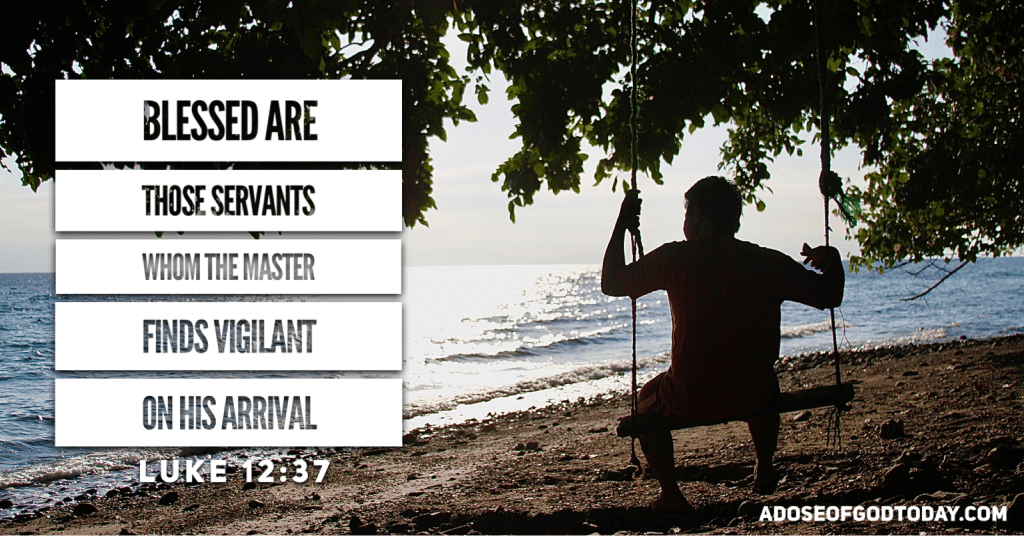
    Again, Jesus reminds us today in the Gospel “blessed are those servants whom the master finds vigilant on his arrival,” because the master himself brings peace. This is affirmed also today in our first reading. Paul tells us in his letter to the Ephesians that, “Christ is our peace.” Moreover, our Psalm also proclaims to us, “The Lord speaks of peace to his people.

    Therefore, Jesus wants us to await and be always attentive to his many surprises for us and to his simple revelations in us, in our daily life – wherever we are. Jesus calls us to expect, anticipate and await with joy his everyday coming to assure us of his abiding and ever-faithful presence. It is God’s promise that he brings peace to us to dispel the worries and anxieties, the boredom and the tiredness in our hearts from waiting, from whatever kind of waiting we may be enduring this moment.

    As we wait and welcome the Lord, may our daily encounter with him become life-changing and reassuring. Hinaut pa.

    Jom Baring, CSsR