Tag: Thursday

  • How do we react when confronted with our failures?

    How do we react when confronted with our failures?

    October 15, 2020 – Thursday of the 28th Week in Ordinary Time

    Memorial of St Teresa of Avila, Virgin and Doctor of the Church

    Click here for the readings (https://bible.usccb.org/bible/readings/101520.cfm)

    Homily

    One time, I was asked to reconcile a church organization over a conflict that had caused hatred and division among the members. This started when a member took the risk of giving a feedback to their leadership. The person confronted them and told them about their exclusivity. The leadership seemed to favor few members over the others. The person who brought this out could not take this kind of attitude in the organization anymore. It was in the person’s best intention and good faith to improve the relationship within the organization. However, the leadership’s reaction was quite hostile. Instead of welcoming such feedback, they reacted so much to the point of finding the faults of the person who confronted them. Instead of taking it as a challenge to make themselves better, they became more exclusive and at the same time hostile to those who confronted their attitude.

    A person can be hostile when confronted with his or her failure. Even among our friends, we find it difficult to tell one another of our sins and mistakes. Others, because of such confrontation, friendship was broken. Among neighbors especially, when one begins to pinpoint the mistakes of another, this may cause endless hate-speech, gossiping, and even violent reactions. This happened in that organization whose leaders were confronted of their failure to be inclusive.

    Indeed, people who tend to display a strong image with a sense of self-righteousness will be resistant towards his or her critics. This happens to us when we think highly of ourselves that we forget how to be humble and be accepting of negative comments and confrontations.

    When we have grown to be arrogant, we display an air of contempt towards those whom we believed are threatening our good image. Thus, we become hostile and aggressive towards those who confront us and friendly only to those who flatter us.

    These are the attitudes that we find in today’s Gospel. When Jesus confronted the failures and sins of the Pharisees and scholars of the law, they became unfriendly towards him. Jesus pointed out how their ancestors, as leaders, killed the prophets in the Old Testament in order to hide their failures and sins from the people. The Jewish leaders wanted to keep the people away from the truth and away from God.

    Consequently, in order to advance their personal interest, to preserve their privileges, influence, wealth and power in the community, they developed ways of enslaving the people. They created many laws and demanded that the public must follow them literally but they themselves did not; heavy taxes were imposed upon the people but they themselves would not properly pay taxes to the temple; and they developed a gap among their people, stretching the gap between rich and poor, righteous and sinners.

    And Jesus confronted them, pointed out their failures and evil intentions. But they could not accept it. As a revenge to Jesus, they planned to silence Jesus by killing him.

    The Lord has revealed himself to them but still they refused God’s offer of salvation. These people were without faith. They did not worship God but themselves alone.

    Nevertheless, God continues to confront us of our sins and failures because the Lord desires our salvation, our freedom. Our Psalm proclaims today, “The Lord has made known his salvation.” Paul reminds us too in his letter to the Ephesians, “God chose us, to be holy and without blemish before him.”

    This is God’s desire that we will be able to claim also that we are his and called to be holy. The path of holiness involves confrontation of ourselves, of our selfish tendencies and evil intentions. By confronting ourselves and welcoming God and others to correct us, then, we embrace the grace to be transformed. This is the very life that St. Teresa of Avila embraced also. She confronted the way of life of her community that she believed had already departed from its original intention.

    St. Teresa’s journey as a reformer was not easy. She herself became a threat to many, a contradiction to those in power. Thus, she became unpopular, misunderstood, misjudged and opposed. Yet, St. Teresa would say, “God alone is sufficient.”

    God alone is sufficient.

    St Teresa of Avila

    St. Teresa of Avila whose feast we celebrate today reminds us of a person who truly found satisfaction, true comfort and riches in God. Through her closeness with Jesus, she discerned and chose God’s desire for her rather than her personal desires even if that leads to personal conflict and difficulty. She made God as the most essential in her life which made her offer also herself.

    This is what Jesus wants us to be, that we become persons who are not trapped by our mere personal desires. The Lord desires that we become free and truthful to ourselves because it is in this way the we shall also find life meaningful and become life-giving in our relationships with our family and friends and with our colleagues at work.

    Let us allow Jesus to confront us. His confrontations with us may appear in different forms. This could be through a lingering guilt and shame of the past sins that we have done, through a friend and colleague who has the nerve to confront us, and through a family member who takes the risk of making us aware of our sins and mistakes. Through them, we may welcome God’s way of transforming us everyday. Hinaut pa.

    Jom Baring, CSsR

  • Ask, Seek and Knock

    Ask, Seek and Knock

    Advertisements

    October 8, 2020 – Thursday of the 27th Week in Ordinary Time

    Click here for the readings (https://bible.usccb.org/bible/readings/100820.cfm)

    Homily

    Is prayer an obligation? Many of us must have felt that prayer is an obligation, that it is some kind of a to-do list item or like a house chore that one must observe and follow. When I was young, I was taught that I “must and should” pray so that I become a good boy and God will not get angry. Many of us have developed ways of praying and different devotional practices like praying the rosary and the various novenas to the saints. Yet, many of us would always believe that prayer is indeed an obligation.

    Moreover, for us religious (priests, consecrated brothers and nuns) are actually obligated to observe our prayer schedules as defined by our Constitutions and Statutes. No wonder, that because of this “obligation to pray” we become guilty when we are not able to observe our prayers. People come to confession because of the guilt feelings of not being able to observe faithfully their prayers.

    However, did Jesus really mean that we are obligated to pray?

    Today’s Gospel on the “persistence in prayer” is a continuation of yesterday’s Gospel. Yesterday, the disciples asked Jesus to teach them to pray. This means that it was the disciples’ desire to learn how to pray. Never did Jesus impose it to the disciples. The disciples recognized the importance of prayer because they realized that this was a way of developing a closer relationship with God, to a deeper friendship with the Lord. This is the invitation for us today.

    On these particular verses of Luke’s Gospel, Jesus elaborated on how one should dispose himself/herself in prayer in order to develop ones friendship with God. Indeed, Jesus teaches us to be persistent in prayer and to continuously develop our closeness with the Lord. Jesus gives us these three attitudes in praying.

    ASK. Before we can truly ask the Lord, we also need to recognize and identify our need. Recognizing what we need means acknowledging our limitations, our emptiness, our failures and our powerlessness. This also needs an amount of humility to bow our heads and recognize that God truly fulfills and satisfies our hearts. This brings us into a deeper awareness of ourselves and to become more accepting of ourselves. Only then, that we can truly ask the Lord to satisfy the deepest desire of our hearts, and we shall surely receive the grace. Therefore, stop for a moment and pause.

    Seek. In the process of asking the Lord for the grace we need, there will be surely a time of becoming weary and anxious. We might feel that God is taking too long to answer and grant our prayers. Doubts may hit us thinking that we might have been forgotten. Thus, prayer also involves “seeking” as in “searching.” Prayer, then, is also a form of searching what is hidden and what remains undiscovered in us, waiting to be found. We don’t search for God for God has not been lost. We continuously seek and search ourselves and to let God find us. Thus, seek for a deeper insight, seek for understanding and wisdom because God answers us not outside of us but within our own context, experiences and relationships. Open the scriptures and seek God’s wisdom.

    KNOCK. God always waits for us to come closer and to dwell in God’s presence. When everything else in life will seem to be burdensome, we long for comfort. As demands from work, from home and from our relationship, and expectations from others begin to suffocate us, we long for a break. When failures, pains and guilt begin to take hold of us, we long for an embrace that will give us assurance of love and mercy. To pray is to come closer to God in order to knock the door of His heart. When we come and knock at God’s door, God is most willing to embrace us with His presence, with his forgiveness and mercy. To pray, then, is to seek entrance in God’s heart and to be welcomed by Him. Thus, never be afraid to knock because God is ready to open up His arms to embrace us. Come to the sacraments and be embraced by God’s grace.

    With these three attitudes in praying, these tell us now that prayer is never an obligation but more than that. To pray is a privilege given to us to build our friendship with God. When we pray, then, we embrace that opportunity to grow in the knowledge of ourselves and knowledge of God. The more we pray, the more we see ourselves. The more we become persistent in praying, the more we recognize the Lord’s presence in our life, both as individuals and as a community.

    Hence, move beyond obligation and instead, pray maturely and freely as we build deeper and intimately our friendship with God and with one another. Hinaut pa.

    Jom Baring, CSsR

  • Power of Asking Forgiveness

    Power of Asking Forgiveness

    Advertisements

    September 17, 2020 – Thursday of the 24th Week in Ordinary Time

    Click here for the readings (https://bible.usccb.org/bible/readings/091720.cfm)

    Homily

    Why do we come for confession? Why do we seek forgiveness of our sins?

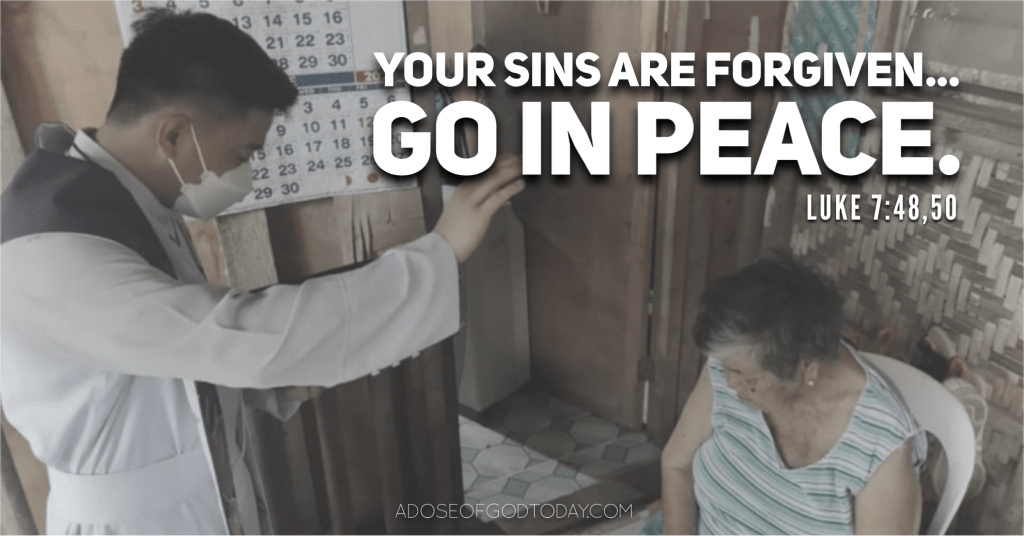
    Many of us today have doubts or have taken for granted the Sacrament of Reconciliation thinking that it does not need for one to confess his or her sins to a priest. Our basic catechism teaches us that the ordained priests are given authority to forgive sins in behalf of the whole church and as God’s representative to his people. It is not the priest that forgives but God. The church listens to the confession of a penitent through the person of the priest. The priest does not give judgement and condemnation but delivers the mercy of God to those who seek for it.

    Indeed, there is wisdom and power behind recognizing one’s imperfections and sins. The recognition of sins is not just be limited within personal realization keep within the self. It only becomes a true realization when sins are confessed to somebody, letting another person know about our sins. The priest in this case represents the church for the person who realizes his or her sins.

    Once we recognize our sinfulness then it is also God’s opportunity to change our lives and to make us new again. “Recognition and confession of sins” is our humble way of acknowledging that we need mercy and forgiveness, thus, we need God.

    The opposite of this is the denial of ones sins and imperfections. Thus, denial of our need of God and denial of our need of mercy and forgiveness. This happens to us when we have grown righteous. When we begin to think that we have committed no sins, then, we think of ourselves highly to the point of making ourselves above others whom we think as lesser than us.

    This is the story that we have heard in today’s Gospel. The woman who knelt before Jesus represented those who recognized their need of forgiveness. On the other hand, the Pharisee who invited Jesus represented those who do not need forgiveness because they believe that they do not need God.

    Let us see these two personalities to clearly discern God’s invitation for us today.

    The woman who was known to be a public sinner was despised by that Pharisee. He would not even dare talking to her because of fear of being contaminated by her sins. That is why, he felt disgusted with Jesus who allowed this woman to wash his feet with her tears and wipe them with her hair. The woman’s actions were her humble way of recognizing that she was in need of God’s mercy. Despite her sins and the shame that she was bearing, she took the risk to go in public to ask Jesus forgiveness.

    And because the Pharisee thought of himself so highly, never thought that he too was in need of mercy. This attitude of the Pharisee made him condemning of the woman. He was indifferent towards her and saw no hope in her. This will also happen to us when we become righteous and think that we do not need mercy from God. We become persons who easily condemn others. We become persons who do not see hope with those who have failed in their life. We become angry persons and bitter towards others.

    However, Jesus invites us to learn from her. She who recognized her sinfulness, allowed Jesus to transform her life. Her actions towards Jesus was her expression of her affection and at the same time of her need of forgiveness, Jesus who is the face of the Father’s mercy, willingly granted her forgiveness.

    When we become persons who recognize our failures and sins, we become persons who also see hope and life. We become persons who become positive with life and at the same time positive with others. We become happy persons.

    This is what Jesus wants us because recognition and forgiveness of sins allows us to unburden ourselves from guilt. This will also allow God to work in us.

    Thus, do not be afraid of acknowledging ones failures because God always sees hope in us, God does not condemn but grants his mercy and forgiveness to us so that we shall live in peace, freedom and joy. Hinaut pa.

    Jom Baring, CSsR