Tag: The Lord is Risen

  • On the Road towards realizing the Presence of God

    On the Road towards realizing the Presence of God

    April 15, 2020 – Wednesday within the Octave of Easter

    Click here for the readings (http://www.usccb.org/bible/readings/041520.cfm)

    What are the things that we desire most? Wealth? Good health and long life? Stable job? Love? Committed and grounded relationship? Success and meaning in life? 

    All our desires whether material or not are said to be connected to that deepest desire of every man and woman. Our deepest desire is what draws us closer to God and to a meaningful purpose in life. Our deepest desire is God’s way of leading us to discover and affirm who we are and what we are meant to be in this life.

    That deepest desire is what our Gospel portrayed to us today. There were two disciples of Jesus who truly desired God. Yet, in that desire to be with Jesus and to follow Jesus, they experienced their greatest horror when Jesus himself was crucified on the cross. That disappointment and horror of these two disciples were shown in that image of leaving away from Jerusalem and going to Emmaus. They were leaving in order to forget the pain that they endured in Jerusalem. 

    Moreover, even though they wanted to forget Jerusalem, deep in their hearts they still sought the Lord. This was the reason why the two were conversing and debating about what happened to Jesus. In that way, they sought for explanation to understand their own situation and meaning as disciples of the Lord. Deep down in their hearts, they wanted to make sense of those painful events. However, the pain and the horror were just too great. In addition, women were saying that he rose again. Something that was beyond there human understanding. 
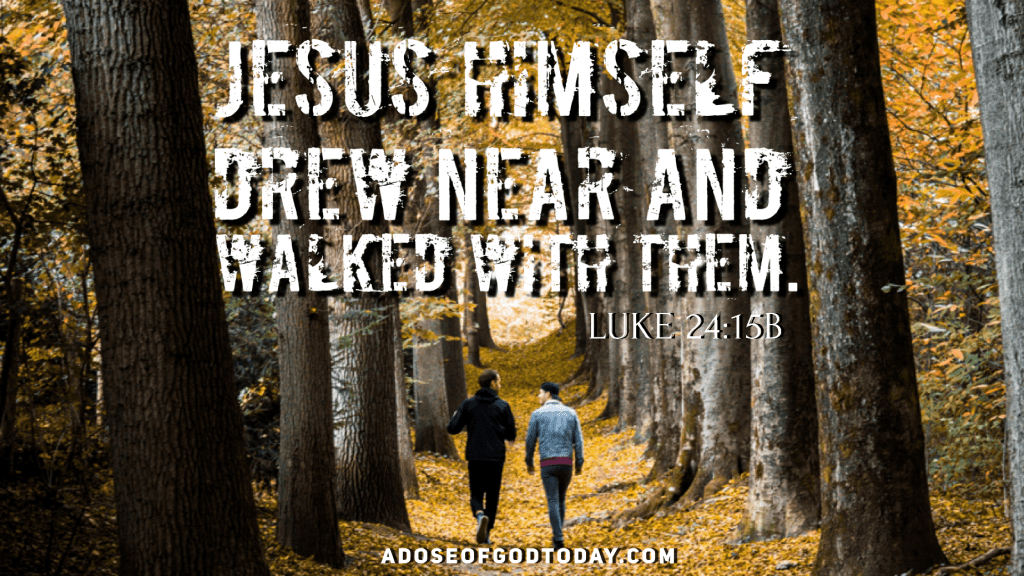
    Until, a stranger, who was actually Jesus, joined them on the road. The Lord explained to them the scriptures yet they were not able to recognize the Lord because their hearts were filled with sorrow and pain. This was described in the Gospel, “and their eyes were prevented from recognizing him.” They were too fixated of their emotions brought about by that painful and confusing event in their life as disciple. Moreover, their hearts were also clouded because they have not realized that the stranger who explained to them the scripture, was actually the risen Jesus.

    Yet, it was when they have invited the stranger to join them in the supper and when the stranger broke the bread that they have recognized that the stranger was actually Jesus. Their eyes were opened because in that meal, they were reminded of Jesus’ presence saying to them, “Do this in memory of me.”

    When they have recognized the Lord, it was their time too to discover for themselves who they were and what they were meant to do, their mission and purpose in life. 

    Yes, by recognizing Jesus in the breaking of the bread, they too have affirmed that they were his disciples, that they were not left alone, were not abandoned by God but loved and cherished by this faithful and merciful God. 

    Through this realization they have discovered their purpose at that moment, and that was to “go and tell others” of Jesus’ resurrection.

    This is the invitation for us today – that is to recognize God among the strangers, among the people we encounter, with those we meet every day particularly your own family, your friends– and in recognizing the Lord in them, hopefully, we too will also discover our own mission, God’s invitation for us.

    Today, Wednesday, we ask the intercession of Mary, Our Mother of Perpetual Help, that like her, we too shall recognize the Lord in the presence of our brothers and sisters in this time of great crisis, and will discover how God calls us now. Hinaut pa.

    Jom Baring, CSsR

  • When hoping against hope, brings hope

    When hoping against hope, brings hope

    April 14, 2020 – Tuesday of the Octave of Easter

    Click here for the readings (http://www.usccb.org/bible/readings/041420.cfm)

    Among the women friends of Jesus, perhaps Mary Magdalene was the closest to him. Mary Magdalene was closely following the Lord wherever he would be. Mary Magdalene was confident that God is in Jesus. She was most sure of it next to Mary, mother of Jesus. Thus, when the disciples fled and hid because of fear. Mary Magdalene together with other women remained. They followed Jesus until his death. Even when Jesus was brought down from the cross, Mary was surely there. Indeed, Mary was filled with grief and sadness when Jesus suffered and died.

    Yet, despite the grief and sadness, Mary returned to that place of pain and darkness. She went to the tomb of Jesus. Why go there when it would only remind her of sadness and grief?

    She went into the tomb at dawn, while it was still dark, the Gospel says. The darkness here means sadness and pain, yet, what is interesting was the dawn was breaking. The sun is soon to come out. Indeed, what Mary will witness is the victory of light over darkness.

    This brings us into the kind of relationship Mary had with Jesus. Despite the grief and sadness, Mary did not just go away and give up even though her friend died. The sadness, disappointment and pain that she felt, urged her more actually to seek Jesus even in times of confusion and darkness in her life.

    This reminds us of our experiences. When we too encounter difficulty and pain, sadness and frustrations, and even boredom in life, we might find ourselves to go away, to step back and become fearful.

    There is something to learn from the friendship Mary Magdalene had with Jesus. It was a friendship that was beyond physical attraction and emotional attachment. It was a friendship built on trust, faith and confidence of being loved.

    Even though Mary was confused and in pain, but, somehow, she knew in her heart that Jesus did not left them, and did not abandon her. She completely believed in Jesus. That is why, even in the seemingly senseless way of going to the tomb; Mary still went to hope against hope.

    Mary recognized the Lord when Jesus said her name, “Mary!” Jesus has her way of calling the name of Mary and when she heard him, Mary opened her eyes from grief and sorrow and recognized that it was Jesus. It is the same when our parents would call us. We would always recognize that it is our mother or father calling us. It is the shared intimacy or the close relationship that we have that make us recognize the voice of the person. The Lord also has his own way of calling our names. Discover how God calls us!

    Each of us is invited to develop this kind of friendship that Mary developed with Jesus. How do we develop it? Four points to remember.

    1. Be with Jesus always and follow him. Wherever Jesus went, Mary also followed. Thus, always seek the desire of Jesus for you to lead you where he wants you to go. You may ask, “What Jesus wants for me today?” So, as we continue to struggle with “community quarantine and physical distancing” ask this question so that you may follow him in your heart, in your mind and in your actions. Surely, when we are with Jesus, we will never get tired. We will be filled with joy and satisfaction.
    2. Allow Jesus to come to you and call your name. Like Mary, she allowed the Lord to come into her life and to call her name. Allow also Jesus to occupy your mind and heart. Receive him constantly through “Spiritual Communion” at this moment of quarantine until things get back to normal and you receive Him physically. Moreover, receive Jesus also through the Bible. You might want to begin to do “Bible sharing” in your family. This might be awkward at the beginning, but it will be enriching.
    3. Constantly pray. Mary learned from Jesus in praying to the Father in heaven. Through prayer, Mary became more aware also of herself and of God’s presence. Thus, since the quarantine has given us more time to be at home, pray. Grab this opportunity to gather as family to pray and reflect. While at home, you may also “tweet” with Jesus, speak “What’s on your mind?” and post to Jesus your “instragamable” feelings and concerns.
    4. Know that you are loved and forgiven. Mary accepted in her life that Jesus loved her and that through him she was forgiven. Despite her sins in the past, Jesus never condemned her, but accepted her because she is being loved.

    All of these led Mary Magdalene to be ever grateful to Jesus. And because she was grateful, she was confident; she was filled with hope and became fearless. This is how Mary showed to us when hoping against hope, brings hope to us. 

    This leads to Mary’s Easter Proclamation, “I HAVE SEEN THE LORD” 

    Mary had seen the Lord. Going to the tomb was never useless and senseless because even in the midst of pain and confusion, God reveals himself.

    We may also ask ourselves, “Have I also seen the Lord, in those times of difficulties and pain in my life?” or “How have I seen the Lord in these times of COVID-19 and Community Quarantine?

    Mary’s painful experiences had become the ground for God to reveal himself to her. Mary’s relationship with Jesus was also the foundation of Mary’s keenness in recognizing Jesus in her life. And seeing Jesus, empowered Mary to become the “Apostle to the Apostles.”

    By seeing the Lord, Mary was sent to become the first Missionary after the resurrection of Jesus. Mary was sent and so we are. Each of us who have seen the Lord in our life is also called to proclaim to others, “I have seen the Lord.” Hinaut pa.

    Jom Baring, CSsR

  • Be captured by the Power of Resurrection

    Be captured by the Power of Resurrection

    April 13, 2020 – Monday within the Octave of Easter

    Click here for the readings (http://www.usccb.org/bible/readings/041320.cfm)

    Homily

    The Gospel story from Matthew presents to us how truth can be manipulated by people who desired to advance their personal agenda. The soldiers who were witnesses of the Resurrection were paid not to tell what really happened but to create another story. These soldiers must have been filled with awe and wonder in the event of the resurrection. Light must have pierced into their unbelieving hearts. However, what was sad in their story was when they were presented with the immediate comfort of money.

    They were willing to cover the truth of resurrection and create fake news for the sake of money. They accepted a corrupt offer to spill the untruth to people rather than to tell others of God’s power and mercy.


    Why was that? Is money more powerful than God? Certainly not. It is just deceiving.

    Nevertheless, apart from this sad story, we still have the women who showed to us how the resurrection of Jesus changed their life. The Gospel tells us that they were still fearful yet “overjoyed.” This means that despite the seeming darkness they have experienced in the past days and the fear that enveloped them, the presence of Jesus filled them with so much joy.

    The women did not succum to despair and fear unlike the soldier who succumbed to money and corruption. The women continued to believe in Jesus in spite of the confusions and even pain and suffering that they witnessed. They never lost their hope in Jesus.

    This kind of attitude in them was showed in their action as they went to the tomb early in the morning. The tomb surely would remind them of the death of Jesus, meaning, of sadness and failure, of pain and disappointment. However, even in the midst of all of these, they found a reason to find light in the midst of darkness, to find hope in the midst of hopelessness and to find life in the midst of death.

    And true enough, as they desired to see Jesus, they indeed saw and witnessed the glory of resurrection. This was how they also found their mission, and that was to be Jesus’ witnesses to others.

    Now, as Jesus called them to tell other disciples about him, each of us now too is called to tell others of Jesus’ presence in our very life. Galilee, then, is very important here. Galilee, indeed, was a very symbolic place. 

    The people in Galilee were the excluded, the poor, and the marginalized where only bad news were heard and imposed. And Jesus grew up in this environment. He indeed belonged to this marginalized-second-class people who were systematically oppressed by oppressive powers. And Jesus identifies himself with them. With them Jesus shared food, drinks and stories. Moreover, Jesus called his disciples who were mostly Galileans, in the poor and marginalized people. 

    Galilee now represented the world where people continued to suffer, to be marginalized and oppressed. It is in this place where Jesus will be found by the disciples and where the good news of the resurrection will also be preached. 

    As disciples and modern day apostles of Jesus, we are to seek also the marginalized and the oppressed in our society. We are to bring hope and good news to those who are troubled and in despair. It is to be faithful to the mission of Jesus entrusted to us his believers that we shall also meet the risen Christ. This mission is surely radical and demanding, thus, it must always be motivated through the person of Jesus with the power of the Holy Spirit. Yes, only through the person of Jesus and not in money, in benefits or comforts for ourselves. 

    As we respond to the call of the Risen Lord, may we find him more in our efforts in making difference in the lives of our brothers and sisters especially in this difficult times brought by the pandemic Covid-19. Hinaut pa.

    Jom Baring, CSsR

  • The Silence of Empty Tomb: An Invitation to seek your own Resurrection Story

    The Silence of Empty Tomb: An Invitation to seek your own Resurrection Story

    April 12, 2020 – Easter Sunday

    Click here for the readings (http://www.usccb.org/bible/readings/041220.cfm)

    Homily

    The Lord is risen! Alleluia! Alleluia!

    The word Alleluia is a Hebrew word that expresses rejoicing

    It is just right for us now to be joyful because the Lord is risen. Jesus is alive and did not abandon us at all. We might have felt fear and haunted by the anxiety brought by the Covid-19, but God remains truly faithful. He is with us and present among us. 

    Jesus’ resurrection is God’s ultimate declaration of God’s justice and mercy, for those who are oppressed, those who are in pain, for those who suffered and died.

    These past few days, we have been reflecting on the passion, suffering and death of our Lord. The Easter triduum that started on Holy Thursday prepared us to enter into the great suffering of Jesus on Good Friday. On that day, we were deeply touched as we remember the death of Jesus as God’s expression of love for us. 

    By Black Saturday, of which the Great Silence has been observed, we were invited also to continue to reflect on this great mystery of love. Last night, we anticipate the resurrection of the Lord. Today, on this Easter morn, Mary of Magdala brought the news of the empty tomb to Peter and to the beloved disciple. 

    It would be good for us then to look deeper on how these three received the resurrection of Jesus.

    Mary of Magdala was perhaps in great sadness as she came to the tomb of Jesus on that early morning. Perhaps, Mary was not able to sleep thinking that his master died and left her. What did she expect then when she went to the tomb, in that place of sorrow and pain? The Gospel tells us that Mary did not actually see the inner part of the tomb, but, she was sure that the Lord was not there. Mary brought this news to Peter and the beloved disciple that the Lord was taken away – Mary actually thought that Jesus’ body was taken away from them.

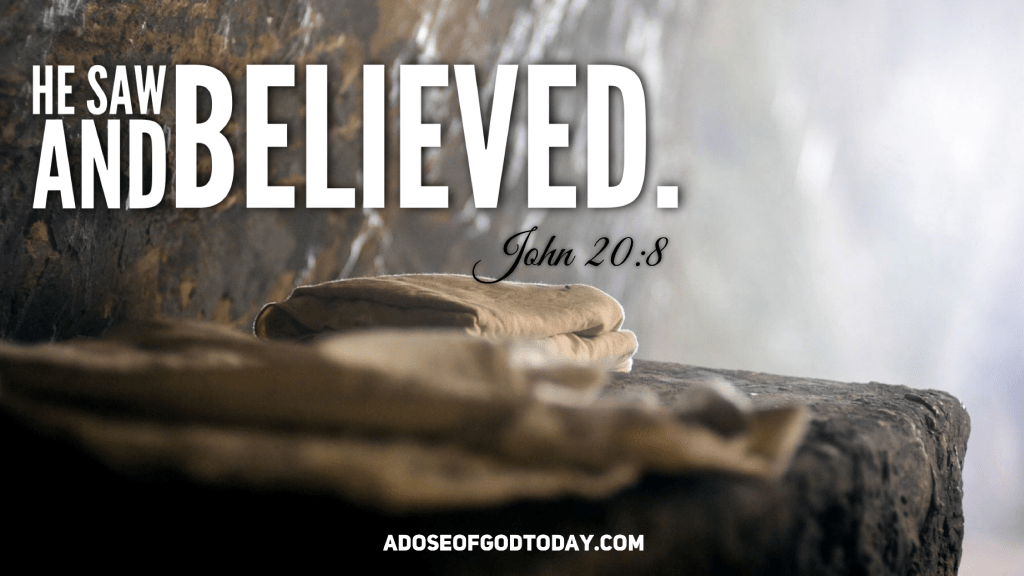
    The beloved disciple upon hearing the news ran faster than Peter and arrived first. Yet, he did not enter until Peter arrived. He just bent down and saw the linen cloths lying flat.

    When Peter arrived at the tomb, he entered and saw also the linen cloths lying flat. How will he explain this empty tomb now to the other disciples? He who denied the Lord three times might have been really confused and worried.

    There was no word being uttered as they saw the empty tomb and the linen cloths. There was only silence. And silence from the empty tomb. They were perhaps confused of that event. But what was interesting was the napkin that had been rolled up in its place. That napkin was used to wrap the head of Jesus.

    But when the beloved disciple entered also in the tomb, he saw and believed!

    Yes, the beloved disciple who was dear to Jesus saw the signs, the empty tomb, the folded linens and napkin. Those were the signs that indeed the Lord was risen. He is alive. However, to these three, they did not yet fully understand what had happened.

    This event triggered something in them and that is to seek their “own resurrection story.” Jesus did not appear to them immediately. Jesus allowed them to have doubts and to believe in him despite their own confusions and anxieties. Jesus permitted them to have a glimpse of his resurrection – a glimpse of the Easter joy.

    This is now the invitation for us– that is to recognize our own resurrection story with the Lord.

    We might find it difficult to find our own resurrection story because like Mary of Magdala and Peter, our hearts might still be clouded with despair and anxieties. Covid-19 has not yet left us until now despite the many weeks and even months for others of quarantine and lockdown. We have terribly missed by now the company of our friends and colleagues. Everyday the infection is rising and deaths are adding too.

    However, let us look again of that beloved disciple who was personally close to Jesus. It was him who saw and believed! 

    But take note of this, what the beloved disciple saw was beyond “physical.” He did not see Jesus rising. He did not witness that. What he only saw and witnessed was the silence of the empty tomb. And beyond that, the beloved disciple felt and realized that something glorious happened. Seeing that, he believed that God conquered death. God has taken away sadness and fear. Jesus is here and he is alive. This is what he believed.

    Therefore, let us come closer to Jesus because each one of us is dear to him too. In that way, we will be able to truly believe that the Lord has risen and has brought hope to all of us. This will help us to recognize the times where God has let us experience our own resurrection – in those times where we found ourselves in hopeless situation, yet we were given hope; in those times where we thought we were not valued, yet we were loved; in those times where we felt that we were abandoned, yet, after all we realized that we have friends and family members who treasured us.

    Recognizing our own resurrection stories will make us more open to God’s invitation to believe in the joyful resurrection of Jesus where God dared to be at the side of the oppressed and the suffering people.

    Let our faces now, be overwhelmed with our smiles and let it be translated into action by doing good things to others, by being more compassionate to your neighbor, by being considerate to those who are most in need, by being friendly and showing concern to people whom you will meet despite the “physical distancing.” Hinaut pa.

    Jom Baring, CSsR