Tag: Sunday

  • Jesus Prayer

    Jesus Prayer

    October 23, 2022 – 30th Sunday in Ordinary Time

    Click here for the readings (https://bible.usccb.org/bible/readings/102322.cfm)

    A story once told about two robbers were caught stealing. While trying to evade the chasing police and dogs, one of them said to the other: “Pray”. But the other snapped back in reply: “I don’t know how to pray”. Then, the first one persisted on: “Just pray any prayers you know, anyway, your God will listen”. The second wondered: “Any prayer will do?”. The first pushed: “Ya, any prayer”. So the second prayed the only prayer he knows, this way: “Bless us, O Lord, for these thy gifts, which we are about to receive from your goodness through Christ’s our Lord. Amen”.

    Here, they are. Chased by the dogs and police. About to be apprehended and punished for stealing. And the only prayer, one could think of is the formula-Prayer before Meal. Well, nice words, but surely not the right & appropriate prayer for that very moment.   

    Prayer is our Chat-talk with God – our exchange of words with God. Praying then is more than just mumbling words from subscribed formula or -prayer-format, because it is the opportunity for us to be who we are before God and to express our hearts’ desires to our Father. Better then for us, in praying before God – to say what we mean, and mean what we say, than just reciting formulas which we don’t really mean and thus does not say who we really are and what we really mean before God. Meaning, pray your heart’s desire before the Lord in you own words.

    Perhaps this is what Jesus is teaching us today about prayer. Through the parable of the Pharisee and the tax collector, Jesus teaches us that in prayer, God listens to us. God hears our cries and satisfies our heart’s desires. What is required of us, however, is our real selves humbly longing for Him – saying what we mean and meaning what we say to Him. Unlike the Pharisee, we should pray not for what we have done and what we have been doing, but pray instead in humility for what we need before God and for what God can do for us. Prayer is not our exhortations and exaltations of what we have done for God but our humble supplication before God’s presence for what He can do to us better & further in life.

    We also hear in our gospel today, the simple humble prayer of the tax collector: “O God, be merciful to me, a sinner”. This is the simple prayer-words that God as well as Jesus approves, for these words profoundly express who we humbly are before God, and what we mean, say, and desire from Him.

    Lord, Have Mercy on me a sinner”. Perhaps the simplest yet most effective prayer words in our Christian life are these words: “Lord, Have Mercy on us” “Ginoo, kaluy-I kami”, “Panginoon, Maawa ka sa Amin”. Junim, Jabirul Bepusoso.” These words, (traditionally also  known as “Jesus prayer”) are not only prayed by the tax-collector in our gospel today, but also in the Scripture, as cried out in prayer by the ten lepers, the blind Lazarus, and others. These people were all healed, forgiven, and redeemed for they have prayed to Jesus: “Lord, Have Mercy.”

    To pray then the Jesus prayer: “Lord, have mercy on me” means and says a lot. It reveals our very identity of who-I-am or who-we-are before God. First, it is a Cry for God’s Help, that is, it is our way of saying: “I need God’s help”. To ask for help today is considered as weakness and dependence. To pray then for God’s mercy is to rely not on our own but to depend on God’s strength and power. Second, it is a declaration of faith, i.e. our way of saying: “I believe in God’s will and I trust in God’s way”. In our world of distrust and unbelief, and toppled with individualism, to pray for God’s mercy is to believe and trust in an-other greater authority/power than ourselves. And lastly, to pray, “Lord, have mercy” is our humble obedience to God, i.e. it is our way of saying: Lord, I rest my case. I now listen to you. It’s now, not mine, but your will be done. Bahala na. Kabay pa. Siya Nawa.” This means that finally, after all has been said and done, prayer leads us into total respect and reverence to divine will & providence as well as peaceful silence before God’s presence.

    Remember then that God rejects the prayer of self-righteous persons, but listens to the prayer of sinners who are aware of their inner poverty. God hears the prayer of the humble who are aware of how poor they are before God for “the Lord hears the cry of the poor.”

    Perhaps we ask ourselves now, when was the last time we utter those words: “Lord, Have Mercy on Us” Panginoon, Maawa ka sa Amin; Ginoo, Kaluy-I kami; “Junim, chabirul bepusoso”? Did we say what we mean? Did we mean what we say? Are we saying those words, as a Cry for His Help in our lives, as declaration of our faith and trust in Him, and as our humble obedience to His plans and will for our lives? OR we said those words, like any prescribed formula-prayer inappropriately and without meaning it?

    Before God then, to pray the simple words of Jesus prayer, said with meaning and humility – is but enough and appropriate at all times.

    Whatsoever then happened, is happening and will happen at every moments of our lives, we own up our humble poverty before Him, and pray with full consent and intent the Jesus prayer: – “Lord, Have Mercy on Us sinners.” Amen.

  • UNDERSERVING yet Graced and Loved

    UNDERSERVING yet Graced and Loved

    October 17, 2022 – Monday of the 29th Week in Ordinary Time

    Click here for the readings (https://bible.usccb.org/bible/readings/101722.cfm)

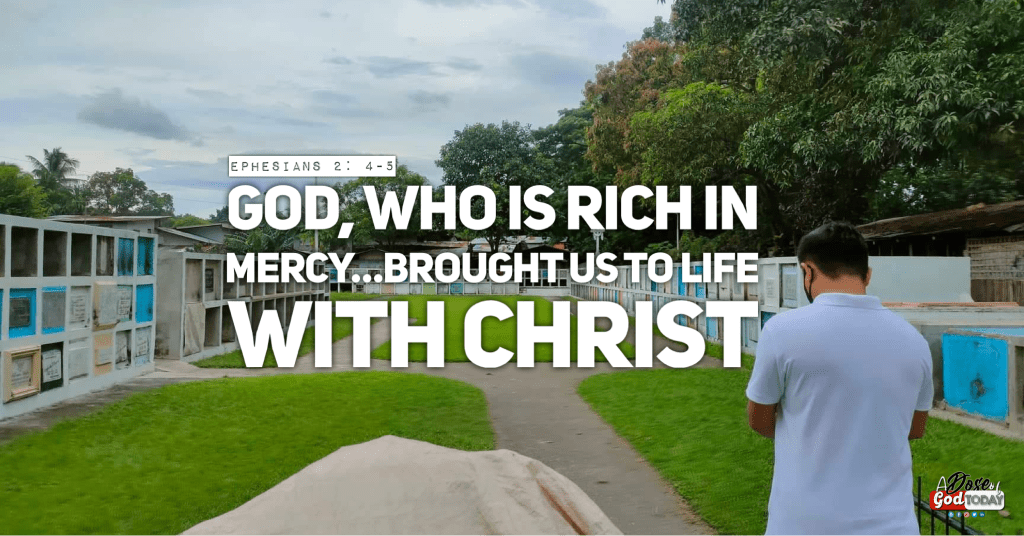
    This is who we are – UNDERSERVING yet we are graced and loved by God who would do everything to liberate and empower us from whatever that is preventing us to live life to the full. This is how Paul captured such image of ours before God in his letter to the Ephesians, “you were dead in your transgressions and sins… but God who is rich in mercy, because of the great love he had for us… brought us to life with Christ (by grace you have been saved).”

    Let us become more conscious of this and claim such grace from the Lord. This act is indeed God’s initiative, out of that great love we are shown mercy and brought to life. We realize how each of us matters in God even though we are not deserving in anyway. Paul further tells us, “For by grace you have been saved through faith, and this is not from you; it is the gift of God; it is not from works, so no one may boast.”

    Yes, it is a sheer gift of God! A gift that offers us freedom and peace, reconciliation and the fullness of life with Christ.

    This is how we also understand the parable of Jesus in today’s Gospel from Luke. Jesus did not condemn people who are rich materially. The warning of Jesus is directed towards a heart that has become dependent on possessions to the point that greed consumes the person. Total dependence on material possessions or whatever possessions we may have or “things that possessed us,” lead our hearts to greed. Greed keeps us away from others and from God because it worships not the Lord but something and someone else. Greed corrupts the hearts and destroys our relationships.

    This makes any person to be distanced from the grace of God, away from the company of true friendship and love from the community because the person grows to be vicious and self-centered. This is what the Lord wants anyone to be free from. When we become dependent and totally occupied by something else rather than by our relationship with God and with one another, then, we become prisoners of our own human desires and selfish tendencies. This is the transgressions and sins that Paul tells us.

    Jesus invites us to invest and be rich in what matters to God. This means that as God has shown us mercy because of his great love for us, we are offered and given life with Christ. This is the fullness of life.

    Thus, what matters to God is for us to replicate what we have received, that is, to show mercy to our brothers and sisters, to express concretely our love for each other and to God and to become life-giving persons. The fullness of life is not being experienced alone but can only be experienced within the context of our community. Hence, it is by being able to give life, inspire life and heal life in our families, group of friends, workplaces, organizations and communities that we shall also truly experience the fullness of life with Christ. Kabay pa.

  • PRAY WITH OUR FRIENDS

    PRAY WITH OUR FRIENDS

    October 16, 2022 – 29th Sunday in Ordinary Time

    Click here for the readings(https://bible.usccb.org/bible/readings/101622.cfm)

    A friend shared to me how she has lost her faith. She had been in a depressing situation in life. She did not know what direction she will take. She was totally lost and confused. She was emotionally abused at home and suffered the effects of a broken-home. She was misunderstood by many, among her other friends and colleagues. Her personal and family problems keep adding to the point that she felt suffocated by all of these.

    This was how she felt that her prayers seemed to be unanswered. The many times she cried during her prayers seemed to be in vain. God appeared to be very far from her to the point that she claimed, God is absent, thus, losing her faith.

    Yet, as she opened up and began to tell her narrative that became an opportunity for me to journey with her being a friend. In one of our conversations, I asked her if she still believed that God was with her. She answered a very big “no.” She neither can feel God’s presence nor believe that God was with her at that moment. She was indeed very hurt, confused and lost. She stopped going to Church. She stopped praying because everything seemed to be useless. I could not blame her for that. She has been through a lot already. What I can do was to listen to her and let her know that she was not totally alone.

    I asked her once if it’s okay that I will pray with her. She seemed to be hesitant but said yes. I prayed with her, recognizing God’s presence even in times of not being able to feel His presence. I prayed with her asking the Lord for comfort and assurance from the gift and embrace of friends, family and community. And I prayed with her to ask for the grace of humility to recognize our nothingness before God, for the grace to see light in the midst of dark experiences in life, for the grace of hope in midst of many uncertainties in life, for the grace of peace and freedom in the midst of overwhelming difficulties and grace of faith to believe even when it is hard to believe.

    When I opened my eyes after that, I saw her shoes all wet with her tears because she was sobbing while we were praying together. She found strength in there and comfort. “God is with me,” those were her words that touched me very much. Indeed, this is how I also realized the power of praying with others, praying with our friends and finding at the end how our faith grew together, and how we become closer to God’s presence. Such encounter brings a change of perspective in life as well as growth in our relationship with God and with one another.

    This encounter I had with a friend reminds me very much of the invitations we have on this 29th Sunday in Ordinary Time. Praying with our friends is what our first reading in the Book of Exodus tells us.

    We were told how Moses grew tired while he was praying. This happened when an enemy, Amalek waged war against Israel. Moses prayed to God for strength and victory. As long as Moses raised up his hands, they were winning. However, when he grew tired and rested his hands, they were losing. And so, Aaron and Hur helped Moses and supported his both hands. As a result, Moses’ hands remained steady until sunset. Thanks to the two for helping in that prayer.

    This story may sound primitive but there is wisdom behind here. We find it there in the power of praying with our friends. Surely, praying can be tiring as Moses experienced it. It is also time-consuming. It can be emotionally exhausting especially when we are internally and externally troubled. Yet, praying with our friends is different. The company and the assurance that we are not alone, gives us hope.

    This is what Jesus also wanted his disciples to realize as he gave them the parable of the judge and the widow. The judge in the story even though he was not at all righteous, did not fear God and did not respect any person, but gave in to the request of the persistent widow. Yes, it was because of the persistence of the widow that he granted her plea. This was the image Jesus used to bring out the character of God who is merciful. God will surely answer us because God listens to his people.

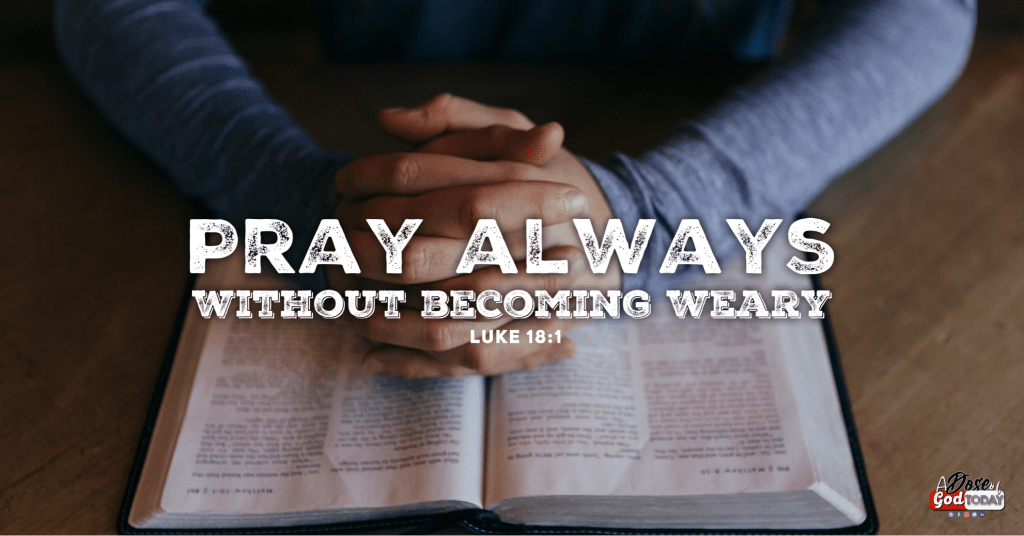
    Indeed, the parable is an invitation of Jesus for all of us to realize the need to pray always without becoming weary or exhausted. But how do we not grow weary? Well, this is where we find the importance and significance of our friends, of our community. As this was addressed by Jesus to all the disciples, it is to be understood that prayer becomes our strength, source of comfort and growth in faith when prayer also becomes our way of life as a community of disciples of Jesus.

    Now, these are the invitations for us today as well as your take-aways.

    Pray with our friends. Do not be shy or hesitate to ask your friend/s to pray with you. Even if you are in a public place, pray with your friends. Even if that is through a simple meal that you share, pray with your friends. Pray with your friends not just during bad and difficult times but also during celebrations and in times of gratitude.

    Pray with the Holy Scriptures. St. Paul tells us in his second letter to Timothy, “All Scripture is inspire by God.” And so, as we pray with our friends, maximize also the gift of the Holy Bible because praying with the Holy Scriptures allows us to discover God’s wisdom and invitations.

    Pray to confront, to encourage and to embrace. Praying with our friends is not just about mumbling words or repeating memorized prayers but this also becomes our way of confronting ourselves of our sins and failures, to encourage one another through our presence and to embrace each one with love and affection despite our limitations and differences.

    In this way, we allow our faith to grow together as friends and as a community of believers and certainly, Jesus will find faith among us. Kabay pa.

  • Lambing

    Lambing

    October 16, 2022 – 29th Sunday in Ordinary Time

    Click here for the readings (https://bible.usccb.org/bible/readings/101622.cfm)

    Resentful of his neighbor’s humble faith, a local bully would usually make fun of the old lady’s religiosity. At times he would mockingly insult her, saying: “Waay ka gid makuha sa imo pag-ampo” – You gain nothing from praying. The old lady would just keep silent & smile instead. One day, the bully overheard the lady praying this way: “Gratitude O Lord for all your blessings. My food-supply though is just enough for this week.  Hope my hard-up children could extend assistance. Though I believe you would take care of me as you always have been. If it is your will, Lord, grant me enough of what I need. So may it be.”

    Hearing this, the bully bought some enough food-supply at the grocery. Then, next day, he went to his old lady’s house, placed a bagful of grocery in front of her door, hid somewhere and waited for his neighbor’s reaction. When the neighbor found the bag outside, she was happy and all praise to God for the graces right in front of her. Suddenly, the man intervened and said, “Aha, got you. That bag of food is not from your God but from Me. See, your God doesn’t care for you“. The old lady just smiled & loudly prayed, “Lord, many thanks for these food you have provided me today and….. for letting my good neighbor pay for it“.

    Praying to God has always been part of our faith-life. And in our efforts to pray, there will always a discontent within us with the way we pray – that somehow there is something kulang/inadequate or missing in the way we pray, and we don’t know what and how. There is always a desire and longing for the best way to pray. Deep inside, we do cry: “Lord, teach us how to pray”. Our readings today are all about prayer, and teaching us how to pray.

    In our first reading, we hear that Israel won the war against Amalekite as long as and because of Moses persistently raising up his hands to heaven to pray – not without the help of others. St. Paul in the second reading appeals for constancy and never losing patience in proclaiming and sharing our faith to others. Jesus in our gospel today points out that the same kind of widow’s persistency to the judge moves God to respond to our pressing needs and concerns.

    Meaning, prayer is our humble, trusting and persistent expression of our appeals, requests – of our heart’s desire to God before His presence. In other words, our readings today are teaching us that prayer is basically our persistent & constant lambing  “Kakulitan” “Pamaraig” “paang-ga” to God, our Father.

    Here, we are reminded that God always listens to our prayers. God as our parent wants to listen to our heart’s desire. He knows and understands our needs and concerns. At the same time, he wants us to come near & be constant in our prayer-lambing to Him.

    Also, God always answers our prayers in His own time and ways. Yes, sometimes we do feel frustrated with God for not answering our prayers. But same way we experience our own parents, God seems silent or passive with our prayers but actually He is discerning and planning what is best for us, better than what we prayed for. We are only to express our prayers – our pamaraig persistently, wait patiently and trusting that not long for now we receive more and better than what we expected.  Like what happened with our story above, God has His own ways and time to grant our prayers… & perhaps, even allow others to pay for it.

    Our readings these past few Sundays have taught us also a lot about faith. We come to learn that Faith is not something we can demand, for it is God’s gift to us. Faith also is rather our response in gratitude & in return for such gift of faith we already have. And today, we are taught that our faith is also our constant loving Lambing to our father, as he reminded us in our gospel to “pray always without weary”. Meaning our faith is our constant, consistent & persistent entrusting of ourselves to Him in lambing-prayer. 

    What matters then, for Jesus is not our desires, longings, needs, hungers, and cravings for gifts, but it is our persistency, patient waiting and trust and confidence in God, our Father. Praying to God, then is about not what we pray, but how we pray; not what we ask for, but how we ask it from Him that matters. It is the manner of prayer – the lambing, kakulitan, pamaraig, paangga: is significant “For everyone who asks, receives; and the one who seeks, finds, and to the one who knocks, the door will be opened.” In other words, it is the FAITH – the asking, seeking, and knocking – and not the content, outcome, or perks are most important.

    May our prayers then be expressions of our persistent faith & without weary lambing, heart-desire to the Giver of the gift rather than our mere longing for the gifts we want & need.

    Amen. So be it. Siya Nawa.

  • GOD without Borders

    GOD without Borders

    October 9, 2022 – 28th Sunday in Ordinary Time

    Click here for the readings (https://bible.usccb.org/bible/readings/100922.cfm)

    The common belief among many Jews in Biblical times was that God was only for them. Yahweh chose them to be His people and thus, it was understood that the Lord God would only favor them and no other peoples except them. This belief made them exclusive to the point that outsiders are unwelcomed. More than this, God was as if being monopolized by the people and not wanting the Lord to be outside. This belief proved to be problematic and caused a lot of divisions, hatred and indifference among the people.

    Such form of monopoly can also be present and creeping even in our culture today as Christians among our groups and religious organizations. Like for example, there was a choir-group in a small parish who seemed to be so exclusive and trying to monopolize their services for weddings, funerals and even birthday events in the community. There were even particular songs they claimed that only them should sing and no other groups. They went further by advertising their choir group to the people to advance their singing services. As a result, such actions caused divisions and unnecessary conflicts and tensions in the Parish Community. Their exclusivity and monopoly become toxic.

    This belief and attitude of our heart, indeed, not just limit us but also limit God to be God. Our exclusivity and monopolizing attitude could make us unwelcoming and horribly indifferent towards others.

    This is something that the readings we have today on this 28th Sunday in Ordinary Time are trying to convey to us that God is without borders and our Church and all our communities cannot be exclusive and cannot monopolize God. So, allow me now to journey with you through our readings and see how God calls us today.

    In the first reading from the Second Book of Kings, Naaman who was a commander of a Syrian Army, went to Elisha to be cleansed from leprosy. Naaman was first told about Elisha by his captured-slave, a young girl from Israel. Naaman who was very desperate listened to her and went to Elisha. For the Hebrews at this time, their belief told them that this foreigner did not deserve to be cleansed of leprosy because he was different and an enemy. Yet, though it was not directly through Elisha, Naaman was cleansed as he was instructed by the prophet to plunge into the Jordan river seven times.

    This was something very significant here. Elisha was telling something very important. He did not even touch Naaman but only instructed him. Elisha wanted Naaman to realize the power and grace of God directly working in Naaman. Naaman understood this, hence, he was grateful for that encounter with the Lord. The gratitude of Naaman was overflowing and was transformed into action through his new found faith in God. Though Elisha refused to accept his gift, yet, Naaman in response worship the Lord from then on.

    This healing story of Naaman already tells us that God is not limited among the Hebrew people. God’s grace and favor cannot be monopolized by a particular culture or group. This is something we have heard as well in the Responsorial Psalm that clearly proclaims, “The Lord has revealed to the NATIONS his saving power.” Yes, the Lord’s presence is revealed to many nations not just to one nation, not just to a particular group of people or race or language. But to all.

    Moreover, today’s passage in the Gospel of Luke tells us also of another healing of a group of despised people, the lepers like Naaman. There were 10 of them who asked Jesus’ mercy so that they will be cleansed. Nine were Jews and one was a Samaritan. People won’t come near them for fear of contamination. This was the reason why they stood at a distance and did not dare to come near. Here, we can already notice the indifference among the people against them. These lepers were unwanted and unwelcomed, believed to be cursed by God.

    However, as the 10 lepers were on their way to the priest as instructed by Jesus, they were healed and cleansed from leprosy. This is where we find the turn of events and a seemingly more faces of animosity and indifference. Only one of the ten came back to give thanks to God for the grace of healing received. The nine did not, as Jesus also wondered. Well, we can also suspect that the nine Jewish lepers, they must have not believed that the Samaritan among them will also be healed and cleansed. It must be still in their hearts that bitterness and exclusivity.

    Upon seeing the Samaritan who was also healed, they must have felt bad and turned bitter believing that the Samaritan did not deserve such grace. This could be the reason why they forgot to give thanks to God. Their heart must be heavy and could not accept the reality that God also graces even non-Jews.

    However, God is not limited to any group of people. No one can monopolize the grace of God or claim that God is theirs alone because God remains faithful to all. Yes, God is faithful to all humanity and to all His creatures. This is what Paul reminds us in his second letter to Timothy. Paul who was already old and was in prison at this time reminded his friend Timothy, of God’s faithfulness even when we become unfaithful to the Lord.

    Thus, on this Sunday there are at least two points that I would like you to dwell.

    First, God is without borders. Meaning, we do not have the monopoly of God and of God’s grace. This invites us  then to be more faithful to our identity as Catholics, which basically means, universal or inclusive. Thus, let not our differences become a reason to be indifferent with one another, or become hostile with each other. We are all brothers and sisters, no one should be left alone and be apart from God’s family.

    Second, let our gratitude transform to active faith. Naaman’s gratitude made him worship God and the healed Samaritan Leper’s gratitude made him to give thanks to the Lord. So, let also our gratitude to the Lord become an expression of faith that recognizes God’s inclusive presence and grace to all. Hence, let our faith become inclusive and not discriminating. Let our faith gathers, not divides. Let our faith generates understanding and love, not hostility and apathy to those who are different from us. Kabay pa.