Tag: Sunday

  • LONGING AND HOPING IN OUR EVERYDAY LIFE

    LONGING AND HOPING IN OUR EVERYDAY LIFE

    November 27, 2022 – First Sunday of Advent

    Click here for the readings (https://bible.usccb.org/bible/readings/112722.cfm)

    Have you been so overwhelmed by your issues and enormous problems at the moment? Or by the tragedies and traumas in your life? Or are you simply so caught up with the demands of work, family life, studies and in reaching out your dreams that you seemed to be always running out of time; so engrossed with the expectations that you begin to stress out; feeling terribly anxious and pressured that you forget other important aspects of your life?

    However, in realizing such situations we are in, we also begin longing and hoping for peace, reconciliation, healing and freedom. We have begun the first day of the new Liturgical Calendar in our Church today and we are being reminded to refocus our gaze, our longing and our hope to the Lord. Hence, those aspects of our life that would incline us to lose our awareness and sensitivity of the Lord’s presence are the very areas where we are invited to grow. So, allow me now to draw out God’s call for us on this First Sunday of Advent through the Scripture readings we have heard.

    In the first reading from the Book of Isaiah, the prophet expressed wonderfully the longing of the people for the coming of the Lord. This book was written at the time when the people have suffered from being exiled in Babylon. While being captured and made into slaves, they longed for the time when all of them will come home and will be reunited. They longed for that time of peace where there will be no more wars but abundance and joy.

    Isaiah expressed this hope for the people which was meant to uplift the spirit of the people. This reminds us of the significance of the first candle that we have lighted on this first Sunday of Advent. That candle symbolizes hope. This hope is what the prophets of the Old Testament have told us. Thus, the candle is also called as the Candle of the Prophets.

    This hope as told by the prophets is reechoed in our Psalm today, “Let us go rejoicing to the house of the Lord.” This is an expression of a longing to be in the presence of God. Yet, let us also not forget our human tendency to lose hope particularly when things become overwhelming for us. Because of so much pain and of the suffering we endure, we too might feel of losing hope and forgetting our desire for God.

    This is what St. Paul in his letter to the Romans reminds us. Paul tells to be awake from sleep because of the discouraging and disappointing events that had happened in our life. We could have fallen asleep because we have become so tired from waiting for the Lord, because our prayers remain unanswered, because we have already failed several times in spite of our efforts, or your partner or a family member remains problematic despite your prayers, or until now you are not yet healed from your illness which gives you suffering, or your loved one was taken away from you because of a sudden death. Because these are discouraging, we would feel the absence of God just as the Hebrews felt when they were exiled. We could declare that we have lost our faith, because God seemed not to care for us. But, this is not true because God’s remains faithful to us and remains ever present in us. We are not just sensitive!

    Likewise, aside from the trials in life, there is another reason in losing our focus of God’s presence in life. This is basically the business of our usual days, of the demands of our everyday life, of our work, family responsibilities, studies, and everyday endeavors. This is the tendency of many who are occupied all day with many things. Indeed, the demands of everyday life are merciless. There is always more to do and not enough time to do it.[1]

    This is how Jesus reminds us today in the Gospel, “to stay awake.” This is the Lord’s invitation for us to grow in our longing and hoping for God’s presence in our everyday life. Jesus wants us to be always attentive of his presence and attentive to his everyday coming in our daily life – at home, at work or at school.

    Hence, as St. Paul teaches us in “conducting ourselves properly,” we are called to be more selfless by expressing our love for one another. When we become less self-centered, then, we also begin to recognize others and recognize God. By showing our concern for one another, we also become more aware of God. When we begin to build intimate connections with our family and friends by opening up ourselves to them, then, we also begin to open up ourselves for God. Our intimacy with others brings us, actually, into the intimacy we have with God. In other words, our closeness with those who are around us brings us into closeness with God.

    And when our routinary days are filled with demands, may we not tend to forget the Lord and lose our gaze on him and become indifferent of his presence. Thus, in the midst of our busy routinary life, let our awareness of God’s presence be intertwined in our work, in our studies, and in our activities. Therefore, it is still possible to become awake and aware of the movements of God and his invitations for us while we are working or doing something as long as we allow the Lord to be with us wherever we are. Let those moments of our awareness of God and encounters with God bring us to peace, to reconciliation, to healing, to freedom and to the fullness of life. Kabay pa.


    [1] John Shea, On Earth as it is in Heaven (Asia Trading Corporation: India, 2010), 28.

  • Already yet Still

    Already yet Still

    November 27, 2022 – First Sunday of Advent

    Click here for the readings (https://bible.usccb.org/bible/readings/112722.cfm)

    A mother once knocks at his son’s door and have this following this exchange of words. Mother: “Son, wake up.” But the son said: “Mom, I don’t want to get up.” Mom continued: “Son, Get up now. You have to go to the church today.” Son said, “I don’t want to go to church today”. Mom asked: “Why not?” Son replied, “I will give you three reasons: “I’m too young to go church, it’s dull and boring in the church, and people there don’t like me.” Mom persisted, “Now, I will give you only three reasons you should go to the church. Today you have to be there, you are already 30 years old and it’s your wedding day. So, Wake up and get up now. You are already grown up – enough to just go back to sleep again.

    Which is more difficult nowadays: to lay down and go asleep in the evening or to get up and stay awake in the morning? Waking up and getting up in the morning, and staying awake the whole day have always been our daily struggle. We always want to go back to sleep. All day long there is a longing in us to go back to bed and sleep again. Even when we are up and awake, we still have bouts of daydreams and musings the whole day through. That is why we have a Filipino saying: Mahirap gisingin ang taong gising. “It is not easy to wake up someone who is already awake”. In other words, how can you wake up someone who is already awake?

    We may not only be dealing here about our getting up physically in the morning and the whole day through, but this may also be true about getting up and staying awake in our whole life.  This may also be about how awake and aware are we in living our lives.

    As we go through our lives, there are many moments that we are more asleep than awake. Habitually we may have found ourselves already physically awake but still actually unaware, out of sync, lukewarm, numb, and out of touch of reality. In life, we find usually ourselves in situations where we are already yet still – already awake yet still asleep. It is like, you already realize your mistake, but still doing the same mistake all over again. Same way as that son, who is already awake but still find reasons and excuses not to get up but to go back to sleep on his wedding day.

    Waking up and staying awake in life may be a struggle but it is also a choice. In other words, “to get up and stay awake OR to go back and remain asleep” in life is perhaps the first decision we have to struggle with and make daily in life. What is significant here is not only the action and decision taken but moreso on the awareness, realization, and choice of the present NOW in facing life. Since now you know your mistake, now you have the choice to continue the same mistake, or do something about it. Since you know NOW you are old enough to go to church today because it’s your wedding day as your special Day with your spouse before the Lord, you may get up OR to go back asleep.

    This is why on the first Sunday of Advent in preparation for the coming Christmas day, the Lord has very simple message to us: STAY AWAKE, and BE prepared.

    Human as we are, the Lord knows that we rather stay asleep than awake in life. He recognizes that we are already awake yet at times mostly asleep in life. He also knows however that we do have the choice NOW whether to stay awake or asleep. That is why He is particularly calling us to Stay awake, be prepared, get up and go forward for He promises that there are more and better in life yet to come.  His words in our gospel today are not His warning but a wake-up call to us to brace ourselves to the New Normal Life Ahead.

    To remain awake and stay aware in life, is indeed a struggle yet a choice in life. But if we continue to heed and do our part in the Lord’s invitation of staying awake and being aware now in our life, we will see more and eventually become witnesses to fullness of the New Normal life God can offer us now & the near future ahead.

    As the Lord reminds us today: Therefore, Stay awake and be prepared… for the Son of Man will come.”  In other words, Hoy Gising… Wake up for I am on-the-way coming NOW.

  • A King at our side

    A King at our side

    November 20, 2022 – Solemnity of our Lord Jesus Christ, King of the Universe

    Click here for the readings (https://bible.usccb.org/bible/readings/112022.cfm)

    What is your image of a king? How does he look like? What does he do? With so much influence from the cartoons, anime and movies that I watched since I was young, I would imagine a king who wears a golden crown, covered in a golden robe, sitting on a golden throne and living in a big palace. In fact, in the middle ages, a king is a powerful man who has thousands of armies, defeated countless enemies, or conquering other territories by waging bloody wars. Yet a king is untouchable. Commoners, slaves and servants cannot talk to him directly. Everyone serves him and pays tribute to him. His throne is too far from the ordinary people.

    Even up today, in other countries in the world some have kings, or emperors or sultans who give identity to their people and serve as a symbol of unity in their own kingdoms. They may not anymore engage in bloody wars unlike before, but still they have enormous wealth and riches. The royalties are reserved and ought to be served by the people.

    This is not far from how we imagine Jesus Christ our King. Influenced by the western culture of royalties, we also imagine Jesus Christ the king who wears a golden crown, wrapped in a golden robe and sits on a golden throne. However, this image, for me, seems to be a distant king who does not know the daily affairs of his people. A king who merely shows greatness, triumph and wealth, but has no concern and no close relationship with his own people.

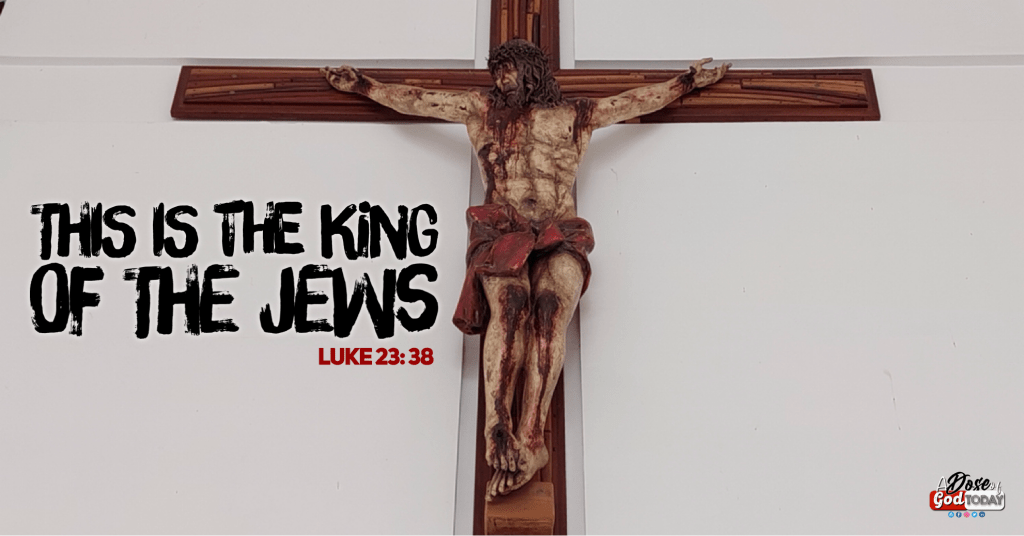
    Indeed, the kingship of Jesus is not one who stays in a comfortable throne and pampered situation, but in a humiliating and humbling position, there on the cross. Yes, the Gospel speaks nothing of a king who is intoxicated with comfort and riches. What we have is a powerless king, crucified on the cross. This is Jesus’ statement that he is not an earthly king who only shows grandeur, control and domination over his subjects. He is a king who became like us, who lived with us and journeyed with us in every story of our life especially in those difficult and dark moments of our life. He is a king who knows your pain, who understands your struggle and who desires you and me, no matter what.

    He is not an unreachable king sitting there on the high golden throne but he is a God-with-us (Emmanuel). He is a king who knows us and our deepest secrets and desires. But he is a king who does not control and impose himself on us. He only calls and invites us to come to him. “Come to me and be embraced by my friendship,” this is the invitation of our King to us.

    This is the very reason why Jesus’ determination to call us and to gather us brought him into that difficult situation. Despite the danger and the suffering he would endure as king, he is always ready to take the risk to offer his life for our sake, that we may have freedom and healing. We find now his invitations for us through the three different people in the Gospel and their individual response to Jesus. So, let us look at them once more and discover how we are all called today, young and old alike.

    The first was the group of people such as the Jewish authorities and soldiers. These people refused to recognize Jesus as King and Messiah because he was a threat to them, a threat to their comfort, a threat to their influence and threat to their earthly power. Their hostile rejection of Jesus was a decision they made despite the invitations of Jesus for them to believe in Him. Jesus did not condemn them, he even asked forgiveness on their behalf. God’s offer of salvation and life is for all. Yet, our rejection of God’s friendship is our self-condemnation.

    The second was one of the criminals who insulted and reviled Jesus. He was actually confused and did not make any stand. He was lukewarm. He neither condemned Jesus nor accepted him as Lord, King and Redeemer. Despite the closeness of God in him on the cross, he did not recognize God in Jesus because he was still full of himself. He was unrepentant. Indeed, the Lord never imposes himself on us, but he waits for us.

    The third was the other man on the cross. He was the one who recognized God in Jesus and decided to accept Jesus as his Lord. This made him say, “Jesus, remember me when you come into your kingdom.” Being powerless on that cross, he was able to recognize the face of the Lord, his king. This person felt a God who accompanied him in his suffering and even towards death. Through his very suffering, he found God to be so close to him. In his shame and guilt, he found God at his side forgiving him. Jesus indeed, is the image of the invisible God, as Paul told us in his letter to the Colossians.

    This tells us now of a king who is close to us. Jesus is not a king who is distant from our sufferings and fears but a king who patiently and lovingly walks with us. God, indeed, meets us where we are and he is ready to be at our side in order to encounter us in the saddest and darkest part of our life.

    Yet, let us also remember that Jesus requires our participation, our response. To every person that Jesus met, he gave them the chance to recognize him but the hardness of their hearts and because of their arrogance, they refused to see Jesus. But with this other man on the cross, in recognizing his sins and failures in life, that brought him into that realization that he was in need of God. This means that when we humbly recognize our weaknesses and sins we also recognize God’s love for us. This becomes, then, an opportunity for God to transform our life. And so let that redeeming love, that un-imposing and self-sacrificing love of our King who hangs upon the cross to embrace us, to renew us and to empower us as young people and as God’s people. Kabay pa.

  • Our Witnessing of HIM

    Our Witnessing of HIM

    November 20, 2022 – Solemnity of our Lord Jesus Christ, King of the Universe

    Click here for the readings (https://bible.usccb.org/bible/readings/112022.cfm)

    Usually during Eucharist, after the homily, we stand up and renew our faith by saying the words: “I believe in God, the Father Almighty..” These words are the very foundation of our Christian faith and of our Eucharistic celebration. By professing our Christian faith, we renew our Christian commitment and we articulate our witnessing to God’s salvation through our Lord Jesus Christ.

    There are moments, however that we express our faith without any serious intentions and commitments. There are moments that some would even say these words halfheartedly and without sense & spirit at all. Like a memorized formula, saying those words without meaning it. Worse, others cannot even memorize those words. I remember once, during Baptism and Easter Vigil Mass, where we usually renew our faith, when the priest: “Do you believe in God the Father?”, rarely you would hear a loud response: “I do believe”. Others would not even respond at all, as though they don’t care if we and they believe at all.   

    Today, we celebrate the solemnity of Christ the King. We honor the kingship of Jesus Christ in our lives today. However, we hear from our gospel today that Jesus, our King is not only a crucified king but also a king who is rejected, insulted, dishonored, and humiliated by the people. We cannot deny in our gospel today that Jesus Christ is a harassed, rejected, disgraced, maltreated, and persecuted King. Indeed, they proclaimed Jesus as King, but a Redeemer king who cannot even redeem and save himself – a king without a throne, and worse crucified on a cross. 

    We do need to seriously reflect our gospel today, for it challenges us to deeply understand our faith not only on his Kingship but most of all our faith in Jesus himself. We might ask ourselves: “Do we really acknowledge and believe Jesus as Christ the king?” or “Are we like, Pontius Pilate who admits or not, because others say so?” “Before me, who is Jesus? Who do I say Jesus is?”. Or perhaps ask ourselves: “who and what do I believe and worship? Is it God whom we believe and worship? Or we rather believe and worship our life, work, honor, wealth, and others than God himself?”

    This is a concrete call for us Christians to look deeply into our own personal commitment to what and who we really believe in. We honor Jesus today, our Christ and our King whom people have persecuted, humiliated, maltreated and rejected. “Would you still consider him as your King? Would you recognize and bear witness to Him as your king? Or would you reject, dishonor, and persecute him again like what others did and are doing today?”

    God’s kingdom then does not rest only the kingship of Christ but on our authentic witnessing and commitment of our faith in Jesus Christ. As His Witnesses now, we consider Jesus as our King, not only because of what he has done but most of all on His own commitment towards the Father and for the salvation of all. God’s kingdom and the kingship of Jesus Christ do not only mean name, power, and prestige of Jesus but moreso our heartfelt and wholehearted profession, proclamation, witnessing and commitment to God’s salvation through our faith in Jesus Christ. The kingdom of God then requires our total and authentic commitment to Christ, as Christ commits himself to us & our Father.

    Again, here in our celebration today, we Christians are called to proclaim and witness our faith in Jesus Christ. As Jesus bears witness to his great love to the Father, we are also invited to the same total and wholehearted dedication and faith in Jesus. Brothers and sisters, as Christians, we should not be ashamed to express and proclaim our faith to ourselves, to each others and to others. As Filipino Catholics, we look also forward now to the next 500 years of our Christian faith & witnessing here & abroad.

    As we end and about to begin a new liturgical year, let our eucharist today be  another beginning to renew our faith, that is to make our faith better than ever.  Amen.

  • THE END OF TIME IS A JOYFUL ONE

    THE END OF TIME IS A JOYFUL ONE

    November 13, 2022 – 33rd Sunday in Ordinary Time

    Click here for the readings (https://bible.usccb.org/bible/readings/111322.cfm)

    How would the end of time look like? What would happen to us and to the world? When the pandemic struck us in 2020, I have friends who really asked if that was the beginning of the end of time. Even in social media sites and radio stations, there were people who entertain such thought because of the massive anxiety it caused us and the millions of the lives lost in this pandemic growing daily. Indeed, it was terrifying and horrifying seeing dead bodies of covid patients wrapped and buried in mass graves in many countries, even here. Hence, many of us would perhaps express fear of the end of time and imagine the destruction of the world, that there will be calamities and unimaginable tragedies, that there will be great suffering, pain and death.

    Our readings this Sunday seemed to have the same horrifying images also. The first reading from the Book of Prophet Malachi prophesied about the destruction of the evildoers. In the Gospel of Luke, Jesus described the signs that will come like the powerful earthquakes, famines, plagues, wars, and persecutions.

    However, does the end of time really mean to be terrifying and horrifying for us? To answer this question let us see closely the prophesy of Prophet Malachi and the words of Jesus in the Gospel of Luke so that we too will be able to discover God’s invitation for us on this Sunday.

    The prophecy from the Book of Prophet Malachi was addressed to all the Israelites who have returned from exile. However, at their return the prophet saw how the leaders of the Jewish community had become corrupt, abusive and indifferent to the common people.

    Those words of destruction and death are meant for those who continually reject God and oppressed His people. Yet, the prophecy is also a hopeful promise to end the evil institution and the end of corruption and death. And for those who remained faithful and in friendship with God, the words of Malachi meant comfort and strength, for to them, the Lord will come to bring healing. And this will be the most wonderful and joyful time.

    In the Gospel of Luke, Jesus warns us of those who acted like a “god” and not to follow them because they only lead us to death and not to life. Jesus also reminds us of the sufferings in life that may come but he comforts us not to be terrified and not to be afraid. Jesus promises us with his presence abiding in us. He will never leave us alone. Jesus will walk with us and accompany us.

    Moreover, at the fulfillment of time, Jesus will be with us in person with his power and glory. And when he comes, Jesus will gather His people who believed in him and trusted him even in difficult times. His coming will be the end of the corrupt and the murderers. It will be a destruction of the powerful and arrogant, the ruthless and the violent.

    Now, the beautiful message lies here.  The message of comfort and strength, of joy and peace is for us who are waiting patiently for the end of time. This is what St. Paul tells us for us who believe in Jesus that the end of time is not something that we should be afraid. It is not a terrifying event but it will be the most joyful moment of our life. Meeting the Lord is a moment of fulfillment of all our hopes, prayers, desires and dreams.

    However, it will surely be a destruction to what is evil. It will be the most terrifying moment for those who continually reject God and for those who pretend and act like a god.

    With all of these, what can we do then, as we patiently wait for the second coming of Jesus? God in His generosity and love prepares us daily for that wonderful moment of our life. God prepares us by making Himself felt daily and in every moment and event in our life. Jesus reveals himself in us and through us. Indeed, Jesus’ words will not pass away, his promises will never fade. God is faithful and He is ever present with us. That is why, it is very important that we become discerning and welcoming of Jesus’ presence being revealed in us and around us.

     How do we do it then? Our prayers as constant communication with God, both individually and as a community, will help us to make ourselves open to God. When we pray, we allow God to transform us and transform the way we look at things, the way we judge things and people and our way of relating with others. Thus, the effect of constant talking and listening to God forms us to be more aware of His presence in our life. Prayer is here not about murmuring our memorized prayers and novenas but being able to talk to God, listen to him by being able to reflect and contemplate God’s voice and actions in our life.

     This calls us to recognize God in everyone and in everything. What would be its consequence now? When we grow tired from praying because our dreams and desires were not granted, remember that God never grows tired in making Himself known to us. God also reveals himself in moments of failures and defeats. When we become confused and doubtful of our faith, remember that God never surrenders on us. God makes himself known even in moments of our pain and suffering. When we feel that we are surrounded by evil, corruption and deaths, remember that God brings justice and makes himself bright even in the darkest part of our lives as Christians and members of our community.

     As we are about to end the liturgical calendar and begin the Season of Advent in few weeks’ time, let us make this week more wonderful and exciting. Let us intensify our “Wi-Fi connection” with God, by making our prayer frequent and sincere. Hopefully, this will lead each of us to see and feel the face of God among ourselves and even among those people who are not familiar to us and events that may be surprising and strange for us. In this way, we hope that we too will grow in our faith and become more excited in the end of time where we will certainly meet the Lord, who is the fulfillment of all our dreams and hopes. Kabay pa.