
Tag: Sunday

  • Of Being Social-Distanced

    Of Being Social-Distanced

    June 28, 2020 – 13th Sunday in Ordinary Time

    Click here for the readings (http://www.usccb.org/bible/readings/062820.cfm)

    Homily

    Not until the first quarter of this year that we come to experience and be familiar with the term: “social distancing”. To protect ourselves from Corona Virus infection, nowadays we normally resort to social distancing. To avoid being infected by others or possibly infect others as well, we now set apart and maintain a safe distance from others as we assume that the world around us is getting sick, and we can easily get sick.

    Safe and practical it is and would be, social distancing is never been that easy as observed and practiced. Simply because social distancing is particularly painful to us  for it requires of us not only the physical bodily distance but also the  experience of being and feeling isolated, lonely and cast-out/cast-off from one another. Being physically quarantined, isolated, set apart, distanced, marginalized, suspected, and monitored could make us also personally feel marginalized, segregated, ostracized, stigmatized, outcasted, feared, unwelcome, abandoned, lost and forgotten. With or without viral pandemic, physical and social distancing has always been painful and difficult (even traumatic) experience for all of us for it deprives us of our need for personal intimacy, closeness and relationships. In other words, social distancing hurts because it is not only physical but also personal.

    It is but natural and life-giving for us to connect, relate and interact as persons. More just being social animals, social inter-actions and interpersonal relationships are very important dimension of our lives. And a song would insist, “No man is an island.. No one stands alone.” We are not just being with others but we are human PERSONS with others. We grow, live and thrive in life as community of persons: Persons related and relating with others personally. That is why to live life alone, distance, and isolated is difficult, painful and discouraging indeed.

    Our readings today reminds of the great value of our interpersonal relationships both in life and faith. Jesus in our gospel today appeals for us to “receive me”, “love me”, “follow me”. He invites us to have a personal intimate relationship with Him. Like any of us, he wants us to be close to Him as much as He wants to be close with us personally.

    Being Christian, as Paul emphasized, we are WITH Christ: personally related with Jesus in death, life and resurrection. And like in the first reading, to be personally welcoming  and hospitable host to our guests would blessed and graced us with the gifts of their person, to receive and love the person Jesus in our lives personally is to personally be with and share with His divine life with our Father.

    Personal intimacy, closeness and connected with Jesus and with one another as community is indeed promising and life-giving. While social distancing and isolation is sickening and life-threatening indeed.

    While we suffer physically and personally with social distancing  for safety and protection from infection nowadays, we may take this trying times as opportunity for us to review, reflect and renew the quality of our personal relationships with God, with our family and friends and our community. Just because we are physically constrained and apart, it does not mean we are not and cannot anymore be connected with one another personally. Distancing thus could also be a chance to improve the quality of our faith, personal life and inter-personal relationships.

    For instance, social distancing may have deprived of us to celebrate Sunday Eucharist and worship as community of faith, but it could also make us improve the quality of our Spiritual Communion with Jesus and our participation as we hope and look forward to the coming opportune time for celebration. We also may find more quantity and quality time and improved lifestyle with our own selves and with our loved ones now, and thus be in touch with most essential and important in ones life.

    In other words, since social distancing is personal, so let us make it more personal, let us get more and Better Personal…. And improve the Quality of our personal, social and spiritual life during this time.

    On my fifty-ish age and nearing my silver years as Redemptorist missionary priest, perhaps my five-year old musings below could be of assistance in reflecting about our experience of social distancing nowadays:

    “Paradox of being with others”

    Along the way, we suffer two things being with others: too much & too little – of closeness and distance. Too much and too little Closeness & too much and too little Distance. Coping with these both blocks our growth in relationships as well as forms and sharpens us to be better person for and with others. Ultimately it moves us to be intimately independent as well as independently intimate with one another.

    As we are personally in faith with the Lord, may we communally not be separated from Him and one another,  and  may we not lose life but rather find Life meaningfully. Amen.

    (By: Fr. Aphelie Mario Masangcay CSsR, a Filipino Redemptorist  Missionary stationed in Gwangju South Korea, though now still stranded in Cebu until further notice for available flights.)
  • “What are your plans? What’s next?”

    “What are your plans? What’s next?”

    June 21, 2020 – 12th Sunday in Ordinary Time

    Click here for the readings (http://www.usccb.org/bible/readings/062120.cfm)

    “What are your plans? What’s next?”

    Perhaps nowadays we find ourselves confronted quite frequently with these questions about our near future, as raised to us by others and/or even we ask personally ourselves. However, unlike before when it was easy to see opportunities ahead, today’s quarantined and lockdown world during pandemic times renders our foreseeable future bleak and unpredictable. Wherever, whatever, whenever and however we find ourselves now, to plan ahead for what we want to happen next is quite difficult and challenging. This is not only because possible opportunities for our future can be impossible to discern and predict, but also the normal lives we used to live with have to adjust and adapt to the new and unfamiliar realities of the pandemic world and times we now live in. Whether we like it or not, our life is changing. Our world is changing, We are changing. Challenging it is to deal with and manage our present realities, how much more difficult than it is to foresee and make  plans for the near future.

    And it is and would be difficult and challenging for everybody. Making plans would surely be difficult for people who know what they want, for they also see how limited and constricted they can now be, considering available resources, mobility, programs, systems and schedules. It would also be much challenging for people who does not know readily what they want because they have to tend first to the immediate needs of others. We think here of people who are in helping professions, those who are in the frontlines of public services, medical-mental-spiritual health, education, and above all our parents who have to postpone, numb and even forego their own personal plans just to accommodate and address other people’s needs while also worrying about available resources and possibilities. We could understand then that raising the question now about future plans can be difficult and challenging, if not, already distressing and depressing. How game-changing indeed our world  now we live in.

    Somehow however, we may also wander what would Jesus say about our plans. What would Jesus say about our difficult and challenging realities now and ahead?

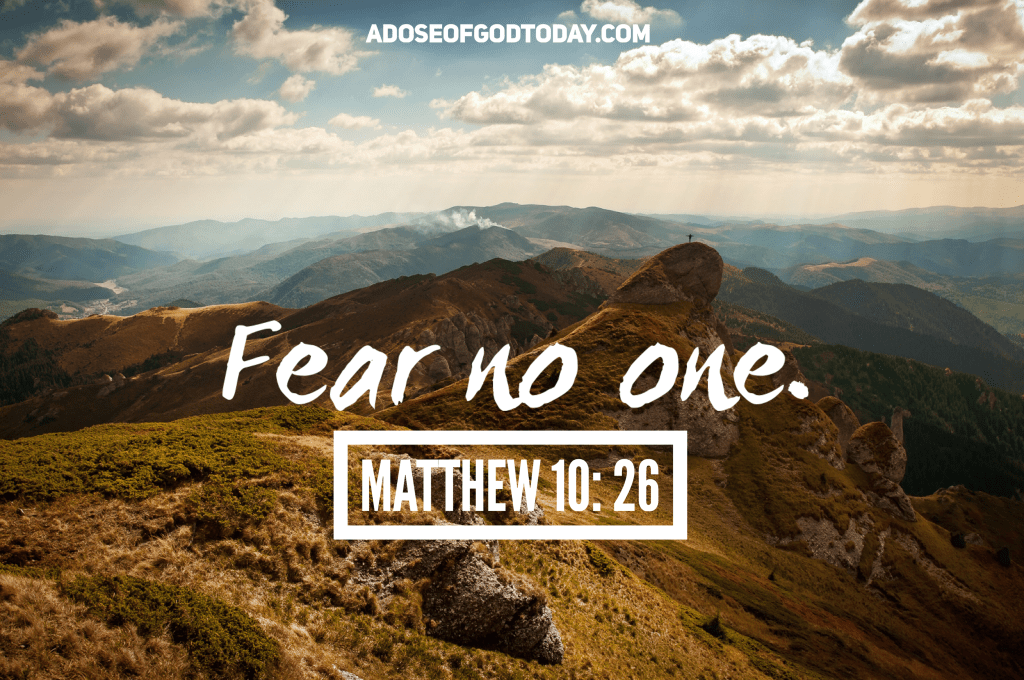
    Like a teacher giving pointers to students before an exam or a coach giving advices to players during the game, we hear Jesus in our gospel today telling His disciples and us now words like: “Fear no one… do not be afraid… worry not… you are worthy… acknowledge me… have faith.” As we struggle with our present life and worry about our future, Jesus is saying us here words of assurance, encouragement, affirmation, faith and confidence on us, as His on-going guidance and directives for us. Moreover, Jeremiah & our Psalm today also reminded us how God protects and answers those who remain faithful and loyal to Him in the midst of life-adversities, same way as Paul wants us to recognize the promise of God’s grace and Christ’s gift that “overflow for the many”. What is very important here is that God has a plan in Jesus; and we are to acknowledge, believe and trust in it. Somehow in our game of life – stable or changing it might be, we need to believe and trust that “God got our backs for He has a plan for us”.

    Advertisements

    It is once said: “When we get what we want, that is God’s Direction. When we don’t get what we want, that is God’s Protection.” True indeed, when our wants and plans are in sync with God’s plan, we are being directed on the right track.  But when our plans and wants are not in sync with God’s plan, we are being protected for we are off the tracks. This is not about us  surrendering to fate or have an irresponsible “do or die, que sera sera” attitude towards life, but is all about doing our part, involving with and being responsible not only for our own actions and plans but moreso, in God’s grand plans and ways of being in life. Not getting what we want while also not knowing and unsure of what our next plans then is perhaps God’s way of protecting us from possible failure and death, and His constant invitation to believe in Him and trust in His plans for us.

    So, what’s the next plan?

    Since God got and has a plan for us in Christ, we abide and trust in His plans, His directions, and His protection…. That’s the Plan. In other words, Be part of God’s plan.

    And may this be our prayer to Him: “As we abide in Your plans during these trying times, Thanks you, Lord for protecting us from what we thought we wanted, and for blessing us with what we don’t know we needed.” Siya nawa. Hinaut pa unta. Kabay pa. Amen.

    (By: Fr. Aphelie Mario Masangcay CSsR, a Filipino Redemptorist  Missionary stationed in Gwangju South Korea, though now still stranded in Cebu until further notice for available flights.)

  • Relationship Status Update…

    Relationship Status Update…

    Advertisements

    June 7, 2020 – Solemnity of the Most Holy Trinity

    Click here for the readings (http://www.usccb.org/bible/readings/060720.cfm)

    What is your relationship status? The state of your relationships – your being with others? 

    Social media netizens nowadays have the option to post in public their own relationship status in their profile. This is more than just about their usual civil status of being single, married or separated, but more so about the description of the present state and quality of their relationship with an-other special person: be it in-love, complicated, available, committed and others. (perhaps same way as MU: mutual understanding and SS/DU: Sikit-Sikit/Dili Uyab, as we used to describe before).

    As others may concern about their relationship status, we might as well consider our relationship status at the time of social distancing in today’s pandemic world. Quarantine and social distancing have rendered us nowadays isolated and distance from others and with one another. And surely this has affected the quality of our relationships with others: be it too/less close or far; too/less deep or hollow, too/less presence or absence. Social distancing during pandemic has deeply and uniquely affected our social relationships. While it may have shaken and threatened our family, community and love life to possible break-up, dryness and dying, we could not deny also that our distance from and/or being “stuck” at-home with them may have also re-ignited, rekindled, renewed, and deepen our relationships with another. So also as we consider our relationship status during these times, healthy for us to consider our faith status – our relationship with our God: on how social distancing have affected the state and quality of our relationship with God.

    Today, first Sunday after Easter Season, is Solemnity of Most Holy Trinity or simply called Trinity Sunday. More than just a reminder of our Christian faith in the Triune (the three in one) nature of our God, our celebration today invites us to reconsider our relationship status with God. 

    In our gospel, (as the key text and core message of St. John’s gospel), Jesus gives us the description of the status and quality of God’s  relationship status with us. God is so in-love with us that He gives us His Son to believe and follow, for us not to be condemned in life but to have eternal life with Him. With these words, we can highlight here two points to describe the quality of God’s relationship status with us: God is in covenant with us and God is in collaboration with us

    The word covenant roughly  means “coming together”. To describe God’s relationship status with us as “in-covenant” would mean that God “comes together” with us – God is one, in community, in loving marital relationship with us, because He is so in love with us. Moreover, the word collaboration would also roughly mean “working together”.

    To describe then His relationship with us as “in-collaboration” would mean that God “works together” with us – God is in sync, tandem, partnership with us  by offering us to adopt and be co-responsible for His Son in our life and faith. By His Love for us, God is in relationship with us, and by giving us His Son, God is responsible for us and with us. This is how blessed we are and should be, for God is in covenant relationship and in collaborative commitment with us. 

    Now, what is and should be our relationship status with God? 

    Moses wished that though we may stiff-necked and wicked, God may “come along in our company” and “receive us as (His) own”. Paul prays that “the grace of the Lord Jesus Christ, and the love of God, and the fellowship of the Holy Spirit, BE with all of Us.” It is thus the hope and prayer of the forefathers of our faith, and still now, that we also may be “in covenant” and “in collaboration” with God – that our faith, our relationship status with God is in sync also with God’s status with us – however righteous, limited or stubborn we might be.

    Advertisements

    A wise man once said, “Each one of us are but angels with one wing. We can only fly by embracing one another.” True enough, this saying not only affirms our limited human nature of being one-winged, but more so highlights our spiritual nature of being angels. Our present life then is and should be in relation, in sync & in tandem with God and one another, so that we can sore and rise above to the occasion of living our lives to its fullness as we journey back to our heavenly home, and share in God’s offer of eternal life with Christ. 

    Ironically to protect and keep us safe, our pandemic world rendered us now limited, restricted, set apart and distanced from one another. However, our natural longing to be social – to be one and together with one another and God offers us breath, life, hope and support in the during these trying and difficult times. And putting value anew, upgrading and working out to improve the quality of our relationships status (our being with God and others) could somehow alleviate and bring more purpose and meaning to our present predicament.Though limited angels with one wing may be and due to pandemic realities now set apart from one another, may we always keep the faith, and come and work in one – together with our Triune God, as He is forever in covenant and collaboration with us. Amen. 

    (By: Fr. Aphelie Mario Masangcay CSsR, a Filipino Redemptorist  Missionary stationed in Gwangju South Korea, though now still stranded in Cebu until further notice for available flights.)
  • Absence makes the heart grows fonder

    Absence makes the heart grows fonder

    Advertisements

    May 24, 2020 – Solemnity of the Ascension of the Lord

    Click here for the readings (http://cms.usccb.org/bible/readings/052420-ascension.cfm)

    As the world we lived in these days is getting limited, sick and quarantined, we should not forget that what we are going through now is but particularly a constant daily struggle of migrants living and working abroad even before our COVID19 pandemic world today.

    For migrants living and working abroad away from our families and loved ones, separation, distancing, isolation and above all homesickness have been a usual constant struggle in their day to day lives. With or without COVID19 pandemic, migrant or resident we might be, nevertheless our experiences of distancing and homesickness (of not being at home, or of being away from home) are indeed never been easy to deal and content with in our journey through life. 

    Difficult as it may be,  but we also know that our day to day wrestling with separation and distancing could also provide us opportunities for growth in meaning and values in life. Because during these life-moments, we can and may become more in touch and conscious of who are most important people in our own life, and what, why and how are they valuable in one’s life.

    Separation and homesickness could be a chance for us to discover, claim and commit once again to what is important and essential in our own lives.

    Since, like “one cannot see the forest for the trees” at times, we need to detach, separate and be distant  (even worse, be deprived or quarantined) from our attachments in order to see and discover once again for ourselves the values, principles and meanings that are most dear to us now and in effect inspire us to move on forward with life. In other words, separation and homesickness can move us to be more appreciative, responsible and hopeful in life. Thus, “Absence makes the heart grows fonder”. Ang mawalay nakakabusog rin ng puso. Ang mahibulag makatambok pud sa kasingkasing. This can be the UPSIDE of life-separation and homesickness. 

    However, the DOWNSIDE of separation and homesickness is “Out of sight, out of mind”. Ang mawalay nakakawala ng landas at nakakasira ng ulo rin. Ang mahibulag makasaag ug makabuang pud. If you don’t see, you don’t mind, and you even don’t care. Separation and homesickness can also render us lost, directionless, meaningless and hopeless in life. 

    What is crucial then in our experience of isolation, distancing and homesickness is the once-again longing search, giving importance and making a promise again & anew to our values and missions in life.

    Today, we celebrate the 2nd Glorious Mystery, the Ascension of the Lord. Tradition has it that forty days after His appearances before his disciples, the Lord has ascended back to Our Father, leaving behind and separated away from us His disciples. This reminds us that the mystery of God’s glory is made known to us through Jesus’ departure from our lives.  This would mean then that in our life and faith, our  homesickness and separation share a part in the story of our normal life and salvation as well. Like the experience of the two disciples in Emmaus where the Lord appeared to them and then disappeared when they recognized Him, salvation also requires the Lord’s resurrection and departure (His coming and going into our own lives).

    Part and parcel of our faith and life story is the paradox of homecoming and separation, of the hellos and goodbyes. And during moments of departure and distance, separation and homesickness – though with a downside of pain, anguish, and lost, there could also be the upside and opportunity to discover and claim once again what is important and valuable in our life as well as what is our mission in life now, that is, our life-values and life-missions.

    Our readings remind us that in the Lord’s ascension, the Lord empowered and gave his disciples the task and mission to be His witnesses in the world, saying “Go, therefore, and make disciples of all nations, baptizing and teaching them” with the assurance “I am with you always forever.

    This explains why the Lord’s ascension is more than just about the Lord’s departure, separation and disappearances but more so about ourselves Christians, once again and anew finding, claiming, committing and fulfilling our life-missions. In a way, the Lord’s Ascension is the day when the Jesus started to WORK FROM HOME… so also that we could do and fulfill, here and now OUR Work, Mission and responsibility in this life.

    Advertisements

    The Lord’s Ascension teaches us also a lot about Jesus Christ himself and us, being Christian. Like our risen Lord himself, we Christian, as Easter followers of the risen Lord, are both Migrant and Missionary in our faith and life.  As migrant, we are now IN this life but we are not OF this life for we are OF God’s home and life.

    Ours now is not our Home, we are just  but transient passersby – coming and going, on our way back to our Home with our Father. However, while still here, as missionary, we are on-mission. We have a special task to fulfill in life here and now. And through the Lord’s seeming departure and absence, and perhaps through periodic sickness and pandemic, at times we need to be detached, isolated, distanced, homesicked, and even deprived and quarantined in order to be reminded of our true identity and mission in this life now, and to more directed and committing in fulfilling our life-missions in our daily lives.

    Like the two disciples of Emmaus, we pray then that may our difficult experiences of distancing, detachment and deprivation in life now, and the usual Lord’s disappearance, distance and seeming absence from us, move and inspire us to recognize and go on discovering and upholding our values, principles, and meanings in life, as well as fondly reclaim and actively fulfill our hopes and missions in life, and above be assured that whatever happens, He will be with us always and evermore until the end of ages. Amen.  

    (By: Fr. Aphelie Mario Masangcay CSsR, a Filipino Redemptorist  Missionary stationed in Gwangju South Korea, though now still stranded in Cebu until further notice for available flights.)

    Join 2,860 other subscribers
  • Life amidst and after COVID-19

    Life amidst and after COVID-19

    Advertisements

    May 17, 2020 – Sixth Sunday of Easter

    Click here for the readings (http://www.usccb.org/bible/readings/051720.cfm

    Life under quarantine is without a doubt, difficult. For almost a quarter of the year 2020 now, we find our world on lockdown amid pandemic realities. Definitely these are trying and uncertain times for all of us, humanity as the world we live in is now sick and under serious threat. We find ourselves now limited and deprived – reduced to mere essentials. As we adapt to the challenges of our today’s changing world, we cannot help but be somehow resigned to the possibility that “our life ahead will never be the same again”. And as we also discern with the “new” normal with its required distancing, limited mobility and isolation that would greatly affect our social relations and dealings, we also grapple with basic question: “Is and will there be Life amidst and after COVID-19 2020?”

    Recently a Youtube video-clip called “The Great Realisation” by Probably Tomfoolery about Life in 2020 Pandemic world have circulated around and caught the attention of the social media. Here in a poetic bedtime story manner, and at the hindsight, the father tells the story and describes to his son the causes and effects of COVID-19 virus to humanity. While it projects and promises a much better humane and personal relationships among peoples in our tomorrow’s world,  particularly the following conversion in the video is worth pondering…

    Son: But why did it take a virus to bring the people back together?

    Dad: Sometimes you got to get sick, my boy, before you start feeling better.

    Sometimes you got to get sick, my boy, before you start feeling better.

    Such a profound wisdom. Definitely in changing world during these trying times, our life will never be the same again, …. but our life will be much better and anew than before. And part and parcel of this change for the better life is the virus and sickness that we have to go through and overcome in preparation for our better life-ahead.

    As St. Peter suggests, “better suffer doing good than doing evil”, the bitter herb/taste of medicine, painful injections, the life-threatening surgery, the chemotherapy treatment, dialysis or regiment of blood transfusion – the whole sickness we go through is part of the whole healing process towards our well-being, and better lifestyle.    This is paradox of our life: Our present trials, sufferings, difficulties and uncertainties in life do prepare and brings out the best and  better version in us. In other words, “Sometimes we got to get sick to start to get better.”

    In preparing them for the suffering ahead, Jesus in our gospel challenges his disciples to keep His commandment, which is to love one another as He has loved them. Here Jesus did not only warn his disciples of the coming difficulties His persecution, suffering and death will cause them, but also prepares them the implications and responsibilities of His coming resurrection. And for Jesus, His commandment of “Loving one another” is the key essential attitude and necessary behavior for His disciples, and us now to surpass the difficulties and challenges of His cross and resurrection into our constantly changing  lives.  

    Our love and loving, however, must be “as I have loved you”, which is thus to be done in the same way and as patterned in Jesus’ way of loving us. Unlike our way of loving, Jesus’ way of love also somehow involves patience, distancing and separation, which is usually painful for us. Though His love is personal, intimate and constant, His love is not exclusively for you but to all,  not clingy – too attached “Touch me not” and even provides space and time as we experience it in His seeming absence, separation and distance, as well as in His unpredictable timing. While His love offers us the mystery of  Joy, Light and Glory in life, His love also requires the painful and suffering mystery of our sorrows in loving others. 

    Jesus’ commandment of “Loving one another as He has loved us” would also mean the paradox of resurrection through our cross – meaning “the way to our salvation is the way of the cross”.  Resurrection to new life happens then through the sorrowful mystery of our cross in loving others. In the same manner, reflected here is the life-paradox of sickness before getting better, of pain and suffering towards healing, of rising to the occasion despite difficulties and uncertainties in life. 

    Now as to our musings: “Is there Life during Covid-19? Will there be Life after Covid-19?”

    For those who have faith and trust in Jesus and in God, and who is keeping the Lord’s commandment of “loving others as He has loved us”, along with our faith-life struggle with His cross and resurrection in life, getting better and rising to the occasion of our best and better version of our world despite difficulties and uncertainties, there is and will be life during and after COVID19 2020. However, our life will never be the same again, for without a doubt, our Life then is and will be anew and better than  before. 

    May our love  for one another now, promising though painful it can be, cooperate with the Lord’s healing ways of creating and building our better world in  our life ahead. Amen. 

    (By: Fr. Aphelie Mario Masangcay CSsR, a Filipino Redemptorist  Missionary stationed in Gwangju South Korea, though now still stranded in Cebu until further notice for available flights.)

    Join 2,860 other subscribers