Tag: St. Peter

  • The Cathedra: A Symbol of Service and Self-Giving

    The Cathedra: A Symbol of Service and Self-Giving

    February 22, 2025 – Feast of the Chair of St. Peter, Apostle

    Click here for the readings (https://bible.usccb.org/bible/readings/022225.cfm)

    Today we celebrate the Feast of the Chair of St. Peter. Yes, what is being revered is the “chair” or the cathedra of our first Pope. This feast reminds us of the importance of our unity with the Bishop of Rome, now under the leadership of His Holiness, Pope Francis.


    As Catholics, let us pray for our Pope, to always remember him in our prayer. When he was elected as Pope, the first thing he asked to the people was to pray for him. Let us continue that for he indeed needs our constant prayer so that Christ may always give him the strength and that the Holy Spirit may guide him and bless him with wisdom.


    These past few days, Pope Francis has been in difficult times due to his illness. Countless Catholics are praying, and we join this multitude of people, praying for the healing and recovery of Pope Francis. Yet, even in this struggle, the Pope remains a beacon of hope for us. He constantly reminds and shows us that “faith is not about fear but love; that leadership is not about power but service.”[1]


    Being true to the mission given to Peter, Pope Francis continues what has been entrusted to the “cathedra of the Pope,” that it is of service and self-giving.


    As members of the One, Holy, Catholic and Apostolic Church, let us also support the Pope’s initiatives and his pronouncements in building closer relationships with all our brothers and sisters across the globe that is in showing mercy and compassion. This is very evident in the ministry of Pope Francis and how he expressed his closeness with all the suffering.

    Moreover, for us individually, the story of Simon’s confession to Jesus posts a call and a reminder to us. Let us closely look a bit into the attitude of Simon Peter and his relationship with Jesus.


    Simon was quite hesitant, doubtful and sometimes inconsistent. In the scriptures we find him having doubts as he was invited by Jesus to walk on water. He was also called by Jesus to get behind him because he refused to believe that Jesus should undergo suffering. He ran and hid himself when Jesus was arrested and even denied him three times when he was questioned by the people.


    However, what was redeeming for Simon was his “openness” to the invitations of God to him. This explains to us why he immediately followed the Lord when his brother Andrew brought him to Jesus. This openness of Simon allowed him to intimately recognize and know Jesus in the most profound way. That is why, when Jesus asked his disciples about their perception of him, it was Simon who was so bold in professing that Jesus is the “Christ, the Son of the Living God.”


    Simon did not depend on others perception of Jesus who might have thought that Jesus was merely a teacher or some sort of magician. Simon had a personal encounter with Jesus and recognized the Lord.

    Though Simon was an imperfect disciple but God revealed himself to him because Simon was open to God. And thus, Jesus called him to follow and to serve him in the best way he could serve God. This attitude of Simon earned him to be named by Jesus as Kephas or the Rock, a responsibility given to him by the Lord to lead the Church.


    This is the message for us now. God knows that each of us is not perfect, yet, our God calls each of us to accept certain tasks in our community. We don’t have to be perfect to be a youth minister, an animator or coordinator, or lector, server, or religious or priest etc. Remember, God never called perfect people. God choose the wounded, the broken, the weak, the fearful and doubtful, the imperfect ones to become His friends and fellow workers.

     Like Peter, God sustains us, he strengthens us and transforms us into mature, faithful and joyful persons if we are also open to God’s call and invitations. We may learn how to open ourselves to God and to be more accepting of his invitations to each of us. Jesus assures us that when we put our trust and faith in him, he will never leave us and will always be with us. That is his promise. Hinaut pa.


    [1] Niere, Harvey Malmis, (https://www.facebook.com/share/p/15hJv2J3VT/).

  • FINDING MEANING AND JOY

    FINDING MEANING AND JOY

    April 14, 2023 – Friday in the Octave of Easter

    Click here for the readings (https://bible.usccb.org/bible/readings/041423.cfm)

    Do you also escape when you go through difficulties? Do you also hide and retreat when you experience failures and disappointments? Do you go back to your old and unhealthy coping or attitudes when you feel sad, angry, or broken hearted? These are some of our possible reactions when we face these realities in life because we don’t know what to do and where to go. This had been the situation of the disciples. Their hearts were filled with pain, disappointment, with frustrations and doubts.

    The arrest of Jesus, his suffering and his death were so shameful and terrifying that they also hid themselves for fear of the Jews. Because of these negative experiences, they believed that they have failed the Lord, and so they themselves were failures.

    Their immediate response was to go back their old self, to retreat and not to confront anymore what they were going through. Because they believed that they were failures, they succumbed to the temptation to go back to their old ways and that was to fish. They have been called from being fishermen to become fishers of people, yet, having a painful and horrible experience, they retreated, they were giving up.

    However, all night they caught nothing. The “night” in the Gospel is very symbolic because it reveals to us that the disciples were in darkness and they couldn’t find light. They were hopeless. They wanted to give up. But, at dawn a stranger appeared on the shore and said, “cast the net over the right side of the boat and you will find something.” And they did, they trusted that stranger and to their surprise, when they pulled the net they could barely pull it back because there were plenty of fish.

    Then, the “beloved disciple” recognized that it was the Lord Jesus. Jesus is alive and there waiting on the shore. This tells us too that once we have become intimate with Jesus, our heart will always desire for Jesus.

    This inspired Peter to respond immediately and to come near to Jesus. Again, this was symbolically done. Peter let go again of his boat, that is, his old self. He jumped confidently into the sea of his past failures and frustrations because he knew that Jesus was waiting for him.

    This reminds us that we might come to the point in our life when we feel hopeless and helpless because we have failed, because the situation is just too difficult, family problems are just depressing, our poverty is overwhelming, or our relationship with others have failed – and then, our immediate reaction is to retreat, to hide in our own failures and pain, to dwell so much on our problems, to go back to our old and bad habits, becoming fearful, anxious and mediocre – which means going into the darkness of depression, of sin rather into the light of hope and life.

    Yet, Jesus calls us to we find meaning and joy even in the midst of pain, of failures and difficulties. Hence, the Risen Lord invites us today.

    First, when we meet failures and difficulties, do not go back to the old unhealthy ways and old habits, which could only be our emotional reactions. Rather, pray and ask the Spirit of the Lord to give us courage and patience to confront what we are going through.

    Second, as we face them, never think that you can do everything alone. The journey is lighter when we are with somebody whom we can trust, whom we can share our story. Find and build lasting friendship, build a deeper family relationship, invest in your relationships. When we are told to cast our net, to change the course of our boat and to change our life – go for it and trust the Lord because it might be in that direction that we will find the abundance of love and life.

    Third, be always aware of God’s presence. Just like the beloved disciple let us always be intimate with Jesus. It is when we become more familiar with Jesus that we also become aware of his presence in everyone. Hinaut pa.

  • Peter on that Good Friday

    Peter on that Good Friday

    Peter was a man who have many inconsistencies. If you remember, it was him who first realized that Jesus was the Messiah, the Son of the Living God. Because of the close friendship with Jesus, Peter knew in his heart that this man Jesus is someone bigger. Yet, it was Peter also who was scolded by Jesus and was told, “Get behind me Satan!”

    After confessing that Jesus is Lord and the Messiah, Peter also wanted to prevent Jesus from doing the will of the Father by not undergoing pain and suffering. Peter wanted Jesus to escape from pain and suffering. This was how he was named Satan at that time because Satan will always tempt us to take a short-cut, to prevent us to go through pain and suffering. Yet, at the end, Satan will only bring us to destruction and death.

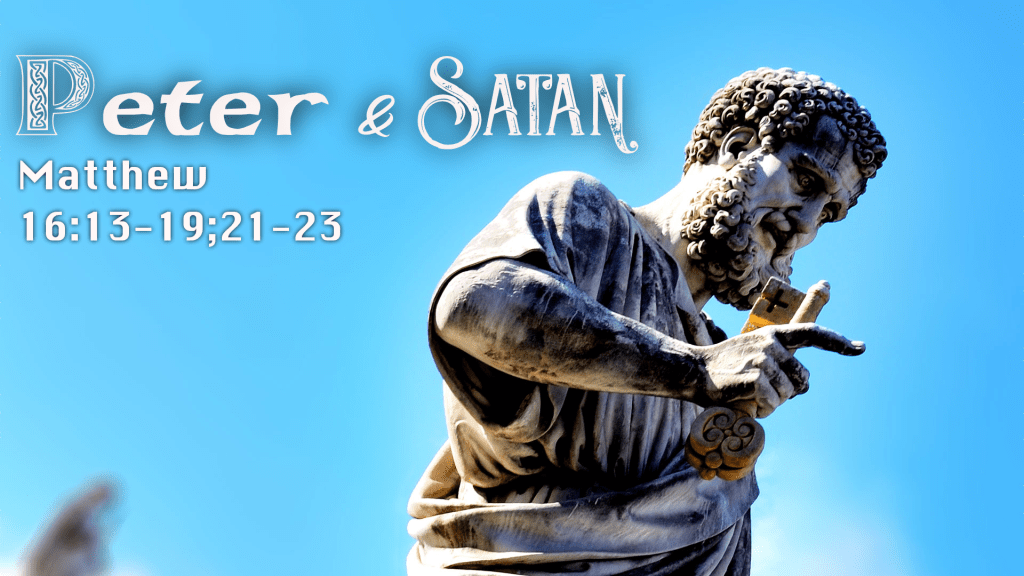
    Peter and Satan: A Reflection[1]

    With this particular attitude of Peter, let me ask these questions to you.

    Who wants a life without suffering, without sacrifices and difficulties? That would be nice, right?

    We dream of a life that knows only comfort, that is easy, and that we’ll always feel good. Today, we are actually being offered with different ways to make our life comfortable, fast, easy and smooth.

    There is actually nothing wrong of dreaming a life filled with comfort and without sacrifices and difficulties, to always feel blessed and good. This is a desire from us to feel secured. Nevertheless, the danger lies within the heart that denies sacrifice and suffering as part of our life, and as part of our Christian way of living.

    I remember a story being told to me when I was in college. There was a boy who went out into their garden and found a cocoon. It was so timely that he saw how the cocoon moved. The butterfly was about to come out from its cocoon. However, the butterfly was struggling. The boy felt pity for the butterfly. And so, the boy immediately, ran back to his room, got a pair of scissors. He wanted to help the butterfly and so, with scissors in his hand, he cut the cocoon carefully in order not to wound the butterfly. He was so successful that the butterfly was in her perfect shape and out of her cocoon.

    But then, something was wrong with the butterfly. She did not fly. Why? She couldn’t fly because her wings were too weak. When the boy cut the cocoon, the butterfly lost the opportunity to make her wings strong. She was supposed to go through in that struggle, in that difficulty of coming out from her cocoon. Because of the easy way out, her wings were not made strong to enjoy the wind as she was supposed to fly.

    You know, Jesus scolded Peter when he denied that Jesus should suffer and die. Even though, Peter confessed that Jesus is indeed the Messiah, the Christ sent by the Father, but then, Peter did not understand the commitment of being sent by the Father.

    Peter only knew of the victorious image of the Christ who will bring salvation and glory. Peter held on to his belief that in Jesus, there will be only blessings, power, and praises. This means that to follow Christ is not just about feeling good, feeling blessed, with abundance and material prosperity.

    This was the mistake of Peter. He couldn’t accept that Jesus will undergo suffering, persecution and death. He couldn’t accept of a vulnerable and weak God. This caused Peter to be scolded by Jesus and even called Satan because Peter only wanted an easy one, an easy life. Peter only considered what he wanted, not what God desired.

    This is also the consequence when we encounter Jesus. Before Peter was being rebuked by Jesus, the Lord actually asked the disciples, “Who do you say that I am?

    This question of Jesus was a question of commitment. And Peter responded this question with conviction. Peter said, “You are the Christ, the Son of the Living God.” Like Peter, if we confess that Jesus is the Christ, our Lord and Savior, then, this confession implies commitment and risk.

    After all, when we commit ourselves to somebody we love, risks and sacrifices are implied. We are reminded neither to fear nor deny the reality of making a sacrifice, of experiencing pain and difficulty in our life. Life is found when we go through the process of struggling. Never cut the cocoon or else there will be no life. When we experience pain, struggles, and difficulties never lose those opportunities because those are ways where we too shall find life, meaning and purpose.

    When we are called to make a sacrifice for others, never fear, because life is brought forth there. Take the example of parents and to mothers especially, giving birth is painful and excruciating, but the beauty of life is found when the baby finally comes out.

    Hence, do something concrete this Holy Week that would best express your faith and knowledge of Jesus. Hopefully, having this consciousness, this will further help us in knowing Jesus all the more because it is in knowing him that we also grow in our faith, in our commitment and relationship with God and with one another.

    Peter and His Denials

    When Jesus was arrested, Peter was confronted by the people and recognized him as a disciple of the Lord. However, Peter denied Jesus three times which can be found in all four Gospels (Mt. 26:33-35; Mk 14:29-31; Lk 22:33-34; Jn 18:15-27).

    He denied the Lord because he was afraid of going through the same pain and suffering of Jesus. But then, Jesus never condemned Peter. Jesus only looked at Peter in the eyes.

    In the same way, Jesus also looks at us lovingly. Individually, he looks at our eyes, calling us by our name. The gaze of Jesus is an assurance to us that we are not judged and we are not condemned.

    Even though we might consider ourselves as unworthy and useless, yet, Jesus would never point his finger on us condemning us for being sinful and unfaithful. Rather, Jesus looks at us with affection and love, wanting us to be with him.

    With that look of Jesus, Peter realized what he had done. He denied the Lord because he was afraid and did not have the courage to stand and be true to his faith. Peter was filled with shame and guilt. But then, Peter also realized that he was sorry.

    With that look of Jesus, he found not condemnation nor judgment from the Lord. Peter only saw forgiveness from Jesus. This moved Peter to come out from his fear and accept God’s forgiveness. That is why, Peter was given the gift of Jesus after the resurrection to lead the Church because Peter acknowledge his failure and sins, but also he accepted God’s forgiveness. With this, it transformed Peter into a better person.


    [1] Matthew 16:13-19;21-23 (He said to them, “But who do you say that I am?” Simon Peter said in reply, “You are the Messiah, the Son of the living God.” Jesus said to him in reply, “Blessed are you, Simon son of Jonah. For flesh and blood has not revealed this to you, but my heavenly Father. And so I say to you, you are Peter, and upon this rock I will build my church, and the gates of the netherworld shall not prevail against it. I will give you the keys to the kingdom of heaven. Whatever you bind on earth shall be bound in heaven; and whatever you loose on earth shall be loosed in heaven.” n From that time on, Jesus began to show his disciples that he* must go to Jerusalem and suffer greatly from the elders, the chief priests, and the scribes, and be killed and on the third day be raised. Then Peter took him aside and began to rebuke him, “God forbid, Lord! No such thing shall ever happen to you.” He turned and said to Peter, “Get behind me, Satan! You are an obstacle to me. You are thinking not as God does, but as human beings do.”)

  • VENERATION OF THE CHAIR OF PETER

    VENERATION OF THE CHAIR OF PETER

    February 22, 2021 – Monday, Feast of the Chair of St. Peter, Apostle

    Fr. Manoling Thomas, CSsR

    Click here for the readings (https://bible.usccb.org/bible/readings/022221.cfm)

    Last February 13th, Saturday, part of the celebration of the Lunar New Year, by the Chinese, was the practice of paying respects to their ancestors. This used to be called the “ancestor worship”. But those Chinese who embraced Christianity re- named it to “veneration of the ancestors”. We Catholics venerate and honor the “saints”, those who have gone ahead of us; and have now entered the Kingdom of God. We set aside November 1st, as a day for them!   

    Today’s feast originated from the ancient Roman practice of remembering departed family members. Part of the celebration was a formal meal. An empty chair was reserved during the meal, to represent the ancestors. This ancient Roman practice was “Christianized” after the spread and legalization of Christianity throughout the Roman Empire. This feast originated in the 4th century.

    The “veneration of the chair of Peter” became an occasion for remembering the apostle Peter as “the ancestor in faith” of the Christian community in Rome. Pope Benedict XVI pointed out that this celebration highlights the “privileged sign of the love of God, the eternal Good Shepherd who wanted to gather his whole Church and lead her on the path of salvation.”

    Peter was chosen by Christ to be the “shepherd of Christ’s flock” [Jn. 21: 15-17]. Jesus called Peter to be “the rock” on which Jesus’ church would be built. [Mt. 16: 18-19]. Peter, in the 1st Reading, advised the other Church elders on how to care for the “flock entrusted to their care.” [1 Pet. 5:1-4].

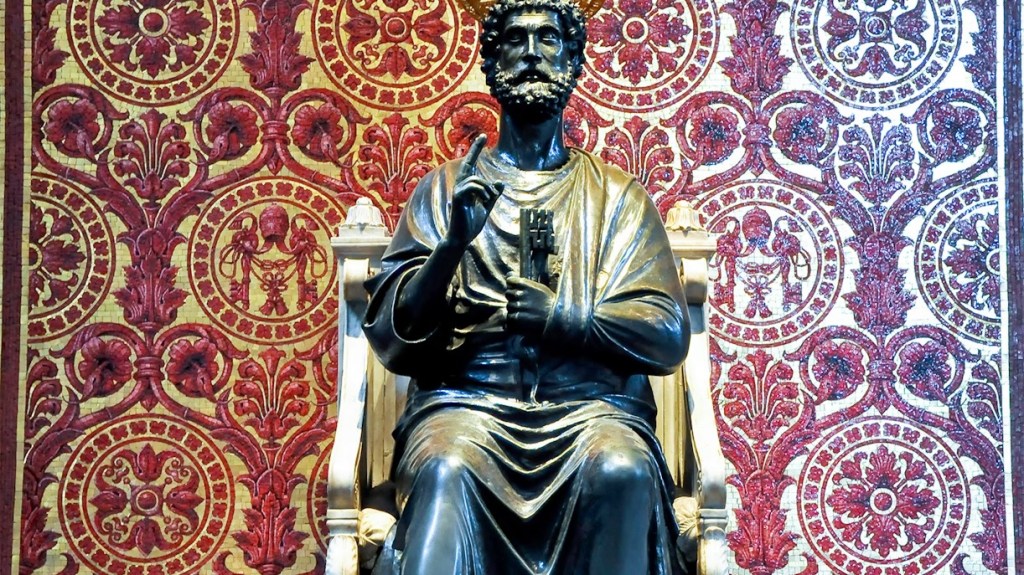
    The chair represents the authority of St. Peter and his successors. The chair represents the unity of the Church founded on the Apostle Peter.