
October 21, 2024 – Monday 29th Week in Ordinary Time
Click here for the readings (https://bible.usccb.org/bible/readings/102124.cfm)
Reaching a higher status or position in life could make us demanding and entitled to what we have achieved. A child who has been better than his siblings may demand more love, praises and attention from his/her parents for doing more and better. An authority figure or a colleague promoted to a higher position may also demand that he/she should be addressed according to the position he/she has gained, to be treated extra-special than others. A priest or nun may also demand from people or parishioners that he/she must be given this and that for his/her personal use and ministry because of his/her role in the church.
A heart that has grown to be (self)-entitled demands from others because of the belief that “I have become this! I have become that! – and so I deserve and must be treated and pampered this way and that!”
When we ourselves become this kind of person, this can be very irritating and tiring to people around us. Consequently, we become demanding in our relationships. Our work or ministry is merely grounded on what we can gain and benefit from others. Our good works and performances are always counted as our way of gaining favors. Yet, the heart is in danger of being corrupted by greed. Jesus said in today’s Gospel, “Take care to guard against all greed, for though one may be rich, one’s life does not consist of possessions.”
The tension and the conflict between those two brothers in the Gospel tell us how greed divides and destroys our relationships. The one who inherited the wealth from his father was the eldest who demanded that everything should only be for him because he was the eldest son. This was the culture before that reinforced the eldest son to be more self-entitled and indifferent.
Jesus pointed this out also as he presented the parable of the rich man who after being contented only with that he possessed in this world had also become intoxicated by his own wealth and success. The rich man without any concern for others only saved for himself alone. His heart that has also grown entitled has become indifferent and unconcerned of the suffering of the people around him.
However, Paul in his Letter to the Ephesians reminds us of this tendency in us. This comes from the “desires of our flesh, following the wishes of the flesh and impulses.” Yet, God who is rich in mercy, brought us to life with Christ – because of God’s great love for us.
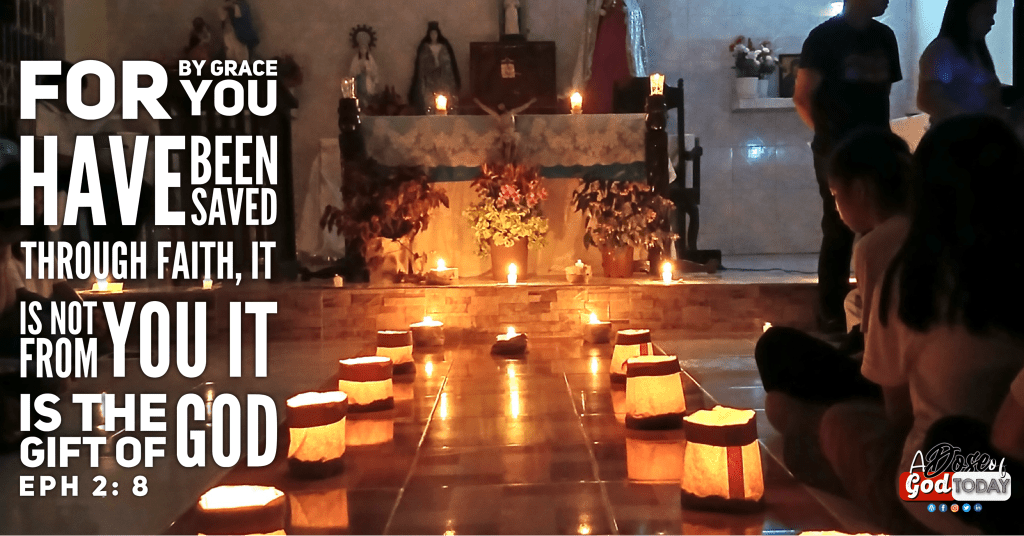
Paul continued to remind us that this freedom is not caused by us or by any good works we have done. Paul said, “For by grace you have been saved through faith, and this is not from you; it is the gift of God.”
This means that we are actually not entitled to this gift. Such gift of life and freedom, forgiveness and peace, even our talents, achievements and success, power and wealth we enjoy are God’s gifts! These gifts are God’s initiative because God loves us and kind to us.
Our Psalm for today even reechoes of who we truly are before God, “The Lord made us, we belong to him.”
It is only right then, that we are actually called to give thanks to the Lord. The Psalm reminds us too, “Enter his gates with thanksgiving. Give thanks to him; bless his name, for he is good: the Lord, whose kindness endures forever, and his faithfulness, to all generations.”
From here, the Lord reminds us that the antidote to our self-entitled and demanding hearts is gratitude! No one is deserving and entitled to the graces and blessings from God. What the Lord grants to us, the life, healing and freedom that we received through faith in Jesus, is not caused by our merits or good works. Everything is God’s grace, because God is good, loving and faithful to us.
We ask for this grace today, that we become more grateful to the Lord and to the many people around us. Let our gratitude be our ground as we do good things for others. Let our grateful hearts express concretely our faith in Jesus. Let us come near Jesus through the Sacraments of the Church, not because we are obliged, but because we are grateful. Hinaut pa.


 A DOSE OF GOD TODAY