
December 4, 2022 – Second Sunday of Advent
Click here for the readings (https://bible.usccb.org/bible/readings/120422.cfm)
Have you ever encountered a leader who is filled with vanity and only thinks of himself or herself? A leader in a group or in an organization, or in a company or community or in a nation who has become pretentious but insecure can be very dangerous. It would be in this kind of leaders that we find persons who have no intentions to serve others but rather abuse the authority conferred upon them for their personal advantage and comfort. This is how we suffer because of such ruthless, incompetent and corrupt leaders which may happen even in our small groups, organizations, companies, communities, churches or even countries.
Our failure as people is when we become indifferent, lenient and have no concern when our leaders turned against the weak and powerless. When members of an organization or even in a small community would play blind over the dishonest dealings of a leader, then, members start to condone and perpetuate such abuses.
The Hebrew people to whom the Book of the Prophet Isaiah was written had this similar experience. The people had been through a lot of suffering and disgrace. The people suffered because of their incompetent, selfish, abusive and corrupt leaders. Both their religious and political leaders had turned against the weak and the powerless in their society. The appointed leaders who were given authority to build the nation and uplift the people, were the very ones who caused suffering to many. This was how the prophets were chosen in order to call the attention of the leaders and give hope to the suffering people.
This is what we have heard in the first reading on this Second Sunday of Advent. Isaiah tells us of the birth of a child who will be the Messiah. This child shall restore order, peace, harmony and prosperity through reconciliation and forgiveness of sins, through change of our way of life.
Isaiah tells us of the person of the Messiah. His arrival will be as silent as a shoot sprouts or as a bud blossoms. Many will not notice his coming for it will be completely no grandeur. It will be simple yet powerful because he has the Spirit of the Lord. He confronts the wicked and the corrupt. He defends the poor and heal the afflicted. He is just and faithful. He brings peace and harmony to all. He is gentle and not violent.
This is the very hope also expressed in our Psalm today that, “Justice shall flourish in his time and fullness of peace forever.” This is God’s promise which reminds us of the event in Bethlehem, the place of birth of the Messiah. Holding on to this promise of the birth of the Messiah, calls us now to faith. Thus, the second candle of advent has been lit. That is why, that candle is called the Candle of Bethlehem and Candle of Faith.
Besides, the second reading from the letter of Paul to the Romans invites us to be open and welcoming of everyone, not to be discriminating. Paul expresses this call in two points. First, Paul prayed, “May the God of endurance and encouragement grant you to think in harmony with one another.” This tells us that living in harmony is an act of giving glory to God because the Lord is a God of community. Second, Paul taught, “Welcome one another, as Christ welcomed you.” This tells us that to be able to embrace one another despite our differences, also gives glory to God. Welcoming others is an expression of God’s presence among us.
Therefore, having harmony in our community, showing compassion, justice and concern for each one is what the Lord calls us to be. This is also what we are hoping for, a time of peace.
Both readings from Isaiah and Paul are addressed to the unfaithful and the faithful people, to the oppressors and oppressed, to the poor and the rich, to the powerless and the powerful. Indeed, a time of peace shall come through the “birth of a child.” This is the birth of the Messiah who shall come with peace and joy. This is God’s expression of faithfulness to us.

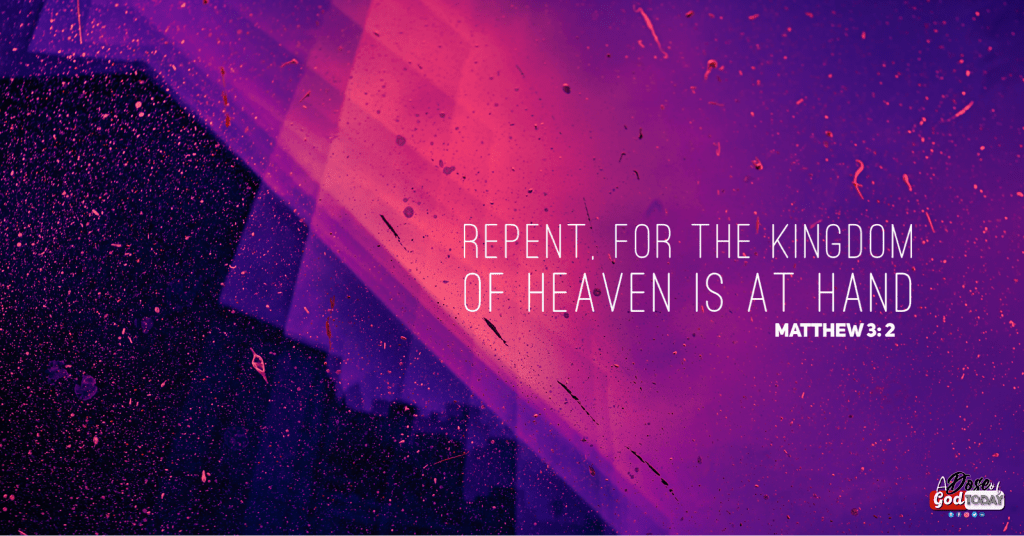
Yet, this promise also brings an invitation for us and that is to REPENT, to change our wicked ways, to reform our selfish and evil intentions. This is what the Gospel of Matthew tells us through the person of John the Baptist. John, a cousin of Jesus, prepares us to welcome the Lord fully and joyfully, without reserve, pretentions or conditions. John also expressed this in two points. First, to repent, for the kingdom of heaven is at hand. Second, to prepare the way of the lord and make straight his paths.
The very life of John is a testament of that call to change our ways by “acknowledging our sins.” However, the acknowledgement of sins here is not about our petty-personal-habitual sins that we usually confess. Indeed, there is something lacking in our conscience when we can only see those petty-personal-habitual sins and limit our awareness on our failure to attend Sunday Mass, in our failure to say our prayers, or in telling white lies and our sexual fantasies. Yet, when our heart is blind and indifferent to the many “social sins” in our institutions and communities, our conscience is truly limited or worst damaged! This makes us sick!
Social sins exist in our groups and communities that condone any structure, or belief or culture that oppresses and abuses people or even the environment, that violates human dignity, suppresses freedom and imposes great inequality.[1]
That is why, John especially called the attention of the many Pharisees and Sadducees who came to see him. These people were leaders in their communities who cannot even get along with each other but both held power over the people. Both tend to abuse their influence over the people for their own personal advantage.
Therefore, John calls us to acknowledge our sins of “indifference to corruption and dishonesty, in condoning and tolerating these practices in our institutions and communities, in our failure to side with the poor and the economically disadvantaged, and in our failure to uphold justice.
Thus, this Second Sunday of Advent invites us now with these three points of reflections.
First, to fully acknowledge our social sins as individuals and as a community.
Second, to be more available for God and others. This means that we are called to build among us a culture that is sensitive and aware of the needs of others.
Third, this calls us to faith, faith in the Messiah that we ourselves will become his presence today as we commit to work for justice, to defend the powerless and to resist the temptation of dishonesty and corruption in our institutions, workplaces, organizations and communities. Kabay pa.
[1] https://www.wearesaltandlight.org/learn-together/understanding-social-sin

 A DOSE OF GOD TODAY