
Tag: Saints

  • How to live life the way Jesus wants us to live

    How to live life the way Jesus wants us to live

    Advertisements

    July 22, 2020 – Wednesday; Feast of St. Mary Magdalene, disciple of the Lord

    Click here for the readings (http://www.usccb.org/bible/readings/072220.cfm)

    Homily

    How do you live your life? Are living in your past? Then, that makes you a prisoner of the past. Are you living in the future and of what is to come? Then, that makes you live in anxiety because of uncertainty.

    The only way we could live a life that is fulfilled and contented even in the midst of trials and sufferings is to live in our present. To live in the past whether because of a painful or joyful memory is a baggage that we carry in the present. This distracts us to be more aware of our present moment because we are occupied with what happened with us in the past. When we continue to hold on to what was already past, then we also become bitter and angry in the present. This happens because we prevent new people, new ideas or new invitations to disturb us to move forward.

    Moreover, when we are also overwhelmed with expectations and with what we want to have for tomorrow, we also become restless in our present moment. Our anxieties and insecurities may control how we relate with people and with God. As a result, we could become impatient because we want immediate satisfaction and instant results.

    The woman, whose feast we celebrate today, reminds me of the importance to live in the present, to capture the moment and to be ever grateful of what is here and now. Mary Magdalene, portrayed for many centuries as dirty and sinful woman, never allowed her dark past to control on how she lived with the present. She never let herself be overwhelmed of her future and to be anxious of what was to come next. She was just contented and fulfilled with what God gave her in every moment of her life.

    This made Mary Magdalene to be a dear disciple of Jesus and called as the woman apostle to the apostles. I want to invite you now that we bring ourselves into her story as told to us in the Gospel of John.

    The Gospel on her feast tells us of Mary’s encounter with the risen Jesus. There are three interesting events here that I would like to highlight.

    First, John tells us that Mary went to the tomb early in the morning while it was still dark.  This is very symbolic of Mary’s emotional and spiritual state. The dawn was breaking, an image where darkness is conquered by light. Indeed, Mary who developed a special friendship with Jesus was in grief and deep sorrow because of the death of her Lord and friend. What Mary did was to confront her grief and sorrow with hope, that beyond this overwhelming suffering and death, there is life; and beyond her sinful and dark past, there is hope and mercy.

    Second, as Mary searched for her Lord, she discovered an empty tomb. As she confronted her grief and sorrow, her pain and loss, her sins and failures, she discovered emptiness. This made Mary felt confused. However, it was in that emptiness that she was being filled with God. As she accepted her emptiness, Jesus filled her empty heart with the mystery of Resurrection, with love.

    Third, Mary’s close relationship with Jesus helped her to find herself when she was overwhelmed with pain and confusion. This was manifested as Mary recognized the presence of the Lord in the way Jesus called her name, “Mary!” This brought her into reality and to recognize her dearest friend, Jesus at that moment. And the reality is that Jesus never left her. Indeed, Mary has a special place in the heart of God. No matter what others would think about the sinful past of Mary, God did not condemn her and left her in misery. The Lord came to rescue her and transformed her in the way God wanted her to be. This shows us too how our friendship with Jesus could transform us.

    With this encounter of Mary with Jesus, this made her to proclaim, “I have seen the Lord.” It was because that Mary confronted her darkness, accepted her emptiness and the Lord’s desire to transform Mary, that she was able to see clearly the presence of God working in her life. this made her a witness, a faith-sharer and an apostle to all of us.

    These are the invitations for us today on this feast of Mary Magdalene that we may live in the present moment with joy and peace.

    Advertisements

    So I would like you now to remember these three points for today.

    First, in order for us not to burdened with our past, then confront the darkness in us and seek the light of forgiveness and reconciliation.

    Second, never be afraid to embrace our emptiness and to acknowledge our vulnerability. The Lord comes to us when our heart has a space for him. The Lord fills us with his graces and blessings when we empty ourselves from distractions of our bad habits and selfishness.

    Third, develop a deeper friendship with Jesus. We can only do this when we also develop the habit of prayer of talking our concerns to God but also listening to God’s desire for us. This involves an awareness of the presence of God in my brothers and sisters for they too are reflections of who God is.

    Hopefully, in these ways then, we too in our own ways will be able to proclaim to others, that, certainly, we have seen the Lord. Hinaut pa.

    Jom Baring, CSsR
  • To Become Persons of Encouragement

    To Become Persons of Encouragement

    Advertisements

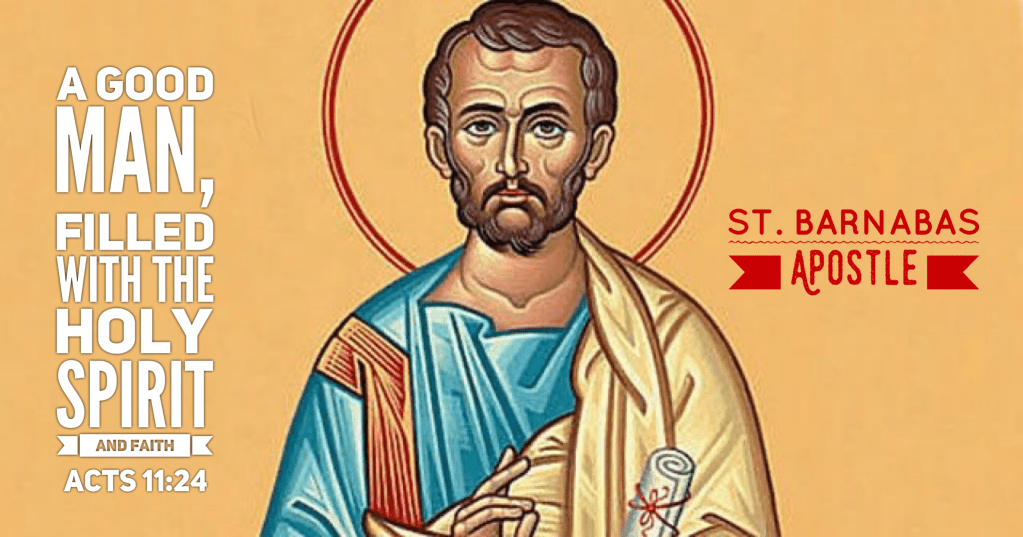
    June 11, 2020 – Feast of St. Barnabas, Apostle

    Click here for the readings (http://www.usccb.org/bible/readings/061120.cfm)

    People who encourage others would always bring support and growth because encouragement nurtures confidence and hope. Parents who would give generous encouragements to their growing children would find children to be happier and lively. Teachers who would also express words of encouragements to their students would find them animated to perform well in their studies. 

    This is also true among employers or corporate heads. A supervisor or manager who is generous in expressing encouragement to his/her workmates or colleagues or employees would surely find people around him or her to work confidently and competitively in a healthy way. Thus, a person who is being looked up by many as a leader and expresses words and actions that unite people, that heal division and reconcile differences, creates a space that bring people to work together. However, when a leader or any authority figure becomes vicious in his or her speech or acts unfaithfully from his or her duties, promises and words, then, he or she promotes unwarranted conflicts and stress to people.

    Moreover, when words of encouragements are expressed whether at home, at school or at work, they lessen unnecessary stress, avoid unnecessary conflicts and rather promote self-confidence, trust and hope. 

    This attitude of encouraging others had been shown to us through the person whose feast we celebrate today. St. Barnabas, an apostle, was a man of encouragement. During his lifetime, in his ministry, he never forgot to encourage people around him. In fact, it was through his encouragements, together with St. Paul, that they helped and nurtured the early Church to grow and to mature. It was in the Church of Antioch, through Barnabas too, that the Church realized that indeed, it is Catholic or universal in its nature. In Antioch, Jews and Gentiles lived together. Despite the differences in culture, language, and history, the Church became one in faith but so dynamic and vibrant in living together as Christians. 

    It was in Antioch also, that we, believers of Jesus, were first known as “Christians.” Thanks to that attitude of Barnabas because his encouragements to the first Christians made them confident in living together and become reconciled with one another. In fact, the name Barnabas means, “the son of encouragement.”

    The Acts of the Apostles reminds us of the attitude of Barnabas that he was “a good man, filled with the Holy Spirit and faith (Acts 11:24).” This tells us that when we welcome and allow the Holy Spirit to satisfy us, then, we also become discerning on how the Holy Spirit works in the life of those people around us. Certainly, we become familiar to the movements of the Spirit and become welcoming to God’s invitations for us.

    This calls us now to become welcoming of others. We shall surely see more opportunities of growth and rooms for developments for ourselves and for those people around us. Accordingly, we see more value in expressing encouragement rather than in blurting out destructive criticisms that may only damage one’s self-confidence and the hope to redeem oneself after a failure. We also see more value in expressing encouragement rather than in making threats that would incite violence and indifference toward others.

    Thus, on this feast of Barnabas, each of us is being reminded and called to be more welcoming of the Holy Spirit in our life so that our hearts and minds will be filled with wisdom, understanding and compassion particularly in these trying times where this pandemic has caused so much stress and anxiety in our life. 

    We may  become then, persons of encouragements that promote growth, confidence, trust and hope in our own context; whether at home, at work, or wherever we are called to be. Hinaut pa.

    Jom Baring, CSsR

  • Go and Share Jesus today

    Go and Share Jesus today

    Advertisements

    April 25, 2020 -Feast of St. Mark, the Evangelist

    Click here for the readings (http://www.usccb.org/bible/readings/042520.cfm)

    St. Mark was converted to the faith by Peter, who journeyed with Peter to Rome and served as his secretary or interpreter. When St. Peter wrote his first pastoral letter to the churches in Asia, he called him affectionately as “my son Mark.” Mark is considered as the author of the Gospel of Mark. According to tradition, he was sent to Egypt and founded the Church of Alexandria. One day he was seized by pagan authorities, dragged by ropes over stones and thrown into prison and died as a martyr. (Source: ibreviary)

    Today is the Feast of St. Mark, believed to be the author or the person behind the Gospel of Mark. The Gospel of Mark is believed also to be the earliest Gospel among the four. One evident characteristic of the Gospel that would tell us about this, is that it is the shortest. The Gospel is more direct in telling the story of Jesus. There are less elaborations or if there are explanations, then, those are short and simple.

    This tells us too that the community of St. Mark to whom this Gospel was addressed had that consciousness to preserve the story of Jesus through writing. It is through writing, then, that the memory of the Risen Jesus will be preserved and will be handed down from one generation to another. True indeed, that memory has been preserved and we today, share that memory of the early Christian community.

    What actually moved them to do this? Or what made Mark to decide to write what had been told to him by his mentor St. Peter? 

    We will find the answer at the end part of the Gospel of Mark. Jesus said to the apostles, “Go into the whole world and proclaim the Gospel to every creature.” 

    The followers of Jesus were now ready. They have become firm in their faith and so were all sent by Jesus to share and proclaim the joyful message who is Jesus himself. 

    Yes, the Gospel that they were about to proclaim is the person of Jesus, the God-with-us, who died and restores us through his resurrection. Mark being an assistant to St. Peter had become a witness of such joy. Mark himself experienced the joy of being with Jesus and being loved by the Lord just like Peter.

    This joy of being with Jesus is what made Mark and his community to write down their memory of Jesus so that others will also be able to experience the joy that they have tasted.

    Today, for all of us who have been the recipients of this great joy proclaimed to us in the Gospel of Mark, each of us is also called to “proclaim Jesus to every creature.” Each of us who have been able to experience the “goodness of God is called to to sing it for ever,” as our Psalm proclaimed to us today.

    Advertisements

    May I invite you then to be more aware of this invitation from Jesus – to go and share Jesus to every person we meet, to every creature that we will touch and encounter.

    Despite the physical distancing, the call of staying home and enhanced community quarantine, sharing Jesus to our brothers and sisters in the most concrete ways is still very possible. Expressing concrete actions of kindness and generosity to your neighbors in need is a way of sharing Jesus. Comforting an anxious and troubled friend is a way of making Jesus alive too. We do share Jesus not just as a mere memory of the past, but making Jesus alive in flesh through us. Thus, go and share Jesus today! Hinaut pa.

    Jom Baring, CSsR

    Join 2,850 other subscribers