Tag: Recollection

  • God’s Caress of Mercy and Friendship – Part 2

    God’s Caress of Mercy and Friendship – Part 2

    Mercy and Friendship transform us

    To see the goodness in us as God sees it, can be a struggle. It can be really difficult and might even next to impossible for others. We might recognize the innate goodness in us but we might also forget about it and so fall again into self-pity, guilt and shame.

    Time and again, these feelings of  shame, guilt and fear may struck us and we will realize how broken and unworthy we are. God has been so good to us and yet, we are sinners, unfaithful to God. This is how we encounter ourselves and so encounter God as well.

    But such encounter with the Lord would reveal to us that each of us, does not earn God’s favor and grace. I cannot and will not earn God’s mercy because God grants it freely and generously to you and to me. Friendship with God is also offered freely. We are not forced to accept it. We are rather invited to embrace that friendship. And our friendship with Jesus, cannot be broken,[1] as Pope Francis said. Indeed, it is from this mercy and friendship with Jesus that we are also being transformed, healed and reconciled.

    This reminds me of St. Paul’s realization of being transformed by mercy and of friendship. Paul said, 1 Cor 15:8-10.

    Last of all, as to one born abnormally, he appeared to me.
    For I am the least of the apostles, not fit to be called an apostle, because I persecuted the church of God.
    But by the grace of God I am what I am, and his grace to me has not been ineffective. Indeed, I have toiled harder than all of them; not I, however, but the grace of God [that is] with me.

    As Jesus revealed himself to Paul whose name was Saul at the beginning, Paul saw his own shadows. Paul was in fact in disgrace because as a Jew, he felt so righteous, and he persecuted those who believed in the risen Christ. He brought many Christians to prison and even to their death. But his encounter with Jesus turned his life upside down. It began when he was on his way to Damascus and Jesus appeared to him in a vision.

    Yet, he found the Lord without condemnation against him, but only with love and forgiveness for him. That encounter with Jesus brought him to see how wrong he was. Moreover, that very encounter of Paul with Jesus, was also the beginning of their friendship. And that friendship led Paul to commit himself to the risen Christ to be an apostle to the Gentiles, and that through the grace of God, not earned but freely given.

    Aside from friendship with Jesus, Paul also realized the value, the importance and the holiness that can be found in our human friendships. In his letter to the Philippians, Paul acknowledged how this gift of friendship sustained and saved him. In Phil 4: 13-16, Paul said,

    I have the strength for everything through him who empowers me.
    Still, it was kind of you to share in my distress. You Philippians indeed know that at the beginning of the Gospel, when I left Macedonia, not a single church shared with me in an account of giving and receiving, except you alone.
    For even when I was at Thessalonica you sent me something for my needs, not only once but more than once.

    Indeed, the presence of our friends in our life would truly make difference.  Well, it is usually with our friends that we share our deepest thoughts and dreams, our fears and confusions, our pains and sorrows, our joys and successes. Sometimes, our friends know more about us than our immediate family members.

    Why? It is because friends allow us to be who we are. We find with our friends a space to be fully accepted and embraced. Friends also unconditionally support us and understand us when our homes do not provide that for us. And this is because of our shared experiences, shared stories and shared dreams. These are some reasons that connect us intimately with our friends and that make our hearts truly grateful.

    Paul in this letter to the Philippians recalled such gratitude in his heart for the gift of friendship he had developed with the Philippians. Paul who was in prison and in many difficulties, was comforted by the thought that his friends remembered him and cared about him. His friends sent material resources that he would need. This was not just the first time because even during the travels of Paul to preach in other cities, the Philippians expressed their generosity and support by providing his needs for the journey. Paul said it intimately, “it was kind of you to share in my distress.” The thought of being remembered by friends had given Paul assurance and confidence despite the suffering and persecution he faced.

    More than this friendship, Paul also expressed that what sustained him was his friendship with the Lord.  Paul expressed it in this way, “I have the strength for everything through him (Jesus) who empowers me.” This friendship with Jesus was the very reason of that friendship he had with the Philippians.

    This gives us a picture of our capacity to give oneself, to be generous and kind in order to express our support and love for our friends. Moreover, this also makes our heart to be truly gracious for the gift of friendship we have.

    Interestingly, Simon Peter had his own story of encounter also with Jesus. Luke 5: 4-10.

    After he had finished speaking, he said to Simon, “Put out into deep water and lower your nets for a catch.” Simon said in reply, “Master, we have worked hard all night and have caught nothing, but at your command I will lower the nets.” When they had done this, they caught a great number of fish and their nets were tearing.
    They signaled to their partners in the other boat to come to help them. They came and filled both boats so that they were in danger of sinking.
    When Simon Peter saw this, he fell at the knees of Jesus and said, “Depart from me, Lord, for I am a sinful man.” Jesus said to Simon, “Do not be afraid; from now on you will be catching men.”

    This encounter made Simon realize his own sinfulness. Simon was told by Jesus to “put out into the deep waters and lower his nets” even though they had been fishing all night and caught nothing. This tells us that Jesus invited Simon to dwell deeper into his own life and to lower down his comforts, to leave behind his uncertainties and anxieties, fears and guilt. This became possible because of that friendship between Simon and Jesus. The Lord was able to challenge Simon, and Simon trusted because the Lord was his friend. Indeed, when Simon did all those, what he found was God’s goodness and tremendous love and generosity symbolized by the great catch of fish.

    This moved Simon to beg Jesus to depart from him because Simon had become aware of his sins, failures, fears and insecurities. However, this realization became the entry point of Jesus to transform Simon. This was how Simon gained another name, Peter, or Rock because he was commissioned by Jesus for a mission.

    However, Simon Peter who was an impulsive man also stumbled along the way. During the Passion of the Lord, we recall how Simon Peter denied Jesus, three times. This brought deep sorrow to Peter. Because of his fears, he denied the Lord and refused to be with Jesus in those painful and traumatic moments.

    With his leadership, after the death of Jesus, Peter and the other disciples hid themselves because of their fear of the Jews. They were terrified because the same fate might also happen to them. However, most of all, they were frustrated and very disappointed with what happened to Jesus. They believed that Jesus would liberate Israel from oppression and suffering from the Roman invaders. Many disciples must have expected that Jesus will raise an army and start a revolution. They could have dreamed that one day they will be seating on a golden throne near their master. However, all those dreams and desires were shattered because Jesus was condemned by his fellow Jews and was crucified by the Roman soldiers.

    Peter and the other disciples left their old life to follow Jesus. But Jesus was condemned to death, what will happen to them now? Peter surely also asked this question. “What will happen now?” Jesus is dead and they have no one else to follow.

    Thus, this failure that caused them so much frustrations and fears moved them to go back to fishing – to their old self, to their old habits, and not stepping forward because their dreams were shattered, expectations broken and hope was taken away.

    Nevertheless, God has his own way of calling us back again. Let us remember how Jesus called back his friends after they retreated to their old selves. Let us read this Gospel passage.

    John 21:3-7

    Simon Peter said to the other disciples, “I am going fishing.” They said to him, “We also will come with you.” So they went out and got into the boat, but that night they caught nothing.
    When it was already dawn, Jesus was standing on the shore; but the disciples did not realize that it was Jesus. Jesus said to them, “Children, have you caught anything to eat?” They answered him, “No.”
    So he said to them, “Cast the net over the right side of the boat and you will find something.” So they cast it, and were not able to pull it in because of the number of fish.
    So the disciple whom Jesus loved said to Peter, “It is the Lord.” When Simon Peter heard that it was the Lord, he tucked in his garment, for he was lightly clad, and jumped into the sea.

    Now, Jesus appeared on the shore but the disciples did not recognize him. That night they caught nothing. This only tells us that when we also succumbed into darkness and sin then we will surely lose our way just as what happened to Simon Peter. But Jesus would never give up on his friends. Remember that!

    Lord is ready to meet us wherever we are now. The Lord shall come and meet us in our dark moments, in times of our depression, sadness and sickness, even in times of great confusion and doubts, and in times of failures and frustrations. The Lord is always ready to do that because he wants us to live free from those.

    Now, what was also interesting was on how the beloved disciple recognized Jesus. In fact, it was him who first recognized Jesus and told Peter about it. This tells us also, that once we have become intimate with Jesus, our heart will always desire for Jesus. This beloved disciple of Jesus, who had become so familiar with the Lord, recognized Jesus with joy.
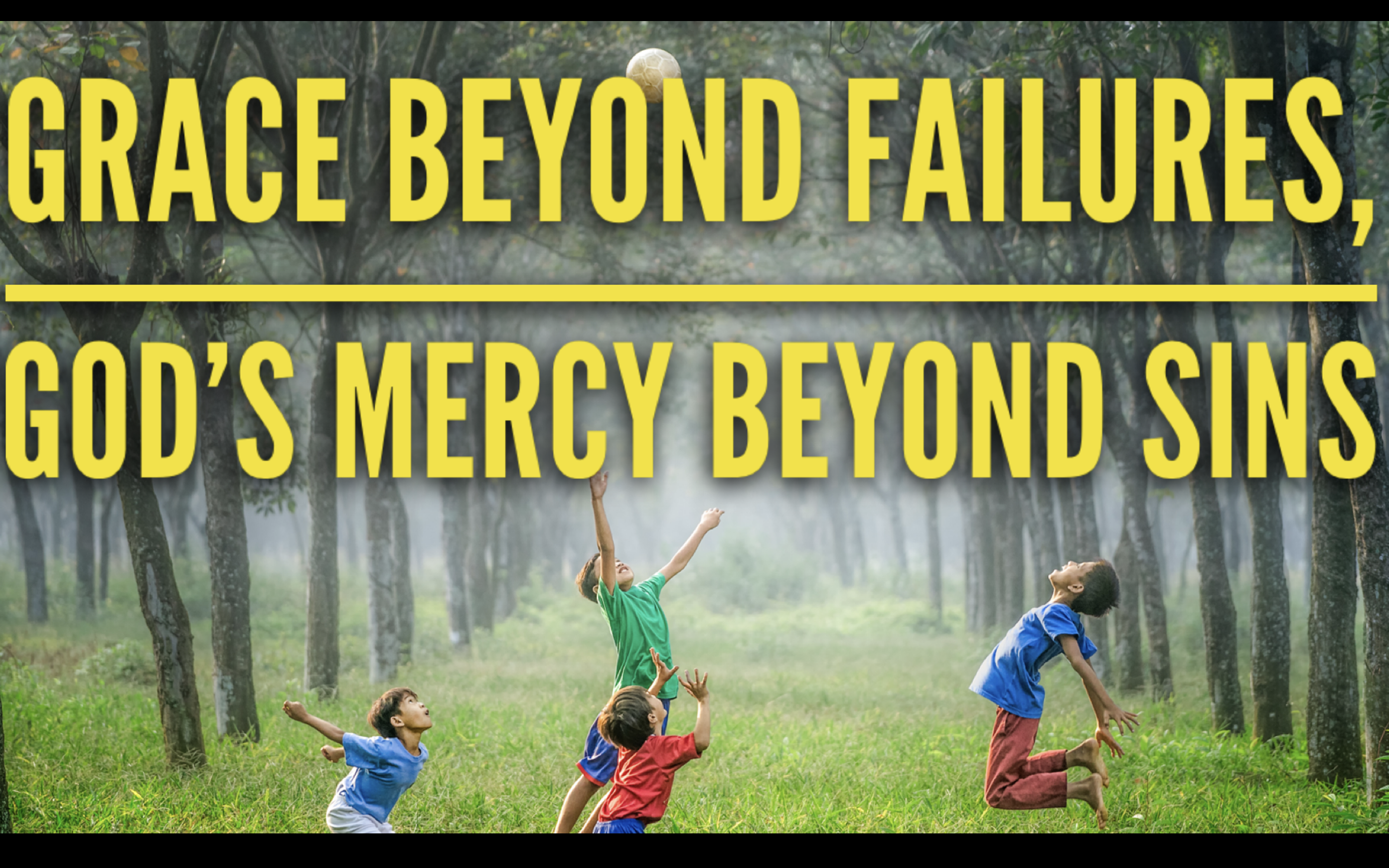
    This inspired Peter to respond immediately and to come near to Jesus. Again, this was symbolically done. Peter let go again of his boat, that is, of his old self. He jumped confidently into the sea of past failures and frustrations because he knew that Jesus was waiting for him on the shore. This was how Peter showed us that there is indeed “grace beyond our failures and God’s mercy beyond our sins.” Peter embraced that grace joyfully by encountering Jesus on the shore. Again, it was not earned but freely given.

    There is also another moving encounter of Peter with Jesus that gives us more perspective on how mercy and friendship with God will transform us. Allow me to read to you this biblical event in the Gospel of John 21:15-17.

    Jesus said to Simon Peter, “Simon, son of John, do you love me more than these?”
    He said to him, “Yes, Lord, you know that I love you.” He said to him, “Feed my lambs.”
    Jesus then said to him a second time,
    “Simon, son of John, do you love me?”
    He said to him, “Yes, Lord, you know that I love you.” Jesus said to him, “Tend my sheep.”
    Jesus said to him the third time,
    “Simon, son of John, do you love me?”
     Peter was distressed that Jesus had said to him a third time, “Do you love me?” and he said to Jesus, “Lord, you know everything; you know that I love you.” [Jesus] said to him, “Feed my sheep.

    During the funeral wake of my Papa, my mother told me about a conversation with my 5-year-old niece. She playfully asked my parents, “Tatay, do you love Nanay?” Asking my Papa if he loved Mama. And then she asked in the same way her grand mom, “Nanay, do you love Tatay?” This happened just a week before Papa died in 2019.

    In the eyes of my niece, perhaps what she was doing was a mere play of asking questions and relaying the answer to both of her grandparents. Yet, the question entails commitment and faithfulness.

    The question of Jesus to Peter essentially involves commitment and faithfulness. The three questions of Jesus were not of condemnation and judgment against the unfaithfulness of Peter. However, the question, “Do you love me?” was an affirmation that Peter was loved and forgiven.

    Thus, the question of Jesus, “Simon, Son of John, do you love me more than these?” refers to that attitude of Peter. Jesus was basically asking Peter, “Simon, do you love me more than your fishing career? More than your fears and doubts? More than your sins and guilt? More than your insecurities? More than your dreams, desires and personal wants?”

    Positively, Peter understood what Jesus was asking. Jesus asked three times to tell Peter of the great responsibility and also of the joy of the meaning of loving his dear friend, Jesus. To feed or tend the lambs and sheep basically means, “Take charge to care and love others.” This reminds us of Peter’s capacity to care and love others as Jesus did on the cross.

    To each of us today, the Lord also asks us, “Do you love me more than these? More than your insecurities and fears, more than your personal wants and ambitions?” Then, the Lord also asks us to take the risk of loving him, who is our dear friend, by being able to love others, to become courageous and confident in loving others. Remember, it is in taking the risk of committing ourselves to love others that we too shall find our true selves.

    The Lord knows that each of us has that capacity to love and take care of others. Never be afraid then, never be afraid to love. Never be afraid to express your care and affection towards others. It is in this way that like Peter, we will be able to follow Jesus, who invites us today, to express our love and care to others in the most concrete ways as we have experienced it from our dear friend, Jesus.

    These are stories of encounter with a merciful God and of friendship that led to transformation and to a mission. Indeed, real encounter with God’s mercy and friendship would strip us from our pretensions and masks. Such encounter makes us true and without pretensions to see how sinful and unworthy we are before God.

    Yet, it is in this moment of openness and honesty that we find God more merciful and forgiving to us.  Let us remember this, it is when we own and claim our weakness, sinfulness and failures to God that we are also being strengthened, forgiven and empowered by the Lord.

    Thus, for this second part of the recollection, these are the invitations for us.

    First, we are called to be fully aware of our own sinfulness and failures, to take responsibility of our sins. Thus, stop blaming others. This, certainly, needs an amount of humility and honesty from us.

    Second, we are invited to allow the Lord to transform us through his mercy, friendship and forgiveness. We can seek God’s mercy and affection then, by our constant devotion to the Eucharist, in receiving his grace in the Sacrament of Reconciliation and by reflecting and seeking wisdom from the Bible.

    Third, we are called to let God empower us by allowing God to make us His own instruments of mercy, friendship and reconciliation. God calls us and empowers us in the way we live our life now. We are called to become God’s witnesses as parents, as professionals, as leaders in our community, as workers or vendors, as children and friends, as students and as young people, as senior citizens.

    PRAYER

             God of Mercy and Friendship, you have constantly reveal to the world your unconditional love. Through your Son, our Lord Jesus, this love is fully manifested. Grant me now the courage to love and to commit my whole life in loving and in giving so that I may become your own instrument of mercy and friendship in my own home, among my friends and in my community. Amen.


    [1] Pope Francis, Christus Vivit, n. 154, 65.
  • God’s Caress of Mercy and Friendship – Part 1

    God’s Caress of Mercy and Friendship – Part 1

    (This is the talk given during the Holy Week Reflection on Holy Monday, April 3, 2023 delivered at St. Clement’s Church, Iloilo City.)

    Are we being punished? Are we being condemned because of our sins? Has God abandoned us? Has God given up on us?

    When Covid-19 hit us in 2020, we were all afraid and anxious. The world seemed to stop, and the many restrictions of our movements contributed so much to our feeling of being isolated and helpless. With this health crisis, economically or financially, we were being challenged in many ways. Many have lost their jobs and the most vulnerable among us were those who worked and earned on a daily basis and the poorest of the poor, the homeless and street children.

    Likewise, every day many were haunted by anxiety of being infected by the deadly virus, or we might have been so worried for those family members and friends who were at the frontline fighting against the virus and ministering the infected. Or we might have been sobbing and grieving in those days because we have lost a family member, a close friend, or a colleague because of the virus.

    In total, there are about 761,071,062 cases worldwide of covid infections,[1] and a total of 6,879,644 deaths worldwide as of March 26, 2023. (Last Update)

    On February 24, 2022, Russia invaded Ukraine and this war brought economic challenges worldwide especially of the inflation of oil which affected us here in the country. This war continues until now which already affected 14 Million people being displaced[2] , with 140,000 infrastructures destroyed, with 15,000 people missing and 42,295 deaths.

    Just last February 6, this year, a 7.8 magnitude of earthquake struck southern and central Turkey as well as the northern and western Syria which affected 24 million people[3], 2.5 million displaced persons and 56,00 deaths.

    At the local level, at least in this post-pandemic time, no natural disaster has greatly affected the whole country except Odette in 2021 or any war that has ravaged the country. Yet, what is alarming, aside from the inflation of commodities is the rise of poverty level in the country. According to the recent DSWD Listahan 3, that survey found out that there are 5.6 million Filipino Families living in poverty.[4] In terms of individual persons, there are 2 in every 5 Filipinos who are poor. This is equivalent to 30 million poor Filipinos which is 27% of the 111 million population.

    These are just some figures and images of suffering in the world and beyond these, there are more pain, suffering, and deaths unknown to us, not covered by statistics or by many news media. There are many who suffer in silence.

    Thus, we ask again, are we being punished? Are we being condemned because of our sins? Has God abandoned us? Has God given up on us?

    Talk 1

             God’s Caress of Mercy and Friendship. This is the over-all theme that I would like to share with you tonight. We understand “caress” as an action that expresses, closeness, affection, love, concern and gentleness.

             As Pope Francis said in one of his homilies, “God forgives not with a decree but with a caress.” And with mercy, “Jesus too goes beyond the law and forgives by caressing the wounds of our sins.[5]

    Mercy has touched the Pope so much that he led us into the Jubilee Year of Mercy in 2015-2016. Thus, Pope Francis affirmed that “mercy is God’s identity card[6].” Indeed, Mercy is the name of God.

             Again, Pope Francis in his Apostolic Exhortation called, Christus Vivit  addressed to the Young People and to the Entire People of God, he wrote, “Friendship is one of life’s gifts and a grace from God. Through our friends, the Lord refines us and leads us to maturity.[7] This is how friendship that we have developed helps us to grow and become the person God wants us to be.

             Moreover, an author, Fr. Ronald Rolheiser, OMI, wrote a section of his book with its title, Friendship is Liberating Too, that, “Friendship can save us. Loving, challenging friends who can melt our bitterness and free us from the need to be angry are as critical within the spiritual life… To neglect friendship is to court bitterness and perversion.[8]

             This explains to us how friendship also plays a role in making ourselves free, free from anger and hatred, from bitterness and corruption that will only bring us into isolation and sadness.

             Hence, as I journey with you tonight, let us refresh our hearts and minds with scriptural texts that would bring deeper into God’s caress of mercy and friendship.

             I would like to invite you now to the story of Jonah.

    Jonah 1:1-3

    The word of the LORD came to Jonah, son of Amittai:

    Set out for the great city of Nineveh, and preach against it; for their wickedness has come before me.

    But Jonah made ready to flee to Tarshish, away from the LORD. He went down to Joppa, found a ship going to Tarshish, paid the fare, and went down in it to go with them to Tarshish, away from the LORD.

    Jonah was quite rebellious to God because he was sent by God to do something, which he did not want to do.  If you remember, Jonah did not like this assignment to go to Nineveh because he hated the people. They were Assyrians, the traditional enemies of Israel who oppressed and attacked them. These Assyrians were known to be brutal invaders.

    That is why, Jonah was so against God’s plan of sending him there to call them for repentance. Jonah was anxious that the people might believe in God and thus, God might show mercy to them and spare them from death.  Jonah wanted this people to die. He wanted revenge against these people whom he thought were Godless. This was all because he was angry and he disgusted those people.

    Yet, this is what really happened. When Jonah called the people to repent, they repented and believed in God and that was why, God showed mercy to them and saved them from death.

    Jonah’s attitude may not be far from many of us who cultivate a narrow and vindictive mentality.[9] Like Jonah we too might have asked God, How could you love worthless, good for nothing people Lord? How could you show mercy to those who do not even recognize you as God? How could I also be merciful to them when they oppressed my people?

    We might also find ourselves wishing suffering and death to those whom we hate, especially those who have caused us so much pain. We might have wished and cursed those people who did something terrible to others too. When a violence and or a crime is done to an innocent, we might have demanded also the same violence and crime to perpetrators. Like Jonah, we too might have believed that justice is attained through a gruesome death to our enemies. Like Jonah, we also could tend to believe that God should not show mercy to those who have hurt us, to our enemies and people who did terrible things to the innocent.

    Yet, with Jonah, the people of Nineveh and God, there is something very interesting here. Jonah was totally honest to God about his thought and feelings against Nineveh. Jonah was comfortable enough to complain to God, to express his dismay and anger over this people. Jonah even tried to escape from God and argue with the Lord. And the Lord God, listened to him, the Lord God accompanied Jonah and allowed Jonah to grow and become mature as a person and as a prophet by being able to recognize his own limitations and biases against others. The Lord challenged Jonah to see beyond himself, beyond his pain and frustrations and to recognize that God’s mercy and friendship are for all.

    Now, this exchange between Jonah and God expressed closeness and intimacy and that is evident in Jonah’s confidence to express himself before God. Is it not friendship at all? It is! Jonah was a friend of God. God is Jonah’s closest friend. And it is in this friendship that Jonah was called, challenged and was transformed. In a way, Jonah was the first to receive that caress of mercy and friendship with God which the Lord wanted Jonah to share with the people of Nineveh.

    This helps me to realize now that God’s mercy and friendship are not limited to any group of people. God is a God of everybody, of bad and good people, of sinners and righteous, of criminals and law-abiding citizens.

    God showed this concretely to us in the person of Jesus, the ultimate sign of God’s mercy and friendship with us. Pope Francis reminds us, “Friendship is so important that Jesus calls himself a friend: ‘I do not call you servants any longer, but I call you friends.’(Jn 15.15)[10]” Thus, in Jesus, the Father tells us that we are never abandoned, that there is always hope and goodness in each of us no matter how broken we are, and sinful we have turned to be. God always sees goodness in us, because we too are God’s friends.

    This is the same invitation that we have heard from Jesus when he addressed the adulterous woman brought by the scribes and Pharisees. Like Jonah at the beginning, the scribes and the Pharisees were filled with so much hatred and anger. This made them to become condemning towards the woman. With this attitude, they refused to give another chance and opportunity for the woman to change and to redeem herself.

             Thus, they wanted to stone her to death as what “the law” told them to do. But what did Jesus do? Listen now to the Gospel of John chapter 8, verses 7 to 11.

             John 8:7-11

    But when they continued asking him, he straightened up and said to them, “Let the one among you who is without sin be the first to throw a stone at her.”

    Again he bent down and wrote on the ground.

    And in response, they went away one by one, beginning with the elders. So he was left alone with the woman before him.

    Then Jesus straightened up and said to her, “Woman, where are they? Has no one condemned you?”

    She replied, “No one, sir.” Then Jesus said, “Neither do I condemn you. Go, and from now on do not sin anymore.”

    This is what Jesus showed to the woman. Jesus said, “I do not condemn you. Go and sin no more.” God has delivered his judgment, showed His mercy and offered friendship. Jesus freed the woman and was commanded to sin no more and not to go back to her old sinful self. She had, surely, found her way to freedom and peace in Jesus.

    Pope Francis in his homily on this Gospel story said, “Jesus forgives. But here, there is something more than forgiveness because Jesus goes beyond the law. Though Jesus was pure and the only person who is worthy to cast the first stone against the woman, but Jesus did not because he showed mercy.[11]

    Mercy, as the Pope says, is difficult to understand. “Mercy does not erase sins. It is God’s forgiveness that erases our sins. But then, mercy is the way in which God forgives.[12]

    Thus, unlike the scribes and Pharisees, Jesus saw more in the person of that woman. The limited awareness and refusal of the Scribes and Pharisees to see more, prevented them to discover that there was always hope in every sinner, and that there was more in a person’s weakness and imperfection. This is how Jesus defends us, sinners from the just condemnation of death.[13] Again, (because) God always sees goodness in us and offers us his friendship that we may be renewed and find peace in his presence.

    PRAYER

             God of Mercy and Friendship, I am confident that it is not your desire to punish and bring us to condemnation, but to caress us with your love. Allow my heart to be ever closer to you, to grow in faith and affection towards you. As you see goodness in me, let me also see the goodness in others that I may learn to caress with mercy and friendship. Amen.


    [1] https://news.google.com/covid19/map?hl=en-PH&mid=%2Fm%2F02j71&gl=PH&ceid=PH%3Aen

    [2] https://www.google.com.ph/search?q=war+in+ukraine

    [3]https://www.google.com.ph/search?q=earthquake+in+turkey+and+syria

    [4] https://www.rappler.com/nation/filipino-families-living-in-poverty-2022-dswd/#:~:text=Sign%20in%20to%20listen%20to%20groundbreaking%20journalism.&text=MANILA%2C%20Philippines%20%E2%80%93%20There%20are%20over,Welfare%20and%20Development%20(DSWD).

    [5] Pope Francis, The Name of God is Mercy: A Conversation with Andrea Tornielli, translated by Oonagh Stransky (New York: Random House, 2006), xii-xiii.

    [6] Ibid, 9.

    [7] Pope Francis, Christus Vivit: Post-Synodal Apostolic Exhortation of the Holy Father Francis to Young People and to the Entire People of God (Philippines: Paulines, 2019), n. 151, 64.

    [8] Ronald Rolheiser, OMI., “Friendship is Liberating Too,” in Forgotten Among the Lilies: Learning to Love Beyond Our Fears (USA: Doubleday, 2005), 34-35.

    [9] Jonah, Introduction, The New American Bible.

    [10] Pope Francis, Christus Vivit, n. 153, 65.

    [11] Jonah, Introduction, The New American Bible, xvi.

    [12] Ibid.

    [13] Ibid.

  • EXCITED KA NA NAMAN BANG UMASA MULI?

    EXCITED KA NA NAMAN BANG UMASA MULI?

    This Advent Reflection invites us to dwell deeper on the importance of our presence and of God’s presence in our life and in the life of others. The excitement to hope again calls us to hold on to hope, to be hopeful and to be the hope for others.

    Below is a link of the reflection.

  • WHICH VALUE SYSTEM DO WE FOLLOW?

    WHICH VALUE SYSTEM DO WE FOLLOW?

    Advertisements

    June 8, 2020 – Monday of the 10th Week in Ordinary Time

    Click here for the readings (http://www.usccb.org/bible/readings/060820.cfm)

    (This article is not a usual weekday homily as one may find this too long. This was first used as a recollection material given to a group Redemptorist Seminarians.)

    As we live our Christian vocation and commit ourselves to Jesus, the Redeemer, we encounter both joys and sorrows in our life. We also encounter temptations and challenges as disciples of Jesus. The world that we live in, the environment that we are situated with both provides challenges and opportunities for growth in our commitment to God and to our Christian Faith. 

    It would be very good then to make ourselves aware of the dynamics present in our world and in particular, in our small environment. It would be advantage to examine and be made aware of the “value systems of the modern world” that offers easy and comfortable alternative for us in living our Religious and missionary vocation and Christian Vocation in general.

    But then, we should also ask honestly ourselves, will these value systems bring me closer to myself, to my neighbors and to God? Or will they only lead me farther?

    These are the Value Systems of the Modern World.

    1. Happy are the rich and powerful, those who possess plenty because they can have whatever they want and do things instantly.
    2. Happy are the popular and pompous because they all have the praises and attention of everyone now.
    3. Happy are those who do not care of other people’s suffering for they will not be affected by such trouble.
    4. Happy are those who only stay in their own comfort zones and do not dare to give them up for they feel secured there.
    5. Happy are the aggressive; for they will get anything they want, no matter what.
    6. Happy are the proud and the arrogant because inferior people will bow on them.
    7. Happy are the bullies and haters because they will have a lot of fun over other people’s pain and weaknesses.
    8. Happy are those who do not speak up and stand up for justice, who choose not to see and hear oppression and injustice for their lives will be out of trouble and there will be no persecution from the powerful.

    These value systems are, indeed, attractive and tempting because they promise security but false security. They seemingly promise comfort and happiness for a moment but nothing for tomorrow. These values keep us away from becoming true disciples of Jesus. These are rather values of an UNBELIEVER, a secular person who rejects God’s goodness and the beauty and wonder of his/her neighbor.

    Advertisements

    Let me share with you THIS REFLECTION ON the Sermon on the Mount by Sharla Guenther

    We use the word bless a lot but perhaps we don’t know what it really means.

    If someone sneezes we usually hear someone say, “bless you!”  It is not completely clear why we say that but the word ‘bless’ is a positive word.

    Jesus had been walking with his disciples always teaching and talking with them.  More and more people would see Jesus and follow him because they could sense there was something special about him.  The way he spoke and what he spoke about captured everyone’s attention.

    This was one of those days when people had been following and Jesus decided to stop on a hillside with his disciples and taught those who wanted to listen.

    Jesus made ten points in the first part of his sermon known as the beatitudes.  All except one of these points start with the word blessed.  So we should probably figure out what the word means before we continue.

    To be blessed is to be more than happy.  

    Life does not always go our way, or the way we plan and expect it to be. Because of this, it does not make us happy. However, being blessed is being full of joy on the inside even if things are not perfect. Being blessed is to be grateful in life even if there are also things or aspect in our life that may seem to be lacking. 

    Thus, to be blessed is a deeper joy because we know, as believers, that the spirit of God lives in us.

    Now let us see each one the Beatitudes and the invitations for us.

    1. Blessed are those who are poor in spirit for theirs is the kingdom of heaven.  Being poor in spirit means that we are not attached to all the stuff that we have.  That you understand that God has given you all the great things or blessings and we should be very thankful and even willing to give them up or share them with others.  All our things on earth do not matter because we cannot take them with us to heaven, which will be more amazing than we can imagine.
      • To be poor in spirit also means to become confident in the providence of God, in his grace upon us. It invites us then to grow in that confidence but at the same time also to embrace the feeling of our insecurity. Hence, it is okay to feel inadequate, to feel our poverty, to feel our emptiness and lacking in something. Remember, it is when we are empty that God can also fill us. God will not be able to fill us up when we are already full of many things.
      • Chairman Cha in a K-Drama entitled Clean with Passion For Now, said, “To fill up, you must be empty and in order to grab, you must let go.”
    2. Blessed are those who mourn, for they shall be comforted.  Mourning is when we are really sad. Perhaps you have cried because you got hurt or someone you knew died, but this is different from that.  This is being very upset about those people who have not heard about God or being upset about the sin in our life.  We might not think about these things very much yet but as we get closer to God this will bother us and that’s okay.  God promises to comfort us when we need it.
      • To mourn and be sorrowful of our personal sins is not about ‘being guilty.’ Guilt only leads us away from the mercy of God and from the chance of renewing our life. Guilt makes us imprisoned of our own failures and sins. To mourn is to be truly sorry of our sins with the intention to be transformed by God. To mourn accepts God’s forgiveness and allowing ourselves to be led and transformed by God in the way God want’s us to be.
    3. Blessed are the meek for they shall inherit the earth.  Being meek is being patient and gentle, not easily angered and not thinking of ourselves too highly.  A bad example of this in the Bible was the Pharisees.  They would make sure people knew that they were fasting and praying and seemed proud about what they were doing for God.  Except God is looking for us to do these things without putting on a show for others but doing it just for God, not for approval from others.
      • This is an invitation for us to grow in humility, to seek God’s favor and not our own favor, to seek God’s glory and not our personal glory. Our person, our talents, intelligence and many gifts are not instruments to merely boast oneself but ways for us to recognize better our God, the giver of gifts. Thus, be mindful when we will tend to draw attention and recognition from others, when we become conscious of our self-image that we also become arrogant and worst will refuse to be corrected or criticized by our friends. 
    4. Blessed are they who hunger and thirst for righteousness: for they shall be filled.  Being righteous is impossible on our own.  Can we always do the right for God?  No, and God knows that.  We can do our best to do the right thing and if we don’t, we can always ask forgiveness and be renewed.  The verse not only asks us to try to be righteous but to hunger and thirst for it.  Have you ever been really hungry and thirsty?  To be truly hungry and thirsty you might have to go without food or water for more than a day or two. God wants us to need and feel like we’re starving for righteousness and He will fill us up with it.
      • This invites not to remain passive in our baptismal vows but to live our vows pro-actively. It means that we are called to exercise righteousness with full consciousness. Yet, let us also remember that at times we may fall asleep, but then, be always aware of your attitudes so that you will also be able to wake up again. In other words, make it your heart’s desire to live your Christian life with honesty, sincerity and gratitude.
    5. Blessed are the merciful: for they shall obtain mercy.  To have mercy is to be loving and kind to others.  This does not mean just being loving and kind to your family and friends but also to those whom you might not know and even those you don’t like. Those who are ready to forgive the offense of others, shall be forgiven. The merciful tastes the forgiveness of sins and innumerable blessings of this life.
      • This invites us to always exercise mercy as the hallmark of our Christian vocation in the way we relate with ourselves, with our family and friends and enemies. This calls us more when we are ask to show mercy to those who have offended us or who have sinned against us.
    6. Blessed are the pure in heart: for they shall see God.  Being pure is like having a clean heart.  Like the heart inside of us, it pumps blood and keeps us alive and if something is wrong with our heart, we won’t work right.  Jesus is talking about the place where we think and make decisions, why we do things, and our thoughts.  If we keep our mind, thoughts and decisions full of good, God says we’ll understand Him more as we see Him better in all things and in every people we meet. This is a call for sincerity in our words, deeds and piety.
      • This invites us now to examine our intentions and motivations. What is really in my heart now? What is it that keeps me going? Or what is it that prevents me from accepting myself fully and welcoming God in my life? Or what is it that keeps me bothering now, which disturbs me a lot? Hopefully, in treating those questions, they too will lead us in purifying our intentions so that we too shall see God clearly, ever working in our lives.
    7. Blessed are the peacemakers: for they shall be called the children of God.  The simplest way to explain this is someone who makes peace.  Helping others to get along would be a big part of it.  The second part of this beatitude says: then you will be called the children of God.  Being God’s child would mean that you truly are a part of God’s family and that you’re starting to be more like Him; just like when we are with our parents. This is an assurance that God is indeed our Father for God is a God of peace.
      • This invites us too to seek peace in our hearts and minds, peace in ourselves. If we do not have peace, then, how can we become peacemakers? What we can only give is that something we have at present. Thus, seek peace, let God give you that peace so that in return then, you too will be able to make peace with others and inspire others for peace.
    8. Blessed are they who are persecuted for righteousness’ sake: for theirs is the kingdom of heaven.  God knows that being who He wants us to be is not the way the world acts.  By doing the opposite of the world we will be made fun of or worst, because people don’t understand why we don’t do things only for ourselves.  By living a life that does things for others confuses the way the world thinks.  A lot of people in the world want beauty, money, fame and attention and don’t care about others as long as they get what they want.  This is opposite to the life God wants us to lead.  Doing the right thing isn’t easy but God wants us to know that the kingdom of heaven is waiting for us if we can get through the tough times in this life.
      • It invites us now to always seek God’s desire for us, God’s desire for me. God’s desire may not be popular. God’s desire for us may be different from what others desire for us or from our own desire. Always seek that and be ready to let go of other desires because it is in following God’s desire that we shall also find the fulfillment. But remember this, in seeking and following God’s desire, others may not like it or we may not like it too, we might be facing oppositions from our friends and family and even our very selves. 

    God calls us to be different than the rest of the world.

    The beatitudes end by saying that we should rejoice and be glad because by following these we will receive great treasures in heaven.

    God promises that we will be blessed when we follow these teachings but it won’t be easy.  We all are still figuring out how to do these things, but don’t be discouraged.  God calls us to be different than the rest of the world.

    Keep in mind that the beatitudes are impossible to do without God’s help.  He wants to help us and to become a big part of decisions you make and in all that you do. Give to God, then, that opportunity to work in you and through you.

    Advertisements

    Remember, Jesus didn’t give us these beatitudes and then wants us to fail.  He wants to give us something to aim for.  He wants us to do our best and give us a life full of blessings not just for tomorrow in heaven but even today.

    For a deeper reflection, let this contemporary interpretation on the Beatitudes challenge and lead us closer to the Lord.

    Jesus’ Beatitudes Today

    1. Blessed are you who recognize your need of God because you will give yourself to the providence of God’s love to direct your life.
    2. Blessed are you who feels sorrow for your sins against God and your brothers and sisters and to repent, because you will find true comfort from God’s loving forgiveness.
    3. Blessed are you who choose not to live by your selfish tendencies but will give yourself to God because you will find and have the important things in your life.
    4. Blessed are you when you truly desire to please God and not others or yourself alone because that deepest desire of yours will be fulfilled.
    5. Blessed are you who love, care, serve others, heal the wounded and comfort the sorrowful because you too will surely be shown mercy.
    6. Blessed are you as you dedicate your life sincerely in doing the will of God because in that pursuit you will have a deeper understanding of being God’s beloved.
    7. Blessed are you who strive to promote peace and reconciliation because you yourself will become a witness and instrument of God.
    8. Blessed are you when you stand for what is right, just and true even in the midst of accusations, insults and persecutions because you will have an everlasting joy with God.

    Jom Baring, CSsR