Tag: Peace

  • Power of Asking Forgiveness

    Power of Asking Forgiveness

    Advertisements

    September 17, 2020 – Thursday of the 24th Week in Ordinary Time

    Click here for the readings (https://bible.usccb.org/bible/readings/091720.cfm)

    Homily

    Why do we come for confession? Why do we seek forgiveness of our sins?

    Many of us today have doubts or have taken for granted the Sacrament of Reconciliation thinking that it does not need for one to confess his or her sins to a priest. Our basic catechism teaches us that the ordained priests are given authority to forgive sins in behalf of the whole church and as God’s representative to his people. It is not the priest that forgives but God. The church listens to the confession of a penitent through the person of the priest. The priest does not give judgement and condemnation but delivers the mercy of God to those who seek for it.

    Indeed, there is wisdom and power behind recognizing one’s imperfections and sins. The recognition of sins is not just be limited within personal realization keep within the self. It only becomes a true realization when sins are confessed to somebody, letting another person know about our sins. The priest in this case represents the church for the person who realizes his or her sins.
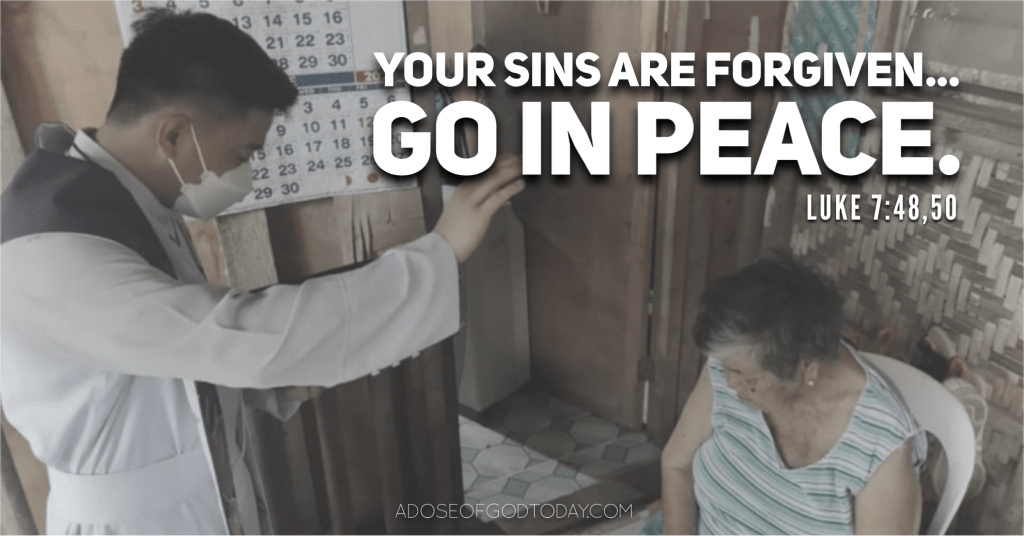
    Once we recognize our sinfulness then it is also God’s opportunity to change our lives and to make us new again. “Recognition and confession of sins” is our humble way of acknowledging that we need mercy and forgiveness, thus, we need God.

    The opposite of this is the denial of ones sins and imperfections. Thus, denial of our need of God and denial of our need of mercy and forgiveness. This happens to us when we have grown righteous. When we begin to think that we have committed no sins, then, we think of ourselves highly to the point of making ourselves above others whom we think as lesser than us.

    This is the story that we have heard in today’s Gospel. The woman who knelt before Jesus represented those who recognized their need of forgiveness. On the other hand, the Pharisee who invited Jesus represented those who do not need forgiveness because they believe that they do not need God.

    Let us see these two personalities to clearly discern God’s invitation for us today.

    The woman who was known to be a public sinner was despised by that Pharisee. He would not even dare talking to her because of fear of being contaminated by her sins. That is why, he felt disgusted with Jesus who allowed this woman to wash his feet with her tears and wipe them with her hair. The woman’s actions were her humble way of recognizing that she was in need of God’s mercy. Despite her sins and the shame that she was bearing, she took the risk to go in public to ask Jesus forgiveness.

    And because the Pharisee thought of himself so highly, never thought that he too was in need of mercy. This attitude of the Pharisee made him condemning of the woman. He was indifferent towards her and saw no hope in her. This will also happen to us when we become righteous and think that we do not need mercy from God. We become persons who easily condemn others. We become persons who do not see hope with those who have failed in their life. We become angry persons and bitter towards others.

    However, Jesus invites us to learn from her. She who recognized her sinfulness, allowed Jesus to transform her life. Her actions towards Jesus was her expression of her affection and at the same time of her need of forgiveness, Jesus who is the face of the Father’s mercy, willingly granted her forgiveness.

    When we become persons who recognize our failures and sins, we become persons who also see hope and life. We become persons who become positive with life and at the same time positive with others. We become happy persons.

    This is what Jesus wants us because recognition and forgiveness of sins allows us to unburden ourselves from guilt. This will also allow God to work in us.

    Thus, do not be afraid of acknowledging ones failures because God always sees hope in us, God does not condemn but grants his mercy and forgiveness to us so that we shall live in peace, freedom and joy. Hinaut pa.

    Jom Baring, CSsR

  • Life and Freedom in forgiveness

    Life and Freedom in forgiveness

    Advertisements

    September 13, 2020 – 24th Sunday in Ordinary Time

    Click here for the readings (https://bible.usccb.org/bible/readings/091320.cfm)

    Homily

    A friend shared her troubles. There have been nights of anguish and sorrow that she was enduring in the past months. The difficult situation of the lockdown and the movement and work restrictions in the City added to her emotional suffering and even heightened the way she’s handling her troubles. There’s so much anger, hatred and self-blame in her heart. Something has triggered her painful memory of the past that relived the physical and emotional abuse she suffered from her father. That painful memory brought fresh anguish and sorrow, as well as those feelings of anger, hatred and self-blame.

    These emotional suffering became episodes of attacks to the point of having sleepless nights and empty feelings during the day. As she said, she could not find a way on how to reconcile things, find peace and realize forgiveness. Her traumatic memory was just too painful to forget.

    Though that memory happened in a distant past but it remains fresh in her mind every time she remembers that. Indeed, this happens when a traumatic memory is merely buried in forgetfulness and covered by pretensions that as if nothing had happened. However, not unless that past of horror is accepted, embraced, confronted and be forgiven and not forgotten, only then, a person achieves peace and reconciliation.

    How important really then, is forgiveness? Is it possible at all to forgive without forgetting?

    This Sunday’s Gospel, the response of Jesus to the question of Peter regarding the number of times to forgive others and the parable he gave to his disciples tell us of God’s invitation to forgive and its important in the way we live our life as Christians and in our desire to live in freedom.

    We have heard Peter how he asked Jesus about how many times he should forgive. For the Jews a righteous man should forgive those who have hurt them for four times. However, Peter exceeded that and made it to seven. He thought he has more than enough. Nevertheless, Jesus responded to him that not just seven times but seventy seven times. The number actually does not matter. What Jesus is saying is that, forgiveness has no limit.

    Why is that? Why forgive without limit? It is even so difficult to forgive even once especially when the person who hurt us is someone we love and someone we trust. As what my friends shared to me, most of our pains are sometimes rooted from our relationships especially when we are betrayed or abused or deceived by a family member or friends.

    The pain and suffering that come from those broken relationships create deep wounds in us. And will forgiveness be possible then? Yes, it is. And forgiveness will always be a call for each of us.

    Hence, unless we find forgiveness in our hearts that begins with accepting and embracing those painful experiences and go on with life, then, we will not be free.

    Remember, forgiveness will make us free. It will not erase the scar of betrayal or of abuse or of deceit in our life but we will be able to stand up, to wipe our tears and go on with life.

    Forgiveness then is not about telling the person, that what he/she did was okay and pretend as if nothing happens. No! Forgiveness is to heal our wounded heart that will make us say to the person, “I forgive you not because of who you are but because of who I am.” This is what the Dalai Lama said.  This means that to forgive is not about to forget. To forgive is not to allow that painful memory to hurt us again in the present and to be freed from grip of violence.

    Forgiveness, then, also is not really for the person who hurt us or those who caused us the pain but rather it is all about us. The pain that we endure will lead us to feelings of anger, hatred and bitterness.  When we linger to these they will lead us to a heart that seeks revenge. This will become our tendency from our belief that by hurting the person back, our anger and hatred will be satisfied. But then, we are wrong because anger and hatred will never be satisfied by violence. Violence will only make us angrier, hateful and bitter person. The more we linger to our pain, anger and hate; they become a cycle that will never end. The Book from Sirach reminds us about this, that wrath and anger are hateful things that we sinners love to hug them tight.

    Advertisements

    This is how a person can create a cycle of violence, of revenge, of anger and hatred mostly directed towards ourselves. We will become prisoner of our own pain. All of these will control our lives, our thoughts and actions. We will never be free. We will begin to become suspicious to our other relationships. We will be afraid of trusting others, of loving others again and even ourselves. We are fearful because we linger to that pain thinking that other people might do it again to us. Hence, the cycle begins.

    This, indeed, is the attitude of an unforgiving person portrayed by Jesus in the parable. The person who was all cleared by the king from his debts became unforgiving and unkind to his fellow servants. Despite the kindness and the forgiveness shown by the king to him, he turned to be filled with hatred and resentment towards those who were indebted to him. He was violent, vicious and hateful. Thus, while causing pain and damage to others because of being unforgiving, he too later on was punished and suffered more.

    This is what Jesus is saying to us now and he wants us to forgive many times because a single un-forgiveness will only make us prisoner of our own pain and hatred. Jesus wants us to be free and not prisoners of anger, hatred, and bitterness or of violence. Jesus invites us to find life and freedom in forgiveness.

    In this way, we may always find reconciliation with God and with those who have hurt us so that in return, we too shall also be forgiven by those we hurt in one way or in many ways. Hinaut pa.

    Jom Baring, CSsR

  • Be united in prayer because Christ is in the midst of us

    Be united in prayer because Christ is in the midst of us

    Advertisements

    September 6, 2020 –  23rd Sunday in Ordinary Time

    Click here for the readings (https://bible.usccb.org/bible/readings/090620.cfm)

    Homily

    Who wants to be corrected? Who wants to be criticized? Being with our friends, with our family or with a community, we cannot really avoid conflicts and tensions. However, a particular difficult situation can be more problematic when we become unwelcoming to corrections and to criticism.

    Jesus, in today’s Gospel offers us practical steps to overcome such situations in order to arrive in a mature way of attaining peace and reconciliation.

    Let us also bear in mind that because of the biases and discriminations that have been built up in us, we can become vicious when we are confronted by others because of our faults. That’s why, Jesus told us how to approach gently a person when we confront them of their faults or when we are being confronted. Yet, knowing that we can exercise forms of denial and refusal to admit our mistakes, then, Jesus affirms the need of the participation of the community. The Lord affirms this as he told us, “for where two or three are gathered together in my name, there am I in the midst of them.”

    Before I proceed deeper into the participation of the community, I would like to invite you that we look first and remind ourselves of our tendency to deny and refuse to be confronted and criticized of our sins and failures.

    Thus, I would like to share with you the two forms of denial that may become our attitude when confronted by others.

    First, when confronted, we might tend to overemphasize the faults of others yet; there will be no acknowledgement of our personal defects and sinfulness. This overemphasis of the faults of others is a mere cover up of one’s skeletons hidden in the closet. It is a way of taking revenge cruelly.

    Second, when confronted, we could display an air of self-righteousness and arrogance in our hearts; claiming that we are always right and good and never committed any mistake. As a result, we could become violent to our critics and would even seek to destroy them. This kind of attitude boasts oneself of his or her good image but hungry of recognition and praise from people around him or her.

    Moreover, there is actually wisdom and goodness in criticism in itself and by being confronted by others. This is how others, friends, family members and our community play a big role  in conversion and transformation.

    Nevertheless, we also remind ourselves also of these two kinds of criticism. There is a constructive criticism and destructive criticism.

    A constructive criticism seeks the good of my brother and sister. In this criticism, we do not seek to ridicule the person but to help the person to grow and learn from mistakes and failures. It gives both positive and negative feedbacks. This is done with honesty and sincerity. St Paul in his letter to the Romans reminded us too to express our love for one another. Indeed, in this way we express it concretely because this seeks the good of the others. We fulfill, then, the law, because it does no evil to our neighbor, but goodness and love.

    This is basically what Jesus offers us in the Gospel today.

    Jesus offers us to do it intimately and confront the person personally. If this will not work, then, Jesus suggests to bring a common friend to serve as a mediator. Yet, if the two will not work and the person continues to refuse, then we seek the judgment of the community or of the Church.

    On the other hand, what we avoid and what Jesus does not want to happen is when we choose the destructive criticism, which is hateful because it desires damage to my brother and sister. It is destructive because it puts down and humiliates the person and has no desire to help the person to grow and to learn. Destructive criticism is a mere accusation that is filled with bitterness and hate.

    Thus, this is done with evil intent. It is usually done when we talk behind the person in initiating, perpetrating and joining others to destroy the image of a person, like in gossiping.

    Advertisements

    Jesus does not want us to be that bitter and hateful accuser of our brothers and sisters but rather disciples of him who are humble enough to recognize our wrongdoings, and courageous enough to speak what is unjust and oppressive around us. Jesus desires that each of us becomes free by being able to recognize our sins so that transformation of hearts will be possible. It is in this way that we become a help to one another, so that as parents, leaders, mentors and authority figures, we will not be leading others blindly but with humility and willingness to be corrected, affirmed and challenged.

    This is where we can find the need of the participation of the community, and that is to be united in prayer. To be united in prayer is to become discerning both in our words and actions. To be united in prayer also practically suggests that we are in a community, and we are a community. When we become united in prayer, then, we allow the Lord to be present in us.

    Thus, to be able to truly confront the sins and failures present in our community, we are called also that we unite in prayer. This also include that we bring, in the spirit of prayer, our effort to confront and correct one another so that we will grow and become the persons God wants us to be.

    To be united in prayer is not just about asking God’s favor to grant our petitions. To be united in prayer then, is to pray in the name of Jesus and that is according to the mind, heart and will of the Lord.

    To be united in prayer also means to change our hearts and minds according to the will of God and not changing God’s mind and heart according to our own desires. As a community, this will help us to be able to trust in God and to give our hearts to God so that we can grow according to God’s desire for us. Hinaut pa.

    Jom Baring, CSsR

  • To offer no resistance to one who is evil?

    To offer no resistance to one who is evil?

    Advertisements

    June 15, 2020 – Monday of the 11th Week in Ordinary Time

    Click here for the readings (http://www.usccb.org/bible/readings/061520.cfm)

    Violent, cruel, brutal and merciless are some of the words we could describe on what happened with Naboth the Jezreelite. A man who refused to give up his ancestral heritage was falsely accused, treated with so much brutality, viciously framed for a crime he did not commit and murdered in daylight by the minions of Jezebel.

    No one stood for Naboth. Nobody dared to speak on his behalf. The minions just followed the order from above perhaps they too were more excited of what they can gain from participating in such crime.

    Ahab, on the other hand though did not commit the crime directly but played passively. He was passive because he did not want to be involved himself. Yet, he did not also choose to stop Jezebel because he knew he would be able to benefit from such corrupt and murderous act of her wife.

    This tells us really that no matter how much possessions we may have or no matter how secured we can be materially, or no matter how much power and influence we may possess, it does not mean that we will be satisfied. This has been shown already by Ahab even before the murder. Ahab was disturbed and angry because he did not get what he wanted though he did not need it. Thus, in that greed of Ahab through the cunning and vicious plans and actions of Jezebel, the little possession of Naboth was taken away from him including his life.

    Is God then, blind to this kind of crime committed against the weak and powerless? Our Psalm proclaims to us today the prayer of a man like Naboth, Lord, listen to my groaning.” This is an appeal to the Lord to listen to that groan filled with pain. It is a cry for help from a person who find life too much to bear because of the exploitation and abuse from others.

    The author of the Psalm also recognized that indeed, the Lord is not blind or deaf to that painful groan for the Lord abhors the bloodthirsty and the deceitful. This is the very image that Jezebel gained after that murderous act, bloodthirsty and deceitful.

    However, what is more puzzling in today’s God’s invitation for us is what Jesus tells us in the Gospel,offer no resistance to one who is evil.”

    Does it mean that we become passive to the abuses committed against us, against the weak and the powerless? In the case of Naboth, it was perhaps even impossible to resist because the evil scheme against him was just too overwhelming. He was alone.

    However, to offer no resistance to one who is evil has a deeper meaning. Not to resist to one who is evil, is not allowing evil to control us. Meaning, once we resist to one who is evil, this may bring us into the same position of the one who is evil. We shall tend to resort to the same violence, then. Hence, responding evil with evil or responding to violence with violence will only bring us into an endless cycle of evil and violence.

    Hence, responding evil with evil or responding to violence with violence will only bring us into an endless cycle of evil and violence.

    The wisdom of Jesus lies in the offer of peace. To offer the other cheek when someone strikes us on the right cheek, though this sounds ridiculous for many of us, is an opportunity for the one who hurt us to embrace peace and reconciliation. Peace and reconciliation is truly a difficult path. A very unpopular one. However, this is the only way to end the cycle violence and evil.

    Advertisements

    Moreover, this is not an excuse to just remain passive to the abuses and other forms of oppression. It does not mean that when your spouse physically abuse you, or a family member is sexually abusing you, or a friend or colleague is exploiting your goodness and generosity, that you remain passive and indifferent. The teaching of Jesus is meant to keep violence at the minimum and not to escalate more violence towards others and ourselves. In such situations, we are called to get out from the abusive relationship and to demand justice and show mercy.

    To demand justice then is to make the perpetrator take the responsibility and consequences. To show mercy is to get rid of hatred and anger within our hearts for us to live free by offering peace and reconciliation towards those who have wronged us.

    Therefore, God invites us today to live freely by not allowing evil to control us or to have an access to our hearts by holding on to grudges, hatred, anger and selfishness. God calls us to be more satisfied with what we have and to be grateful of the blessing God gave to us so that unlike Ahab, our hearts won’t grow ungrateful and corrupt. God calls us too that in the event when an evil act is committed against us, do not give a chance to evil to have a control over us by resorting to evil also. Jesus calls us to offer peace, not violence, not anger, not hatred, but also not for a passive peace or an indifferent one. Offer peace that gives and promotes life. Hinaut pa.

    Jom Baring, CSsR

  • How often do you worry?

    How often do you worry?

    Advertisements

    May 12, 2020 – Tuesday 5th Week of Easter

    Click here for the readings (http://www.usccb.org/bible/readings/051220.cfm)

    How often do you worry?

    I am sure that we would find ourselves worrying about many things in life, almost everyday. You worry about your husband or your wife, or your growing children and the failing health of your parents. Or we worry about the demands of our job or the difficulties in our business, or about your new relationships, and newfound friends. We might also find ourselves worrying about our tomorrow, of what is to come the next day because of the uncertainties brought by the pandemic. Or worrying also about our unfulfilled dreams and unsatisfied desires.

    Our worries and anxieties may prevent us from seeing things as they are because our minds and hearts are already troubled. When worries and anxieties overwhelm us too, we might not be able to respond properly and responsibly because we are internally disturbed. 

    Indeed, excessive worrying may lead us to high anxiety, which may cause us physical and mental illness. When this comes, our decision making process is also affected and our relationships with others and even with God will suffer.

    That is why; it is very important that we remain calm and at peace with ourselves and with what surrounds us. It is in this way that we will be able to move forward with our life and will be able to respond generously to what God calls us to be.

    Today, the Risen Jesus invites us to be confident with the gift that his resurrection brings to us. Jesus said, “Peace I leave with you; my peace I give to you but not as the world gives, do I give it to you. Do not let your hearts be troubled or afraid.”

    It would be good for us to see and understand what Jesus was saying about the peace that he gives and the peace that the world gives.

    Let us see first to what Jesus said about the peace that the world gives. We may understand that what the world tells us about peace is the normalcy of life or ‘business-as-usual.’ This means that we go and proceed to what we usually do in life by doing what we want and by satisfying our needs and desires. But is it really peace at all?

    The peace that the world gives is shallow and remains self-centered. This peace focuses on our ego. But then, when the ego is not satisfied then the promised peace is lost because worries and anxieties will overwhelm us again.

    However, the peace Jesus gives is something different. This peace is growing in confidence with God, with my brothers and sisters no matter who they are. Thus, this peace allows us to see and recognize our brothers and sisters. This peace breaks any form of division, discrimination and indifference.

    This goes beyond to what is physical but into our hearts, in believing and becoming confident that God is with us and that God never abandons us. This peace sips through our troubled life, even into our stressful work or ministry, and into our un-reconciled relationships, into our danger-filled surrounding brought by covid-19, into the many displacements and halting of our so-called normal life before the Covid-19,  and into our anxieties of what is to come tomorrow.

    Advertisements

    Jesus gives us His Peace! This is Jesus’ gift to us. Are we ready to accept it? Are we willing to embrace it? Or do we prefer to just do our normal and usual things in life? To continue making ourselves submerged in worries and anxieties of life?

    Jesus wants us to be free from the troubles of worries and anxieties, to be free from fears and hesitations. This is the reason why the Lord gives Himself to us so that we will have him and enjoy his peace.

    Be confident that the Lord is with us; the Holy Spirit is among us and within us. By becoming confident in Jesus, we may also recognize the peace that others may bring into our lives. Hence, be welcoming also of the peace that our brothers and sisters may bring into our life.

    Peace be with you always. Hinaut pa. 

    Jom Baring, CSsR

    Join 2,860 other subscribers