Tag: Ordinary Time

  • Ask, Seek and Knock

    Ask, Seek and Knock

    Advertisements

    October 8, 2020 – Thursday of the 27th Week in Ordinary Time

    Click here for the readings (https://bible.usccb.org/bible/readings/100820.cfm)

    Homily

    Is prayer an obligation? Many of us must have felt that prayer is an obligation, that it is some kind of a to-do list item or like a house chore that one must observe and follow. When I was young, I was taught that I “must and should” pray so that I become a good boy and God will not get angry. Many of us have developed ways of praying and different devotional practices like praying the rosary and the various novenas to the saints. Yet, many of us would always believe that prayer is indeed an obligation.

    Moreover, for us religious (priests, consecrated brothers and nuns) are actually obligated to observe our prayer schedules as defined by our Constitutions and Statutes. No wonder, that because of this “obligation to pray” we become guilty when we are not able to observe our prayers. People come to confession because of the guilt feelings of not being able to observe faithfully their prayers.

    However, did Jesus really mean that we are obligated to pray?

    Today’s Gospel on the “persistence in prayer” is a continuation of yesterday’s Gospel. Yesterday, the disciples asked Jesus to teach them to pray. This means that it was the disciples’ desire to learn how to pray. Never did Jesus impose it to the disciples. The disciples recognized the importance of prayer because they realized that this was a way of developing a closer relationship with God, to a deeper friendship with the Lord. This is the invitation for us today.

    On these particular verses of Luke’s Gospel, Jesus elaborated on how one should dispose himself/herself in prayer in order to develop ones friendship with God. Indeed, Jesus teaches us to be persistent in prayer and to continuously develop our closeness with the Lord. Jesus gives us these three attitudes in praying.

    ASK. Before we can truly ask the Lord, we also need to recognize and identify our need. Recognizing what we need means acknowledging our limitations, our emptiness, our failures and our powerlessness. This also needs an amount of humility to bow our heads and recognize that God truly fulfills and satisfies our hearts. This brings us into a deeper awareness of ourselves and to become more accepting of ourselves. Only then, that we can truly ask the Lord to satisfy the deepest desire of our hearts, and we shall surely receive the grace. Therefore, stop for a moment and pause.

    Seek. In the process of asking the Lord for the grace we need, there will be surely a time of becoming weary and anxious. We might feel that God is taking too long to answer and grant our prayers. Doubts may hit us thinking that we might have been forgotten. Thus, prayer also involves “seeking” as in “searching.” Prayer, then, is also a form of searching what is hidden and what remains undiscovered in us, waiting to be found. We don’t search for God for God has not been lost. We continuously seek and search ourselves and to let God find us. Thus, seek for a deeper insight, seek for understanding and wisdom because God answers us not outside of us but within our own context, experiences and relationships. Open the scriptures and seek God’s wisdom.

    KNOCK. God always waits for us to come closer and to dwell in God’s presence. When everything else in life will seem to be burdensome, we long for comfort. As demands from work, from home and from our relationship, and expectations from others begin to suffocate us, we long for a break. When failures, pains and guilt begin to take hold of us, we long for an embrace that will give us assurance of love and mercy. To pray is to come closer to God in order to knock the door of His heart. When we come and knock at God’s door, God is most willing to embrace us with His presence, with his forgiveness and mercy. To pray, then, is to seek entrance in God’s heart and to be welcomed by Him. Thus, never be afraid to knock because God is ready to open up His arms to embrace us. Come to the sacraments and be embraced by God’s grace.

    With these three attitudes in praying, these tell us now that prayer is never an obligation but more than that. To pray is a privilege given to us to build our friendship with God. When we pray, then, we embrace that opportunity to grow in the knowledge of ourselves and knowledge of God. The more we pray, the more we see ourselves. The more we become persistent in praying, the more we recognize the Lord’s presence in our life, both as individuals and as a community.

    Hence, move beyond obligation and instead, pray maturely and freely as we build deeper and intimately our friendship with God and with one another. Hinaut pa.

    Jom Baring, CSsR

  • How to find peace in our days filled with worries

    How to find peace in our days filled with worries

    October 6, 2020 – Tuesday of the 27th Week in Ordinary Time

    Click here for the readings (https://bible.usccb.org/bible/readings/100620.cfm)

    Homily

    Are you feeling overwhelming pressures from all sides these days? Pressure from work, pressure in your family caused by conflicts or demanding responsibilities, pressure caused by financial difficulties, pressure from your personal and trouble-filled romantic relationship could pile up until you feel suffocating. Students, perhaps, because of the new mode of learning, though are already familiar with latest technology, but still struggling these days due to the demands in their online classes and at home while suffering from emotional pain. These are just few examples that we are feeling these days considering also how we adjust ourselves with this pandemic around us.

    With all of these, we also desire and hope for ways to better handle and manage these pressures that make us worry and troubled emotionally and spiritually. We desire peaceful nights where we can sleep free from worries. We long for a mind and a heart that though we continue to live in the midst of troubles and worries in life, but we could maintain a balanced way of life.

    With the extra challenge of Covid-19 pandemic, the more we long for this today. Thus, it would be very good to find better ways and healthy ways of handling and managing the different pressures and worries we have in life for our mental and spiritual health. Our Gospel today suggests something that we could learn and adopt and develop into a habit. What the Gospel teaches us is a good way indeed, of maintaining balance and healthy awareness of oneself and of God’s presence in us.

    This Gospel story tells us of Martha and Mary, sisters of Lazarus and good friends of Jesus. Let us see a bit deeper the different responses of Martha and Mary as they welcomed Jesus into their home.

    It was Martha who welcomed Jesus into her home. Being friends of the Lord, it was Martha’s delight to welcome and receive Jesus. Martha being a concerned woman wanted to make the Lord and the disciples comfortable. Her concern and generosity made her busy with many things in the house. She must have been very busy cooking, providing food and drinks and serving the Lord. Yet, in her effort to do all of these, she grew worried and pressured. She must have done that out of generosity. Though she was not duty bound, but felt responsible. Yet, along the way, Martha must have lost her focus on the Lord. She was dominated by the pressures of serving the men and providing their comfort. She must have felt tired.

    This was the reason why Martha sounded annoyed, troubled and restless. She became more concerned in “doing” that in the process she lost and forgot that “one important thing – Jesus.” With this, Martha lost her peace of mind and had lost the opportunity of spending quality time with Jesus who have come to visit them.

    Well, Martha just did what was natural in their culture, and that was to express her hospitality to Jesus. However, when we let the different pressures around us to dominate our mind and heart and attitude, then, we too, like Martha will lose the opportunity of enjoying the presence and the company of people who love us.

    Indeed, as Jesus identified Martha’s problem, “of being worried and troubled about many things,” he also emphasized the value of taking the opportunity of enjoying the comfort of the presence of those who love us. This was what Mary did. Mary sat at the feet of Jesus and listened to the words of the Lord. Mary set aside those troubles and worries first in order to make more time with the Lord. Mary did this because she knew that what the Lord requires her to do was not to do many things, but just to “waste time” with God at that moment.

    Mary’s response made her more aware of Jesus’ presence and thus of her need of God. It was Jesus who visited them. This means that it was God who initiated the visit. Jesus came to visit them. Jesus wanted their company and desired that his friends will spend more time with him. Certainly, Mary found peace even in the midst of the worries and troubles in life.

    There are three invitations that I would like you to remember today so that like Mary, we too shall find peace even though worries and troubles, difficulties and challenges remain. What surrounds us is beyond our control but what we can do is to change our attitude and response to what surround us. So, remember these.

    1. Be aware of God’s visits. God visits us to surprise us any day and in any time of the day. God’s presence could be revealed through a friend, an encounter with a stranger or an event. We are called to be always welcoming of God’s presence and be filled with God’s peace through others.

    2. Develop a habit to spend time alone with God. To be able to spend few minutes alone will allow us to gather our thoughts, to subside our strong feelings and emotional reactions, and to see things clearly. Having this time allows us also to become discerning in our actions and thoughts for us to respond to a particular situation in a mature and healthy way and according to God’s desire for us.

    3. Spend quality time with people whom you love and who love you. To do this, we also need to be more aware of what is happening in us and around us. By recognizing what troubles us and what makes us worry, allows us to be more open to our loved ones. Thus, by spending quality time with them, we become more assured of their presence and find comfort in their love for us. This was the experience of Mary. She indeed found assurance in God’s love and comfort in God’s presence, thus, she found peace. Hinaut pa.

    Jom Baring, CSsR

  • Not Yours or Mine but HIS

    Not Yours or Mine but HIS

    Advertisements

    October 4, 2020 – 27th Sunday in Ordinary Time

    Click here for the readings (https://bible.usccb.org/bible/readings/100420.cfm)

    Homily

    For pasalubong, a madre once bought a box of munchkins from dunkin doughnut. While waiting for their flight, a family sat beside her at the pre-departure area. Giving in to her cravings for sweets, the sister took a munchkin from the box, and enjoyed eating it. Suddenly, from the same box the little boy also took and ate one. She did not mine at first, thinking the boy must be hungry. But then, the ate also took and ate one. This has upset the madre but she just ignored it and took one for herself. But then so did the nanay and tatay. This really irritated her that she glared at the family who was consuming the rest of the munchkins. But what really infuriated her was when the nanay took the last munchkin and offered it to her. Now indignant and so enraged, the sister stood up and changed her seat. But later on, when she opened her tote bag to get her purse, she saw, much to her embarrassment and shame that inside her bag was her own box of munchkins unopened. “Opps, hindi pala kanya yon.”

    Sometimes it is good to examine and ask ourselves: “What are the things that we claim as being rightly ours and yet are not truly ours?” This may not only be material possessions but could also be our status in society used to lord over others… titles used for personal advantages, prejudices and biases harbored towards others… or self-righteous behaviors that makes us feel morally better or more privilege or important than others. Sometimes, we are not different from that madre. We sometimes claim these privileges, which do not really belong to us, that we come to think and believe that they are only ours to own. Worse, we are sometimes greedy enough to claim that we are the rightful owners of the munchkins and it is only us to have and enjoy.

    Certainly Jesus would not tolerate and justify such behavior of distinctiveness, self-righteousness, greed and conceit. This is what Jesus criticizes here in our gospel today. 

    By telling us the parable of Ungrateful Tenants, he reminds us that God has already done His part for our salvation, and that we should also do our part. And our part is not to hoard, accumulate and own all the blessings He has given us but to produce its fruits and share it with others. Here, Jesus strongly condemned the Pharisees and scribes of his time and warns us of our tendency to be so pre-occupied with honor, recognition, privileges, titles, and social status – thinking and claiming that we are greater compared to others, and much worse, even resorting to greed, fraud, and murder, (pangdaraya, kaswapangan at pagpatay) in order to protect and maintain such claim.

    For Jesus, the Kingdom of God is wider than our human standards of social status and privileges. He reminds us today that we are not the rightful owners but mere tenants, sharers, benefactors or stewards of God’s graces. We cannot exclusively claim ownership and privilege for what we have, because everything we have is a gift from God.  For Him, God’s Kingdom is more like a big farm where all of us participates and shares in the production and fruits of the bounty, where each of us has something to contribute and benefit from, since no one is too poor who cannot share with others and no one is too rich who does not need others. 

    Our Eucharist today has a simple message: What you enjoy now are not only fruits of your labor but most of all, God’s gifts.  All of these are God’s blessings to you and for all of us. Accept the Gift, but don’t forget to acknowledge and thank the Giver. Be fruitful and share the fruits of God’s kingdom to others, for all these are not yours or mine, but His.

    Life on quarantine during these pandemic times do make us reflect and realize that our life is essentially on-loan, a God-given chance to live and create this life now. What we have now are just but borrowed time, talents and treasures to make life fruitful and bountiful for all. Somehow pandemic times is God’s way of pruning and forming us to be who we are and we should be – His stewards, mere tenants of His creation. Grant us, O Lord the humility to trust your Ways of creating anew our lives according to your Will. Amen.

    By  Fr. Aphelie Mario Masangcay, CSsR (a former Filipino Redemptorist Missionary for Filipino Migrants in South Korea who, due to immune compromised diabetic condition, stationed back home  in the Philippines for now).

  • Will you also reject God?

    Will you also reject God?

    Advertisements

    October 4, 2020 – 27th Sunday in Ordinary Time

    Click here for the readings (https://bible.usccb.org/bible/readings/100420.cfm)

    Homily

    Being rejected or to experience rejection is truly a terrible experience. When someone you love, a friend or family member rejects you for being who you are and for what you have done, is so painful. This experience creates emptiness in us and feelings of not being loved, not being wanted. This experience makes us worthless and useless, thus, traumatic. We experience this also in our workplaces when a co-worker and/or  your employer get angry at you and shows sour attitude towards you. Or when your work has been rejected or a proposal has not been approved because of their biases with you.

    In our community, there are many forms of rejection also that sometimes we are not aware of. We could just reject those whom we think are useless. We could easily not pay attention to those who do not belong in our circle of friends. We could just dismiss a person just because of appearance, education, family background or culture.

    These kinds of rejections are not alien to God. Our Gospel this Sunday tells us that God is also experiencing rejections from us. Yes, God has been rejected by us in many ways. Jesus describes this in the parable. The tenants of the vineyard rejected the emissaries of the landowner by killing them, and even his own son.

    This describes on how Israel repeadtedly rejected Yahweh by murdering the prophets sent for Israel’s conversion. However, the people’s response was of violence. The people rejected God’s messengers and killed them. It culminated in the life of Jesus, the Son of God. Indeed, Jesus, even though he is the Son of God had also been rejected. Only few recognized him as the Messiah. Many, especially the leaders of the Jewish people, failed to recognize and even refused to believe that he is indeed the Messiah. Hence, they killed him by nailing him on the cross, a shameful way of killing.

    God is still being rejected by us until today. We are doing it in many ways and even in creative ways. We reject God because we want our own ways. We reject him because we want to believe what we like to believe. We fall short on this when we think that we know better than God. That is why, we have the tendency to linger on GUILT, to always feel guilty of what we have done instead of feeling sorry of our sins and ask God’s forgiveness and accept God’s mercy.

    We reject God when we refuse to recognize his many appearances through the people we encounter. We reject God when we fail to recognize his presence in each of us. We reject God when we judge others. We reject God when we tend to believe that sinners such as alcoholics, drug addicts are less humans than us. Thus, we tend to believe that they are worthless and are good for nothing. We reject God when we continue to deprive others, when we continue to oppress and refuse to extend help to those who are in need. We reject God when we fail to see his face in each of us especially among us sinners, the poor and the oppressed.

    God hungers for you and me. He hungers for our attention and love. He hungers for our goodness and generosity that we are called to show to the needy; because in these ways we become a people of God who shows what is just, lovely, pure and gracious as what St. Paul told us in the second reading.

    God calls us today to recognize him, to feel his presence and to listen to what he is saying to us. I would like to invite you then to close your eyes… and remember those times when you failed to recognize God by rejecting the goodness of others, by judging the weaknesses of others, and by not accepting and embracing your own gifts, talents and also failures and weaknesses in life.

    Let us be sorry then, and ask God’s forgiveness so that we will be able to feel and recognize him in us and through others. In this way, we may able to receive the Body of Christ in our Eucharistic Celebration with joy in our hearts. Hinaut pa.

    Jom Baring, CSsR

  • In our Capacity to receive and embrace

    In our Capacity to receive and embrace

    Advertisements

    September 28, 2020 – Monday of the 26th Week in Ordinary Time (Feast of San Lorenzo Ruiz)

    Click here for the readings (https://bible.usccb.org/bible/readings/092820.cfm)

    Homily

    Look at how the disciples behaved themselves. This passage of the Gospel of Luke tells us how the disciples argued among themselves on who was the greatest among them. They must have been boasting one another about their closeness with Jesus, their great qualities, their faithfulness, on who was the first to be called and who was the favored one among them. Their argument must have been fierce because it reached the ears of Jesus. Jesus heard not just their words but even realized the intention of their hearts.

    At this point, the disciples thought that Jesus’ kingdom will be like those of kings sitting on a golden throne in the palace with a great army, a political king. They believed that Jesus will inherit political power and vast riches and material wealth. Thus, obtaining a position and having a closer relationship with Jesus will give them the security and assurance of a higher and influential position when Jesus reigns.

    Consequently, the argument of the disciples was based on how they could benefit from their friendship with the Lord. As Jesus heard them, he too realized that this was in the heart of the disciples. Jesus had to teach them and to mold their hearts according to God’s desire.

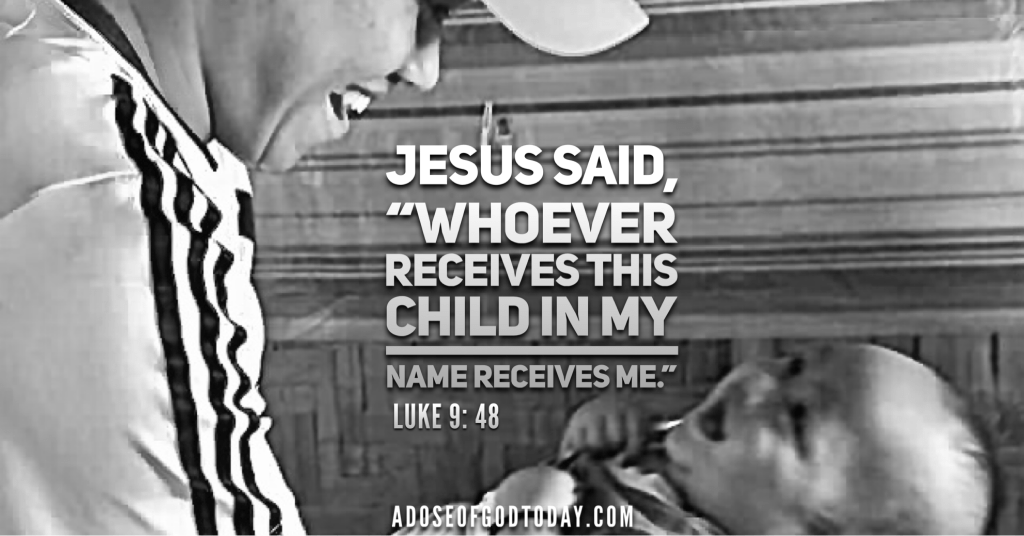
    That’s why Jesus taught the disciples an important lesson through a child. Jesus took and placed the child by his side and said, “Whoever receives this child in my name receives me, and whoever receives me receives the one who sent me. For the one who is least among all of you is the one who is the greatest.”

    Children, at the time of Jesus were considered not important because they were dependent, they have no rights and thus cannot be called as fully man at all. Jesus teaches that in the Kingdom of God, greatness is measured in the capacity to receive God. To receive God is best expressed in welcoming, in embracing and in receiving the least in our community.

    We are called to receive God in the person of those who are the least in our church and society. We are called to aspire to be great but neither in the way that we will be above others, nor to seek a higher position at the expense of others, but in the way of embracing others.

    This capacity to embrace others and embrace God fully was what San Lorenzo Ruiz showed to us. In offering his life, even to the point of death, San Lorenzo was always confident that Jesus was with him. He said, “If I have thousands of lives, all of them, I will offer to God.” This shows us that San Lorenzo had found himself, the kingdom.

    Thus, we shall surely see that when we make ourselves open to receive others, we too shall receive Jesus and Jesus will live in us. This is the reward, Jesus himself. The kingdom of God will be present in us because when we have Jesus, we will be at peace, secured and loved even if we are in the midst of trials and turmoil in life. Hinaut pa.

    Jom Baring, CSsR