Tag: Ordinary Time

  • Our Experiences of Waiting

    Our Experiences of Waiting

    October 20, 2020 – Tuesday of the 29th Week in Ordinary Time

    Click here for the readings (https://bible.usccb.org/bible/readings/102020.cfm)

    Homily

    We must have experienced in many ways the reality of waiting. These days, many have exercised their patience to wait for the arrival of their item ordered online. Others may have experienced to wait outside before they can enter a establishment because of the enforced health protocols. Others may be waiting for their medical result that causes anxiety because it may not be too good. Others too may be waiting to be given attention by their loved one and be given a chance to be loved again. Others also may be waiting to be forgiven and hoping to be embraced. Today, the whole human family is also waiting for the vaccine to be fully developed in order to fight Covid-19.

    These are just few examples of waiting that we experience daily. Some forms of waiting may be small and simple, but some could mean a long waiting, a tiring waiting and a painful waiting.

    With this reality of waiting in our life, there is another form of waiting and welcoming that is fairly significant for us to be given importance and attention. This is the “waiting of the Lord’s everyday coming” and “welcoming him daily.”

    Indeed, the Lord comes to us and also waits that he will be welcomed by us. This is portrayed today through the story in the Gospel. Jesus declares how blessed are those servants who awaits the return of their master because the presence of the master means something very great. Jesus gives us the image of the presence of the master who serves his servants and enjoys the company of his servants.

    Jesus emphasizes the importance to await and to be vigilant at all times to welcome him when he comes. The attitude of anticipating and being attentive to God’s coming is characterized by a joyful manner. Thus, to expect and to wait Jesus’ coming does not only require us to sit straight, but also to expect him with joy and with a dose of surprise.

    Let us remember, God’s manifestations of his presence and the revelations of his grace are done even in silence. Consequently, when God reveals himself, it is simple, humble and even ordinary.

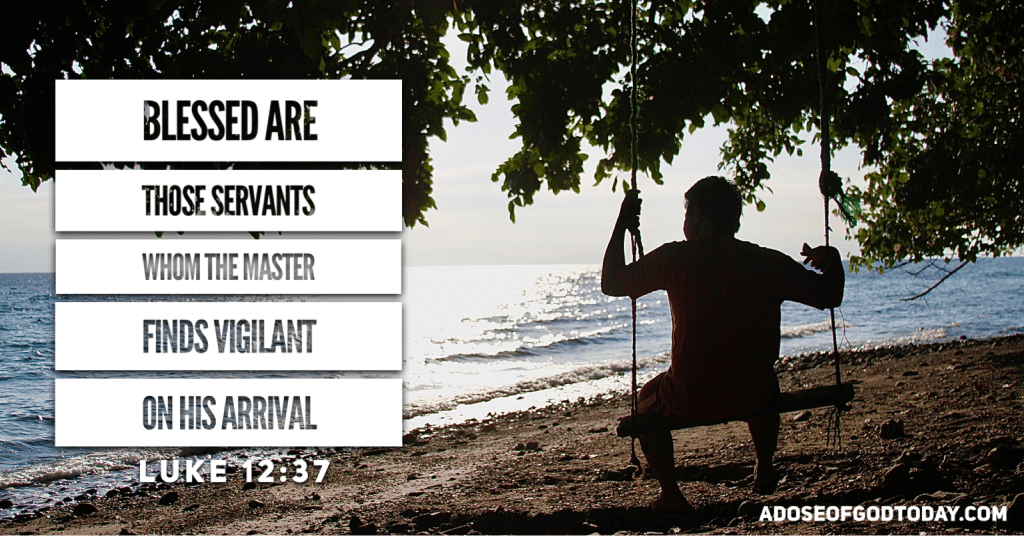
    Again, Jesus reminds us today in the Gospel “blessed are those servants whom the master finds vigilant on his arrival,” because the master himself brings peace. This is affirmed also today in our first reading. Paul tells us in his letter to the Ephesians that, “Christ is our peace.” Moreover, our Psalm also proclaims to us, “The Lord speaks of peace to his people.

    Therefore, Jesus wants us to await and be always attentive to his many surprises for us and to his simple revelations in us, in our daily life – wherever we are. Jesus calls us to expect, anticipate and await with joy his everyday coming to assure us of his abiding and ever-faithful presence. It is God’s promise that he brings peace to us to dispel the worries and anxieties, the boredom and the tiredness in our hearts from waiting, from whatever kind of waiting we may be enduring this moment.

    As we wait and welcome the Lord, may our daily encounter with him become life-changing and reassuring. Hinaut pa.

    Jom Baring, CSsR

  • The danger of being possessed by greed

    The danger of being possessed by greed

    October 19, 2020 – Monday of the 29th Week in Ordinary Time

    Click here for the readings (https://bible.usccb.org/bible/readings/101920.cfm)

    Homily

    To possess material wealth is not evil. Material wealth is God’s gift to us. However, material wealth becomes a problem if we would allow this to possess us. This becomes problematic especially among families who have wealth to inherit. This causes conflicts and misunderstanding that would even reach to lawsuits and broken family relations. This is something we have heard in today’s Gospel from a man who asked Jesus to help him so that he too will have a share from his family inheritance. Indeed, we might believe that to possess so much wealth will give us security and joy.

    However, this is not the case because the more we possess things, the more we also become insecure and anxious. Just observe ourselves. The more a person possess wealth, the more the person becomes defensive. High walls are built to protect a rich house, sometimes with electric current running 24/7 on barb wires and with a 24-hour security personnel. And when the person becomes unaware of his/her unquenchable desire to possess more, then, the heart turns greedy and insecure, and even corrupt and oppressive.

    Jesus warns us of our tendency to be greedy and the danger of being possessed by greed. Greed comes from a heart that believes in self-containment and self-satisfaction and that desires total independence from God. But then, material things could never quench our greatest desire to be satisfied and fulfilled. Thus, a person will tend to accumulate more and possess more even at the expense of others.

    This is how the cycle of corruption and oppression happen. When our desire becomes unsatisfiable, we become greedy of many things, who will tend to collect as many material things and wealth us much as possible.

    Such attitude will not just appear in our heart out of nowhere. Sometimes, this has something to do from our childhood memories. A child who has been deprived from many things particularly of essential things in the child’s development such us food, shelter, toys and clothing and even affection and love from parents, may become a form of emptiness in the heart of a child. When the child becomes adult, that kind of experience could give the person the anxiety to be deprived again. Hence, in order to gratify such anxiety, the person could become a hoarder who accumulate things and possessions.

    When this happens too, a hoarder or a greedy person is blinded to see the needs of others. It will be difficult for the person to open up and be generous to those who are in need around him or her because the person feels insecure every time he or she gives.  The person would only look at his/herself and never to others. This is now an attitude of the heart that is truly being possessed by possessions.

    Thus, Jesus said, “Take care to guard against all greed, for though one may be rich, one’s life does not consist of possessions.” Jesus tells us that our life is more than our possessions.

    Be mindful, then, of our possessive attitudes because these may affect and endanger our relationships with our families, friends and colleagues.

    We may ask, what is it that possessed me? What are those that kept me from being free? We do not have to think of millions of pesos because even a single smartphone may possess us. Remember, when we put so much focus and attention to a material thing, it could make us indifferent, greedy and unkind towards others. Our attachment to a single smartphone may indeed, prevent us from giving more time, attention and focus towards our studies (for the students), or may prevent us from giving our affection and presence to our loved ones.

    We believe that what gives us true satisfaction, freedom, joy and contentment is a life with God. Jesus calls today to have a life with Him and to let go of whatever that possessed us because this is the way of making ourselves free and happy. Then, by being free, we shall be able to let ourselves be satisfied truly by the Lord himself. In response, our self-satisfaction from the Lord will lead us to recognize that everything we have is God’s blessing that must be shared to others. Hinaut pa.

    Jom Baring, CSsR

  • GETs mo? Paminaw ba… Listen Please.

    GETs mo? Paminaw ba… Listen Please.

    Advertisements

    October 18, 2020 – 29th Sunday in Ordinary Time

    World Mission Sunday and Sunday for Cultures

    Click here for the readings (https://bible.usccb.org/bible/readings/101820.cfm)

    Homily

    Two priests were walking in a downtown area. Suddenly, one suddenly stop and said, “Listen to the lovely sound of that cricket.” The other listened, but heard nothing. Turning to his priest friend, he asked, “How in the world can you hear the sound of a cricket amidst all these traffic noise and people?” His priest-friend didn’t explain. He simply took coins out of his pocket and dropped them on the sidewalk, whereupon a dozen people began to stop and look on them. Then he said, ‘Now do you understand? People hear the dropping sounds of coins but they are not able to hear the lovely sound of the cricket. We only hear what we listen & we listen only for what we want to hear.”

    Surely this piece of wisdom is real and true in our life. Human as we are, we do have some problems with our hearing. We only hear and listen to what we want and use and to hear. Thus, we listen to things not as they are, but as We are – from our own biased perspectives and preferences. That is why this is called selective hearing for this made us unable to hear other voices, sounds, words, messages and news. And we all know the side-effects of selective hearing are miscommunication & misunderstanding. We all know how relationships among spouses, families, friends, and communities were unfortunately stained and worse, broken due to miscommunication, misunderstanding and selective hearing. 

    Our readings today are about misunderstanding, miscommunication, and selective hearing. Yahweh in our first reading keeps on insisting to the people that “I am the Lord, there is no other”. God wants them to listen and realize that He is the Lord, and He did and is doing a lot of good things for them – even to the point of choosing, anointing and commissioning Cyrus, a pagan Persian king to save them. But still, “they know me not”, they did not recognize and acknowledge Him and the good things He had done to them and for them.

    Jesus in our gospel today is also in the same situation. He has already preached to the people that He is the Messiah, and He has done great things to witness the Good News from God. But still, there are people who cannot hear Him, and worse even refuse to hear Him, because they only want to hear and listen to what they are used to and wanted to hear. Jesus here is asking them, “Can you not see me? Can you not hear me? It is I, the Lord.” But they did not. “Hindi nila na-GETS?” Worse, they want to deal with Jesus in their own terms. They want only to listen to Jesus’ opinion about their favourite topics: Taxes, Money, Coins, Politics.

    Our gospel today is more than just about Jesus’ opinion about our taxes, tax-paying or our obligations to pay tax or politics. Jesus is directing us that above anything else, above our human concerns, we should not forget to recognize and listen to the Lord our God. We are supposed to give our glory and praise that is due to Him, more than what is due to ourselves and others. This is righteousness – our right relation with God, that entails a lot of communication & understanding – of hearing from Him and listening to Him. How can we glorify and worship Him, if we don’t recognize Him, if we are not listening to Him, if we are not communicating with & believing in Him, if we don’t Get what he is doing to us now and always?”

    Be reminded that Jesus is in our world now with us because, over and above our earthly affairs and concerns, he is on-mission to offer us a way to our salvation – a way to save our day & life-ahead towards God our Father. And all of these will come to its fulfillment through His spirit & grace, along with our consent and participation with the mission of Jesus. We should understand that even until now, during pandemic times, God has done, is doing & will continue to do His part for our salvation. But the question is: Do you hear Him? Do you recognize Him? Do you listen & understand Him who is calling, choosing, anointing and sending us (you & I) His followers also on-mission to share His message and ways to our world today? Are we responding to Him or just we just hear ourselves & listen to our worldly concerns? So, Gets mo? paminaw ba… Listen please.

    Remember, “the Word made flesh, and dwelt amongst us”. He comes as a word, a message from God who needs a lot of communication with us. Then He became flesh, like us, who needs our acknowledgement, recognition and above all our faith. And He visits us in our home and hearts, and asks for our hospitality and fellowship, and our faith & commitment to follow Him as well.

    Perhaps, we may ask ourselves: Am I infected with selective hearing? Do I only want to listen to what I am used and want to hear? Am I open to listen to other’s voices, sounds, words, messages and news? And most of all, do I listen, recognize and welcome Jesus, “Word of God becoming flesh” – in my life now and always?

    Remember what God said during the Baptism of Jesus: “This is my Beloved Son, Listen to Him.” As we celebrate today World Mission Sunday during these pandemic times, may we hear & understand again His invitation to us, once more claim anew our Christian vocation, commitment and mission in this life now, and hopefully contribute our specific role and part in God’s saving actions. So may it be.     Amen.

    By  Fr. Aphelie Mario Masangcay, CSsR 

  • Being a Christian and a Citizen

    Being a Christian and a Citizen

    October 18, 2020 – 29th Sunday in Ordinary Time; World Mission Sunday

    Click here for the readings (https://bible.usccb.org/bible/readings/101820.cfm)

    Homily

    You must be familiar with our own inconsistencies like for example, being a devout Christian in the Church but a vicious neighbor at home. Or being a devout Catholic on Sundays, but a corrupt person at work. Or observing faithfully religious devotions and practices but dishonest and unfaithful in our relationships. These are some of our inconsistencies that perhaps where we could ourselves.

    To be trapped in this kind of way of life makes us similar to the Pharisees who were only after gaining praise and recognition from others but filled with insecurities and evil intentions deep within. However, being a Christian, to be a Catholic is not just limited with our explicit observation of rituals, doing devotional practices and prayers. Our very identity rests on who God is to us. For us to discover and understand this a bit deeper, let us explore more our readings this Sunday and grasp God’s invitations for us, as Christians and at the same time as citizens.

    Prophet Isaiah in our first reading tells us who God is. Twice, Yahweh said, “I am the Lord and there is no other.” It affirms the power of God and that all others are subjected to him. Yahweh is supreme for in Him everything came into being. He is the source of all riches, all things and all life. That is why, King Cyrus of Persia who was considered by the Hebrews at that time, as God’s anointed, was only a subject to God’s power. Cyrus was chosen by God even though Cyrus did not know God.

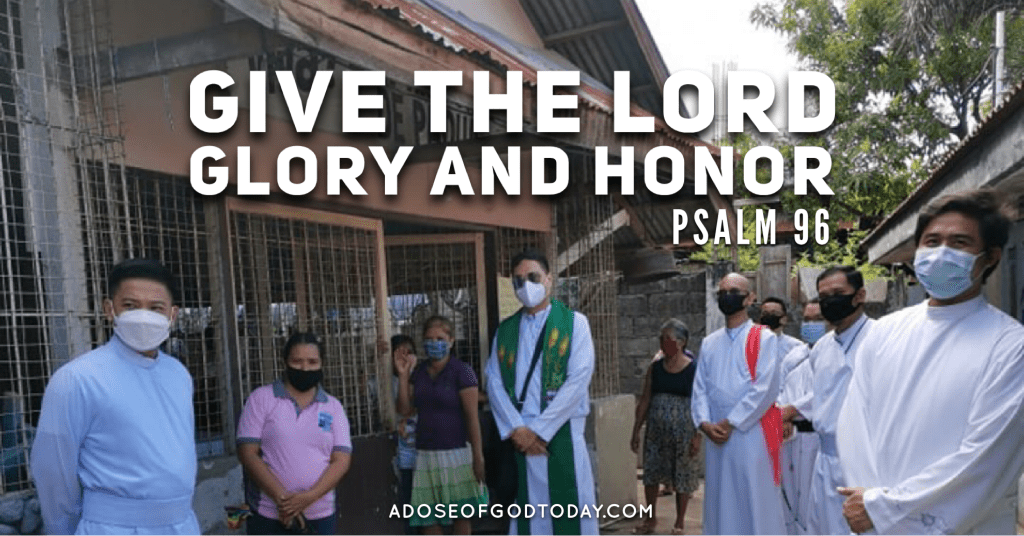
    Thus, our highest praise and worship only belongs to God who has called us and who blessed us with so many things. Our psalm also affirms this as it says, “Give the Lord glory and honor.”

    St. Paul in his letter to the Thessalonians gives us the hint on how to give true glory and honor to God. It is through “preaching the Gospel” in words and in deeds. This is our calling, the vocation of every Christian, of every believer of Jesus Christ.

    In the Gospel, Jesus reminded us of our identity, duties and responsibilities as we are to give Caesar what belongs to Caesar (which means the Emperor of Rome) but to give God what belongs to God. Yes, we are citizens of this Republic but we are also Christians.

    It means that…

    We have the duty to give due respect to our political leaders. To support and to cooperate with the leaders of the land. But remember, “they are not gods,” they are not to be worshipped.

    Thus, we are called to be responsible citizens of our country by exercising our rights as to vote during elections and even to protest when a law or a leader becomes oppressive to the people.

    We are called also to participate and cooperate in ways that will make our society peaceful, harmonious, just and progressive. We are called to do our duties well as citizens and to exercise justice and responsible leadership especially with those who are working in the government.

    But remember that we too are Christians. We are called to preach Christ, to preach the Gospel by our life, whoever we are and wherever we are.

    Are you a vendor, a driver, a teacher? You are called to preach the Gospel. Are you an engineer, a nurse, doctor, a lawyer? You are called to preach Christ. Are you a Tanod, Brgy Captain, a City Councilor, Mayor, Congressman? You too are called to preach the Gospel and to give glory and honor to God who has blessed you, who gave you influence, your family and friends and all the things you are enjoying now.

    Each of us is called to give glory and honor to God by our words, our deeds, through our professions, through our work and role in our society. It is in this way that we will be able to give to God what is due to Him.

    This call that we share as Catholic Christians of our country reminds us of what we celebrate today, the World Mission Sunday! This Sunday tells us that we priests, deacons, and religious are not the only ones who are called to preach the Gospel but each one of us. We who experienced and witnessed God’s goodness and mercy are called in the mission of preaching and spreading Christ to all, not just in our words but also in our actions.

    This identity makes us different from the rest of other Christian denominations because the call to preach the Gospel of Christ is not only limited in our Eucharistic celebration. My faith and your faith, is not only confined within the walls of our Church for an hour on Sundays.

    Our Christian belief, our confidence in the risen Christ calls us to actively participate and to involve ourselves in all aspects of human life and the whole community not just in the spiritual aspect but also in cultural, social, economic and political aspect of life. This is the beauty of being a Christian and a citizen.

    May we always remember this and become true Christians in the way we live our life, in the way we perform our work and in the way we relate with others and with one another so that we will be able to give God what truly belongs to Him and become true to our identity as Christians and citizens. Hinaut pa.

    Jom Baring, CSsR

  • Influences

    Influences

    Advertisements

    October 16, 2020 – 28th Week in Ordinary Time

    Feast of St. Gerard Majella, Redemptorist Brother and Patron of Mothers, Parents-to-be and their Infants

    Click here for the readings (https://bible.usccb.org/bible/readings/101620.cfm)

    Homily

    A wise man once said, “Never underestimate our power of speech. It can make life better or bitter”. True indeed, the words we use, either written or spoken, for better or for worse, can affect and influence us & others. Like, better or bitter. Simple play of spelling and pronunciation may invoke both courage and discouragement, can be empowering as well as alarming, and may connote many meanings and messages. That is how powerful our words are. They can influence LIFE (yours and mine) for better or for worse, better or bitter.

    Along with these words is also a warning that we should also be conscious of our influences, i.e. – either by words or action, we should be careful on how others are influencing you and on how you are influencing others as well. Nowadays, by the words you post, comments you made, posts you shared, you are already influencing others. And the vloggers, life-coaches, and so-called influencers you follow, the book you read, the movies & news you watch are already influencing you. That is why we should be conscious and careful of our influences, and be cautious of our words for it can make or break our lives.

    This is what Jesus warns us in our gospel when he said: “Beware of the leaven – the hypocrisy- of the Pharisees”. For Jesus, we should be conscious of the many influences in our lives – and should prefer to choose the life-giving and encouraging influences that recognize our worth and value before God, over and against soul-crushing and life-breaking worldly influences in our lives. Here, Jesus challenges us to direct and allow our minds, heart, life and soul to be influenced by God’s grace & spirit rather than be influenced by rigidity and oppressiveness of our earthly hypocrisy of human laws and practices.

    Same way with Paul. He believes that God has a better plan for each and everyone of us, but it can only happen in our lives, if and when we allow God’s will and plans to influence our very lives rather than be influenced by the soul-crushing, demanding, and life-breaking influences of our world nowadays.

    Consider St. Gerard. In our Redemptorist house in Caposele, Italy where he lived until his death, you can find at the very door of his room a wooden signage posted by St. Gerard that says: “Here the will of God is done, as God wills, and as long as God wills it.” These words represent the very orientation and spirituality that influence the life & faith of St. Gerard, which is God’s will. For him, Everything (life here & now, has been, & will be) is all about and centers on God’s will. All that has happened, is happening & will happen is a chance-encounter & a fulfillment of God’s will, according to God’s plans & ways, and in accordance with God… rather than of ours, & by ours. These words are reflective of St. Gerard’s single-minded devotion to God & his straight forward messages & influences to all those he has ministered and shared his witness of faith and life.

    Again like our power of speech, let us be cautious then of our influences on others & influences in us of others, for it can be life-giving or life-breaking. And like St. Gerard may our influences be of God rather than of men, be for the better than for worse, be for the better & not for the bitter. Amen.

    By  Fr. Aphelie Mario Masangcay, CSsR