Tag: Mary

  • Gratitude to the Gifts of the Lord

    Gratitude to the Gifts of the Lord

    December 22, 2020 – Seventh day of the Misa de Aguinaldo

    Click here for the readings (https://bible.usccb.org/bible/readings/122220.cfm)

    Homily

    How grateful am I today? Gratitude makes us recognize the many things that surround us in a manner of being appreciative and positive. Gratitude allows us to be embracing and accepting of the things and people around us. It is when we are grateful too that we become joyful persons because we see the goodness and uniqueness of others.

    The joy that comes from being grateful leads us to be more aware of God’s tremendous generosity to us despite our weaknesses and sins. When we become joyful, we also become generous towards the people around us, no matter who they are, whether they are friends or strangers.

    Such character in us that is being nurtured because of gratitude, calls us now on this Seventh Day of our Misa de Aguinaldo to be more conscious of God’s gift to us and to grow in gratitude. For us to recognize the gifts in us, let us see first how gifts of the Lord were also being revealed in today’s readings.

    In the First Book of Samuel, we heard the story of Hannah. Hannah had been into humiliation and shame because of being infertile. She could not bear a son which gave her so much anguish. Being the second wife of Elkanah, Hannah was always humiliated by Peninnah, the first wife. Yet, through the prophet Eli, Hannah’s prayers were answered. She bore a son, Samuel.

    Through the gift of Samuel to Hannah, she realized how faithful God is to her. Through this gift, she also realized the other gift she received, through her friendship with Prophet Eli. The presence of Eli to Hannah was a reminder that there was hope. That friendship, made Hannah to be comforted when she was humiliated. Eli was Hannah’s prayer warrior. This made Hannah to be ever grateful to God. Because of her gratitude to God’s blessing and saving her from humiliation, she dedicated her son to God. In fact, because of this offering, Hannah had been blessed also to have 5 more children after Samuel. Hannah’s story is a testament that when we become generous, God’s blesses us more.

    The Responsorial Psalm, which was also taken from the same Book of Samuel, expressed the experiences of the people and particularly of Hannah in the first reading. God comes to rescue his people who were oppressed, humiliated and broken. The response, “My heart exults in the Lord my savior,” expressed that deep gratitude to God who is not indifferent to the suffering of the people. A heart that exults God is joyful and grateful. Thus, to praise and truly worship God is to have a heart filled with joy and gratitude.

    To both, we are reminded of God who comes to bless us in order to save us, to liberate us and to empower us. This character of God has been the experience of Mary. Her song famously called as the Magnificat expressed also that deep gratitude to the Lord.

    God is indeed great for he has done many great things to the lowly ones. This recalls and recognizes the action of God where the powerful, the arrogant and the corrupt are brought to shame while the lowly, the poor and the hungry are raised and satisfied. This song depicts how God favored and blessed those who call him God and those who remain faithful. Mary’s song is certainly a song of gratitude to God.

    Everything that we have heard in the readings tell us that when a person grows to be grateful, the person also becomes more aware of the presence of God, the giver of blessings and gifts. This reminds us too that everything is a gift.

    God calls us today to be more grateful of the gifts and blessings that we have received each day, no matter how small that would be. But if we have received so much, be more thankful and be more generous too. Remember, a grateful person is a person who goes forward, because when we are grateful we also become contented of the present, whatever there is. We also become reconciled with the past, whatever that was. And we become hopeful and positive of the future, whatever there will be.

    In a concrete way, let us begin today in recognizing every gift we have received from God, not just our material things, but also the gift of persons of our friends and family, of faith and community. As we recognize them, let our hearts be filled with gratitude to the Lord and gratitude to people around us. Let that gratitude express the joy in us, to dispel our anxieties and fears, our guilt and shame, our indifference and sin. Hinaut pa.

  • The Gift of Presence

    The Gift of Presence

    December 21, 2020 – Sixth Day of Misa de Aguinaldo

    Click here for the readings (https://bible.usccb.org/bible/readings/122120.cfm)

    Homily

    “What an honor this is, that the mother of my Lord shall visit me?” (Lk. 1: 43, LAB)

    Mary’s visit to her cousin Elizabeth provides a positive energy of affirmation and encouragement for the both of them. Affirmation, because both Mary and Elizabeth witnessed God’s promise came to fruition. Encouragement, because they needed each other who both experienced God’s marvelous works in human faculties which only the two of them could understand.

    Mary’s presence during this time of Elizabeth’s life is Mary’s way of sharing the joy of Elizabeth and her gesture of support to her pregnant relative. For the Lord removed the bitter experience of Elizabeth and heal her from the pain of disgrace. Thus, her presence showed that she is with Elizabeth and committed to accompany her in this journey.

    However, God used this encounter between these two blessed women as a privilege locus to highlight the special role of Mary in the economy of salvation. And Elizabeth recognized that, saying: “Blessed are you among women, and blessed is the fruit of your womb.”

    Thus, the Church, the Christian faithful, continues to honor Mary with utmost gratitude for saying “Yes” to the will of God, for which we benefited from. For through her, God commenced his plan of renewing the face of the earth and gathering us all into his Kingdom.

    See, what difference presence can do to others! And so, what about calling a family member or a relative or a friend? What about letting them know that you care about them, and that they can count on you? The time is now! Seize it!

    Gibo Dandoy, CSsR

  • Yes, GO na. We are Ready. 가자

    Yes, GO na. We are Ready. 가자

    December 20, 2020 – Fourth Sunday of Advent

    Click for the readings (https://bible.usccb.org/bible/readings/122020.cfm)

    Homily

    Whenever we reflect on our childhood memories, our dear mother is always there present. Be she young, or old, dark or fair, how else would we be here now, if our mother did not make our well-being her life and vocation? The relationship we share with our mother is special and sacred, and is based on a bond of mutual love. It was our mother, who is the first person who loved us, took care of us, committed herself for us, assured us that she will always be there whatever happens, and would willing die for us so that we may be borne & live. It is our Mother, who first said, “Yes” for you. She might be the mother of all “No”s TO you but, she is “the Mother of all “Yes”es FOR you, in favor of you, who first opted and chosen YOU. Through our mother we also heard first God’s Promise, “I will be there FOR you always”.

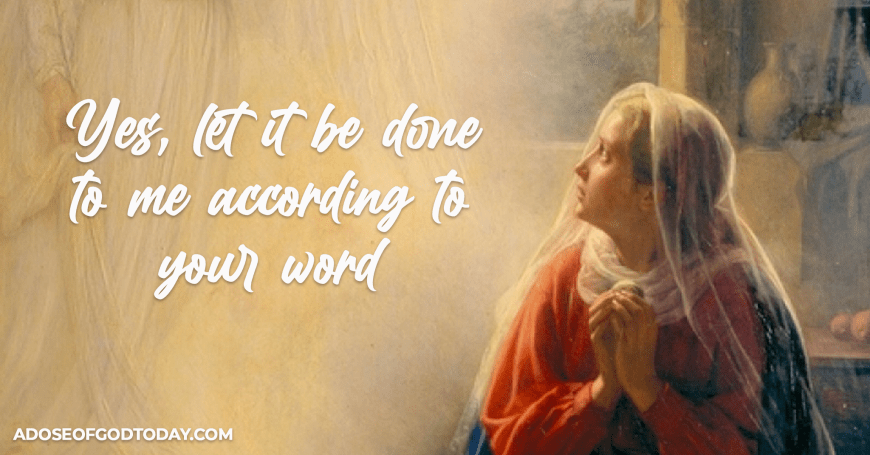
    No wonder then that Mary is at the center of today’s gospel, which gives us a simple but moving account of the greatest message ever delivered to us – “the Lord is with us”. In it we are told simply and plainly that there was a young maiden, who knelt down at the angel Gabriel’s mysterious message and, in freedom of her heart, gave the total gift of herself to God, saying: “Yes, let it Be done unto me according to thy Word.”

    The Annunciation was the moment when God first revealed a mystery that he kept secret for endless ages. It is true that his love for us is so great that he wants to become one of us. And in doing so, Mary was needed by God. Mary was asked to co-operate with God, and be the mother of Christ. And the moment she said, “Yes” to the angel, salvation dawned on us all. However, Mary did not say “Yes” to God on only one occasion. She had to confirm that “Yes” many times during her life. The moment she said, “yes” to God’s invitation life was never the same again for her. She became a refugee in Egypt and some thirty years later, a witness her son died the death of a common criminal. And through all these events in her life, she did not abandon her son, stood by Him, always present and supporting Him whatever it takes.

    Christmas is almost upon us and, on this fourth Sunday of Advent, our thoughts turn to our mothers who said “yes” for us so that we may live, and to our mother Mary who listened and responded in cooperation with God’s will.  Mary’s life shows us that to be a Christian is to be a person who keeps our ears open to what God is calling us to do today, so that we are ready to answer Yes to His call and to cooperate with His will. 

    Perhaps we ask ourselves:

    To what extent are we available to God? Do we see what he wants us to do in and through us? If God asks you for favor now, how would you respond?

    Today we are shown the marvelous example of Mary. Even if she did not see clearly all it implied, she accepted her mission to become the mother of the Savior. Mary’s yes offers us salvation. Our own mother’s yes brings us life. May our Yes, our own response and cooperation with God brings life and salvation to others. Like Mary, May our response be: “Yes, Lord, I’m ready. Go na”.

    We pray then that like Mary, we may have her listening and responding heart to God’s call so that we can be as ready and as willing to cooperate in bringing Christ into others. Amen.

  • Pregnant with God’s Presence

    Pregnant with God’s Presence

    Advertisements

    September 8, 2020 – Feast of the Nativity of the Blessed Virgin Mary

    Click here for the readings (https://bible.usccb.org/bible/readings/090820.cfm)

    Homily

    Viva Maria! Viva Hesus!

    Mary, indeed, is a key figure in our salvation history. Yet, not one story in the bible that we could find about her birth. The first time we encounter Mary was already at the annunciation of the Angel Gabriel that she was to become pregnant with God.[1]

    Mary’s birthday can only be understood and appreciated through her pregnancy and her presence in the life of Jesus. So, as we joyfully celebrate her birthday today, let us discover God’s invitations for us as we remember the life of the Blessed Virgin Mother.

    The Book of the Prophet Micah tells us how the lowliest among the clans of Judah, Bethlehem-Ephrathah, was chosen by God to become the bearer of the ruler of Israel, who is called Peace.

    Bethlehem was indeed a small town, though the birthplace of David, the great king, but it remained un-influential. Ephrathah is the old name of Bethlehem which was retained by the Jews. These names are indeed symbolic because of the meaning behind them. Bethlehem means the house of bread and Ephrathah means fruitfulness or abundance.

    Micah tells us how the Lord brings abundance of bread, an abundance of life from this lowly place. Certainly, the son that Mary brings to us is the bread of life who brings abundance of love and life into the world.

    The Gospel today from Matthew recalled how Mary was found out to be pregnant and how Joseph planned to divorce her quietly. However, God intervened through an angel telling Joseph not to be afraid for Mary conceived a son through the Holy Spirit, “She will bear a son and you are to name him Jesus (meaning, God saves) because he will save his people from their sins.”

    This particular story of the pregnancy of Mary tells us more of the birth of Mary, of why we are celebrating with joy and gratitude to God the birth of the Mother of Jesus and our Mother too.

    Through the life of Mary, the Lord reminds us and call us in an intimate way to come closer to Him for God gives abundance of peace and life. There are three points that I invite you to dwell on this birthday of our Mother Mary.

    Advertisements

    First, to be humble. God chooses us not because of the great things that we do. Our desire to be great in the eyes of others is futile in the eyes of God. God chooses us because of who we are to God. We are loved though we are not deserving. The clan of Bethlehem-Ephrathah was surely not deserving but in his lowliness God found delight. God finds delight with the unpretentious that is why God found favor with Mary. And Mary responded to God out of gratitude and faith.

    Second, God never forgets us. God’s intervention in human affairs proved how God will do everything to let us know that we are loved. God, through the participation of humanity, and that is through the person of Mary, made the Divine presence be felt and be manifested in a concrete way. Thus, even in times of so much confusion and difficulties around us, never forget and always remind ourselves, God has never forgotten us. God is with us.

    Third, we can be pregnant with God. Yes, Mary’s pregnancy tells us that humanity can be pregnant with God. This means that we are capable of becoming a bearer of God’s presence to others. To become pregnant with God is to welcome God fully in our life where we are promised to be also filled with love, with peace and with the abundance that life with God can give us. In Mary’s pregnancy with Jesus, her heart is revealed that there was no bitterness, no scars of fear or hate, only love, only peace. By allowing the Lord to be with us, we may also become pregnant with God’s presence where our heart shall also be cleared with bitterness, fear and hatred.

    In this way then, we may hopefully celebrate this day of birth of Mary, our Mother, with true joy and gratitude to the Lord for giving us such grace. Hinaut pa.

    Jom Baring, CSsR


    [1] What we only have is the story of her birth that can be found in a Christian-devotional Text called, “The Protoevangelium of James.” In this text, that parents of Mary were named as Joachim and Anne, an old couple who were also graced with a child.

    Follow Me

    Get new content delivered directly to your inbox.

  • Signs and Symptoms not of Covid-19 but of God

    Signs and Symptoms not of Covid-19 but of God

    Advertisements

    June 27, 2020 – Feast of Our Mother of Perpetual Help

    Readings: Isaiah 7:10-17; Revelation 12:1-6,10; John 19:25-27

    Homily

    As the Corona Virus 2019 stole the spotlight, the medical experts warned us of the signs and symptoms of the virus. Accordingly, the virus can cause a range of symptoms to a person from mild illness to pneumonia. Its most common symptoms, they said, are fever, tiredness and dry cough. Others may also show aches and pains, nasal congestion, runny nose or sore throat.

    We are made aware of it and thus, when we begin to have these signs and symptoms then we are advised to seek medical help. It is, definitely, important to be aware of these because through this first step then, we can save lives, not just our life but also of those who are dear to us.

    Moreover, looking at it from a distance, this pandemic is in itself a sign that no matter how much we have achieved in life, or no matter how much power and wealth we have accumulated, we are vulnerable. This pandemic also is a sign that tells us how competent or ignorant, sincere or corrupt, and organized or messy our leaders can be. This pandemic also is a sign given to us how individuals and communities have reached out to those in need.

    With all these signs and symptoms that the Corona Virus Pandemic has brought to us, this allows me to dwell deeper into the feast we celebrate today, the Feast of Mary, Our Mother of Perpetual Help.

    Our first reading is very interesting because it tells us about signs. Usually, we would ask signs from God, but, in this story of Ahaz, King of Judah, it was the Lord who asked a man to ask for a sign. Ahaz’s story seemed to be very good because he did not ask a sign from God. He refused to ask a sign. However, his refusal to ask a sign from God was actually a refusal to believe in God.

    What really happened? Ahaz sold himself to another god, to the King of Assyria. He sold himself because he thought that this foreign power, Assyria will only be the one who can grant immediate protection and salvation for him and his kingdom. Instead of asking wisdom from the Lord on how to lead his people, Ahaz went to the Assyrians and pleased them. The kingdom of Judah at that time was under the threat of two other kingdoms, Syria and Israel. Instead of trusting the Lord to protect and save him, he went to another god, to whom he thought was his savior.

    However, history tells us that as Assyria defeated the enemies of Ahaz, he became a puppet of the King of Assyria. Not only that, the Assyrians imposed heavy taxes to the people and blasphemed the Temple of the Lord by introducing the Assyrian gods.

    This is the reason why it was the Lord himself who offered Ahaz to ask for a sign so that he may believe that God will bring salvation. Yet, even though Ahaz refused, God still promised a sign of salvation. This sign is through a virgin who will conceive a son. This son will be called Emmanuel, meaning, God is with us.

    This is the sign that even in the midst of our own disbelief, doubts and even refusal to believe, God remains with us. God remains our God and continues to be for us and with us. This is a sign of God’s faithfulness in us despite our unfaithfulness. This is a sign of God’s generosity despite our ingratitude. And this is what we celebrate today on this feast of Our Mother of Perpetual Help. The Virgin who is carrying the son, the Emmanuel in her arms, is the great sign that God showed to us.

    There again on the cross, as the Gospel of John tells us, the son showed us his greatest sign of love and faithfulness. The son has come to be with us and on the cross he stretched out his hand for the sake of all. The son, indeed, comes to help us perpetually.

    Jesus is in fact the true perpetual help. Mary is instrumental because through her, God’s sign has been brought to us. She allowed herself to be God’s instrument of help and compassion, to be the mother of the Perpetual Help.

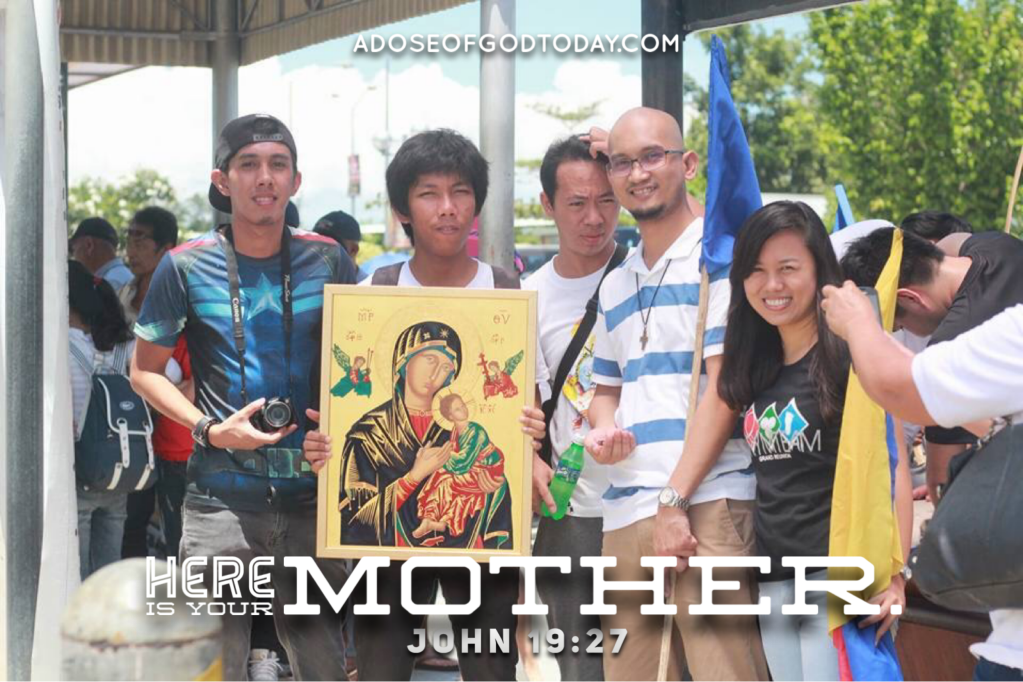
    Even when Jesus was about to die, he assured us to have a mother, that we will not be orphaned and alone. Mary’s presence became the sign of God’s presence among us by becoming our mother.

    This is the reason why we, the Church, would always seek guidance and inspiration from Mary because we feel the identity of being a child to her. The intercession of Mary as a mother, becomes a bridge of faith. It is to lead us to her risen Son, Jesus Christ.

    Thus, this feast that we celebrate does not actually point to Mary. This feast points to the greatest sign, the perpetual help, and who is Jesus himself.

    What is it to you and to me now, to us, who are devoted to Our Mother of Perpetual Help? How shall we express our act of thanksgiving for all the graces and blessings received?

    This feast invites us that each of us and that our community becomes a sign of God’s help and love, compassion and faithfulness. This means that we let our devotion transform our life. It means that our devotion should not only remain a mere devotional practice but must also flow into our actions and words, into our decisions and choices in life.

    Our devotion, then, is call to mission. It is mission because we are sent to become signs and symptoms of God’s goodness. I invite you then this time, to discern for yourself on how you could be a sign and symptom of God’s help and compassion to people around you.

    VIVA MARIA! VIVA HESUS!

    Jom Baring, CSsR