Tag: Mary

  • FULL OF GRACE

    FULL OF GRACE

    December 9, 2024 – Solemnity of the Immaculate Conception

    Click here for the readings (https://bible.usccb.org/bible/readings/120924.cfm)

    According to (Artificial Intelligence) AI Overview, we, human persons, generally speaking, can easily notice and recognize the negatives in our surrounding and people around us rather than the positive. There is a so called “psychological phenomenon” among us called “negativity bias.”

    As psychology teaches us, this concept called negativity bias causes amplified emotional responses to the negative and painful events compared to positive and joyful events even despite having equal magnitude.[1] No wonder, we can easily react when there is something wrong, ugly or painful that we see or experience. We also feel more troubled and distressed when we have negative and painful experiences. We tend to linger on those and find ourselves difficult to move forward.

    However, having such orientation could greatly affect the way we look at things, look at life and look at ourselves. Our relationships even in the way we make decisions in life can be hampered because of such negativity. Yet, there is also a need for us to develop a sense of positivity and finding balance in our life. To be able to recognize what is good, wonderful and beautiful will add more courage and hope in our life.

    On this Solemnity of the Immaculate Conception of Mary, we are reminded and challenged to see and recognize the good, wonderful and beautiful that God made for Mary and for all of us. Indeed, this is what we have heard in the Gospel. “Hail, full of grace!” these were the words of Angel Gabriel to the young lady, Mary of Nazareth.

    That being full of grace of Mary offers us now a different perspective in the way we look at our life and the world. This is in contrast to what happened in the Book of Genesis in which man and woman sinned against God.

    The fear, shame and guilt that they felt move them back to hide from God. They who first enjoyed the presence of God in paradise where the very first ones to have received the fullness of grace, that was ORIGINAL GRACE in itself. Yet, their desire to “become like god” broke that wonderful grace of intimacy with God.

    That led the man and woman to blame each other without claiming their responsibility. This is where we find the ORIGINAL SIN, a concept from St. Augustine. In this concept, human beings are born with that hereditary sin as a consequence of the sin of the first man and woman. It is understood that we have the natural inclination to do bad things, to sin against God and to hurt one another. Nevertheless, to focus only on this negativity of the past will also cloud our faith and relationship with fear, guilt and shame.

    Yet, let us not forget that before ORIGINAL SIN entered, there was first the ORIGINAL GRACE of God for humanity. This original grace, despite what happened after that, has been preserved in the life of Mary, the favored one of God. God chose her because Mary is most willing to embrace and accept the very presence of God in her heart, in her whole life. This made Mary, indeed, to be full of grace.

    In fact, St. Paul in his Letter to the Ephesians also reminds us that we are blessed “with every spiritual blessing in the heavens… to be holy and without blemish before him.” This is the grace that has been given to the whole humanity, “for in him (Christ) we were also chosen, destine in accord with the purpose of the One.

    As we celebrate this feast, we remind ourselves of this ORIGINAL GRACE, of our first inclination to do good things, of our origin in being filled with the grace of God like Mary.

    And so, what we are called to be and to do today, is to allow also the Lord to fill us with His grace. Like Mary, our Mother, may we be more open to God’s invitations for us, to be more willing to participate in bringing and filling grace in our hearts, homes and communities. Hinaut pa.


    [1]See and read more at  https://thedecisionlab.com/biases/negativity-bias

  • WHAT DOES IT MEAN TO LOVE AND BEING LOVED?

    WHAT DOES IT MEAN TO LOVE AND BEING LOVED?

    December 21, 2022 – Sixth Day of the Misa de Aguinaldo

    Click here for the readings (https://bible.usccb.org/bible/readings/122122.cfm)

    Before I begin my homily for this morning. I have a short exercise that I would like you to do first. This will hopefully keep you awake and make you more inspired as you start your day today.

    So, I would like to invite those who are with their husband or wife, girlfriend or boyfriend to look at the eye of your beloved. Silently say, “I love you!” And for those who single and still waiting, you may close your eyes “na lang” and you may say loudly, “I love you self!” 😍

    Being said that, may I present to you this question for reflection, “What does it mean then, to love and being loved?” I am sure you have your own answers to this based on your human experiences of loving and being loved. Yet, for today may I offer you my humble reflections of loving and being loved based on the readings we have on this sixth day of the Mise de Aguinaldo. Let us also see how the Lord calls us to be truly loving and be more confident in being loved.

    Our first reading from the Book of Song of Songs wonderfully described to us the relationship between a lover and the beloved. What we have heard from the reading is that it’s filled with excitement (or kilig-moments) because of the longing to see the person being loved.

    Thus, the lover calls the beloved in these wonderful invitations. The lover said, “Arise my beloved, come!” The lover is described to be like a small deer who was so excited and in its excitement would peep to have a glimpse of the beloved. The lover also said, “my beloved, see, the winter is past, the rains are over and gone, the flowers appear on the earth.” This calls the beloved to recognize that sorrow and grief is over and to embrace life and freedom. Finally, the lover said, “Let me see you. Let me hear your voice.” This is an expression of intimacy that longs for the beloved.

    With these, I therefore conclude, how beautiful and wonderful it is to be in love! – to be filled with love, to be loved and to love! Isn’t it? But, friends, know that I am not just talking about romantic love, thought that’s part of it. Why? Because the Song of Songs by using the images of romantic love, reveals to us now that God is our lover who is more than excited to see us and to be with us. We are God’s beloved. We are the one being loved. And this beautiful Book of Song of Songs invites us to arise from sadness and embrace life. Indeed, the presence of the one who loves us brings comfort as well us life.

    In response to God our lover, our Psalm today expresses our hope and longing for God. The people waits for God’s coming whose presence is the strength of the people. In that anticipation, joy can be felt, thus, a calling to rejoice and sing praises to God. This is wonderfully captured in the last verse, “Our soul waits for the Lord who us our help and our shield; for in him our hearts rejoice.”

    This has been fulfilled and concretely manifested in today’s Gospel. We find Mary, a person who is filled with so much love, because in her womb, is love. The Gospel story today was right after the annunciation of the angel that Mary shall conceive a son and when she realized that it was indeed true. At that moment, Mary carried in her womb God’s concrete manifestation of love. And the love that Mary carried in her womb completely transformed Mary, her presence, her actions and her words.

    At this point, I will be enumerating how Mary responded in loving and in being loved. In each response of Mary, I will be giving questions that would hopefully challenge us to respond in love.

    The first response of Mary is, “she set out in haste.” Mary realized the need and assistance of her old cousin Elizabeth. This response of Mary tells us that she is a person who loves and arises for the sake of others. She is a person who loves and responds immediately to a particularly need. And she is a person who loves and moves out of the self. This is evident at how Mary travelled a long way from Nazareth to a town in the hill country of Judah. At that time, Mary possibly walked for about 130 kilometers to reach the house of Zechariah and Elizabeth.

    In this first response of Mary, Pope Francis said in his message to the youth of the world, “Mary did not hold back or remain indifferent. She thought more of others that of herself.” And so in our way of loving, “Do we also move in haste in order to respond to the needs around us? Do we take the risk to go out of our own comfort and concerns for the sake of others? Or do we remain unmoved, more focused on ourselves and indifferent?”

    The second response of Mary is, “she entered the house of Zechariah and greeted Elizabeth.” Mary cared to enter into the life of others, bringing love. This is how we realize that the very presence of Mary in that house, brought life? How? At the greetings of Mary, the infant in the womb of Elizabeth leaped. It was a joyful reaction of the infant. Indeed, even at hat early moment, the infant John already recognized the fullness of life and love present in the womb of Mary.

    And so in our way of loving, “Do our words bring comfort and assurance of love? Or do our words rather, become forms of insults, harassment and bitterness towards others? Does our presence gives confidence and love to others or rather brings fear, trauma and pain?”

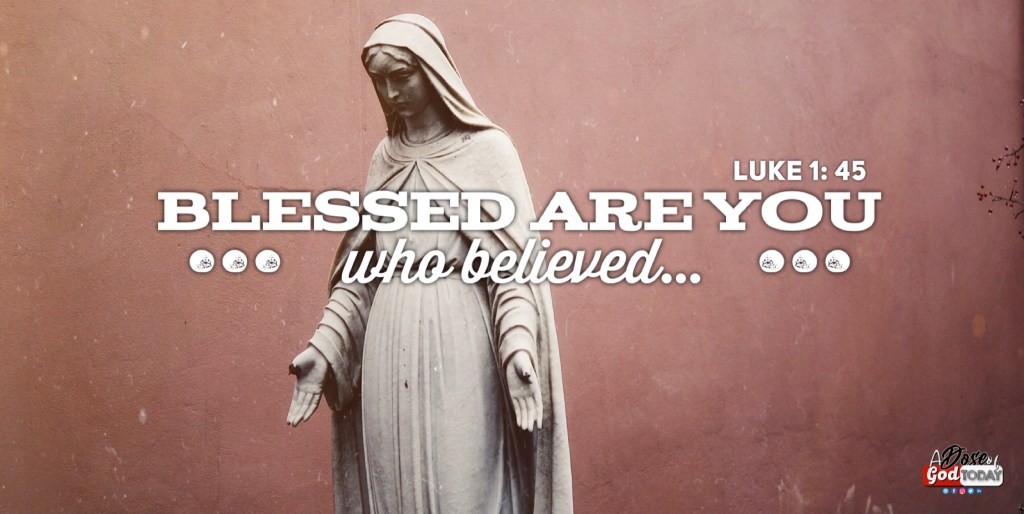
    The third response of Mary is, “Mary believed!” As to the words of Elizabeth, she said, “Blessed are you who believed that what was spoken to you by the Lord would be fulfilled.” This tells us that Mary’s faith brings forth life, concern and intimacy, care and gentleness. These become natural for Mary because first and foremost, her faith is motivated and inspired by love. Mary is filled with love. She is confident that the Lord loves her. Indeed, she believed! – because love has been fulfilled in her and that love is slowly taking a human form in her womb.

    And so in our way of loving, “Has our faith been inspired and motivated by our love, of being loving and being loved? Does our faith also bring life, concern, care and gentleness? Or rather motivated by fear, guilt, fanaticism or superstition?”

    As we bring to mind all these points for reflections, we may all be filled with love and be assured of that love so that like Mary, we too shall dare to move, respond and care for others. As we are about to celebrate the birth of Jesus, the love-made-flesh, may our way of loving then, be life-giving and love-fulfilling. Ok lang? Sana all.

  • We too can bring others closer to Jesus

    We too can bring others closer to Jesus

    November 30, 2022 – Wednesday Feast of St. Andrew, Apostle

    Click here for the readings (https://bible.usccb.org/bible/readings/113022.cfm)

    Who was that significant person who brought you closer to the Church and closer to Jesus? I am sure, each of us here has a particular person or people who became significant in our faith journey. Others could have their grandparents who were the very instruments for them to grow in their Catholic faith. Or perhaps a relative, a parent, a sibling or a friend, or an intimate friend who inspired us to come to Church and encounter God.

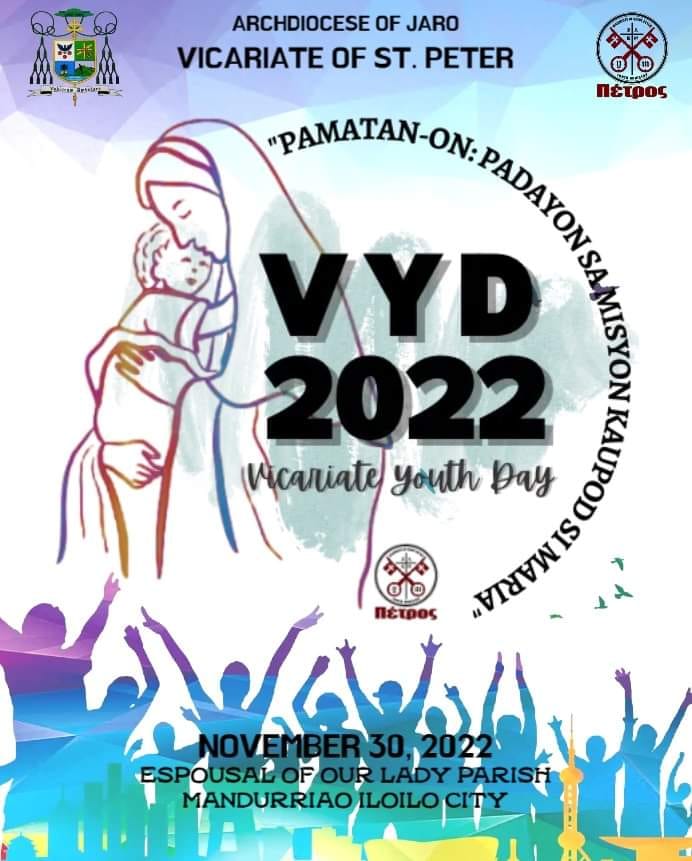
    Indeed, the celebration of our Vicariate Youth Day with its theme, “Pamatan-on: Padayon sa Misyon Kaupod si Maria,” is an expression of that experience of being inspired and motivated to come closer to the Lord. Certainly, this is a good reason to thank them for being an instrument for us in our journey of faith. So, I want you now to close your eyes and imagine that person to be in front of you and in silence, say to that person your words of gratitude for being an instrument of God for you. Say, your “THANK YOU.”

    As we express our gratitude to the people who have become significant in our journey of faith, let us be reminded as well of the feast that as a Church, we celebrate today. This is the Feast of St. Andrew, one of the original 12 apostles. So, allow me now to explore a bit this person of St. Andrew, how he has become significant to our church and on how the Lord invites us today as young people.

    You know, we know very little of St. Andrew. According to our tradition, Andrew became the first bishop in the community of Constantinople until he was martyred through crucifixion on an X-shape cross. The gospels tell us also that he was the brother of Peter. They were from Bethsaida, a town near the Sea of Galilee. In John’s gospel, we were told that Andrew was a disciple of John the Baptist at first. In the same gospel, we found that Andrew had actually brought Peter to Jesus, telling his brother, “We have found the Messiah!” In the other gospels, it was Andrew who called the attention of Jesus about the boy with 5 loaves and 2 fish. Again, it was Andrew who told Jesus that there were some Greeks who wanted to see and meet Jesus.

    From here, we can sense that Andrew was actually an apostle with a typical role. Unlike his brother, Peter, he was not able to witness the transfiguration of Jesus at Mt. Tabor. Andrew was not part of Jesus’ inner circle composed of Peter and the 2 brothers, James and John. He was in fact an ordinary guy, an ordinary apostle of Jesus.

    However, Andrew had a remarkable faith in Jesus. Remember, his brother Peter doubted and even denied Jesus three times. But for Andrew, he was the first one to realize that Jesus was truly the Messiah. In his conviction, he joyfully shared what he found to his brother. He himself became an evangelist, a preacher of the good news to his own brother. Moreover, he brought others to Jesus like the boy and those Greeks. Andrew became a bridge between Jesus and other people. Thus, Andrew became the significant person for many people to encounter and to know Jesus more.

    This is what St. Paul told us in the first reading. As there is a need but there is also beauty in sharing one’s faith in Jesus to others. And we can preach Jesus by making our faith be manifested through words and actions so that what we preach will be heard by many. Paul’s letter to the Romans would help us ponder our own call to be a kind of apostle or bearer of the good news to others like St. Andrew.

    This reminds us now of our theme in this VYD, “Pamatan-on: Padayon sa Misyon kaupod kay Maria.” Mary, is indeed, another significant person in our journey of faith. This celebration of the gift of the young people in our Vicariate of St. Peter calls us to mission by preaching Jesus through our words and actions with Mary.

    Now, we usually think that preaching is only proper to bishops, priests, and deacons. Definitely, public preaching of the gospel in liturgical occasions like what I am doing now is proper to me as a priest and not to you as lay persons. But it does not mean that you cannot preach the Gospel or share Jesus anymore to others. As young Christians, we share the prophetic role of Jesus by virtue of our baptism. It means that each of us has both the responsibility and the privilege to be God’s messenger to others, and this makes us young missionaries.

    The Gospel tells us how we are being called as young missionaries today. To each of us, Jesus says, “COME, FOLLOW ME, AND I WILL MAKE YOU FISH FOR PEOPLE! I WILL MAKE YOU MY OWN APOSTLE!” This can surely be materialized when we preach with joy by our own example. But how? These are few examples.

    First, when we are happy with what we are doing and when we are honest in our relationships and dealings with others – we preach the person of Jesus.

    Second, when we are sensitive to others and volunteer to help without any selfish motivations whenever someone needs a helping hand – then, we preach the person of Jesus.

    Third, when we become joyful givers to those who have less;  when we become more understanding and compassionate with those who are experiencing difficulties in their life; then, we preach the person of Jesus.

    Fourth, when people around us feel the deep expression of our faith as we pray in the church, in our homes or with others… then, we preach the person of Jesus.

    Fifth, when we are able to stand and fight for justice, when we are able to confront what is evil and unjust in our institutions and society, when we choose life not violence and death, then, we preach the person of Jesus.

    Friends, people will see these things and will recognize that we are Christians. Then like St. Andrew and our Mother Mary, we will be able to bring other people closer to Jesus, by becoming bearers of the Good News through our very life. Kabay pa.

  • GROWING NOT IN FEAR BUT IN GRATITUDE LIKE MARY

    GROWING NOT IN FEAR BUT IN GRATITUDE LIKE MARY

    June 20, 2021 – Feast of Our Mother of Perpetual Help; 12th Sunday in Ordinary Time

    Click here for the readings (https://bible.usccb.org/bible/readings/062021.cfm)

    When I was growing up, I was taught to fear God because He brings punishment to disobedient children. I was taught to be good and to follow my parents and elders so that God won’t be angry at me and condemn me in hell. Somehow, I developed dependence on rules and regulations, at home and at school. I tended to be hard on myself and on others whenever rules were broken. Yet, I was also inclined to feel righteous by being an obedient boy but condemning to those who did not follow the rules.

    Such upbringing made me believe that God was like an old grandfather always holding a stick and whose eyes were always angry, ready to strike a naughty boy.

    However, this belief in God made me distant from God. Faith and my relationship with the Lord was motivated by fear of punishment. Is this the kind of faith that God wants us to develop, then? Does God want us to relate with Him through fear?

    Surely, this is not what God wants. God’s self-revelation in our history tells us that God is our creator, defender, savior, a parent, a friend, and a companion because his love is everlasting, as what the Psalm proclaimed today. Indeed, in Jesus, God tells us that He is with us, he brings good news, freedom and salvation.

    This is the very image that has been revealed to us in today’s Gospel. The disciples who were terrified by the storm thought that Jesus was indifferent to the dangers they were facing. Yet, they were wrong. Jesus was entirely confident in the Father. This is what Jesus showed to them as he calmed the storm and brought peace. Having these images and experiences of God, should we be afraid of Him which could prevent us to develop an intimate relationship with God?

    God desires us that we love Him. He constantly invites us to come closer to Him because through Him, then, we shall find the fullness of our life. Jesus desires that we grow in gratitude to God for not giving up on us and for being always with us. In fact, St. Paul told us in his letter to the Corinthians, “Christ died for all” – for each of us no matter how underserving we are.

    We find this in the life of Mary, Our Mother of Perpetual Help. Mary is motivated by love and gratitude to God. Despite the fear that she felt at the announcement of Angel Gabriel to carry in her womb the presence of God, love and gratitude also must have filled her heart to respond to God.

    Her constant listening to God allowed her to understand more fully the identity and mission of her Son and Lord. Because of this, Mary must have discovered herself in God’s plan of salvation. And Mary responded to Gabriel saying, “I am the handmaid of the Lord. Let it be done according to your word,” because the love and gratitude in her heart made her more confident not just with herself, with her ability and strength but most especially, she has become totally confident to God who loves her.

    Indeed, Mary, our Mother, brings inspiration to us now that our God, certainly, desires that we become grateful to Him because it is when we become grateful that we become confident. By being grateful to God, our insecurities will certainly lessen and our fears will be transformed into faith. This is how we become a new creation, as what St. Paul told us, because gratitude brings us closer to Christ and whoever is in Christ is a new creation.

    Let us also remember that when we become grateful, we also become joyful because we will be able to recognize how blessed we are. This is also how the old things in us, (our old hatred and grudges, anger and insecurities) shall pass away so that new things will come.

    Mary, as a new creation, is certainly a joyful woman, and no wonder, she is blessed among women because with her is the presence of God.

    This gratitude and joy will move us also to recognize ultimately the source of blessings. When we are able to recognize God then, it also follows that we will be moved to respond to Him in love.

    The Book of Deuteronomy (6:5) tells us to love the Lord God with all our heart, whole being and strength. Loving the Lord then, is our expression, not of fear, but of our deep gratitude to God.

    Moreover, Jesus reminds us of the immediate result of loving the Lord. The love of neighbor is the concrete manifestation of loving the Lord. Remember, God’s image is in each of us. Therefore, if we love God, then, it also means that our love is being expressed towards ourselves and with our brothers and sisters who are created in God’s image and likeness.

    Thus, we should be very careful when we tend to become so stiff with our religious practices but having a growing indifference towards people around us, then, our devotion to God is empty and merely motivated by fear. Our religiosity can be a mere appearance of our arrogant devotion when we also refuse to see and recognize the abuses in our community and choose to be silent amidst oppression and injustice committed against the powerless and the weak.

    To love God calls us then, to love one another. And we can begin and renew our commitment today by being grateful to God which would hopefully make us joyful persons like Mary. When we are joyful, God transforms us to be generous to others, both in our words and deeds. Thus, joyful and grateful persons are truly generous because true generosity springs forth from those attitudes of gratitude and joy. However, when we pretend to be generous but having an impure motive, just to advance our personal interests, then, this is not a true expression of love towards others, but selfishness.

    Hopefully, we will be constantly reminded through our devotion to Mary, Our Mother of Perpetual Help to grow not in fear but in gratitude and that Jesus invites us to love our God and our neighbors, regardless of our differences. Hinaut pa.

  • GOD’S RECONCILING PRESENCE IN THE HEART OF MARY

    GOD’S RECONCILING PRESENCE IN THE HEART OF MARY

    June 12, 2021 – Memorial of the Immaculate Heart of Mary, Philippine Independence Day

    Click here for the readings (https://bible.usccb.org/bible/readings/061221.cfm)

    “The love of Christ impels us.” Paul reminds us in his Second Letter to the Corinthians. This means that this love indeed urges and motivates us to go beyond and become the person God wants us to be. Hence, Paul also says, “whoever is in Christ is a new creation. The old things have passed away and new things have come.” This has been made possible because of God who came and initiated that we become reconciled with Him.

    Certainly, reconciliation with God transforms us from old into new, from death to life. Such transformation urges, impels and moves us to become a reconciling presence in our communities, in our Church and in the world.

    However, how does a reconciling presence influence others and bring change? Our Responsorial Psalm proclaims today of four main points.

    • First, it gives pardon to all our iniquities.
    • Second, it heals all our ills.
    • Third, it redeems our life from destruction.
    • And fourth, it crowns us with kindness and compassion.

    This is the experience of the Hebrew Community of which the Psalm speaks about. God’s presence in the midst of His people is a reconciling presence because the “Lord is kind and merciful.”

    Such confidence and faith in God must have filled the heart of Mary, whose Immaculate Heart we celebrate today. Her heart is immaculate because what we find there is the Lord who is kind of merciful made into man like us. Yes, the heart of Mary is filled with Jesus.

    This is the reason why Mary remained calm and at peace despite the fear and confusion she felt at the announcement of the Angel Gabriel to her, during the arrival of the shepherds when Jesus was born and now of being baffled and anxious when Jesus was lost but finding him in the Temple.

    Though she did not understand fully everything at an instant but Mary would always “keep everything in her heart.” With all the complexities, strangeness and difficulty to understand the situation, Mary keeps the Lord close to her heart. She keeps all those revelations from the Lord close to her heart that she may be able to understand them in the way God desires them to be understood.

    This was how Mary would always find wisdom and strength because with the many events that happened in her life, she might not be able to bear them all. Mary will surely remain confused, afraid and unable to decide and do anything if she chose to distance herself from the Lord by reacting out of impulse or mere emotions.

    “Keeping all those things in her heart” really means that she tried to understand how God was uncovering and revealing to her the plan of salvation. Mary realized that God reveals Himself every day. Mary did not want to miss all of them.

    Mary was able to do that because within her heart, God is already there. She has welcomed the Lord and allowed the Lord to be always in her heart. This led her into understanding from God’s perspective and so she responded to every invitation of God for her, willingly and lovingly.

    This is how we find Mary’s presence reconciling in our Christian faith because her life is an example of a perfect communion with God. We now find comfort in her, as a mother, because her human heart is touched by the Lord who is kind and merciful. Mary, indeed, has become a reconciling presence to us because we find in heart Jesus, the Lord.

    In the same way, we are called today that our hearts be also touched by the Lord, that we become more welcoming to the Lord and allow the Lord to be in our heart. Like Mary, as we allow the love of Christ to touch our hearts, it may impel us to become a reconciling presence in our homes, communities and in our beloved country, the Philippines. Hinaut pa.